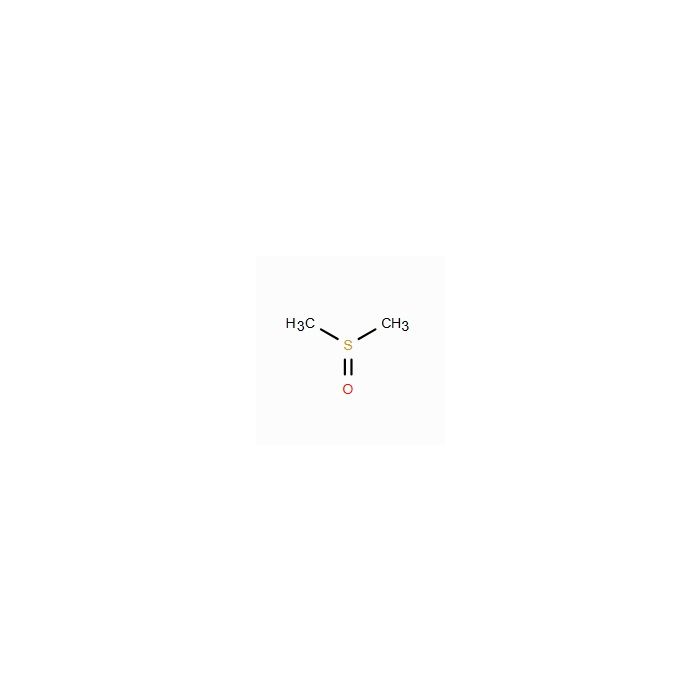
Dimethyl sulfoxide - Ultra dry, ≥99.9%, water≤50 ppm , CAS No.67-68-5

CAS: 67-68-5 Cat. No.: D1521189 Summenformel: C2H6SO Molekulargewicht: 78.13 Beilstein Registry Number: 506008 EG-Nummer: 200-664-3
Zu bestellen verfügbar
QUALITÄT & REINHEIT Ultra dry ? Ultra-dry grade with extremely low water content, packaged to exclude moisture. Use for moisture-sensitive reactions and air-free chemistry. ≥99.9% water≤50 ppm
Storage
Room temperature,Argon charged,Desiccated
Shipped In
Normal
★
Größe
Deutschland (EU)
USA*
Preis
Menge
100ml
D1521189-100ml
Auf Bestellung · 8–12 Wochen
25,95€
500ml
D1521189-500ml
Auf Bestellung · 8–12 Wochen
60,65€
Enter a quantity for the sizes you want to add.

Spezifikationen

Spezifikationen & Reinheit
Ultra dry, ≥99.9%, water≤50 ppm
Storage
Room temperature,Argon charged,Desiccated
Verschickt in
Normal
Note
Ultra dry
Reinheit
≥99.9%
Namen und Kennungen
SMILES
CS(=O)C
IUPAC Name
methylsulfinylmethane
InChIKey
IAZDPXIOMUYVGZ-UHFFFAOYSA-N
InChI
1S/C2H6OS/c1-4(2)3/h1-2H3
Isomere SMILES
CS(=O)C
WGK Deutschland
1
RTECS
PV6210000
Molekulargewicht
78.13
Beilstein
506008
Reaxys
506008
Reaxys-RN_link_address
https://www.reaxys.com/reaxys/secured/hopinto.do?context=S&query=IDE.XRN=506008&ln=

Erweiterte Daten

Taxonomic Classification

Taxonomy Tree

KingdomOrganic compounds
SuperclassOrganosulfur compounds
KlasseSulfoxides
SubclassNot available
Intermediate Tree Nodes Not available
Direct ParentSulfoxides
Alternative Parents Sulfinyl compounds  Organic oxides  Hydrocarbon derivatives  
Molecular FrameworkAliphatic acyclic compounds
Substituents Sulfoxide - Sulfinyl compound - Organic oxygen compound - Organic oxide - Hydrocarbon derivative - Aliphatic acyclic compound
BeschreibungThis compound belongs to the class of organic compounds known as sulfoxides. These are compounds containing a sulfoxide functional group, with the structure RS(=O)R' (R,R' not H).
External Descriptors a small molecule
Zertifikate (CoA, COO, BSE/TSE und Analyse-Diagramm)
C of A & Other Certificates(BSE/TSE, COO):
Analytical Chart:

Find and download the COA for your product by matching the lot number on the packaging.

6 results found

Lot NumberCertificate TypeDatumArtikel
J2620453J2620453Certificate of AnalysisOct 22, 2026 D1521189
J2620454J2620454Certificate of AnalysisOct 22, 2026 D1521189
G2623152G2623152Certificate of AnalysisJul 25, 2026 D1521189
G2623153G2623153Certificate of AnalysisJul 25, 2026 D1521189
E2612008E2612008Certificate of AnalysisMay 19, 2026 D1521189
E2612010E2612010Certificate of AnalysisMay 15, 2026 D1521189
Chemische und physikalische Eigenschaften
EmpfindlichkeitHygroscopic.
Brechungsindex1.477-1.48
Flammpunkt (°F)189 °F
Flammpunkt (°C)87℃
Siedepunkt (°C)189°C
Schmelzpunkt (°C)16-19 °C (lit.)
Molekulargewicht78.14
XLogP3-0.600
Hydrogen Bond Donor Count0
Hydrogen Bond Acceptor Count2
Rotatable Bond Count0
Exact Mass78.0139 Da
Monoisotopic Mass78.0139 Da
Topological Polar Surface Area36.300 Ų
Heavy Atom Count4
Formal Charge0
Complexity29.000
Isotope Atom Count0
Defined Atom Stereocenter Count0
Undefined Atom Stereocenter Count0
Defined Bond Stereocenter Count0
Undefined Bond Stereocenter Count0
The total count of all stereochemical bonds0
Covalently-Bonded Unit Count1
Sicherheit und Gefahren (GHS)
Signal
Warning
Gefahrenhinweise

H227:Combustible liquid

Sicherheitshinweise

P261:Avoid breathing dust/fume/gas/mist/vapors/spray.

P305+P351+P338:IF IN EYES: Rinse cautiously with water for several minutes. Remove contact lenses if present and easy to do - continue rinsing.

P280:Wear protective gloves/protective clothing/eye protection/face protection.

P302+P352:IF ON SKIN: wash with plenty of water.

P321:Specific treatment (see ... on this label).

P405:Store locked up.

P501:Dispose of contents/container to an approved waste disposal plant.

P264:Wash hands [and …] thoroughly after handling.

P271:Use only outdoors or in a well-ventilated area.

P304+P340:IF INHALED: Remove person to fresh air and keep comfortable for breathing.

P403+P233:Store in a well-ventilated place. Keep container tightly closed.

P362+P364:Take off contaminated clothing and wash it before reuse.

P264+P265:Wash hands [and …] thoroughly after handling. Do not touch eyes.

P337+P317:If eye irritation persists: Get medical help.

P332+P317:If skin irritation occurs: Get medical help.

P319:Get medical help if you feel unwell.

WGK Deutschland
1
RTECS
PV6210000
Reaxys
506008
Reaxys-RN_link_address
https://www.reaxys.com/reaxys/secured/hopinto.do?context=S&query=IDE.XRN=506008&ln=
FAQs und Artikel
Comparison of Principles, System Control, and Result Interpretation in Hydroxyl Radical Scavenging Capacity Assays
From Functional Groups to Experimental Decision-Making: Protein Crosslinker Selection and Experimental Essentials
Metal Halide Perovskite Solar Cells: Sources of High Efficiency, Stability Bottlenecks, and Experimental Decision Logic
Mechanisms and Experimental Applications of β-GP, Ascorbic Acid, and Dexamethasone in Osteogenic Induction Systems
How to Troubleshoot Abnormal Impurities in Peptide Synthesis? Locating Process Issues Through Amino-Related Side Reactions
Practical Guide to TSA Tyramide Signal Amplification: How to Select Reagents, Optimize the Workflow, and Reduce Background When Detection Signals Are Weak for Low-Abundance Targets
What Is Synthetic Biology? The Industrialization Pathway from Upstream Reagent Toolchains to Biomanufacturing Applications
CTSOBt Benzotriazole–Sulfonate Coupling Reagent: Carboxylic Acid Activation and Synthetic Application Value
From Photocatalytic Ring Opening to Skeletal Reconstruction: Reaction Logic and Synthetic Applications of Oxygen-Atom Replacement in Oxetanes
Reactions and Applications of 3,3-Difluoroallyl Sulfonium Salts (DFASs): Small-Molecule gem-Difluoroallylation, Selective Peptide Modification, and Subsequent Functionalization
3,3-Spiro-α-Proline Building Blocks: Structural Features, Complementary Synthetic Routes, and Multigram-Scale Preparation
Stereoretentive Decarboxylative Amidation with Dioxazolones: A Two-Electron Rearrangement Mechanism for Stereochemical Transfer from Chiral Carboxylic Acids
Reaction Logic of I₂/DMSO-Mediated Oxidation of Aryl Methyl Ketones: In Situ Generation, Trapping, and Heterocycle Construction of Aryl Glyoxals
Dual Role of NH₄SCN and CN Transfer: From Electrochemical Oxidation of SCN⁻ to the Construction of 1-Cyanoimidazo[1,5-a]pyridines
Screening and Replacement of Green Solvents in Metallaphotoredox Catalysis: Reaction Compatibility and Process Feasibility
Rotary-Evaporation-Assisted Reversible Dehydration Reactions: Reduced-Pressure Evaporation, Removal of Volatile Components, and Equilibrium Response
Fundamentals of the Reactivity of 9,10-Phenanthrenequinone and Its Derivatives: Vicinal Dicarbonyl Electronic Structure, Electron Transfer, and Photochemical Reactions
Bond-Formation Sequence and Process Improvement for 3-Bromo-6-alkyl-1,6-naphthyridin-5(6H)-ones: From Late-Stage N-Alkylation to Enamine Cyclization with Primary Amines
From Temporary Covalent Assembly to Intramolecular Smiles Aryl Migration: DCPDC-Mediated Phenol–Primary Amine C–N Cross-Coupling
Citations of This Product
Lösungsrechner
Bewertungen

Kundenbewertungen

Dürfen wir Sie über Rabattaktionen informieren?

Später erinnern

Vielen Dank! Bitte überprüfen Sie Ihren E-Mail-Posteingang, um zu bestätigen.

Hoppla! Benachrichtigungen sind deaktiviert.