Determine the necessary mass, volume, or concentration for preparing a solution.
| Activity Type | Activity Value -log(M) | Mechanism of Action | Activity Reference | Publications (PubMed IDs) |
|---|

Moligand™, 10mM in DMSO Moligand™ für empfindliche chromatographische und analytische Workflows, die minimale Basislinieninterferenzen erfordern.
Store at -80°C Versand Dry ice packs + Cold packs. Genaue Spezifikationen finden Sie im chargenspezifischen COA.
SDS, COA, Datenblatt und Spezifikationsblatt stehen zum Download bereit. Chargenspezifische COA über Chargennummernsuche abrufbar.
In 1 peer-reviewten Publikationen zu Chromatographie, organischer Synthese und Kreuzkupplungsreaktionen zitiert.
Information
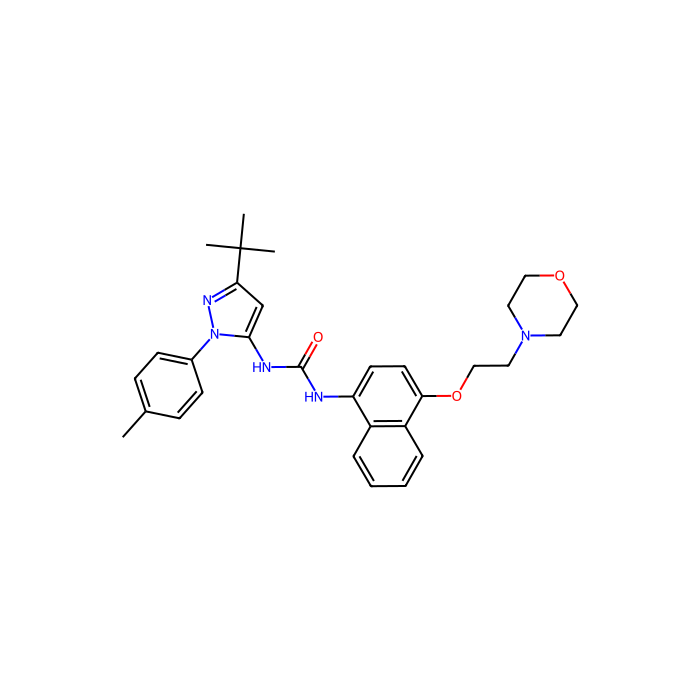
Doramapimod (BIRB 796) is a pan-p38 MAPKinhibitor withIC50of 38 nM, 65 nM, 200 nM and 520 nM for p38α/β/γ/δ in cell-free assays, and bindsp38αwithKdof 0.1 nM in THP-1 cells, 330-fold greater selectivity versus JNK2, weak inhibition for c-RAF, Fyn and Lck,
In vitro
BIRB 796 shows no significant inhibition to ERK-1, SYK, IKK2β, ZAP-70, EGF receptor kinase, HER2, protein kinase A (PKA), PKC, PKC-α, PKC-β (I and II) and PKC-γ. BIRB 796 greatly improves binding affinity by forming a hydrogen bond between the morpholine oxygen and the ATP-binding domain of p38α. BIRB 796 represents one of the most potent and slowest dissociating inhibitors against human p38 MAP kinase now known. BIRB 796 potently inhibits c-Raf-1 and Jnk2α2 with IC50 of 1.4 and 0.1 nM, respectively. BIRB796 also inhibits the activity and the activation of SAPK3/p38γ at a higher concentration than it does in p38α. BIRB796 blocks the stress-induced phosphorylation of the scaffold protein SAP97, which is a physiological substrate of SAPK3/p38γ. BIRB796 blocks JNK1/2 activation and activity in HEK293 cells, while not inhibits the activation and activity of ERK1/ERK2 in Hela cells. Moreover, the binding of BIRB796 to the p38 MAPKs or JNK1/2 is impairing their phosphorylation by the upstream kinase MKK6 or MKK4 rather than enhancing their dephosphorylation. BIRB 796 blocks baseline and bortezomib-triggered upregulation of p38 MAPK and Hsp27 phosphorylation, thereby enhancing cytotoxicity and caspase activation. BIRB 796 downregulates IL-6 and VEGF secretion in BMSCs triggered by TNF-α and TGF-β1. BIRB-796 has a pyrazole scaffold that places a lipophilic t-butyl group into the lower selectivity site and a tolyl ring into the upper selectivity site. BIRB-796 also inhibits B-Raf and Abl with IC50 of 83\xa0nM and 14.6\xa0μM, respectively.
In vivo
BIRB 796 (30 mg/kg) inhibits 84% of TNF-α in LPS-stimulated mice and demonstrates efficacy in a mouse model of established collagen-induced arthritis. BIRB 796 has good pharmacokinetic performance even after oral administration in mice.
Cell Data
cell lines:
Concentrations:
Incubation Time:
Powder Purity:≥98%
Umfassendes Dokument zu Gefahren, Handhabung, Lagerung und Einhaltung regulatorischer Vorschriften.
<<<<<<< HEAD SDS herunterladen → ======= SDS herunterladen → >>>>>>> release248-p3Chargenspezifische Qualitätsdaten. Geben Sie Ihre Chargennummer ein, um das genaue COA abzurufen.
COA nachschlagen →Vollständige Qualitätsmerkmale und Akzeptanzkriterien für diese Qualität.
Spezifikationsblatt ansehen →| Activity Type | Activity Value -log(M) | Mechanism of Action | Activity Reference | Publications (PubMed IDs) |
|---|
| Activity Type | Activity Value -log(M) | Mechanism of Action | Activity Reference | Publications (PubMed IDs) |
|---|
| Activity Type | Activity Value -log(M) | Mechanism of Action | Activity Reference | Publications (PubMed IDs) |
|---|
| Activity Type | Activity Value -log(M) | Mechanism of Action | Activity Reference | Publications (PubMed IDs) |
|---|
| Activity Type | Activity Value -log(M) | Mechanism of Action | Activity Reference | Publications (PubMed IDs) |
|---|
| Activity Type | Activity Value -log(M) | Mechanism of Action | Activity Reference | Publications (PubMed IDs) |
|---|
| Activity Type | Activity Value -log(M) | Mechanism of Action | Activity Reference | Publications (PubMed IDs) |
|---|
| Activity Type | Activity Value -log(M) | Mechanism of Action | Activity Reference | Publications (PubMed IDs) |
|---|
| Activity Type | Activity Value -log(M) | Mechanism of Action | Activity Reference | Publications (PubMed IDs) |
|---|
| Activity Type | Activity Value -log(M) | Mechanism of Action | Activity Reference | Publications (PubMed IDs) |
|---|
| Activity Type | Activity Value -log(M) | Mechanism of Action | Activity Reference | Publications (PubMed IDs) |
|---|
| Activity Type | Activity Value -log(M) | Mechanism of Action | Activity Reference | Publications (PubMed IDs) |
|---|
| Activity Type | Activity Value -log(M) | Mechanism of Action | Activity Reference | Publications (PubMed IDs) |
|---|
| Activity Type | Activity Value -log(M) | Mechanism of Action | Activity Reference | Publications (PubMed IDs) |
|---|
| Löslichkeit | Solubility (25°C) In vitro DMSO: 71 mg/mL (199.23 mM); Water: 71 mg/mL (199.23 mM); Ethanol: 1 mg/mL (2.8 mM); |
|---|
Unser Leitfaden zur Qualitätsauswahl behandelt Reinheit, Stabilisatorstatus und Anwendungseignung für alle Varianten in unserem Katalog.
Moligand™ Qualitätsleitfaden ansehen →