Determine the necessary mass, volume, or concentration for preparing a solution.
| Activity Type | Activity Value -log(M) | Mechanism of Action | Activity Reference | Publications (PubMed IDs) |
|---|

Moligand™, 10mM in DMSO Moligand™ für empfindliche chromatographische und analytische Workflows, die minimale Basislinieninterferenzen erfordern.
Store at -80°C Versand Dry ice packs + Cold packs. Genaue Spezifikationen finden Sie im chargenspezifischen COA.
SDS, COA, Datenblatt und Spezifikationsblatt stehen zum Download bereit. Chargenspezifische COA über Chargennummernsuche abrufbar.
In 0 peer-reviewten Publikationen zu Chromatographie, organischer Synthese und Kreuzkupplungsreaktionen zitiert.
Information
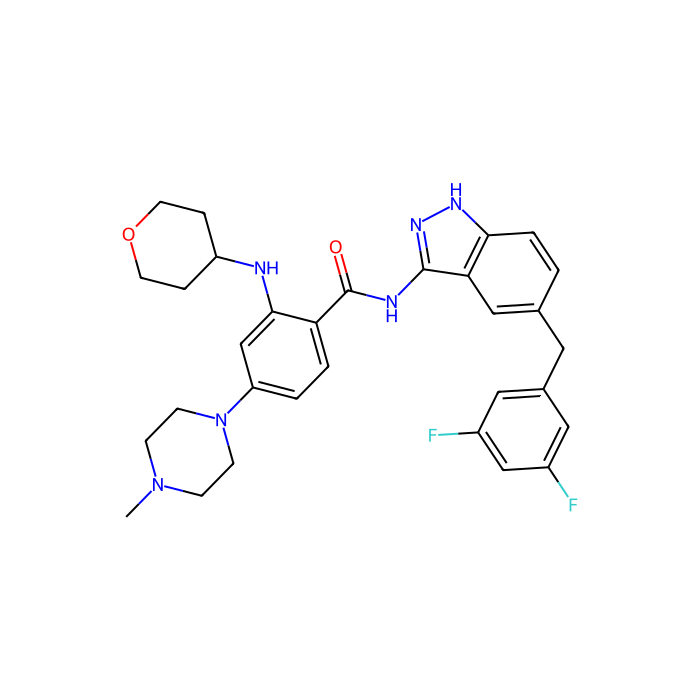
Entrectinib (RXDX-101, NMS-E628) is an orally bioavailable pan-TrkA/B/C,ROS1andALKinhibitor withIC50ranging between 0.1 and 1.7 nM. Entrectinib (RXDX-101) inducesautophagy. Phase 2.
In vitro
Entrectinib selectively blocks proliferation of ALK-dependent cell lines and potently inhibits ALK‐dependent signaling. Entrectinib also highly inhibits cell growth of the NSCLC cell line NCI‐H2228 bearing the EML4-ALK rearrangement.
In vivo
In mice bearing Karpas-299 and SR-786 xenografts, Entrectinib (p.o.) induces complete tumor regression. In NPM-ALK transgenic mice, Entrectinib induces complete regression of tumor masses observed in the thymus and in lymph nodes. In the NB xenograft model, Entrectinib cotreatment enhanced the efficacy of conventional chemotherapy.
Cell Data
cell lines:Tumor cell lines including MDA-MB-361, MDA-MB-231, MDA-MB-468, LNCap, DU145, A498, and HCT116
Concentrations:
Incubation Time:
Powder Purity:≥97%
Umfassendes Dokument zu Gefahren, Handhabung, Lagerung und Einhaltung regulatorischer Vorschriften.
<<<<<<< HEAD SDS herunterladen → ======= SDS herunterladen → >>>>>>> release248-p3Chargenspezifische Qualitätsdaten. Geben Sie Ihre Chargennummer ein, um das genaue COA abzurufen.
COA nachschlagen →Vollständige Qualitätsmerkmale und Akzeptanzkriterien für diese Qualität.
Spezifikationsblatt ansehen →| Activity Type | Activity Value -log(M) | Mechanism of Action | Activity Reference | Publications (PubMed IDs) |
|---|
| Activity Type | Activity Value -log(M) | Mechanism of Action | Activity Reference | Publications (PubMed IDs) |
|---|
| Activity Type | Activity Value -log(M) | Mechanism of Action | Activity Reference | Publications (PubMed IDs) |
|---|
| Activity Type | Activity Value -log(M) | Mechanism of Action | Activity Reference | Publications (PubMed IDs) |
|---|
| Activity Type | Activity Value -log(M) | Mechanism of Action | Activity Reference | Publications (PubMed IDs) |
|---|
| Activity Type | Activity Value -log(M) | Mechanism of Action | Activity Reference | Publications (PubMed IDs) |
|---|
| Activity Type | Activity Value -log(M) | Mechanism of Action | Activity Reference | Publications (PubMed IDs) |
|---|
| Activity Type | Activity Value -log(M) | Mechanism of Action | Activity Reference | Publications (PubMed IDs) |
|---|
| Activity Type | Activity Value -log(M) | Mechanism of Action | Activity Reference | Publications (PubMed IDs) |
|---|
| Löslichkeit | Solubility (25°C) In vitro DMSO: 70 mg/mL (201.27 mM); Ethanol: 7 mg/mL (20.12 mM); Water: Insoluble; |
|---|
Unser Leitfaden zur Qualitätsauswahl behandelt Reinheit, Stabilisatorstatus und Anwendungseignung für alle Varianten in unserem Katalog.
Moligand™ Qualitätsleitfaden ansehen →