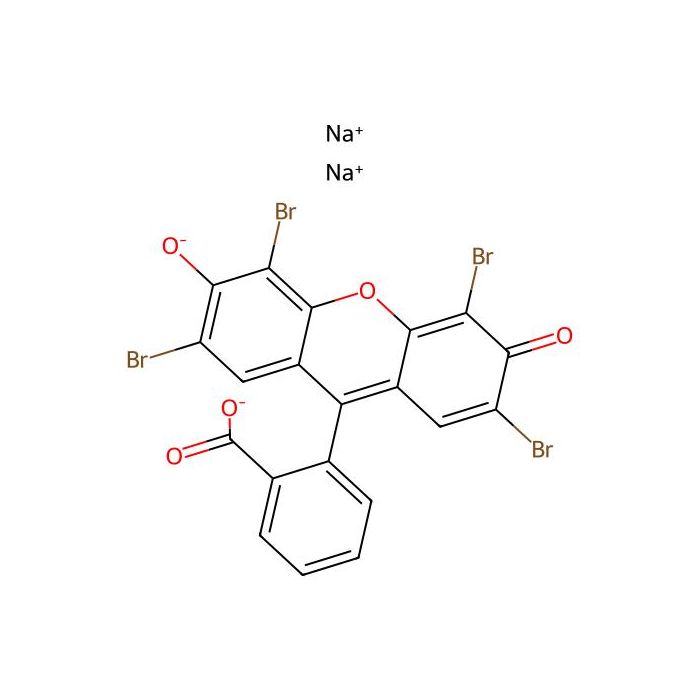
Eosin Y(water soluble) - 10mM in DMSO , CAS No.17372-87-1

CAS: 17372-87-1 Cat. No.: E422128 Summenformel: C20H6Br4Na2O5 Molekulargewicht: 691.85 EG-Nummer: 241-409-6
Zu bestellen verfügbar
QUALITÄT & REINHEIT 10mM in DMSO
Synonyms
Eosine Extra Yellowish|Eosine Lake Red Y|Eosine Yellowish|Eosin Natricum|Fenazo Eosine XG|Phloxine Toner B|Bromo 4DL|C.I. Acid Red 87|Bromo X-100|Bromo 4D|Fluorescein, 2',4',5',7'-tetrabromo-, disodium salt|Tetrabromofluorescein soluble|Eosine 3Y|Eosine sodium salt|Eosine YB|Eosin gelblich|Eosin gelblich [German]|Eosine Yellowish-(YS)|Eosine YS|Eosine J|Eosine w/s|Japan Red 230-1|Bromo B|Bromo FL|Eosin Y Sodium|Hidacid Boiling Bromo|Hidacid Eosine Soda Salt|Bromo X 100|Sodium 2-(2,4,5,7-tetrabromo-6-oxido-3-oxo-3H-xanthen-9-yl)benzoate|Certiqual Eosine|Phlox Red Toner X-1354|Toyo Eosine G|Eosin Y powder|Eosine|Acid red 87|Sodium eosinate|Eosine GF|Eosine Salt Free|Dawn red|Eosin OJ|Eosina|Irgalite Bronze Red CL|Eosin yellowish|Eosine K|Water Red 2|Bromo acid|Eosine A|Tetrabromofluorescein D|2,4,5,7-Tetrabromofluorescein|Eosine BPC|1903 Yellow Pink|Eosin Y Disodium Salt|Fenazo Eoxine XG|Hidacid White Bromo|Eosin|Eosine Extra Conc. A. Export|Eosine G|Bromoeosine|Bronze Bromo|Eosine S13 (bluish)|Basacid Red 316|D and C Red No. 22|Eosine K Salt Free|Disodium eosin|Bromo 4DC|Cerven kysela 87 [Czech]|eosin YS dye|Red No. 103|D & C Red no. 22|Eosine OJ|Sodium eosine|Aizen eosine GH|Bromo Fluorescein|Bromo TS|Eosin A|2',4',5',7'-Tetrabromo-3',6'-dihydroxyspiro(isobenzofuran-1(3H),9- '-(9H)xanthen)-3-one, disodium salt|disodium 2-(2,4,5,7-tetrabromo-6-oxido-3-oxo-3H-xanthen-9-yl)benzoate|Eosine GH|Pure Eosine YY|11731 Red|Bromo JPS|2,4,5,7-Tetrabromo-3,6-fluorandiol|Benzoic acid, 2-(2,4,5,7-tetrabromo-6-hydroxy-3-oxo-3H-xanthen-9-yl)-, disodium salt|D&C Red No. 22|Eosine BS-SF|Hidacid Dibromo Fluorescein|Cerven kysela 87|Eosin Y ws|Eosine 3G|Hidacid Bromo acid regular|Bromofluoresceic acid|Eosine FA|Eosine S 13|water-soluble eosin|11445 Red|2',4',5',7'-Tetrabromofluorescein disodium salt|CI 45380 (Na salt)|Japan Red 103|Eosine DA|Eosine Y|Symuler Eosin Toner|Tetrabromofluorescein S
Storage
Store at -80°C
Shipped In
Dry ice packs + Cold packs
★
Größe
Deutschland (EU)
USA*
Preis
Menge
1ml
E422128-1ml
Auf Bestellung · 8–12 Wochen
24,21€
Enter a quantity for the sizes you want to add.

Übersicht

Eosin Y, a red xanthene dye, has been noted to reduce the affinity of Mg2+-ATPase for ATP and increase the enzyme affinity for Mg2+ at concentrations of 10-50 μM. At higher concentrations near 100 μM the affinity for Mg2+-ATPase for the ion-activator has been shown to be reduced. This compound has also been reported to be a photosensitizer that works as a molecular photoelectrode via catalyzation of the visible-light-driven electron-transfer reaction. Eosin Y has been used to stain structures such as muscle, cytoplasm, and collagen. This agent also enhances fluorescent quenching abilities by forming a complex with polyvinulpyrrolidone.

Spezifikationen

Synonyme
Eosine Extra Yellowish | Eosine Lake Red Y | Eosine Yellowish | Eosin Natricum | Fenazo Eosine XG | Phloxine Toner B | Bromo 4DL | C.I. Acid Red 87 | Bromo X-100 | Bromo 4D | Fluorescein, 2',4',5',7'-tetrabromo-, disodium salt | Tetrabromofluorescein soluble | Eosine 3Y | Eosine sodium salt | Eosine YB | Eosin gelblich | Eosin gelblich [G Show more
Spezifikationen & Reinheit
10mM in DMSO
Biochemische und physiologische Mechanismen
Non-selective PRMT inhibitor (IC 50 values are 0.8 and 1.4 μM for Hmt1p and PRMT1 respectively). Stain for cytoplasm. Inhibits DOT1 and SET7.
Storage
Store at -80°C
Verschickt in
Dry ice packs + Cold packs
Dieses Produkt erfordert Kühlkettenversand. Grundversand und andere Economy-Optionen sind nicht verfügbar.
Namen und Kennungen
Isomere SMILES
C1=CC=C(C(=C1)C2=C3C=C(C(=O)C(=C3OC4=C(C(=C(C=C24)Br)[O-])Br)Br)Br)C(=O)[O-].[Na+].[Na+]
Alternative CAS-Nummer
152-75-0
Molekulargewicht
691.85

Erweiterte Daten

Wirkungsmechanismen
Zertifikate (CoA, COO, BSE/TSE und Analyse-Diagramm)
C of A & Other Certificates(BSE/TSE, COO):
Analytical Chart:
Chemische und physikalische Eigenschaften
EmpfindlichkeitMoisture sensitive.
Molekulargewicht691.9
XLogP3
Hydrogen Bond Donor Count0
Hydrogen Bond Acceptor Count5
Rotatable Bond Count1
Exact Mass691.67 Da
Monoisotopic Mass687.674 Da
Topological Polar Surface Area89.500 Ų
Heavy Atom Count31
Formal Charge0
Complexity796.000
Isotope Atom Count0
Defined Atom Stereocenter Count0
Undefined Atom Stereocenter Count0
Defined Bond Stereocenter Count0
Undefined Bond Stereocenter Count0
The total count of all stereochemical bonds0
Covalently-Bonded Unit Count3
Sicherheit und Gefahren (GHS)
Piktogramm(e)
Signal
Warning
Gefahrenhinweise

H317:May cause an allergic skin reaction

H319:Causes serious eye irritation

Sicherheitshinweise

P261:Avoid breathing dust/fume/gas/mist/vapors/spray.

P264:Wash hands [and …] thoroughly after handling.

P272:Contaminated work clothing should not be allowed out of the workplace.

P280:Wear protective gloves/protective clothing/eye protection/face protection.

P302+P352:IF ON SKIN: wash with plenty of water.

P305+P351+P338:IF IN EYES: Rinse cautiously with water for several minutes. Remove contact lenses if present and easy to do - continue rinsing.

FAQs und Artikel
Visible Light Photoredox Catalysts
Photo-Crosslinking and Patterning of PEG-Based Hydrogels (2D/3D): Principles, Method Comparisons, and Product Selection Guidelines
Giemsa Staining Protocol: Peripheral Blood and Bone Marrow Smears
Methodological essentials for mineralization visualization: Alizarin Red S staining vs. Von Kossa silver staining
Experimental Judgment and Condition Selection for Visible-Light Catalysis in Organic Synthesis
How Degradable Poly(ethylene glycol) Hydrogels Build Tunable Cellular Microenvironments: Adhesion, Degradation, Release, and Experimental Interpretation in 2D/3D Culture
Designing Hydrogel Scaffolds as Programmable Cell Microenvironments: From Click-Chemistry Functionalization to 3D Cell Culture Experimental Design
Functional Distinction among Orange G-6, EA36, and EA50 in the Papanicolaou Staining System
Types, Binding Mechanisms, and Experimental Selection of Nuclear Dyes
Romanowsky Staining Systems: Chromogenic Basis, Method Types, and Result Interpretation
Mechanism of Action and Selection Logic of Photoinitiators
Color-Development Mechanisms, Formulation Forms, and Selection/Application Logic of Colorants in Personal Care Products
Neuropathological Mechanisms of Cerebral Infarction
Establishment and Evaluation Methods of Diabetic Animal Models
Histological Staining Methods for Identifying Hepatitis B Virus: Comparison of HE, Orcein, Aldehyde Fuchsin, Victoria Blue, Immunohistochemistry, and In Situ Hybridization
Summary of Cell Staining Methods
Where Does the Selectivity in Piperidine C–H Functionalization Come From? — Nitrogen Effects, Chair Conformations, and Four Classes of Key Intermediates
Citations of This Product
Lösungsrechner
Bewertungen

Kundenbewertungen

Dürfen wir Sie über Rabattaktionen informieren?

Später erinnern

Vielen Dank! Bitte überprüfen Sie Ihren E-Mail-Posteingang, um zu bestätigen.

Hoppla! Benachrichtigungen sind deaktiviert.