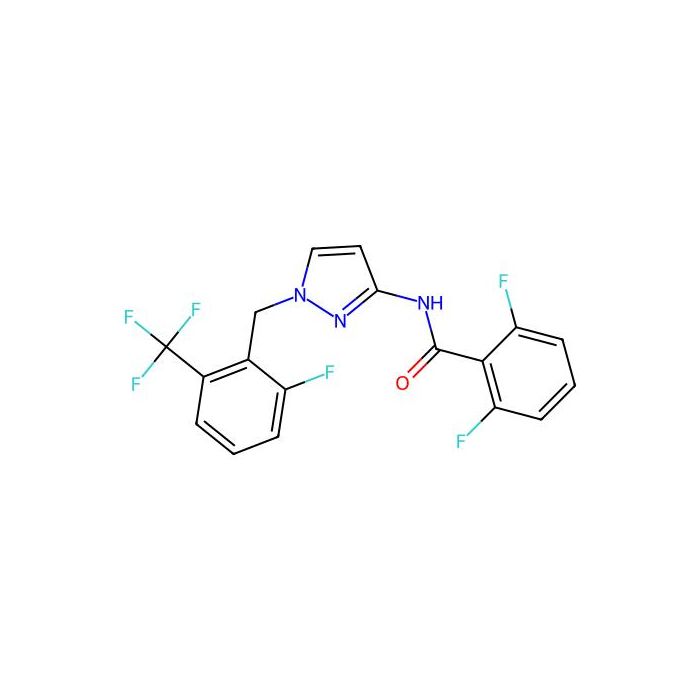
GSK-5498A is a selective CARC channel inhibitor ( IC 50 : 1 μM). GSK-5498A inhibits mediators release from mast cells and pro-inflammatory cytokines release from T cells. GSK-5498A can be used in the research of inflammatory disorders
In Vitro
GSK-5498A (1 and 10 μM) inhibits calcium influx through CRAC channels in human embryonic kidney cells. GSK-5498A (1 nM-10 μM) inhibits the thapsigargin-evoked fluorescence signal (pIC 50 : 6.3) in Jurkat cells, measured using the calcium sensitive dye: Fluo4-AM. GSK-5498A (1 nM-10 μM) evokes concentration-dependent inhibition of Cytostim-evoked interferon-γ and IL-5 production in PBMCs. GSK-5498A (1 μM-10 μM) inhibits degranulation of rat tissue-resident mast cells. GSK-5498A (10 nM-10 μM) inhibits mouse and rat T-cell cytokine (IL-2) release. GSK-5498A (0-10 μM) shows high selectivity for CRAC channels over other ion channels, enzymes and G-protein coupled receptors. MCE has not independently confirmed the accuracy of these methods. They are for reference only.
IC50& Target:CRAC channel
Spezifikationen
Spezifikationen & Reinheit
10mM in DMSO
Biochemische und physiologische Mechanismen
GSK-5498A is a selective CARC channel inhibitor ( IC 50 : 1 μM). GSK-5498A inhibits mediators release from mast cells and pro-inflammatory cytokines release from T cells. GSK-5498A can be used in the research of inflammatory disorders.
Storage
Store at -80°C
Verschickt in
Dry ice packs + Cold packs
Dieses Produkt erfordert Kühlkettenversand. Grundversand und andere Economy-Optionen sind nicht verfügbar.
Zertifikate (CoA, COO, BSE/TSE und Analyse-Diagramm)
C of A & Other Certificates(BSE/TSE, COO):
Analytical Chart:
Lösungsrechner
Molarity Calculator
Determine the necessary mass, volume, or concentration for preparing a solution.
Dilution Calculator
Determine the dilution needed to prepare a stock solution.
Reconstitution Calculator
Bewertungen
Kundenbewertungen
Application Protocols
The Product Data do not list validated application protocols for GSK-5498A.
Item-specific protocols/dilutions/controls: Not specified for this item; refer to CoA/Spec Sheet.
General small-molecule handling protocols (informational, not item-specific):
Stock preparation: Dissolve in anhydrous DMSO to 10–50 mM. Vortex and, if needed, sonicate briefly. Filter (PTFE, 0.2 µm) if particulate remains and chemical stability allows.
Aliquoting: Dispense single-use aliquots (e.g., 10–50 µL) in low-binding tubes or plates. Store at −80 °C, protected from light.
Working solutions: Dilute into assay buffer with vigorous mixing to desired final concentrations, keeping DMSO within assay tolerance.
Plate handling: Use solvent-resistant plates and low-retention tips. Seal plates to limit evaporation and edge effects.
Documentation: Record lot, concentration, solvent fraction, preparation date, and storage conditions.
Develop and validate assay-specific protocols internally for GSK-5498A, as no manufacturer protocols are provided.
Biological Roles
No target, pathway, or mode-of-action is provided for GSK-5498A in the Product Data. The following context is general to small-molecule research tools and is not specific to this compound.
General roles of small-molecule probes in research:
Modulate protein functions or pathways to interrogate biology in vitro or in cell-based systems.
Serve as starting points for structure–activity relationship (SAR) campaigns and medicinal chemistry optimization.
Assist in validating assay platforms, establishing positive/negative controls, and benchmarking technologies.
Experimental considerations (general):
Confirm on-target effects with orthogonal approaches (genetic perturbation, chemoproteomics) to avoid misattribution.
Evaluate concentration–response behavior and cytotoxicity windows to separate specific effects from general stress responses.
Control for assay interference (fluorescence, redox cycling, PAINS liabilities) using appropriate filters and counter-screens.
Data stewardship:
Document lot numbers, solvent composition, storage history, and plate maps to ensure reproducibility.
Until target-specific data for GSK-5498A are obtained (via CoA, literature, or internal characterization), treat it as an investigational research tool and avoid biological claims beyond in vitro lab use.
Buffer Applications
Buffer formulation guidelines are generally not applicable to an undefined small-molecule tool compound beyond ensuring compatibility for dissolution and assay delivery. No buffer system information is provided for GSK-5498A.
Practical, general guidance (not item-specific):
Prepare primary stocks in DMSO and dilute into assay buffers (e.g., HEPES, PBS) maintaining final DMSO ≤0.1–1% v/v as tolerated by the assay.
To prevent precipitation upon dilution, add DMSO stocks to vigorously mixed buffer and consider gentle heating (≤37 °C) or surfactants at low percentages when compatible.
Filter sterilize aqueous working solutions if required for cell-based assays; verify compound stability during filtration.
For any buffer-dependent parameters (pH stability, solubility vs pH), consult the CoA or generate empirical data for GSK-5498A.
Green Alternatives
Given that GSK-5498A is typically used as a dissolved small molecule in assays rather than as a bulk solvent or reagent, “green alternatives” primarily pertain to solvent choices for dissolution and handling. No item-specific solvent requirements are provided; the points below are general and not specifications.
Greener dissolution strategies (general):
Prefer minimal DMSO volumes and highest feasible stock concentrations to reduce total DMSO usage.
Evaluate bio-based or lower-toxicity co-solvents (e.g., ethanol) when assay-compatible, recognizing possible volatility and biological effects.
Use water as the principal diluent whenever solubility and stability permit.
2-MeTHF/CPME: greener ethers used in synthesis; generally not used for bioassay stocks due to immiscibility with water.
Operational green practices:
Scale down assay volumes and adopt miniaturized formats (e.g., 384/1536-well) to cut solvent consumption and waste.
Implement solvent recycling where applicable and segregate halogenated vs non-halogenated waste streams.
Always verify GSK-5498A solubility/stability empirically before adopting alternative solvent systems.
Pharmaceutical Uses
No pharmaceutical excipient status, pharmacopeial listing, or formulation role is provided for GSK-5498A. This product is supplied strictly for research use only and is not intended for human or veterinary use.
General context (informational; not item-specific):
Early discovery compounds may be used to explore ADME and developability in non-clinical research. Such activities require rigorous internal qualification beyond catalog specifications.
Without definitive grade and impurity profiles, materials should not be advanced to GLP/GMP or clinical settings.
If formulating for research models (in vitro/in vivo screening within institutional approvals):
Establish compound-specific solubility and stability in candidate vehicles (e.g., DMSO/saline, PEG400, Captisol) via small-scale tests.
Record and control residual solvent content and pH/osmolality of dosing solutions for reproducibility.
No therapeutic, diagnostic, or clinical claims are made or implied for this product.
Physical Properties
Item-specific physical constants are not provided in the Product Data. The following placeholders indicate where to consult authoritative documentation.
Item-specific values (as supplied):
Appearance: Not specified for this item; refer to CoA/Spec Sheet.
Molecular Weight: Not specified for this item; refer to CoA/Spec Sheet.
Molecular Formula: Not specified for this item; refer to CoA/Spec Sheet.
Melting point (mp): Not specified for this item; refer to CoA/Spec Sheet.
Boiling point (bp): Not specified for this item; refer to CoA/Spec Sheet.
Density: Not specified for this item; refer to CoA/Spec Sheet.
Refractive index: Not specified for this item; refer to CoA/Spec Sheet.
pKa / logP / solubility: Not specified for this item; refer to CoA/Spec Sheet.
General guidance for small-molecule tool compounds (literature/general, not item-specific):
Many screening compounds are solids at ambient conditions and are formulated as DMSO stock solutions (e.g., 10–50 mM) due to broad solubilizing capacity of DMSO.
Typical dissolution workflow: weigh under low humidity if hygroscopicity is suspected; dissolve in dry, anhydrous DMSO; optionally dilute into aqueous assay buffers with final DMSO ≤1% v/v to minimize assay interference.
If aqueous solubility is required, co-solvent strategies (DMSO→buffer), pH adjustment (for ionizable molecules), or surfactants (e.g., 0.01–0.05% Tween 80) can be explored in method development.
Always defer to the product’s CoA/SDS for definitive physical property values and handling limits.
Quality and Grades
Item-specific grade and purity are not provided in the Product Data for GSK-5498A.
Item-specific status:
Grade/Purity: Not specified for this item; refer to CoA/Spec Sheet.
General guidance on grades (informational, not item-specific):
Screening/Library grade: typically supports HTS and SAR work; purity commonly ≥95% by HPLC/LC–MS, but verify on CoA.
Research/Biological grade: emphasizes low residual solvents/metals and identity confirmation (NMR/HRMS).
HPLC grade solvents vs reagent grade: relevant if user prepares analytical methods; HPLC grade minimizes UV-absorbing impurities.
Quality documentation and verification:
CoA normally lists identity (NMR/LC–MS), purity (HPLC area%), and residual solvents/water. Any stabilizers or salt forms are typically disclosed.
If your application is assay-sensitive (e.g., biophysical binding, crystallography), consider requesting expanded analytical data (water by KF, salts, polymorph information) and re-purify if necessary.
Practical tips:
Upon receipt, inspect container integrity and lot-specific CoA. Record lot and prepare single-use aliquots to preserve purity at −80 °C.
If purity threshold is critical (e.g., ≥98% for medicinal chemistry), perform incoming QC (orthogonal HPLC, LC–MS, NMR) before use.
Reaction and Applications
Item-specific reactivity and intended mechanistic applications are not provided. GSK-5498A is listed under small molecules/compound libraries, suggesting primary use as a research tool or screening compound rather than as a synthetic reagent.
Item-specific application statements from the catalog: Not provided.
General research applications for library compounds (informational):
High-throughput screening (HTS) and primary assays to identify activity profiles.
Secondary assays and counter-screens to evaluate selectivity and off-target effects.
Structure–activity relationship (SAR) development when analogs are available.
Biophysical assays (e.g., DSF, MST, SPR) to quantify binding where applicable.
Practical tips (general, non–item-specific):
Prepare concentrated DMSO stocks and aliquot to avoid freeze–thaw. Validate concentration by UV-Vis or quantitative NMR when critical.
Confirm identity and purity by LC–MS/HPLC before critical experiments; impurities can confound assay readouts.
Assess assay interference risks (aggregation, fluorescence, redox activity) using orthogonal readouts and appropriate controls.
As no target or mode-of-action is provided for GSK-5498A, users should design unbiased assays and include broad counter-screens to contextualize any observed activity.
Reaction Conditions
No reaction conditions or synthetic protocols are provided for GSK-5498A. Because the structure and functional groups are not disclosed in the Product Data, practical guidance on reaction temperatures, catalysts, or yields would be speculative and is not provided here.
General notes (not item-specific):
If using GSK-5498A as a test substrate in methodology development, first confirm its identity and purity, then run micro-scale trials to map stability across temperature, pH, and common catalysts.
For biochemistry assays, typical working concentrations range from low nM to low µM, with exposure limited by solubility and assay tolerance to DMSO.
Please refer to validated literature associated with its CAS or to the CoA for any item-specific preparative or handling conditions.
Safety and Handling
Safety details specific to this item are not provided in the Product Data and must be obtained from the product SDS.
Item-specific hazard information:
Signal Word: Not specified for this item; refer to SDS.
H-Statements: Not specified for this item; refer to SDS.
GHS Classification/Pictograms: Not specified for this item; refer to SDS.
General laboratory precautions for small organic molecules (general guidance; not item-specific):
Use in a chemical fume hood, avoid inhalation and skin/eye contact.
Recommended PPE: lab coat, nitrile gloves, safety glasses or face shield.
Avoid contact with strong oxidizers and strong acids/bases unless compatibility is known.
If powdery, minimize dust formation; consider weighing in a balance enclosure.
First aid (general): rinse skin/eyes with water for ≥15 min if contacted; move to fresh air if inhaled; seek medical attention as needed. Spill response: absorb with inert material, collect for disposal as hazardous waste.
Storage and stability (item-specific):
Store at −80 °C (per Product Data). Keep tightly closed, desiccated, and protected from light if photosensitivity is suspected. Minimize freeze–thaw by aliquoting.
Consult the SDS for authoritative hazard, exposure controls, and disposal guidance.
Solvent Selection
No item-specific solubility data are provided. The following are general, literature-based practices for small-molecule tool compounds and are not specifications for this product.
Primary solvent for stocks (general):
DMSO (anhydrous) is commonly used to prepare 10–50 mM stocks due to broad solvency and assay compatibility at ≤1% v/v.
Ethanol or isopropanol: useful for intermediate polarity; often compatible with biochemical assays at ≤1–2% v/v.
Aqueous buffers: feasible after initial dissolution in DMSO, with careful titration to prevent precipitation.
Miscibility/polarity context (general):
DMSO is miscible with water and many organics, easing serial dilution into buffers.
For highly lipophilic compounds, consider adding nonionic surfactants (e.g., 0.01–0.05% Tween 80) to maintain dispersion in aqueous media.
Comparison note (general):
DMSO vs DMF: DMSO is more commonly accepted in biological assays; DMF may be harsher to proteins/cells.
DMSO vs ethanol: ethanol is more volatile and can alter assay readouts at higher percentages; DMSO typically exerts less vapor-phase cross-contamination.
Always verify actual solubility and compatibility for GSK-5498A with small-scale tests and consult the CoA/SDS.
Storage and Reconstitution
Item-specific instructions (from Product Data):
Storage: Store at −80 °C.
Shipping: Dry ice packs + Cold packs.
Not specified for this item; refer to CoA/Spec Sheet:
Recommended reconstitution solvent and target concentration.
Stability upon thawing, freeze–thaw tolerance, and light sensitivity.
General best practices for small-molecule research compounds (informational):
Reconstitution: Dissolve in anhydrous DMSO to prepare concentrated stocks (e.g., 10–50 mM). If aqueous solubility is required, perform stepwise dilution into buffer while mixing to avoid precipitation.
Aliquoting: Prepare single-use aliquots to avoid repeated freeze–thaw. Use low-binding vials; purge headspace with inert gas if oxygen sensitivity is suspected.
Storage: Maintain at −80 °C in sealed, moisture-protected containers. Avoid frost-free freezers due to temperature cycling. Protect from light if chromophores are present or suspected.
Stability checks: Periodically verify integrity by LC–MS/HPLC, especially after >6 months storage or multiple thaws.
For definitive, lot-specific reconstitution concentrations and stability windows of GSK-5498A, consult the CoA or contact Technical Support.
Structure and Identity
Brief description: GSK-5498A is a cataloged small-molecule research compound supplied by Aladdin Scientific for discovery and in vitro laboratory use.
Item-specific facts (from Product Data):
SKU: G655761
Product Name: GSK-5498A
CAS: 1253186-49-0
PubChem CID: 46945384
Storage: Store at −80 °C
Shipping: Dry ice packs + Cold packs
Research Use: For research use only
Molecular Formula: Not specified for this item; refer to CoA/Spec Sheet.
Molecular Weight: Not specified for this item; refer to CoA/Spec Sheet.
SMILES: Not specified for this item; refer to CoA/Spec Sheet.
InChIKey: Not specified for this item; refer to CoA/Spec Sheet.
Structural features:
Item-specific structural descriptors (ring systems, functional groups, stereochemistry) are not provided in the Product Data and are therefore not stated here. Refer to the Certificate of Analysis (CoA) or vendor Structure File (SDF) where available.
2D structure description:
Not specified for this item; refer to CoA/Spec Sheet.
Category context:
Category Path: 全部 / 可售 / 小分子和化合物库 (small molecules and compound libraries), indicating suitability for screening, SAR exploration, and platform assay development.
Synthetic Utility
The Product Data do not provide a structure, functional groups, or reactivity profile for GSK-5498A. Consequently, synthetic applications as a reagent or building block cannot be specified.
Applicability:
This item is positioned as a small-molecule research compound (library member) rather than a synthetic intermediate.
General remarks (informational, not item-specific):
If synthetic derivatization is desired (e.g., for SAR or probe development), first obtain and confirm the full structure (NMR, HRMS) and assess available functional handles for diversification (amines, acids, halides, etc.).
Protecting-group strategies, coupling methodologies, and late-stage functionalization would be entirely structure-dependent.
For concrete synthetic planning with GSK-5498A, consult the CoA/structure file or primary literature corresponding to CAS 1253186-49-0, then design transformations accordingly.
Target Specificity
Target, selectivity profile, and binding parameters for GSK-5498A are not provided in the Product Data.
Item-specific information:
Target/Pathway: Not specified for this item; refer to CoA/Spec Sheet.
Species reactivity or any biological selectivity metrics: Not specified for this item; refer to CoA/Spec Sheet.
General recommendations (informational):
Establish preliminary specificity by testing against a focused panel of potential off-targets and using orthogonal assay formats.
Determine potency (e.g., IC50, Ki, EC50) with appropriate kinetic/thermodynamic methods and report full assay conditions to enable reproduction.
Until target-resolved data are available, treat GSK-5498A as an investigational compound with unknown specificity.
Häufig gestellte Fragen
How should this product be stored?
Store at ?80 °C. Ultra-low temperature storage is required to maintain the specified shelf life.
How is this product shipped?
This product ships frozen with dry ice and cold packs. Unpack on arrival and transfer it to the storage condition stated above; handle dry ice with insulated gloves in a ventilated area.
What are the CAS number, molecular formula and molecular weight?
The CAS Number is 1253186-49-0, the molecular formula is C18H11F6N3O, and the molecular weight is 399.29 g/mol.
What documentation is provided?
Available product documentation, including Certificates of Analysis (COA), Safety Data Sheets (SDS), and specification sheets, is shown in the product document area. Document availability and access follow the current site policy.
Wir verwenden Cookies, um die ordnungsgemäße Funktion der Website sicherzustellen und, soweit zulässig, Ihr Nutzererlebnis zu verbessern. Sie können Ihre Einstellungen jederzeit unter „Einstellungen“ verwalten. Weitere Informationen finden Sie in unserer Cookie-Richtlinie.
Dürfen wir Sie über Rabattaktionen informieren?
Später erinnern
Vielen Dank! Bitte überprüfen Sie Ihren E-Mail-Posteingang, um zu bestätigen.
Products are supplied to verified businesses, institutions, and qualified professionals for research and development use only. Not for use in humans, animals, diagnosis, or therapy.