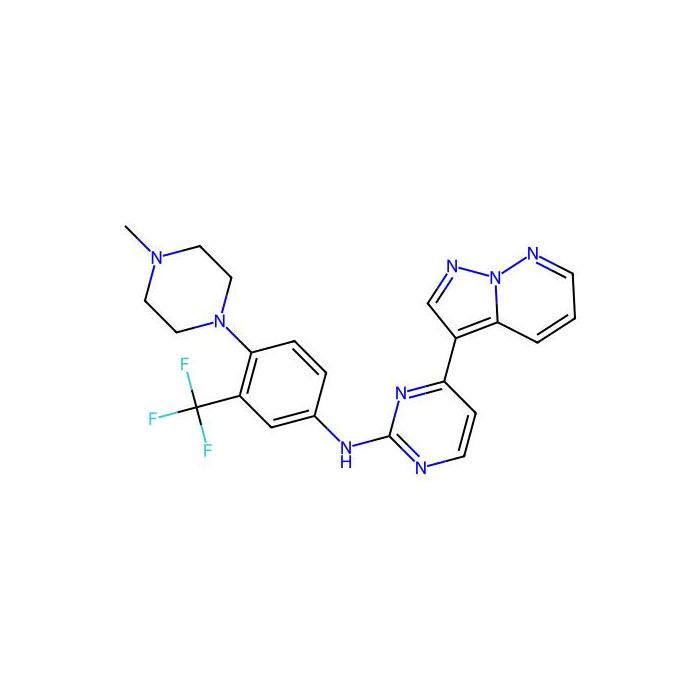
GW779439X is a pyrazolopyridazine identified in an inhibitor of the S. aureus PASTA kinase Stk1 . GW779439X potentiates the activity of β-lactam antibiotics against various MRSA and MSSA isolates, some even crossing the breakpoint from resistant to sensitive. GW779439X is an AURKA inhibitor and induces apoptosis by the caspases 3/7 pathway MRSA:methicillin-resistant S. aureus ; MSSA: methicillin-sensitive S. aureus
In Vitro
GW779439X (2 μM) biochemically inhibits Stk1. GW779439X (5 μM) potentiates ceftaroline activity against a ceftaroline-resistant MRSA strain. GW779439X is able to potentiate the activity of oxacillin against various S. aureus isolates, including both MRSA and MSSA isolates, but the potentiation is clearly strongest in PBP2A-containing strains. GW779439X has growth inhibition effects on the AGP-01 cell line (IC 50 = 0.57 μM). GW779439X (1μM) significantly blockS the cell cycle at the G0/G1 phase and sub-G1 phase. GW779439X (1μM; 72 hours; AGP-01 cells) significantly decreases expression levels of genes involved in proliferation progression ( c-MYC , NRAS , and CDC25A ) and increases expression levels of genes involved in cell cycle blocking ( CDKN1A and TP53 ) [2 . MCE has not independently confirmed the accuracy of these methods. They are for reference only.
IC50& Target:Aurora A|Stk1|apoptosis
Spezifikationen
Spezifikationen & Reinheit
10mM in DMSO
Biochemische und physiologische Mechanismen
GW779439X is a pyrazolopyridazine identified in an inhibitor of the S. aureus PASTA kinase Stk1 . GW779439X potentiates the activity of β-lactam antibiotics against various MRSA and MSSA isolates, some even crossing the breakpoint from resistant to sensit
Storage
Store at -80°C
Verschickt in
Dry ice packs + Cold packs
Dieses Produkt erfordert Kühlkettenversand. Grundversand und andere Economy-Optionen sind nicht verfügbar.
Zertifikate (CoA, COO, BSE/TSE und Analyse-Diagramm)
C of A & Other Certificates(BSE/TSE, COO):
Analytical Chart:
Lösungsrechner
Molarity Calculator
Determine the necessary mass, volume, or concentration for preparing a solution.
Dilution Calculator
Determine the dilution needed to prepare a stock solution.
Reconstitution Calculator
Bewertungen
Kundenbewertungen
Application Protocols
No item-specific, validated application protocols are provided for GW779439X.
Recommended dilutions, plate formats, and positive controls are not specified for this item.
If deploying in HTS or dose–response studies, follow your institution’s SOPs for compound handling, plate mapping, and QC. Validate performance with appropriate vehicle controls and, where relevant, orthogonal readouts.
Biological Roles
Item-specific biological targets, pathways, or mechanisms for GW779439X are not provided in this listing. No claims are made regarding biological activity.
General context for small-molecule research tools
Such compounds are commonly employed as chemical probes or hits in exploratory biology to interrogate protein function, pathways, or phenotypes under strictly research conditions.
Best practice dictates running orthogonal assays and counterscreens to separate true target engagement from assay artifacts (redox cycling, fluorescence interference, aggregation).
If external literature proposes a target for GW779439X (not confirmed here), validate with concentration–response curves, selectivity panels, and, where possible, genetic controls (knockdown/knockout).
Track vehicle (DMSO) effects carefully; maintain consistent final vehicle concentration across controls and treatments.
Important
For research use only. Not for human or veterinary use. No clinical, diagnostic, or therapeutic claims are made for this product.
Buffer Applications
This product is not a buffering agent. However, it is commonly used by dissolving in an organic stock (e.g., DMSO) and diluting into assay buffers.
Practical guidance (general)
Vehicle control: Maintain a constant final DMSO (or other vehicle) level across all wells/samples, typically ≤0.1–1% v/v depending on assay tolerance.
Order of addition: Add compound last to pre‑equilibrated buffer and target mix with thorough mixing to avoid local supersaturation.
Precipitation checks: After dilution into buffer (e.g., PBS, HEPES, Tris), visually inspect for haze/precipitation; use light scattering or filtration if needed.
Adsorption mitigation: Low-binding polypropylene plates/tubes can reduce loss for hydrophobic compounds.
If pH-sensitive behavior is suspected (unknown here), evaluate solubility and stability across the intended buffer pH range and ionic strength.
Green Alternatives
Because GW779439X is a screening compound (not a process solvent or bulk reagent), “green alternatives” focus on reducing solvent use and waste in handling rather than substituting the compound itself.
Greener handling strategies (general)
Minimize DMSO volume: Use higher‑concentration master stocks to reduce total DMSO added to assays; validate solubility and avoid precipitation.
Right-size aliquots: Prepare single-use aliquots (e.g., 10–50 µL) to prevent freeze–thaw cycles and waste from expired leftovers.
Solvent selection hierarchy: Prefer EtOH or MeOH over halogenated solvents when compatible. Avoid chlorinated solvents for routine dissolution unless strictly necessary.
Aqueous-first approaches: Where ionization permits, use buffered aqueous vehicles with minimal cosolvent to reduce organic solvent burden.
Waste reduction: Consolidate DMSO-containing waste streams and label accurately to facilitate compliant disposal; consider micro-volume assay formats (1536‑well) to cut total solvent use.
Trade-offs (general)
Higher-concentration stocks decrease solvent use but can increase precipitation risk on dilution; perform visual and nephelometric checks.
Switching cosolvents can reduce environmental impact but may alter biological readouts; revalidate controls when changing vehicles.
Note: No item-specific green chemistry metrics (E-factor, life-cycle) are available for this product.
Pharmaceutical Uses
No pharmacopeial status, excipient role, or formulation use is provided for this item. GW779439X is supplied strictly for research use only.
General notes (non-clinical)
Screening compounds may inform structure–activity relationships (SAR) in early discovery but are not intended for human or veterinary administration.
If preformulation experiments are conducted (solubility, stability), clearly label as non‑GMP, non-clinical research and segregate from any regulated development streams.
No claims are made regarding bioavailability, safety, or efficacy.
Physical Properties
Item-specific physicochemical parameters are not disclosed in this listing.
Appearance: Not specified for this item; refer to CoA/Spec Sheet.
Melting point / boiling point: Not specified for this item; refer to CoA/Spec Sheet.
Density / refractive index: Not specified for this item; refer to CoA/Spec Sheet.
Solubility: Not specified for this item; refer to CoA/Spec Sheet.
logP/logD, pKa: Not specified for this item; refer to CoA/Spec Sheet.
General guidance for library/tool compounds (literature/practice)
Many discovery compounds are prepared as DMSO stocks (e.g., 10–50 mM) for assay use due to broad solubilizing power of DMSO; aqueous solubility can vary widely with scaffold.
If aqueous use is required, consider cosolvent strategies (DMSO→buffer dilution), pH adjustments (when ionizable groups exist), or surfactants (e.g., 0.01–0.05% Tween-80) as assay-compatible.
Establish a solubility/precipitation check at intended working concentrations by visual inspection and nephelometry or light scattering.
Note: Treat any literature property values located via external databases as provisional until confirmed against the Aladdin CoA/SDS for the specific lot received.
Quality and Grades
Grade/purity (item-specific): Not specified for this item; refer to CoA/Spec Sheet.
Context and expectations (general for screening/tool compounds)
Discovery compounds are commonly supplied at analytical purity (often ≥95% by HPLC/LC–MS) to support screening reliability. Verify purity on the provided CoA for this specific lot; do not assume a generic value.
Identity verification: Expect supporting data such as LC–MS and/or NMR. Confirm that the analytical method (e.g., gradient, detection wavelength) matches your use case (UV/ELSD/MS).
Residual solvents / water / metals: Not specified for this item; refer to CoA/Spec Sheet. If your assay is metal- or water‑sensitive, consider performing Karl Fischer or ICP‑MS on receipt.
Salt form / solvate state: If applicable, verify free base vs. salt on the label/CoA; salt form can materially affect solubility and assay behavior.
Batch-to-batch control: Record lot numbers in screening databases to maintain data integrity across replicate campaigns.
Implications for use
For quantitative biology or SAR, confirm absolute concentration of DMSO stocks by UV (if chromophore known) or quantitative NMR with internal standard.
If low-UV applications (HPLC/UPLC) are planned, verify UV cutoff/absorbance background experimentally; not specified for this item.
Reaction and Applications
This product is positioned as a research small-molecule/tool compound rather than a synthetic reagent. No manufacturer reaction-use claims are provided for this item.
Discovery and screening applications (general)
Primary use: Preparation of concentrated DMSO stocks for use in HTS, fragment screening, target validation, and mechanism studies where the compound’s biological activity is evaluated in vitro or in cell-based assays.
Orthogonal confirmation: Combine biochemical readouts with orthogonal assays (e.g., thermal shift, SPR, ITC, CETSA) to validate interactions and rule out assay interference.
Aggregate/artifact control: Include detergent controls (0.01–0.05% Tween-20/80), evaluate concentration–response curves, and screen for colloidal aggregation (dynamic light scattering or counterscreens like AmpC/MDH) where appropriate.
Redox/photoreactivity checks: If chromophores are present (structure not provided), test for photobleaching/ROS generation under assay illumination conditions.
Analytical handling
Establish HPLC/LC–MS methods for purity check before and after storage/assay deployment to monitor degradation.
For plate-based dispensing, confirm DMSO compatibility of plastics; pre-wet tips and use low-bind consumables to minimize adsorption losses.
Note: No specific reaction chemistry, catalysts, or synthetic transformations are associated with this listing. For derivatization chemistry or SAR expansion, see “Synthetic Utility” for general considerations.
Reaction Conditions
Not applicable. This item is not sold as a reagent for running named chemical reactions, and no structure or reactive functional groups are disclosed in this listing.
General note (for users performing follow-up chemistry on related analogs)
Choose conditions based on the actual functional groups present and verify compatibility with sensitive motifs (e.g., heteroaromatics, halides, protecting groups).
Use small-scale scouting (0.01–0.1 mmol) with analytical monitoring (LC–MS) before scale-up.
For this specific catalog item, there are no manufacturer-recommended reaction conditions.
Safety and Handling
Safety data specific to this item is not fully disclosed here. Always consult the product SDS for authoritative guidance.
GHS classification / pictograms / H‑statements: Not specified for this item; refer to SDS.
Signal word: Not specified for this item; refer to SDS.
Primary hazards (general): Small-molecule research compounds may present risks of irritation, sensitization, or systemic toxicity; handle as potentially harmful in absence of definitive data.
Recommended laboratory practices (general, defer to SDS)
PPE: Lab coat, safety glasses, and appropriate chemically resistant gloves (e.g., nitrile). Use a certified fume hood for weighing, dissolving, and transfers.
Engineering controls: Avoid aerosolization and dust generation; use closed vessels and secondary containment.
Incompatibilities: When structure is not known, segregate conservatively from strong oxidizers and reactive acids/bases. Do not mix with unknowns.
First aid (overview): Inhalation—move to fresh air. Skin/eye—flush with water for 15 minutes, remove contaminated clothing. Ingestion—rinse mouth. Seek medical attention in all cases; present SDS.
Spill response: Cover solids with inert absorbent, collect mechanically while minimizing dust, then wet-wipe area. Dispose in accordance with institutional and local regulations.
Waste: Accumulate in a properly labeled container for organic hazardous waste; do not discharge to drains.
Logistics
Shipping: Provided on dry ice and cold packs as noted; open shipments promptly and transfer to specified storage.
Always prioritize the SDS for the specific lot for quantitative exposure limits and detailed response procedures.
Solvent Selection
Item-specific solubility and polarity are not provided. The following are general, practical strategies for library compounds used in discovery assays.
Primary stock solvent (common practice): High-purity DMSO due to broad solubilizing capability across diverse scaffolds. Prepare 10–50 mM master stocks when solubility allows.
Alternative organic solvents: Methanol, ethanol, acetonitrile, or DMF can be evaluated if DMSO is incompatible with the assay. Ensure solvent-grade is suitable for analytical or bioassay work.
Aqueous use: Many drug-like compounds have limited direct water solubility. Use cosolvent dilution (e.g., add DMSO stock to buffer with vigorous mixing) and keep final DMSO typically at ≤0.1–1% v/v depending on biological tolerance.
pH effects: If the compound has ionizable groups (unknown here), aqueous solubility may increase upon adjusting buffer pH. Validate stability across pH range.
Small comparison (general)
DMSO: Maximal solubility, high boiling point; may affect some targets/cells at >0.5%.
MeOH/EtOH: Lower toxicity in some systems, volatile; lower solubility breadth.
ACN: Low viscosity, miscible; limited for in vitro biology beyond trace levels.
Practical tips
Filter stocks only if soluble; avoid sorptive filters when mass is limited. Use amber vials if the scaffold is light‑sensitive (unknown; test empirically). Conduct a precipitation check after dilution into assay buffer.
Storage and Reconstitution
Storage conditions (item-specific): Store at −80°C.
Shipping: Shipped on dry ice packs + cold packs; transfer to −80°C upon receipt.
Reconstitution and handling (general guidance; not item-specific specifications)
Allow container to equilibrate to room temperature in a desiccator before opening to avoid moisture condensation.
Prepare concentrated stocks in anhydrous DMSO (typical screening practice: 10–50 mM, limited by solubility). If alternative solvents are needed (MeOH, EtOH, ACN, DMF), validate stability and assay compatibility.
Aliquot into single-use volumes (e.g., 10–50 µL) in low-bind, airtight vials or PCR tubes to minimize freeze–thaw. Purge headspace with dry inert gas if stability warrants.
Avoid repeated freeze–thaw; thaw on ice or at room temperature briefly, mix gently, and return unused aliquots to −80°C promptly.
Protect from light and moisture until compound-specific stability is known. Consider storing in amber vials with desiccant.
For aqueous working solutions, dilute the organic stock into buffer with vigorous mixing; keep final DMSO ≤0.1–1% v/v as compatible with your assay.
Expiration/retention
Item-specific shelf life and stability data: Not specified for this item; refer to CoA/Spec Sheet. Reassess purity by LC–MS/HPLC after prolonged storage.
Structure and Identity
GW779439X (SKU: G655324) is supplied as a research-use small molecule from our screening compound collection.
Product name: GW779439X
CAS: 551919-98-3
PubChem CID: 10173796 (literature identifier)
InChIKey: Not specified for this item; refer to CoA/Spec Sheet.
SMILES: Not specified for this item; refer to CoA/Spec Sheet.
Molecular formula: Not specified for this item; refer to CoA/Spec Sheet.
Molecular weight: Not specified for this item; refer to CoA/Spec Sheet.
Structural description
Item-specific structural features (ring systems, heteroatoms, stereochemistry) are not provided in this listing. Consult the CoA/Spec Sheet for definitive identity elements and spectral data.
General note (literature): PubChem CID is provided for external cross-reference only; compare any third‑party structural depictions against the Aladdin CoA before use in regulated or quantitative work.
Identity confirmation best practices (general)
Verify by orthogonal methods such as 1H/13C NMR, LC–MS/HRMS, and HPLC purity prior to biological or SAR studies.
Record compound identifiers (CAS, lot, SKU) in ELNs to maintain traceability across screening and follow‑up experiments.
Synthetic Utility
GW779439X is offered as a finished small molecule for screening; it is not positioned as a synthetic building block in this listing. As the structure is not provided here, no specific transformations or functional-group–based chemistry can be recommended.
General considerations if derivatization/SAR is planned (literature/practice)
Verify full structural assignment (NMR, HRMS) prior to analog synthesis.
Map potential vector points for substitution using computed properties (pKa/logD), if available, to guide polarity/lipophilicity tuning.
Establish robust analytics (quantitative HPLC, chiral HPLC if stereocenters exist) to track purity and stereochemical integrity across series.
For late-stage functionalization (if scaffold permits), consider C–H activation, photoredox, or minimally disruptive cross-couplings to access rapid analog diversity.
Without the disclosed structure, any specific named-reaction guidance would be speculative. Consult the CoA/Spec Sheet or contact Technical Support for structure-enabled synthetic planning.
Target Specificity
No target, pathway, or binding profile is provided for GW779439X in this listing.
Target(s): Not specified for this item; refer to literature and verify independently.
Selectivity: Not specified for this item; refer to CoA/Spec Sheet or your own profiling.
Species reactivity: Not applicable.
Note: Any target assignments found in external databases must be experimentally confirmed under your assay conditions before drawing conclusions.
Wir verwenden Cookies, um die ordnungsgemäße Funktion der Website sicherzustellen und, soweit zulässig, Ihr Nutzererlebnis zu verbessern. Sie können Ihre Einstellungen jederzeit unter „Einstellungen“ verwalten. Weitere Informationen finden Sie in unserer Cookie-Richtlinie.
Dürfen wir Sie über Rabattaktionen informieren?
Später erinnern
Vielen Dank! Bitte überprüfen Sie Ihren E-Mail-Posteingang, um zu bestätigen.
Products are supplied to verified businesses, institutions, and qualified professionals for research and development use only. Not for use in humans, animals, diagnosis, or therapy.