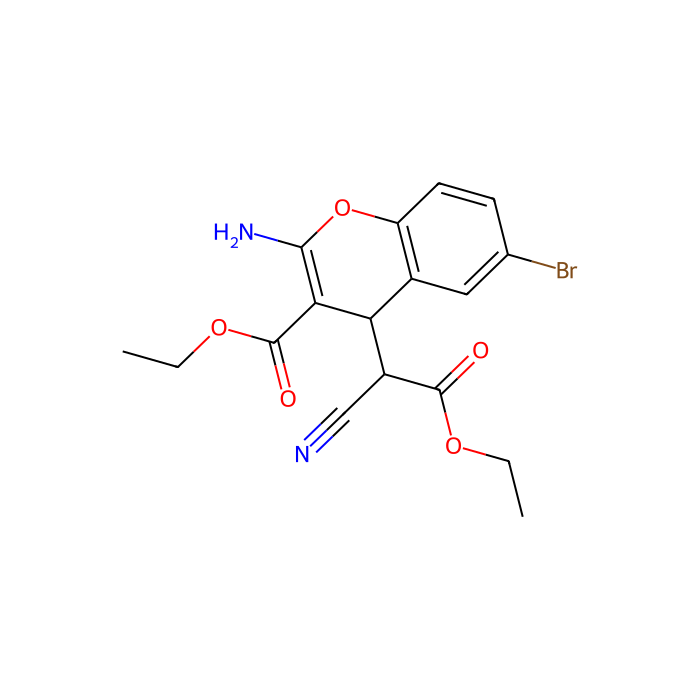
HA14-1 is a small molecule and nonpeptidic ligand of a Bcl-2 surface pocket with IC50 of approximately 9 μM. HA14-1 induces the apoptosis of HL-60 cells in a dose-dependent manner via caspase activation. HA14-1 shows cytotoxic effects on HF1A3, HF4.9 and
Storage
Store at -20°C
Verschickt in
Ice chest + Ice pads
Dieses Produkt erfordert Kühlkettenversand. Grundversand und andere Economy-Optionen sind nicht verfügbar.
Aktionsart
INHIBITOR
Hinweis
Unstable; make up solutions fresh and use immediately. Need more advice on solubility, usage and handling? Please visit our frequently asked questions (FAQ) page for more details.
This compound belongs to the class of organic compounds known as 1-benzopyrans. These are organic aromatic compounds that 1-benzopyran, a bicyclic compound made up of a benzene ring fused to a pyran, so that the oxygen atom is at the 1-position.
External Descriptors
Not available
1. Djoumbou Feunang Y, Eisner R, Knox C, Chepelev L, Hastings J, Owen G, Fahy E, Steinbeck C, Subramanian S, Bolton E, Greiner R, and Wishart DS. ClassyFire: Automated Chemical Classification With A Comprehensive, Computable Taxonomy. Journal of Cheminformatics, 2016, 8:61.
Determine the necessary mass, volume, or concentration for preparing a solution.
Dilution Calculator
Determine the dilution needed to prepare a stock solution.
Reconstitution Calculator
Bewertungen
Kundenbewertungen
Application Protocols
Only product-provided, validated application guidance may be listed here.
Tested applications: Not specified for this item; refer to CoA/Spec Sheet.
Suggested dilutions/conditions: Not specified for this item; refer to CoA/Spec Sheet.
General best practices for small-molecule tool compounds:
Prepare fresh working solutions from frozen DMSO stocks immediately before use.
Keep final DMSO concentration consistent across samples (commonly ≤0.5% v/v in many cell-based assays, subject to assay tolerance).
Confirm solubility and absence of precipitation visually or by light scattering after dilution into assay buffer/media.
Biological Roles
The following describes literature-based, general information about HA14-1; it is provided for research context only and is not product-specific specification or a therapeutic claim.
Research context (literature): HA14-1 is widely cited as a small-molecule tool used to interrogate apoptosis pathways by modulating protein–protein interactions within the BCL-2 family. It has been employed as a prototype BH3 mimetic in biochemical and cellular studies.
Typical experimental roles (literature):
Probe for displacement assays assessing binding at anti-apoptotic protein grooves.
Chemical control for validating pathway dependence in mechanism-of-action experiments.
Assay considerations (literature/best practice):
Employ appropriate negative/vehicle controls and orthogonal readouts (e.g., caspase activity vs. viability) to mitigate assay interference.
Confirm compound integrity by LC–MS/HPLC prior to critical studies; many bioactives can degrade upon prolonged exposure to light, moisture, or elevated temperature.
Off-target/assay interference notes (general): Polycyclic, hydrophobic compounds may exhibit fluorescence or redox activity that can confound certain readouts; use counter-screens where applicable.
All uses are strictly for laboratory research. This compound is not intended for use in humans or diagnostics.
Buffer Applications
This product is a hydrophobic research compound and is not a buffering agent. It does not define pH in solution and is not used to formulate classical buffer systems.
Practical note:
When incorporating into buffered media, pre-dissolve in a miscible organic solvent (commonly DMSO) and add to the buffer with vigorous mixing to avoid precipitation. Maintain a consistent final organic percentage across samples.
Green Alternatives
Green chemistry considerations generally pertain to solvents and large-scale reagents. As HA14-1 is a specialized research compound used at small scale, substitution for a “greener” alternative is typically not applicable.
Use-phase considerations:
Prefer greener cosolvents (e.g., ethanol or water with solubilizing agents) where assay compatibility and solubility allow, instead of higher-toxicity solvents.
Minimize DMSO percentage in assays while maintaining solubility and reproducibility.
Procurement/footprint:
Because quantities are usually milligram-scale, the environmental impact is dominated by solvent choice and waste handling during use rather than by the compound itself.
If your application is solvent-intensive (high-throughput screening plate prep, repeated washes), consider:
Replacing acetonitrile or DMF with ethanol/water blends when feasible.
Implementing solvent recycling and cold-chain optimization to reduce dry ice and packaging waste.
There are no direct “green substitutes” for this specific research molecule, as its structure underpins its study purpose.
Pharmaceutical Uses
This listing is for research use only and is not intended for formulation or therapeutic use.
Pharmacopeial status: Not specified for this item; refer to CoA/Spec Sheet.
Potential roles in a pharmaceutical workflow (general R&D context):
May serve as a reference or tool compound in discovery assays, SAR benchmarking, and target-validation studies (literature/general for chemical probes).
Not typically used as an excipient or process aid.
No claims are made regarding safety, efficacy, or suitability for human/veterinary administration.
Physical Properties
Item-specific specifications have not been provided for this catalog entry. Where helpful, general/literature guidance is noted and should not be treated as product specifications.
Appearance: Not specified for this item; refer to CoA/Spec Sheet.
Melting point: Not specified for this item; refer to CoA/Spec Sheet.
Boiling point: Not applicable/typically not reported for this type of solid research compound; Not specified for this item; refer to CoA/Spec Sheet.
Density: Not specified for this item; refer to CoA/Spec Sheet.
Solubility (literature/general):
Commonly prepared as concentrated stocks in DMSO (e.g., 10–50 mM) due to limited aqueous solubility typical for hydrophobic screening compounds.
Often soluble in high-strength organic solvents (DMF, acetonitrile, ethanol) to varying degrees; aqueous buffers usually require cosolvent or surfactant.
LogP, pKa, refractive index: Not specified for this item; refer to CoA/Spec Sheet.
Practical notes (general):
If preparing aqueous working solutions, pre-dissolve in DMSO, then dilute into buffer with vigorous mixing; keep final DMSO content consistent across controls.
For spectroscopic characterization, DMSO-d6 or CD3OD are commonly suitable NMR solvents for similar heteroaromatic small molecules.
Quality and Grades
Grade/Purity: Not specified for this item; refer to CoA/Spec Sheet.
How to interpret grade (general guidance for screening compounds):
When a purity value is provided on the CoA (e.g., HPLC area %), it indicates the chromatographic purity under the stated method. Impurity profiles (identity/level of individual impurities, residual solvents, water) are method-dependent; consult the CoA.
If “Assay by 1H NMR” is reported on the CoA, it denotes structural integrity and gross purity by NMR integration; it is not a substitute for chromatographic purity.
For bioactivity studies, many labs require ≥95% HPLC purity; for mechanistic or biophysical screening, ≥98% may be preferred to minimize off-target artifacts.
Stabilizers/inhibitors:
None specified for this item. If a stabilizer is included, it will be stated on the label/CoA and may affect UV or MS analyses.
What is specific to this listing:
Storage condition is provided (−20°C). All other quality-defining attributes (purity method, residual solvents, water content, metal content, UV cutoff) are Not specified for this item; refer to CoA/Spec Sheet.
Reaction and Applications
This product is offered as a research compound for screening and mechanistic studies. It is not typically used as a reagent or solvent in synthetic transformations.
Synthetic reaction role: Not commonly applicable. HA14-1 is generally employed as a reference compound/chemical probe candidate rather than as a stoichiometric reagent or catalyst.
Applicable workstreams (general research use):
Biochemical binding assays, thermal shift assays, or biophysical interaction studies (literature, general for small-molecule modulators).
Cell-based pathway interrogation with appropriate controls and dose–response design (literature best practice).
For procedures concerning chemical reactions (e.g., cross-coupling, nucleophilic substitutions), this compound is not a typical substrate; consider using dedicated building blocks or coupling partners better suited for synthesis.
If your goal is organic synthesis:
Please refer to the “Synthetic Utility” and “Reaction Conditions” tabs for rationale on non-applicability and recommended alternatives.
Reaction Conditions
Not typically applicable. This product is not used as a reagent or catalyst in named organic reactions; therefore, standard reaction conditions (solvent/temperature/catalyst/yield) are not provided.
If you are using HA14-1 in biological or biophysical assays (general guidance):
Stock solutions: Prepare in DMSO (e.g., 10–50 mM). Filter if needed. Store as frozen aliquots to avoid repeated freeze–thaw.
Working concentrations: Establish via dose–response; typical screening ranges span low nanomolar to mid micromolar depending on assay sensitivity (literature/general for small-molecule modulators). Exact values depend on system and should be empirically determined.
Controls: Vehicle controls matched for DMSO percentage; include orthogonal readouts and counter-screens to detect assay interference.
Safety and Handling
Authoritative safety information is provided in the product SDS. No GHS details are specified for this item in the listing.
GHS classification, pictograms, signal word, H-statements: Not specified for this item; refer to SDS.
General hazards (class guidance): Small bioactive heteroaromatics may present risks of skin/eye irritation and organ toxicity upon prolonged exposure. Treat as harmful if swallowed, inhaled, or in contact with skin unless SDS indicates otherwise.
Personal protective equipment (PPE):
Lab coat, nitrile gloves, and safety glasses as minimum.
Conduct handling and weighing in a certified chemical fume hood to avoid inhalation of dust/aerosol.
Handling practices:
Avoid generation of dust; use antistatic spatulas and weigh boats.
Use closed containers and wipe down benches after use.
Incompatibilities: Strong oxidizers and strong acids/bases may degrade many aromatic amide/imine/phenolic motifs (general guidance). Keep away from reactive reagents unless required by protocol.
First aid (overview; defer to SDS):
Skin/eye contact: Rinse with water for ≥15 minutes; remove contaminated clothing.
Inhalation: Move to fresh air; seek medical attention if symptoms persist.
Ingestion: Rinse mouth; seek medical attention. Do not induce vomiting unless directed.
Waste: Collect organics in appropriate halogenated/non-halogenated waste per institutional policy.
Research use only: Not for human or veterinary use.
Solvent Selection
Given typical physicochemical behavior of hydrophobic screening molecules, the following guidance is provided as general/literature practice rather than product specifications.
Primary stock solvent: DMSO is strongly preferred for initial dissolution and long-term frozen aliquots (e.g., 10–50 mM stocks). It offers high solvating power and compatibility with most biochemical assays at ≤0.5% v/v.
Alternative organic solvents: DMF (high solvency, hygroscopic), acetonitrile (moderate solvency, volatile), and ethanol (good miscibility with aqueous buffers) may be used depending on downstream application.
Aqueous media: Direct dissolution in water or PBS is often poor. Use cosolvent strategies (DMSO or ethanol) or cyclodextrin-based solubilization if required by the protocol.
Comparison (general):
DMSO vs ethanol: DMSO provides higher solubility and freeze–thaw stability; ethanol can be preferable for cell-based systems sensitive to DMSO, but solubility may limit achievable concentrations.
DMSO vs DMF: Both are strong solvents; DMSO is more commonly qualified for HTS/biochemical assays, whereas DMF can introduce reactivity in some cases and is less favored biologically.
Practical tips:
Warm gently (room temperature) and vortex/sonicate to achieve complete dissolution before dilution.
Filter sterilize diluted solutions (0.22 μm) for cell-based work if compatible.
Keep final organic cosolvent content constant across all experimental arms.
Storage and Reconstitution
Item-specific conditions (from Product Data):
Storage: Store at −20°C.
Shipping: Ice chest + ice pads (cold chain).
Additional guidance (general best practice for small-molecule research compounds):
Upon receipt, allow the container to equilibrate to room temperature in a desiccator before opening to prevent moisture condensation.
If supplied as a solid: Aliquot promptly into small, moisture-tight vials under dry air or inert gas to minimize headspace and humidity exposure.
If supplied as a solution: Keep protected from light; verify solvent and concentration on label/CoA.
Reconstitution:
Preferred: DMSO to prepare concentrated stock (e.g., 10–50 mM). Vortex/sonicate gently to ensure complete dissolution.
Optional cosolvents: DMF, ethanol, or acetonitrile as assay-compatible.
After dilution into aqueous buffers/media, use immediately or within the timeframe validated by your assay; avoid prolonged storage in dilute aqueous solution.
Freeze–thaw: Minimize cycles by preparing single-use aliquots. Store aliquots at −20°C (or lower if specified on CoA). Thaw at room temperature, mix, and use promptly.
Light and moisture protection: Store in amber vials with desiccant when possible.
For research use only.
Structure and Identity
Product name: HA14-1 (research compound)
CAS: 65673-63-4 (literature identifier for HA14-1)
PubChem CID: 3549 (as provided)
InChIKey: Not specified for this item; refer to CoA/Spec Sheet. (Note: the provided string does not match standard InChIKey format.)
SMILES: Not specified for this item; refer to CoA/Spec Sheet.
Molecular formula: Not specified for this item; refer to CoA/Spec Sheet.
Molecular weight: Not specified for this item; refer to CoA/Spec Sheet.
Structural features (general, literature):
HA14-1 is widely described as a small, heteroatom-containing, polyaromatic research molecule developed for apoptosis pathway studies (literature).
Typical features reported include multiple aromatic rings and H-bond donor/acceptor atoms that enable binding to protein hydrophobic grooves (literature, general description).
2D structural description (general):
Literature sources depict a compact aromatic scaffold bearing heteroatoms (e.g., N/O) positioned to act as hydrogen-bond donors/acceptors and to engage in π–π and hydrophobic contacts. Exact atom connectivity and stereochemistry are not specified in this listing; consult the CoA/SDS for definitive identity data.
Synthetic Utility
This compound is sold as a finished research molecule and is not typically employed as a building block or reagent in preparative synthetic chemistry.
Functional-group reactivity: Not specified for this item; refer to CoA/Spec Sheet. Without a disclosed structure in this listing, reactivity planning is not advised.
If derivatization is desired (general advice):
Obtain the full structural information (SMILES/InChI) and assess functional handles (e.g., phenols, amines, halides) before attempting modifications.
Expect that late-stage diversification of polyaromatic research probes can be synthetically challenging and may compromise the intended bioactivity.
Recommendation:
For synthetic method development or library synthesis, consider procuring the corresponding building blocks (simpler aryl halides, amines, acids) rather than modifying this finished compound.
Target Specificity
Only product-provided data may be listed here.
Target/antigen/protein: Not specified for this item; refer to CoA/Spec Sheet.
Species selectivity: Not specified for this item; refer to CoA/Spec Sheet.
Mechanism of action: Not specified for this item; refer to CoA/Spec Sheet.
Note: While literature sources discuss HA14-1 in the context of apoptosis pathway research, no target claims are made for this specific catalog item.
Wir verwenden Cookies, um die ordnungsgemäße Funktion der Website sicherzustellen und, soweit zulässig, Ihr Nutzererlebnis zu verbessern. Sie können Ihre Einstellungen jederzeit unter „Einstellungen“ verwalten. Weitere Informationen finden Sie in unserer Cookie-Richtlinie.
Dürfen wir Sie über Rabattaktionen informieren?
Später erinnern
Vielen Dank! Bitte überprüfen Sie Ihren E-Mail-Posteingang, um zu bestätigen.
Products are supplied to verified businesses, institutions, and qualified professionals for research and development use only. Not for use in humans, animals, diagnosis, or therapy.

 D1725015