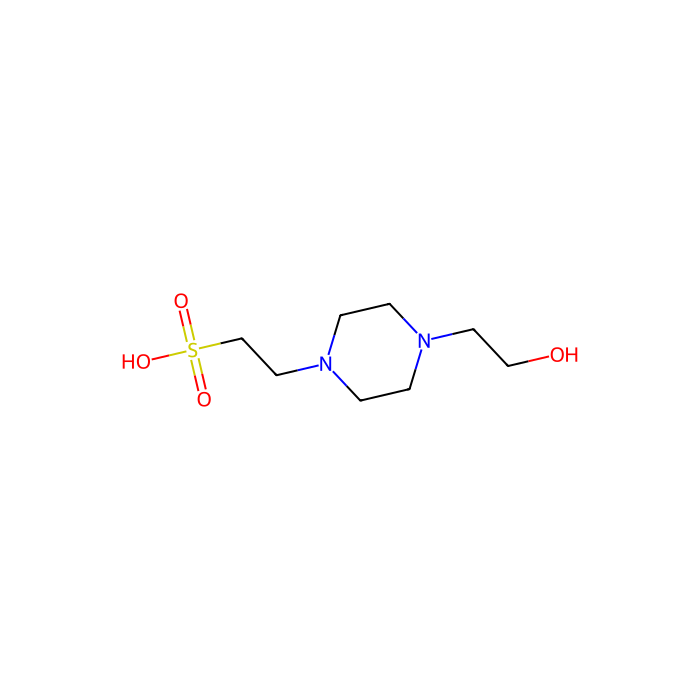
HEPES - Suitable for molecular biology, ≥99.5%(T) , CAS No.7365-45-9

CAS: 7365-45-9 Cat. No.: H109408 Summenformel: C8H18N2O4S Molekulargewicht: 238.30 EG-Nummer: 230-907-9
Zu bestellen verfügbar
QUALITÄT & REINHEIT Suitable for molecular biology ? Molecular-biology grade — free of nucleases and contaminants that degrade DNA/RNA. Use in cloning, PCR, and nucleic-acid work needing clean reagents. ≥99.5%(T)
Synonyms
HEPES, BioXtra, pH 5.0-6.5 (1 M in H2O), >=99.5% (titration) | 1d1p | STK033062 | 2-[4-(2-hydroxyethyl)piperazin-1-yl]ethanesulfonic acid | HEPES, biochemical grade | 4-(2-Hydroxyethyl)piperazine-1-(2-ethanesulfonic acid) | AMY23345 | DTXSID5040382 | Epit
Storage
Room temperature
Shipped In
Normal
★
Größe
Deutschland (EU)
USA*
Preis
Menge
5g
H109408-5g
—
Auf Lager ≥10
10,33€
25g
H109408-25g
—
4 Auf Lager
38,96€
100g
H109408-100g
6 Auf Lager
Auf Lager ≥10
99,70€
500g
H109408-500g
—
1 Auf Lager
344,41€
Enter a quantity for the sizes you want to add.
🧪
Warum diese Qualität

Suitable for molecular biology, ≥99.5%(T) Suitable for molecular biology für empfindliche chromatographische und analytische Workflows, die minimale Basislinieninterferenzen erfordern.

🌡

Lagerung & Versand

Room temperature Versand Normal. Genaue Spezifikationen finden Sie im chargenspezifischen COA.

📋

Qualitätsdokumente

SDS, COA, Datenblatt und Spezifikationsblatt stehen zum Download bereit. Chargenspezifische COA über Chargennummernsuche abrufbar.

📚

Literaturbeleg

In 591 peer-reviewten Publikationen zu Chromatographie, organischer Synthese und Kreuzkupplungsreaktionen zitiert.

Übersicht

HEPES has been described as one of the best all-purpose buffers available for biological research.At biological pH, the molecule is zwitterionic, and is effective as a buffer at pH 6.8 to 8.2. HEPES has been used in a wide variety of applications, including tissue culture. It is commonly used to buffer cell culture media in air. HEPES finds its usage in in vitro experiments on Mg.

Spezifikationen

Synonyme
HEPES, BioXtra, pH 5.0-6.5 (1 M in H2O), >=99.5% (titration) | 1d1p | STK033062 | 2-[4-(2-hydroxyethyl)piperazin-1-yl]ethanesulfonic acid | HEPES, biochemical grade | 4-(2-Hydroxyethyl)piperazine-1-(2-ethanesulfonic acid) | AMY23345 | DTXSID5040382 | Epit
Spezifikationen & Reinheit
Suitable for molecular biology, ≥99.5%(T)
Storage
Room temperature
Verschickt in
Normal
Note
Suitable for molecular biology
Reinheit
≥99.5%(T)
Namen und Kennungen
Pubchem Sid
Pubchem Sid Url
https://pubchem.ncbi.nlm.nih.gov/substance/488182841
Kanonisches Lächeln
C1CN(CCN1CCO)CCS(=O)(=O)O
IUPAC Name
2-[4-(2-hydroxyethyl)piperazin-1-yl]ethanesulfonic acid
InChIKey
JKMHFZQWWAIEOD-UHFFFAOYSA-N
INCHI
1S/C8H18N2O4S/c11-7-5-9-1-3-10(4-2-9)6-8-15(12,13)14/h11H,1-8H2,(H,12,13,14)
Isomere SMILES
C1CN(CCN1CCO)CCS(=O)(=O)O
RTECS
TL6809000
Molekulargewicht
238.30
Reaxy-Rn
883043
Reaxys-RN_link_address
https://www.reaxys.com/reaxys/secured/hopinto.do?context=S&query=IDE.XRN=883043&ln=

Dokumentation

📋 Sicherheitsdatenblatt (SDS)

Umfassendes Dokument zu Gefahren, Handhabung, Lagerung und Einhaltung regulatorischer Vorschriften.

<<<<<<< HEAD SDS herunterladen → ======= SDS herunterladen → >>>>>>> release248-p3

✅ Analysezertifikat (COA)

Chargenspezifische Qualitätsdaten. Geben Sie Ihre Chargennummer ein, um das genaue COA abzurufen.

COA nachschlagen →

📊 Datenblatt

Kurzübersicht über Produktspezifikationen und Anwendungen.

Datenblatt ansehen →

🔬 Spezifikationsblatt

Vollständige Qualitätsmerkmale und Akzeptanzkriterien für diese Qualität.

Spezifikationsblatt ansehen →

Erweiterte Daten

Taxonomic Classification

Taxonomy Tree

KingdomOrganic compounds
SuperclassOrganoheterocyclic compounds
KlasseDiazinanes
SubclassPiperazines
Intermediate Tree Nodes Not available
Direct ParentN-alkylpiperazines
Alternative Parents Sulfonyls  Organosulfonic acids  Alkanesulfonic acids  Trialkylamines  1,2-aminoalcohols  Azacyclic compounds  Primary alcohols  Organopnictogen compounds  Organic zwitterions  Organic oxides  Hydrocarbon derivatives  
Molecular FrameworkAliphatic heteromonocyclic compounds
Substituents N-alkylpiperazine - Organic sulfonic acid or derivatives - Organosulfonic acid or derivatives - Organosulfonic acid - Sulfonyl - Alkanesulfonic acid - 1,2-aminoalcohol - Tertiary amine - Tertiary aliphatic amine - Alkanolamine - Azacycle - Hydrocarbon derivative - Organic oxide - Organopnictogen compound - Organic oxygen compound - Primary alcohol - Organosulfur compound - Organooxygen compound - Organonitrogen compound - Amine - Organic nitrogen compound - Alcohol - Organic zwitterion - Aliphatic heteromonocyclic compound
BeschreibungThis compound belongs to the class of organic compounds known as n-alkylpiperazines. These are organic compounds containing a piperazine ring where the nitrogen ring atom carries an alkyl group.
External Descriptors organosulfonic acid - HEPES
3D-Struktur
Interaktives chemisches Strukturmodell


Wirkungsmechanismen
Zertifikate (CoA, COO, BSE/TSE und Analyse-Diagramm)
C of A & Other Certificates(BSE/TSE, COO):
Analytical Chart:

Find and download the COA for your product by matching the lot number on the packaging.

28 results found

Lot NumberCertificate TypeDatumArtikel
A2304547A2304547Certificate of AnalysisJul 06, 2026 H109408
A2304548A2304548Certificate of AnalysisJul 06, 2026 H109408
A2304549A2304549Certificate of AnalysisJul 06, 2026 H109408
A2304540A2304540Certificate of AnalysisJul 06, 2026 H109408
L2505579L2505579Certificate of AnalysisOct 24, 2025 H109408
H2520140H2520140Certificate of AnalysisAug 28, 2025 H109408
G2516026G2516026Certificate of AnalysisJul 22, 2025 H109408
A2509040A2509040Certificate of AnalysisOct 23, 2024 H109408
J2417344J2417344Certificate of AnalysisOct 23, 2024 H109408
J2417343J2417343Certificate of AnalysisOct 22, 2024 H109408
D2117089D2117089Certificate of AnalysisOct 21, 2024 H109408
D2117088D2117088Certificate of AnalysisJan 15, 2023 H109408
A2304550A2304550Certificate of AnalysisNov 17, 2022 H109408
C2418063C2418063Certificate of AnalysisNov 17, 2022 H109408
E2429003E2429003Certificate of AnalysisNov 17, 2022 H109408
A2304551A2304551Certificate of AnalysisNov 17, 2022 H109408
K2223405K2223405Certificate of AnalysisOct 15, 2022 H109408
K2223487K2223487Certificate of AnalysisOct 15, 2022 H109408
K2223488K2223488Certificate of AnalysisOct 15, 2022 H109408
L2011107L2011107Certificate of AnalysisSep 21, 2022 H109408
L2011105L2011105Certificate of AnalysisSep 21, 2022 H109408
G2213567G2213567Certificate of AnalysisJul 20, 2022 H109408
G2218011G2218011Certificate of AnalysisJul 13, 2022 H109408
G2218012G2218012Certificate of AnalysisJul 13, 2022 H109408
G2218010G2218010Certificate of AnalysisJul 13, 2022 H109408
G2218009G2218009Certificate of AnalysisJul 13, 2022 H109408
G2213181G2213181Certificate of AnalysisJun 23, 2022 H109408
A2410242A2410242Certificate of AnalysisJun 18, 2022 H109408
Chemische und physikalische Eigenschaften
Schmelzpunkt (°C)210 °C
Molekulargewicht238.310 g/mol
XLogP3-4.000
Hydrogen Bond Donor Count2
Hydrogen Bond Acceptor Count6
Rotatable Bond Count5
Exact Mass238.099 Da
Monoisotopic Mass238.099 Da
Topological Polar Surface Area89.500 Ų
Heavy Atom Count15
Formal Charge0
Complexity267.000
Isotope Atom Count0
Defined Atom Stereocenter Count0
Undefined Atom Stereocenter Count0
Defined Bond Stereocenter Count0
Undefined Bond Stereocenter Count0
The total count of all stereochemical bonds0
Covalently-Bonded Unit Count1
FAQs und Artikel
Buffer Reference Center
Culture scheme of neural stem cells
Subcellular Fractionation Protocols
Molecular Biology Grade
Buffer exchange of a sample using a dialysis bag
Professional Guide to Streptavidin-Modified Proteins
Common Types of Buffer Solutions
Common Protectants and Formulations for Protein Storage
Why Did My Ni-Agarose Beads Turn Black or Brown?
Good’s buffers
Differences Between Transformation and Transfection
FAQs on Animal Cell Culture Media
CRISPR Gene-Editing Therapies
How to Choose the Best Protein Purification Technique
FAQ on Cell Culture Serum
What is Ion Exchange Chromatography Used For? 4 Important Applications for Protein Purification
Mag-Fluo-4 AM Magnesium/Calcium Ion Fluorescent Probe: Properties, Experimental Use, and Aladdin Metal Ion Fluorescent Probe Selection Guide
Protease & Phosphatase Inhibitor Cocktails: Research Applications and Principles
Scientific Decision-Making for Chromatography Buffer Selection: Tris-HCl vs Phosphate Systems
How to Purify Proteins by Ion-Exchange Chromatography Under Denaturing Condition
A Review of Ten Commonly Used Techniques for Detection, Quantification, and Interaction Analysis in Nucleic Acid Research
How Organic Acids “Stabilize a System”: Selection Logic via the pH Window, Salt Forms, and Metal-Ion Management (with a navigation guide to Tables A–E)
Phycocyanin: A Review of Sources, Structural Features, Production Processes, Applications, and Claimed Benefits
Angiotensin-Converting Enzyme (ACE): A Review of Molecular Features, Catalytic Functions, and Research and Translational Applications
Piperazine Selection Guide: Using a “Six-Membered Diaza Ring” to Make Salt Forms and Linking Strategies More Controllable (Appendix Tables 1–4 Product Navigator)
Review of Chymotrypsin: Enzymological Properties, Catalytic Mechanism, and Research Applications
Invertebrate Oxygen Carrier Proteins in Immunology and Vaccine Research
Roles of the Carboxypeptidase Family in Protein C-Terminal Processing and Experimental Analysis
Sulfation Landscape Remodeling and Its Biological Effects
The Methodological Value of DSC: Building NHS-Type Activated Intermediates and Deciding When to Use Them
Acetyl-Group Metabolic Enzyme Network and In Vitro Enzymology Analysis
Research Framework for Multi-Enzyme Digestion Strategies and Optimization of Proteomic Coverage
Structural Characteristics, Operational Methods, and Separation Applications of Dextran Gels
Selection Logic, Operating Parameters, and Application Boundaries of Common Cell Culture Coating Solutions
β-1,4-Galactosyltransferase 1: A Precise Glycosyltransferase in Glycan Biosynthesis
Citations of This Product
Lösungsrechner
Bewertungen

Kundenbewertungen

Dürfen wir Sie über Rabattaktionen informieren?

Später erinnern

Vielen Dank! Bitte überprüfen Sie Ihren E-Mail-Posteingang, um zu bestätigen.

Hoppla! Benachrichtigungen sind deaktiviert.