
Why Did My Ni-Agarose Beads Turn Black or Brown?
Why Did My Ni-Agarose Beads Turn Black or Brown?
Ni-agarose beads are typically blue due to coordination complexes between Ni²⁺ and the immobilized chelating ligand. In purification systems containing reducing agents, metal reduction or drastic changes to the coordination environment can shift the bead color from blue to brown or black.
I. Phenomenon and chemical basis
1.Nature of the color change: Brown/black appearance usually indicates partial reduction of Ni²⁺ on the stationary phase to lower valent states (Ni¹⁺) or to metallic nickel (Ni⁰). Their coordination/electronic structures and spectra differ from Ni²⁺, hence the altered visual color.
2.Primary triggers: High concentrations of reducing agents (e.g., DTT, TCEP, β-mercaptoethanol) contacting the resin during loading, washing, or prolonged equilibration can promote Ni²⁺ reduction; high temperature, long residence time, low pH, and high thiol load further amplify this effect.
3.Distinguishing from other color effects: Non-reducing “loss of blue” (e.g., heavy protein binding causing temporary lightening) typically recovers after elution; reduction-driven brown/black usually does not recover after elution and is often accompanied by decreased binding capacity.
II. Common discoloration mechanisms
Color | Typical cause | Diagnostic clues | Quick check | Preferred remediation |
Jet black/gray-black | Nickel sulfide (NiS) formed by sulfide/thiol reagents reacting with Ni²⁺ | Switch to sulfur-free buffer; beads remain black; Ni²⁺ in supernatant drops | Strip with EDTA → alkali wash → reload Ni²⁺ | |
Dark gray–black | Metallic nickel deposition (Ni⁰) under strongly reducing conditions | Stir a small aliquot in air; color barely fades | Same as above; extend alkali wash if needed | |
Brown/tan | Organic foulants/strongly adsorbed protein; Maillard-type browning | Complex lysates; heating/alkaline conditions | Denaturing/high-salt wash → alkali wash → re-charge with Ni²⁺ | |
Dark green–black | pH > 9 or oxidant exposure | Color does not revert after pH normalization | EDTA strip → alkali wash → re-charge with Ni²⁺ | |
Brown-red/tan | Fe/Mn deposition introduced from hardware or water | Batch/line-specific | Prepare with ultrapure water; color improves | Alkali wash + brief citrate wash → re-charge with Ni²⁺ |
III. Aladdin products
For purifying 6×His-tagged proteins from E. coli, yeast, insect, and mammalian expression. Magnetic agarose microspheres are covalently coupled to iminodiacetic acid (IDA; tridentate). After chelating Ni²⁺, the scaffold offers additional sites to coordinate the imidazole rings of His tags, enabling target binding.
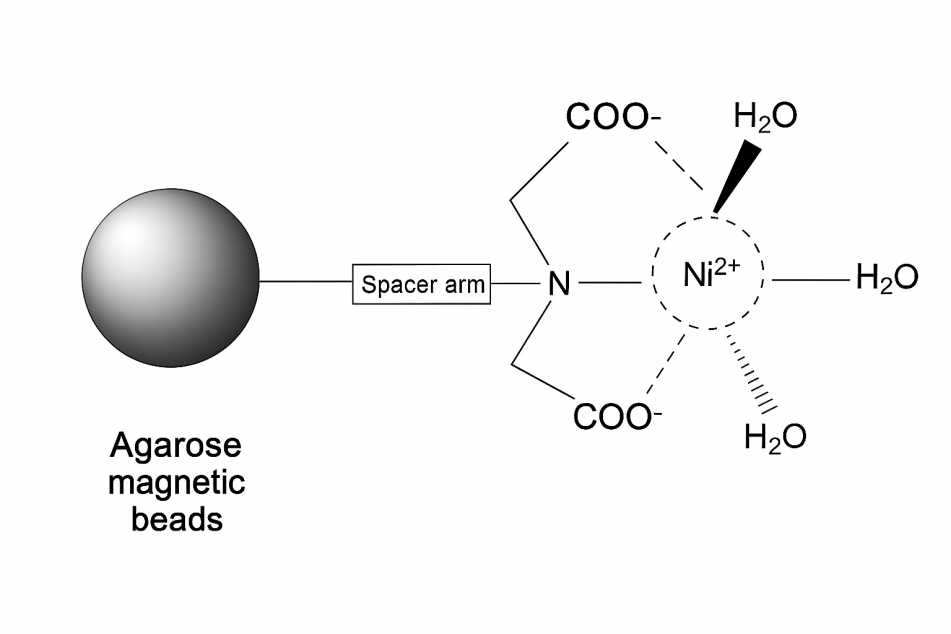
Schematic of chemical structure for UltraBio™ His-Tagged Protein Purification Agarose Magnetic Beads (IDA-Ni)
UltraBio™ TED-Ni Magnetic Agarose Beads(Cat. No.T751558)
Tris(carboxymethyl)ethylenediamine (TED) is covalently coupled to agarose magnetic beads and chelates Ni²⁺ via five binding sites. Specifically captures His-tagged proteins from plant/animal/microbial lysates, serum, ascites, etc., suitable for purification, IP, and Co-IP.
UltraBio™ NTA-Ni Magnetic Agarose Beads for His-Tag Protein Purification(Cat. No.N751557)
A functional material designed for His-tag purification. Compared with conventional IMAC agarose/dextran columns, it requires no repeated high-speed centrifugation/filtration, no flow-rate control, and no expensive LC hardware. Ni-NTA magnetic beads are paramagnetic, enabling easy separation by a magnet; the workflow is simple, often achieving high purity in one step. Elution volume can tune product concentration; beads are readily regenerated and reused. Ideal for soluble His-tag proteins from prokaryotic expression (e.g., E. coli).
IV. Frequently asked questions
Q: I must use DTT—what should I do?
A: Desalt the sample prior to loading to reduce DTT to ≤0.5 mM; avoid reducing agents throughout binding/wash; immediately re-add DTT/TCEP to the collected eluate.
Q: Can I run IMAC in phosphate buffer?
A: Not recommended for binding/wash. If unavoidable, keep ≤10 mM and short contact time; monitor color and backpressure. Tris/HEPES systems are more robust.
Q: Can I clean with hydrogen peroxide/strong oxidants?
A: Not advised—they may damage the ligand and agarose backbone. Prefer NaOH, urea/guanidine, and EDTA combinations.
Aladdin: https://www.aladdinsci.com/