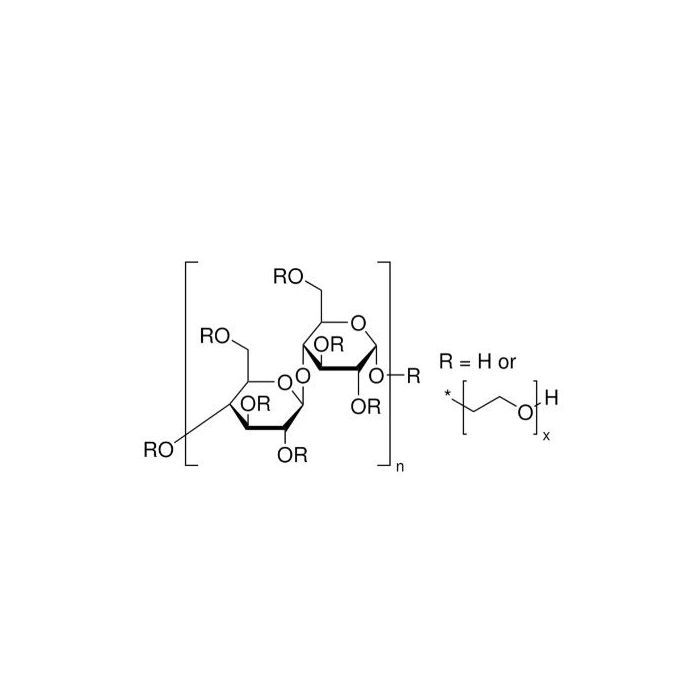
Hydroxyethyl Cellulose(HEC) - 2600~3300mpa.s,25℃ , CAS No.9004-62-0

CAS: 9004-62-0 Cat. No.: H104793 EG-Nummer: 618-387-5
Zu bestellen verfügbar
QUALITÄT & REINHEIT 2600~3300mpa.s,25℃
Synonyms
H11622 | Hydroxyethyl-cellulose | 2-Hydroxyethyl cellulose | DTXSID60873934 | 2-O-(2-Hydroxyethyl)-4-O-methylhexopyranosyl-(1->4)-[4-O-methylhexopyranosyl-(1->6)]hexopyranosyl-(1->5)-2,6-anhydro-1-deoxyheptitol | FT-0627136 | SCHEMBL23306563 | 5-[6-[[3,4-
Storage
Room temperature,Desiccated
Shipped In
Normal
★
Größe
Deutschland (EU)
USA*
Preis
Menge
250g
H104793-250g
3 Auf Lager
3 Auf Lager
20,74€
Enter a quantity for the sizes you want to add.
🧪
Warum diese Qualität

2600~3300mpa.s,25℃ für empfindliche chromatographische und analytische Workflows, die minimale Basislinieninterferenzen erfordern.

🌡

Lagerung & Versand

Room temperature,Desiccated Versand Normal. Genaue Spezifikationen finden Sie im chargenspezifischen COA.

📋

Qualitätsdokumente

SDS, COA, Datenblatt und Spezifikationsblatt stehen zum Download bereit. Chargenspezifische COA über Chargennummernsuche abrufbar.

📚

Literaturbeleg

In 214 peer-reviewten Publikationen zu Chromatographie, organischer Synthese und Kreuzkupplungsreaktionen zitiert.

Spezifikationen

Synonyme
H11622 | Hydroxyethyl-cellulose | 2-Hydroxyethyl cellulose | DTXSID60873934 | 2-O-(2-Hydroxyethyl)-4-O-methylhexopyranosyl-(1->4)-[4-O-methylhexopyranosyl-(1->6)]hexopyranosyl-(1->5)-2,6-anhydro-1-deoxyheptitol | FT-0627136 | SCHEMBL23306563 | 5-[6-[[3,4-
Spezifikationen & Reinheit
2600~3300mpa.s,25℃
Storage
Room temperature,Desiccated
Verschickt in
Normal
Namen und Kennungen
Pubchem Sid
Kanonisches Lächeln
CC1C(C(C(C(O1)CO)OC2C(C(C(C(O2)COC3C(C(C(C(O3)CO)OC)O)O)OC4C(C(C(C(O4)CO)OC)O)OCCO)O)O)O)O
IUPAC Name
5-[6-[[3,4-dihydroxy-6-(hydroxymethyl)-5-methoxyoxan-2-yl]oxymethyl]-3,4-dihydroxy-5-[4-hydroxy-3-(2-hydroxyethoxy)-6-(hydroxymethyl)-5-methoxyoxan-2-yl]oxyoxan-2-yl]oxy-6-(hydroxymethyl)-2-methyloxane-3,4-diol
InChIKey
CWSZBVAUYPTXTG-UHFFFAOYSA-N
INCHI
1S/C29H52O21/c1-10-15(34)16(35)24(13(8-33)45-10)49-28-20(39)18(37)25(50-29-26(43-5-4-30)21(40)23(42-3)12(7-32)47-29)14(48-28)9-44-27-19(38)17(36)22(41-2)11(6-31)46-27/h10-40H,4-9H2,1-3H3
Isomere SMILES
CC1C(C(C(C(O1)CO)OC2C(C(C(C(O2)COC3C(C(C(C(O3)CO)OC)O)O)OC4C(C(C(C(O4)CO)OC)O)OCCO)O)O)O)O
WGK Deutschland
1
RTECS
FJ5958000
Reaxy-Rn
24866087
Reaxys-RN_link_address
https://www.reaxys.com/reaxys/secured/hopinto.do?context=S&query=IDE.XRN=24866087&ln=

Dokumentation

📋 Sicherheitsdatenblatt (SDS)

Umfassendes Dokument zu Gefahren, Handhabung, Lagerung und Einhaltung regulatorischer Vorschriften.

<<<<<<< HEAD SDS herunterladen → ======= SDS herunterladen → >>>>>>> release248-p3

✅ Analysezertifikat (COA)

Chargenspezifische Qualitätsdaten. Geben Sie Ihre Chargennummer ein, um das genaue COA abzurufen.

COA nachschlagen →

📊 Datenblatt

Kurzübersicht über Produktspezifikationen und Anwendungen.

Datenblatt ansehen →

🔬 Spezifikationsblatt

Vollständige Qualitätsmerkmale und Akzeptanzkriterien für diese Qualität.

Spezifikationsblatt ansehen →

Erweiterte Daten

Taxonomic Classification

Taxonomy Tree

KingdomOrganic compounds
SuperclassOrganic oxygen compounds
KlasseOrganooxygen compounds
SubclassCarbohydrates and carbohydrate conjugates
Intermediate Tree Nodes Not available
Direct ParentOligosaccharides
Alternative Parents O-glycosyl compounds  Oxanes  Secondary alcohols  Oxacyclic compounds  Dialkyl ethers  Acetals  Primary alcohols  Hydrocarbon derivatives  
Molecular FrameworkAliphatic heteromonocyclic compounds
Substituents Oligosaccharide - O-glycosyl compound - Glycosyl compound - Oxane - Secondary alcohol - Oxacycle - Organoheterocyclic compound - Ether - Dialkyl ether - Acetal - Hydrocarbon derivative - Primary alcohol - Alcohol - Aliphatic heteromonocyclic compound
BeschreibungThis compound belongs to the class of organic compounds known as oligosaccharides. These are carbohydrates made up of 3 to 10 monosaccharide units linked to each other through glycosidic bonds.
External Descriptors Not available
3D-Struktur
Interaktives chemisches Strukturmodell


Zertifikate (CoA, COO, BSE/TSE und Analyse-Diagramm)
C of A & Other Certificates(BSE/TSE, COO):
Analytical Chart:

Find and download the COA for your product by matching the lot number on the packaging.

13 results found

Lot NumberCertificate TypeDatumArtikel
H2606447H2606447Certificate of AnalysisMay 29, 2026 H104793
H2606448H2606448Certificate of AnalysisMay 29, 2026 H104793
H2606449H2606449Certificate of AnalysisMay 29, 2026 H104793
G2130148G2130148Certificate of AnalysisMay 12, 2025 H104793
E2618161E2618161Certificate of AnalysisSep 05, 2022 H104793
F2506101F2506101Certificate of AnalysisSep 05, 2022 H104793
G2319531G2319531Certificate of AnalysisSep 05, 2022 H104793
H2304149H2304149Certificate of AnalysisSep 05, 2022 H104793
I2216297I2216297Certificate of AnalysisSep 05, 2022 H104793
I2216411I2216411Certificate of AnalysisSep 05, 2022 H104793
I2216425I2216425Certificate of AnalysisSep 05, 2022 H104793
J2527170J2527170Certificate of AnalysisSep 05, 2022 H104793
E2223109E2223109Certificate of AnalysisDec 27, 2021 H104793
Chemische und physikalische Eigenschaften
Schmelzpunkt (°C)288-290°C
Molekulargewicht736.700 g/mol
XLogP3-7.700
Hydrogen Bond Donor Count11
Hydrogen Bond Acceptor Count21
Rotatable Bond Count15
Exact Mass736.3 Da
Monoisotopic Mass736.3 Da
Topological Polar Surface Area315.000 Ų
Heavy Atom Count50
Formal Charge0
Complexity999.000
Isotope Atom Count0
Defined Atom Stereocenter Count0
Undefined Atom Stereocenter Count20
Defined Bond Stereocenter Count0
Undefined Bond Stereocenter Count0
The total count of all stereochemical bonds0
Covalently-Bonded Unit Count1
FAQs und Artikel
Microcrystalline Cellulose (MCC): A Comprehensive Primer and Selection Guide—Structural Features, Key Performance Metrics, and Application Scenarios
Understanding Hydrophilic Polymers in Aqueous Systems: Hydration Mechanisms, Structural Knobs, and Task-Oriented Selection Guide (Including Tables 1–3)
Applications and Selection of Acrylic Resins in Coatings: Analysis of Architectural, Industrial, and Supporting Materials
Natural Resins in Coating Formulations: Functional Positioning, Structure–Property Relationships, and Selection Validation
Waterborne Resin Technology Explained: Waterborne Forms, Performance Balance, and a Technology Map
Waterborne Resin Application Guide: Formulation Synergy, Troubleshooting, and Technology Development Trends
Why LABSA (Sulfonic Acid) Is Commonly Used in Household Cleaning Formulations: Neutralization Mechanism, Detergency Action, and Formulation Application Points
From Structure to Performance: Conditioning, Film-Forming, Thickening, and Chelating Applications of Functional Ingredients in Personal Care and Home Care
From Structure to Rheology: How Carbomer Forms Gel Structures and Enables Thickening, Suspension, and Auxiliary Emulsion Stabilization
What Is the Difference Between Triethanolamine and Diethanolamine: Understanding Their Formulation Functions, Application Differences, and Selection Logic from a Molecular-Structure Perspective
Thickening, Suspension, Auxiliary Stabilization, and Agglomeration Mechanisms of Xanthan Gum in Personal Care Formulations: From Molecular Structure to Processing Applications
AES (Fatty Alcohol Polyoxyethylene Ether Sulfate) in Personal and Home-Care Cleansing Formulations: An Analysis of Structure, Performance, and Low-Temperature Flowability
Understanding CAPB from Its Structure: How Cocamidopropyl Betaine Improves Foam, Enhances Mildness, and Supports Thickening
From Structure to Rheology: Thickening, Stabilization, and Selection Logic of Cellulose Ethers for Personal Care Applications
How to Select Thickeners for Strongly Acidic Cleaning Systems: Comparison of Thickening Mechanisms and Application Considerations for Fatty Amine Ethoxylates
Analysis of the Production Process of Hydroxypropyl Methylcellulose (HPMC) for Putty: Understanding Differences in Substitution Structure and Gelation Temperature from High-Ratio and Low-Ratio Formulations
Why Are Daily Chemical Products Prone to Viscosity Thinning in Summer? Core Mechanisms, Troubleshooting Methods, and Solutions
Types, Mechanisms of Action, Key Quality Indicators, and Selection and Application of Common Cellulose Ethers in Wall Putty
Influencing Factors and Control Strategies for Blistering in Neutral Wall Putty: An Experimental Analysis Based on HPMC Dosage, Viscosity, and Ground Calcium Carbonate Fineness
How to Select Binding/Gel Materials for Neutral Wall Putty? A Comparison of Pregelatinized Starch, PVA, and Redispersible Polymer Powder Based on Four Application Trials
Causes and Mechanism Analysis of Delamination During Sanding of Water-Resistant Putty
What Are the Differences Between Polyvinyl Alcohol 1788, 2488, and 2699? Understanding Workability, Bonding Strength, and Relative Water Resistance from the Perspective of Degree of Polymerization and Degree of Hydrolysis
Common Problems and Formulation Adjustment Strategies for Neutral Putty Under High Summer Temperatures
Differences and Application Selection of Cassava- and Corn-Based Pregelatinized Starch in Neutral Putty Formulations
The Role, Selection, Cracking Risk Analysis, and Dosage Control of Bentonite in Neutral Putty
Dispersants, Anti-Redeposition Agents, and Scale-Control Materials in Household Cleaning Formulations: Mechanisms of Action, Selection Logic, and Representative Products
Experimental Applications of Carboxymethyl Cellulose (CMC) Solution in Enzyme Assays, Suspension Systems, and Functional Materials
Niacinamide Brightening Mechanisms and Formulation Design: Melanosome Transfer, pH Regulation, and Combination Strategies
Citations of This Product
Lösungsrechner
Bewertungen

Kundenbewertungen

Dürfen wir Sie über Rabattaktionen informieren?

Später erinnern

Vielen Dank! Bitte überprüfen Sie Ihren E-Mail-Posteingang, um zu bestätigen.

Hoppla! Benachrichtigungen sind deaktiviert.