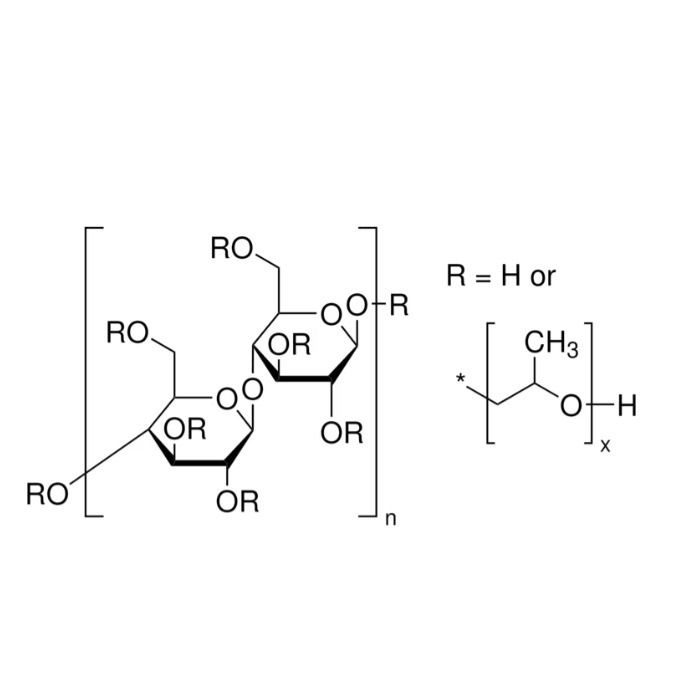
Hydroxypropyl cellulose(HPC) - average Mw ~80,000,average Mn ~10,000,powder,20 mesh particle size (99% through) , CAS No.9004-64-2

CAS: 9004-64-2 Cat. No.: H434477 EG-Nummer: 618-388-0
Zu bestellen verfügbar
QUALITÄT & REINHEIT average Mw ~80,000,average Mn ~10,000,powder,20 mesh particle size (99% through)
Synonyms
HPC
Storage
Room temperature
Shipped In
Normal
★
Größe
Deutschland (EU)
USA*
Preis
Menge
5g
H434477-5g
—
5 Auf Lager
8,59€
100g
H434477-100g
—
1 Auf Lager
41,56€
25g
H434477-25g
Auf Bestellung · 8–12 Wochen
14,66€
250g
H434477-250g
—
1 Auf Lager
86,69€
Enter a quantity for the sizes you want to add.

Übersicht

Hydroxypropyl cellulose (HPC) is biocompatible in nature and exhibits low critical solution temperature (LCST). It has been reported to be prepared by reacting cellulose with alkali, producing alkali cellulose which is consecutively reacted with propylene oxide. HPC is soluble in water at lower than RT. Viscosity behaves inversely to rise in temperature.


Application

Copolymers composed of HPC backbones with poly((2-dimethyl amino)ethyl methacrylate side chains has been synthesized for gene delivery. HPC has been used as a binder in to nanostructured anatase membranes. Polymer conjugates made of HPC backbones and poly(N-isopropylacryamide) as side chains act as smart hydrogels. HPC has been reported to be studied as a glue.

Spezifikationen

Synonyme
HPC
Spezifikationen & Reinheit
average Mw ~80,000,average Mn ~10,000,powder,20 mesh particle size (99% through)
Storage
Room temperature
Verschickt in
Normal
Namen und Kennungen
Pubchem Sid
Pubchem Sid Url
https://pubchem.ncbi.nlm.nih.gov/substance/504770888
WGK Deutschland
1

Erweiterte Daten

Zertifikate (CoA, COO, BSE/TSE und Analyse-Diagramm)
C of A & Other Certificates(BSE/TSE, COO):
Analytical Chart:

Find and download the COA for your product by matching the lot number on the packaging.

22 results found

Lot NumberCertificate TypeDatumArtikel
I2621553I2621553Certificate of AnalysisSep 09, 2026 H434477
I2621552I2621552Certificate of AnalysisSep 09, 2026 H434477
I2621551I2621551Certificate of AnalysisSep 09, 2026 H434477
I2621550I2621550Certificate of AnalysisSep 09, 2026 H434477
I2621549I2621549Certificate of AnalysisSep 09, 2026 H434477
C2625562C2625562Certificate of AnalysisMar 18, 2026 H434477
C2625564C2625564Certificate of AnalysisMar 18, 2026 H434477
C2625563C2625563Certificate of AnalysisMar 18, 2026 H434477
C2625553C2625553Certificate of AnalysisMar 18, 2026 H434477
L2419655L2419655Certificate of AnalysisDec 09, 2024 H434477
L2419711L2419711Certificate of AnalysisDec 09, 2024 H434477
L2419715L2419715Certificate of AnalysisDec 09, 2024 H434477
L2419716L2419716Certificate of AnalysisDec 09, 2024 H434477
L2419717L2419717Certificate of AnalysisDec 09, 2024 H434477
E23291140E23291140Certificate of AnalysisMay 22, 2023 H434477
E23291141E23291141Certificate of AnalysisMay 22, 2023 H434477
E23291142E23291142Certificate of AnalysisMay 22, 2023 H434477
E2329813E2329813Certificate of AnalysisMay 22, 2023 H434477
E2329816E2329816Certificate of AnalysisMay 22, 2023 H434477
E23291139E23291139Certificate of AnalysisMay 22, 2023 H434477
D2409042D2409042Certificate of AnalysisMay 22, 2023 H434477
J2424037J2424037Certificate of AnalysisMay 22, 2023 H434477
Chemische und physikalische Eigenschaften
LöslichkeitH2O: insoluble (above 45 °C); polar organic solvents: soluble
FAQs und Artikel
Microcrystalline Cellulose (MCC): A Comprehensive Primer and Selection Guide—Structural Features, Key Performance Metrics, and Application Scenarios
Materials Can “Switch”: How Smart Polymers Respond to Temperature, pH, and Light (with Experimental Selection Tips & Product Navigation)
Understanding Hydrophilic Polymers in Aqueous Systems: Hydration Mechanisms, Structural Knobs, and Task-Oriented Selection Guide (Including Tables 1–3)
From Structure to Rheology: How Carbomer Forms Gel Structures and Enables Thickening, Suspension, and Auxiliary Emulsion Stabilization
From Structure to Rheology: Thickening, Stabilization, and Selection Logic of Cellulose Ethers for Personal Care Applications
Analysis of the Production Process of Hydroxypropyl Methylcellulose (HPMC) for Putty: Understanding Differences in Substitution Structure and Gelation Temperature from High-Ratio and Low-Ratio Formulations
Types, Mechanisms of Action, Key Quality Indicators, and Selection and Application of Common Cellulose Ethers in Wall Putty
Influencing Factors and Control Strategies for Blistering in Neutral Wall Putty: An Experimental Analysis Based on HPMC Dosage, Viscosity, and Ground Calcium Carbonate Fineness
Differences and Application Selection of Cassava- and Corn-Based Pregelatinized Starch in Neutral Putty Formulations
What Is Direct Compression? Process Characteristics, Suitability Criteria, and Excipient Selection
Citations of This Product
Lösungsrechner
Bewertungen

Kundenbewertungen

Dürfen wir Sie über Rabattaktionen informieren?

Später erinnern

Vielen Dank! Bitte überprüfen Sie Ihren E-Mail-Posteingang, um zu bestätigen.

Hoppla! Benachrichtigungen sind deaktiviert.