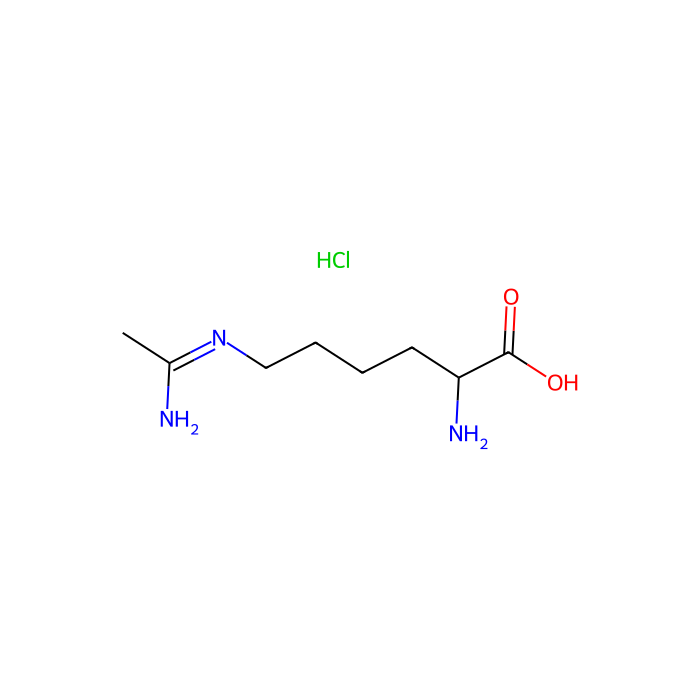
L-N6-(1-Iminoethyl)lysine dihydrochloride has been used as an inducible nitric oxide synthase (iNOS) inhibitor:
to study its effects on leptin-induced modulation of fibronectin type III domain-containing five (FNDC5)/irisin in myocytes and fat cells of murine
to study its effects on leptin-induced inflammation in hepatocytes
to block the production of nitric oxide in mice bone marrow mesenchymal stromal cells (BMSCs)
Spezifikationen
Spezifikationen & Reinheit
≥98%
Biochemische und physiologische Mechanismen
A selective inhibitor of inducible nitric oxide synthase (IC50= 3.3μM).
Storage
Store at -20°C,Argon charged,Desiccated
Verschickt in
Ice chest + Ice pads
Dieses Produkt erfordert Kühlkettenversand. Grundversand und andere Economy-Optionen sind nicht verfügbar.
This compound belongs to the class of organic compounds known as l-alpha-amino acids. These are alpha amino acids which have the L-configuration of the alpha-carbon atom.
External Descriptors
Not available
1. Djoumbou Feunang Y, Eisner R, Knox C, Chepelev L, Hastings J, Owen G, Fahy E, Steinbeck C, Subramanian S, Bolton E, Greiner R, and Wishart DS. ClassyFire: Automated Chemical Classification With A Comprehensive, Computable Taxonomy. Journal of Cheminformatics, 2016, 8:61.
Zertifikate (CoA, COO, BSE/TSE und Analyse-Diagramm)
C of A & Other Certificates(BSE/TSE, COO):
Analytical Chart:
Chemische und physikalische Eigenschaften
Löslichkeit
Solvent:water, Max Conc. mg/mL: 22.37, Max Conc. mM: 100
Empfindlichkeit
Moisture sensitive.
Molekulargewicht
223.700 g/mol
XLogP3
Hydrogen Bond Donor Count
4
Hydrogen Bond Acceptor Count
4
Rotatable Bond Count
6
Exact Mass
223.109 Da
Monoisotopic Mass
223.109 Da
Topological Polar Surface Area
102.000 Ų
Heavy Atom Count
14
Formal Charge
0
Complexity
192.000
Isotope Atom Count
0
Defined Atom Stereocenter Count
1
Undefined Atom Stereocenter Count
0
Defined Bond Stereocenter Count
0
Undefined Bond Stereocenter Count
0
The total count of all stereochemical bonds
0
Covalently-Bonded Unit Count
2
Lösungsrechner
Molarity Calculator
Determine the necessary mass, volume, or concentration for preparing a solution.
Dilution Calculator
Determine the dilution needed to prepare a stock solution.
Reconstitution Calculator
Bewertungen
Kundenbewertungen
Application Protocols
No tested applications or validated protocols are provided for this specific item. Refer to the primary literature and internal SOPs to design experiments.
General guidance (non-specific):
Prepare fresh stocks in sterile water or DMSO; filter-sterilize for cell-based assays.
Perform concentration-response curves with vehicle controls.
Confirm on-target activity with substrate (L-arginine) competition or genetic controls where feasible.
All procedures should be qualified within your laboratory; no warranty is made regarding performance in any specific assay.
Biological Roles
General/literature context (research use only; not item-specific claims):
Functional class: L-NIL (L-N6-(1-iminoethyl)lysine) is a small-molecule, L-arginine-mimetic inhibitor used to interrogate nitric oxide synthase (NOS) biology. It is most widely employed for its selectivity toward inducible NOS (iNOS), with reduced activity on endothelial (eNOS) and neuronal (nNOS) isoforms in many assay systems.
Mechanistic features: Competes at or near the L-arginine-binding site of NOS, interacting with the heme-containing active site and cofactor-dependent catalytic apparatus (BH4, FAD, FMN). Inhibition can display time dependence and may be influenced by substrate (L-arginine) concentration and cellular uptake/transporters.
Experimental readouts: Modulation of nitric oxide (NO) production is typically monitored via nitrite/nitrate accumulation (Griess assay), NO-sensitive fluorophores (e.g., DAF-FM), or electrochemical NO probes. Downstream endpoints include S-nitrosation markers, peroxynitrite-derived modifications, and gene expression of inflammatory mediators.
Systems studied: Frequently applied in macrophage/monocyte models, cytokine- or LPS-stimulated cells, and enzyme preparations for isoform-selectivity profiling. Concentration ranges vary widely depending on matrix, time, and assay sensitivity.
Selectivity caveats: Apparent selectivity can shift with species, expression levels, and assay conditions. Off-target interactions at high concentrations or prolonged exposures are possible; include appropriate controls and orthogonal assays to confirm on-target effects.
All uses are for laboratory research only; no clinical or diagnostic applications are implied.
Buffer Applications
This compound is not a buffering agent and is not typically used to establish or maintain pH in biochemical systems. Instead, it is dosed into existing buffers for enzymology or cell-based assays.
Practical notes:
Prepare working solutions in your assay buffer of choice (e.g., PBS, HEPES, or cell culture media), ensuring compatibility with the detection method.
Check that buffer components (e.g., high phosphate) do not interfere with downstream analytical techniques (LC–MS), if applicable.
Green Alternatives
Context: As a bioactive small molecule used at low concentrations in aqueous media, the principal environmental considerations are solvent choice, waste minimization, and avoiding halogenated organics.
Greener practice recommendations (general guidance):
Prefer aqueous buffers over organic vehicles. Where a co-solvent is needed, DMSO or ethanol (anhydrous, absolute) are typically less hazardous than chlorinated solvents.
Minimize DMSO content in working solutions (commonly ≤0.1–0.5% v/v) to reduce solvent disposal volumes and potential cytotoxicity.
Use volatile, LC–MS-friendly buffer systems (ammonium formate/acetate) to facilitate solvent recycling and reduce salt load versus non-volatile phosphates when appropriate.
Implement microplate-based assays to reduce per-experiment mass of compound and solvent use.
Small comparison (literature-based, general):
Aqueous buffer vs DMSO-heavy vehicles: Aqueous buffers improve worker safety and downstream waste handling but may limit maximum solubility; DMSO enables higher stock concentrations but increases solvent concerns.
Ethanol vs acetonitrile: Ethanol is generally considered a greener solvent, though acetonitrile can be advantageous analytically; choose based on compatibility and disposal infrastructure.
Note: No greener “substitute compound” exists for L-NIL itself if the scientific objective is selective iNOS inhibition; instead, optimize formulation and scale to align with green chemistry principles.
Pharmaceutical Uses
No pharmaceutical or clinical use is claimed or supported for this catalog item. It is supplied strictly for research use only.
General/formulation context (literature and best practice for research reagents):
Role in research formulations: Often prepared as sterile-filtered aqueous or DMSO stock solutions for in vitro assays. The hydrochloride salt enhances aqueous solubility and dosing accuracy.
Excipient status: Not listed here with any pharmacopeial grade or excipient designation. Any use in GMP or clinical settings would require independent qualification and is outside the scope of this product.
Handling for in vitro dosing: Validate vehicle effects, osmolarity, and pH upon addition to media; maintain consistent vehicle percentages across treatments.
For any regulated or translational applications, obtain appropriate grade, documentation, and approvals; this product is provided for laboratory research only.
Physical Properties
Item-specific physical data:
Appearance: Not specified for this item; refer to CoA/Spec Sheet.
Grade/Purity: Not specified for this item; refer to CoA/Spec Sheet.
Molecular Weight: Not specified for this item; refer to CoA/Spec Sheet.
Literature/typical properties for context (not specifications for this lot):
Physical state: typically a white to off-white crystalline or amorphous solid (literature for amino-acid hydrochloride salts).
Ionization: strongly basic cationic functionalities; exists predominantly as multi-protonated species at neutral pH; pKa values not firmly established for this specific derivative in the public domain.
Solubility: usually freely soluble in water and aqueous buffers; also soluble in polar aprotic solvents such as DMSO for concentrated stock solutions (literature practice for cationic amino-acid salts). Quantitative solubility not provided here.
Hygroscopicity: hydrochloride salts of amino-acid analogues can be hygroscopic; handle under dry conditions.
Do not treat the above literature notes as specifications. For exact numerical values (mp, solubility limit, water content, residual solvents, UV cutoff, metals, etc.), refer to the product’s CoA/Spec Sheet.
Quality and Grades
Item-specific information:
Grade/Purity: Not specified for this item; refer to CoA/Spec Sheet.
Stabilizers/Antioxidants: Not specified for this item; refer to CoA/Spec Sheet.
Interpretation and best practices (general guidance for small-molecule bioactives):
Research-grade small molecules are typically qualified by identity (1H NMR/LC–MS/HRMS), assay purity (e.g., HPLC), and residual solvent/water content. When UV transparency matters (e.g., spectroscopic assays), low-UV-absorbing impurities are preferred; verify by HPLC-UV trace if available.
If a specific grade is stated on your CoA (e.g., ≥98% HPLC), it implies tight control of organic impurities that can confound enzyme assays or cell culture experiments. Trace inorganic salts and water content may influence mass-based dosing; adjust calculations to salt form and hydration state.
Stabilizer implications: Many amino-acid salts require no stabilizer; if any stabilizer is listed on the CoA, assess its compatibility with your biological assay and include vehicle-only controls.
Documentation: Use the exact salt form and lot-specific purity to compute molarity. Confirm counterion stoichiometry (e.g., monohydrochloride) before preparing stock solutions.
For definitive specifications (purity assay, residual solvents, water, metals, bacterial endotoxin, bioburden), consult the lot-specific CoA/Spec Sheet.
Reaction and Applications
This product is primarily a biochemical tool rather than a synthetic reagent. As such, its most relevant applications are in enzymology and cell biology rather than in chemical transformations.
Biochemical/assay applications (literature context; research use only):
Selective inhibitor for inducible nitric oxide synthase (iNOS), used to probe NO signaling and macrophage activation pathways. It is structurally related to L-arginine and competes at/near the active site.
Employed in enzyme kinetics to assess isoform selectivity (iNOS vs eNOS/nNOS), mechanism-based inhibition, and cofactor dependency (BH4, FAD/FMN, heme).
Utilized in cell-based studies to modulate nitric oxide production, quantify nitrite/nitrate output, and examine downstream nitrosative stress markers.
Practical tips:
Prepare fresh aqueous or DMSO stocks; filter-sterilize (0.22 µm) for cell culture.
Control experiments: include vehicle and L-arginine competition controls to confirm on-target effects; consider time-dependent inhibition.
Analytical confirmation: verify intracellular/extracellular NO with orthogonal readouts (e.g., Griess assay, DAF-FM fluorescence) to avoid assay artifacts.
Synthetic chemistry note:
L-NIL·HCl is not typically used as a reagent in named organic reactions; it may decompose or racemize under harsh conditions. If chemical modification is intended, protect amino groups and perform coupling under mild, aqueous-compatible conditions.
All uses are for research only; no clinical or diagnostic applications are implied.
Reaction Conditions
This product is not commonly used as a reagent in chemical transformations; therefore, there are no standard “reaction conditions” in the synthetic sense for this item.
Assay preparation conditions (general literature practice):
Stock solutions: Prepare in sterile water or DMSO; vortex to dissolve completely. Filter-sterilize (0.22 µm) for cell culture use. Keep vehicle content low upon dilution into assay media.
Working concentrations: Determined empirically based on assay type and sensitivity. Include titrations and proper controls (vehicle, substrate competition with L-arginine) to establish dynamic range.
Temperature and pH: Conduct biological assays at physiologically relevant temperatures (e.g., 37°C for mammalian cells) and buffered pH (7.2–7.6), unless specific mechanistic studies dictate otherwise.
Note: Quantitative kinetic constants, IC50/ Ki values, and specific protocols vary by system and are not provided as item-specific specifications here. Consult primary literature and validate in your experimental matrix.
Safety and Handling
Item-specific hazard data:
GHS Classification: Not specified for this item; refer to SDS.
Signal Word: Not specified for this item; refer to SDS.
Hazard (H) Statements: Not specified for this item; refer to SDS.
Pictograms: Not specified for this item; refer to SDS.
General safety guidance (literature/practice; not a substitute for SDS):
Likely hazards: As a small, polar organic salt, L-NIL·HCl generally presents low volatility. Avoid ingestion, inhalation of dust, and contact with eyes/skin. Effects specific to this compound should be confirmed in the SDS.
Personal protective equipment: laboratory coat, safety glasses, and appropriate chemically resistant gloves (e.g., nitrile). Use a dust mask/respirator if handling powders prone to aerosolization, per institutional policy.
Engineering controls: handle powders in a fume hood or ventilated balance enclosure to minimize airborne particulates; use desiccated conditions to reduce moisture uptake.
Incompatibilities: strong oxidizers and strong acids/bases may cause degradation; avoid contact with reactive acylating/alkylating agents.
First-aid overview: upon skin/eye contact, rinse with water for at least 15 minutes; if inhaled, move to fresh air; if swallowed, rinse mouth. Seek medical attention as per SDS.
Housekeeping: prevent cross-contamination in biological assays by using dedicated tools and aliquots; clean surfaces to remove residual cationic residues.
Always consult the official Safety Data Sheet (SDS) provided with the product for authoritative hazard, handling, and disposal information.
Solvent Selection
Overview: L-NIL·HCl is a highly polar, cationic salt. Solvent choice is driven by intended application (biochemical assays vs. chemical synthesis) and compatibility with biological systems.
General/typical behavior (literature; not item-specific specs):
Aqueous systems: Readily dissolves in water and common physiological buffers (PBS, HBSS) across a broad pH range where amines remain protonated. For cell-based assays, aqueous buffers are preferred to minimize vehicle effects.
DMSO: Often used to prepare concentrated stocks (e.g., 10–100 mM), then diluted into aqueous media. Verify final DMSO content (commonly ≤0.1–0.5% v/v) to avoid cytotoxicity.
Alcohols: Lower alcohols (MeOH, EtOH) can dissolve the free base more effectively than the salt; if necessary, adjust pH to maintain solubility after dilution into water.
pH considerations: As a polycation, solubility typically increases under acidic to neutral conditions. Avoid strong base that may deprotonate/alter the imino functionality.
Selection tips:
For enzyme assays: use buffer-only vehicles or minimal DMSO; validate that chloride and ionic strength do not interfere with readouts.
For in vitro cell culture: pre-make sterile-filtered aqueous stocks; confirm osmolarity upon dosing.
For analytical work: water or water/acetonitrile with volatile salts (e.g., formate/acetate) are LC–MS friendly. Avoid non-volatile buffers (phosphate) for LC–MS.
Note: Quantitative solubility and partition coefficients are not specified for this item; refer to CoA/Spec Sheet or determine empirically.
Storage and Reconstitution
Item-specific storage and shipping:
Storage Conditions: Store at -20°C, Argon charged, Desiccated (per Product Data).
Reconstitution (not item-specific; general guidance):
Solvents: Typically reconstituted in sterile water or DMSO to prepare concentrated stock solutions. The hydrochloride salt form supports aqueous dissolution; confirm complete dissolution visually.
Filtration: For cell culture, pass through a 0.22 µm sterile filter after dissolution.
Aliquoting: Prepare single-use aliquots to minimize freeze–thaw cycles and moisture exposure. Label with concentration, solvent, and date.
Storage of solutions: Aqueous stocks are best kept at 2–8°C for short term (hours–days) and frozen (−20°C or below) for longer term; DMSO stocks are typically stable at −20°C. Protect from moisture and repeated freeze–thaw.
Notes:
Exact solubility limits, solution stability, and pH ranges are not specified for this item; refer to CoA/Spec Sheet and validate empirically in your system.
Maintain inert atmosphere (argon) and desiccation for the solid, as provided, to limit hygroscopic uptake and potential degradation.
Structure and Identity
Brief overview: L-NIL hydrochloride is a small-molecule, cationic amino-acid derivative (a lysine analogue) commonly used as a selective iNOS inhibitor in biochemical research.
Item-specific (from Product Data):
CAS: 150403-89-7
InChIKey: 123546 (as provided)
SMILES: Not specified for this item; refer to CoA/Spec Sheet.
Molecular Formula: Not specified for this item; refer to CoA/Spec Sheet.
Molecular Weight: Not specified for this item; refer to CoA/Spec Sheet.
Literature/general identity (for context; not item-specific specifications):
Common name: L-N6-(1-iminoethyl)lysine, monohydrochloride (L-NIL·HCl)
Core structural features: L-lysine backbone in the L-configuration; side-chain ε-amino is converted to a guanidino/imidino-ethyl functionality that mimics the L-arginine substrate motif; protonated α-amino and side-chain nitrogens; paired with chloride as the counterion.
2D description in words: An α-amino acid (L-lysine scaffold) bearing a carboxylate and a protonated α-amine; the ε-position is substituted by a 1-iminoethyl group (–NH–C(=NH)–CH3). The hydrochloride salt renders the molecule cationic at physiological pH.
Notes:
Stereochemistry: L-configuration at the α-carbon (literature).
Because this listing lacks full structural identifiers (SMILES, exact InChIKey), consult the CoA/SDS for authoritative identifiers before structure-based calculations or registrations.
Synthetic Utility
L-NIL·HCl is a final bioactive small molecule rather than a general synthetic building block. As such, its direct use in organic synthesis is limited.
General considerations (literature/synthetic chemistry context):
Functional groups: α-amino acid (zwitterion in free base; polycation as hydrochloride), carboxylate, and an ε-side-chain imino/guanidino-like moiety. Multiple basic nitrogens complicate chemoselectivity.
Protection strategies: If derivatization is desired, orthogonal protection (e.g., Boc/Fmoc on α-amine, Cbz/Boc on side-chain amines, and esterification of the carboxyl group) may be required to target the imino functionality selectively.
Coupling chemistry: Water-compatible carbodiimide couplings (EDC/HOBt, HATU) or enzymatic ligations can be employed for conjugation to reporter tags or solid supports, provided that amines are protected to avoid polymerization.
Stability: Avoid strongly basic or high-temperature conditions that may induce racemization, hydrolysis, or decomposition of the imino moiety.
For general organic synthesis workflows, consider simpler protected lysine or arginine derivatives as building blocks; L-NIL·HCl is typically reserved for biological experimentation.
Target Specificity
Item-specific target/assay validations are not provided for this catalog entry.
Isoform considerations: Frequently reported to show greater potency toward iNOS relative to eNOS (NOS3) and nNOS (NOS1) in many assay systems, though selectivity is assay- and context-dependent.
For definitive target validation, potency, and selectivity data for this specific lot/formulation, consult your own assays and the primary literature; no tested applications are claimed for this item.
Häufig gestellte Fragen
What is the purity of this product?
This product is supplied at ≥98% purity (chemical assay). Lot-specific values are stated on the Certificate of Analysis.
How should this product be stored?
Store at ?20 °C, desiccated, under argon. It is supplied under an argon blanket; reseal under inert gas after each use.
How is this product shipped?
This product ships in an insulated container with ice pads. Unpack on arrival and transfer it to the storage condition stated above.
What are the CAS number, molecular formula and molecular weight?
The CAS Number is 150403-89-7, the molecular formula is C8H18ClN3O2, and the molecular weight is 223.7 g/mol. InChIKey HJYWSATZDBEAOS-FJXQXJEOSA-N.
What documentation is provided?
Available product documentation, including Certificates of Analysis (COA), Safety Data Sheets (SDS), and specification sheets, is shown in the product document area. Document availability and access follow the current site policy.
Wir verwenden Cookies, um die ordnungsgemäße Funktion der Website sicherzustellen und, soweit zulässig, Ihr Nutzererlebnis zu verbessern. Sie können Ihre Einstellungen jederzeit unter „Einstellungen“ verwalten. Weitere Informationen finden Sie in unserer Cookie-Richtlinie.
Dürfen wir Sie über Rabattaktionen informieren?
Später erinnern
Vielen Dank! Bitte überprüfen Sie Ihren E-Mail-Posteingang, um zu bestätigen.
Products are supplied to verified businesses, institutions, and qualified professionals for research and development use only. Not for use in humans, animals, diagnosis, or therapy.