GRADE & PURITYMoligand™?Moligand™ — Aladdin's line of ligands and bioactive small molecules. Use for receptor, pathway, and binding studies needing defined small-molecule tools.UltraBio™?UltraBio™ — Aladdin's line for molecular-biology applications. Use for nuclease-free, high-consistency reagents across molecular workflows.≥99%
UltraBio™, Moligand™, ≥99% Moligand™,UltraBio™ for sensitive chromatographic and analytical workflows requiring minimal baseline interference.
🌡
Storage & shipping
Room temperature Ships Normal Check lot-specific COA for exact specifications.
📋
Quality documents
SDS, COA, datasheet, and spec sheet available for download. Lot-specific COA accessible via lot number lookup.
📚
Literature proof
Cited in 605 peer-reviewed publications across chromatography, organic synthesis, and cross-coupling reactions.
Übersicht
L-Tyrosine was used in tyrosine hydroxylase (TH) enzyme activity assay. It was also used as a substrate for tyrosinase enzyme in the growth media of Vibrio cholerae strains to stimulate melanin formation. It may be used as a precursor in the synthesis of (-)-MY 336a. MY 336a, a β-adrenergic receptor antagonist, was initially isolated from the culture broth of Streptomyces gabonae KY2234 (ATCC 15282). It may be used in the synthesis of 3-bromo-L-tyrosine and 3,5-dibromo-L-tyrosine.
This compound belongs to the class of organic compounds known as tyrosine and derivatives. These are compounds containing tyrosine or a derivative thereof resulting from reaction of tyrosine at the amino group or the carboxy group, or from the replacement of any hydrogen of glycine by a heteroatom.
External Descriptors
Common amino acids
1. Djoumbou Feunang Y, Eisner R, Knox C, Chepelev L, Hastings J, Owen G, Fahy E, Steinbeck C, Subramanian S, Bolton E, Greiner R, and Wishart DS. ClassyFire: Automated Chemical Classification With A Comprehensive, Computable Taxonomy. Journal of Cheminformatics, 2016, 8:61.
Determine the necessary mass, volume, or concentration for preparing a solution.
Dilution Calculator
Determine the dilution needed to prepare a stock solution.
Reconstitution Calculator
Bewertungen
Kundenbewertungen
Application Protocols
No validated bioassay or immunoassay protocols are specified for this item. For general laboratory use:
Preparation of aqueous stock (literature guidance): Dissolve at 100–500 mM by adjusting water to pH 9–10 with NaOH while stirring/sonicating; filter-sterilize (0.22 µm) if for cell culture workflows; store cold and use promptly.
For peptide synthesis: Convert to protected derivatives (e.g., Fmoc-Tyr(tBu)-OH) and follow standard SPPS protocols.
Refer to your internal SOPs and the CoA/SDS for project-specific procedures.
Biological Roles
General biochemistry (literature)
Proteinogenic amino acid: Incorporated by the ribosome in response to the UAC/UAU codons. Side-chain phenol participates in hydrogen bonding and π–π interactions, influencing protein stability and active-site chemistry.
Post-translational modification: Phenolic oxygen is a primary site for phosphorylation by tyrosine kinases; phosphotyrosine is central to eukaryotic signal transduction.
Biosynthetic precursor: Tyrosine is formed from phenylalanine (phenylalanine hydroxylase) and serves as a precursor to catecholamines (L-DOPA → dopamine → norepinephrine → epinephrine), tyramine, melanin (via tyrosinase pathway), and thyroid hormones (T3/T4 from tyrosyl residues in thyroglobulin).
Redox chemistry: Phenoxyl radicals of tyrosine can participate in proton-coupled electron transfer in enzymes (e.g., ribonucleotide reductase, photosystem II).
Experimental notes
In cell culture/media, tyrosine solubility limits can be rate-limiting; dipeptide forms (e.g., glycyl-L-tyrosine) or pH-adjusted feeds are often used to increase solubility (literature practice).
Tyrosine fluorescence (λex ~275 nm, λem ~303 nm) can be exploited for protein studies; quenched by neighboring residues/solvent effects (literature).
Buffer Applications
Applicability note
L-Tyrosine is not a conventional buffering agent. Its acid/base groups provide limited buffering only near its pKa values and at low ionic strengths.
Practical guidance (literature)
If used in biochemical assays, do not rely on tyrosine for pH control. Employ standard buffers (e.g., phosphate pH 6–8, Tris pH 7–9, HEPES pH 6.8–8.2) and add tyrosine as a substrate/additive.
For concentrated aqueous tyrosine solutions, adjust pH with NaOH (to ~9–10) to increase solubility, then dilute into the target buffer and re-adjust pH as needed.
Green Alternatives
Context
L-Tyrosine is a commodity biogenic molecule. “Green” considerations primarily concern the solvents/reagents used with it rather than the molecule itself.
Greener choices around L-tyrosine use (literature/guidance)
Peptide synthesis solvents: Consider dimethyl carbonate, 2-MeTHF, or green-optimized peptide solvents (e.g., NBP/PC, ethyl acetate/MeCN mixtures) as partial replacements for DMF/NMP, where compatible.
Coupling reagents: Explore carbodiimide + catalytic OxymaPure in greener solvents, or enzymatic ligation strategies (e.g., sortase, tyrosinase-mediated coupling) in water.
Protection strategies: Minimize protecting group manipulations by using chemoselective methods (e.g., on-resin phenol modification) to reduce steps and waste.
Illustrative comparison (literature)
Conventional: DMF or NMP + HATU/HBTU (good performance; DMF/NMP are reproductive toxicants; uronium reagents form hazardous waste).
Greener pathway: Aqueous/EtOH or 2-MeTHF + EDC·HCl/Oxyma or enzyme-catalyzed couplings (reduced hazard; may require optimization for rates/solubility).
Process tips
If high pH is used to solubilize tyrosine in water, perform minimal excess base and promptly readjust pH post-dilution to reduce salt load and corrosion.
Pharmaceutical Uses
Scope
For research and laboratory use only. No medical or clinical claims are made for this product.
Excipient/nutrient: Tyrosine is a component of some bioprocess media and can be present in infusion feed solutions or nutrient blends prepared in manufacturing settings. Its low aqueous solubility at neutral pH often necessitates pH adjustment or use of more soluble derivatives.
Process considerations: Control of residual solvents, bioburden, and trace metals is important when using amino acids in biologics manufacturing. Particle size may affect dissolution and mixing times.
Regulatory references: Where pharmacopeial grades exist (e.g., USP/EP for L-tyrosine), specifications include identity, optical rotation, specific impurities, and heavy metals; this product’s specific compliance is Not specified for this item; refer to CoA/Spec Sheet.
Physical Properties
Item-specific specifications
Not specified for this item; refer to CoA/Spec Sheet.
Literature/typical values (for reference only)
Appearance: white to off-white crystalline solid (literature)
Melting point: ~344–348 °C (decomposes) (literature)
Solubility: sparingly soluble in water at neutral pH (increases markedly in basic solution due to phenolate/zanterionic forms); very low in most organic solvents (literature)
LogP (XlogP3-AA): approximately −2.3 (reflecting high polarity/zwitterion at neutral pH) (literature)
Optical rotation: [α]D typically negative for the L-enantiomer in acidified water; magnitude varies with c/solvent (literature)
General notes for practitioners
Dissolution is strongly pH-dependent; neutral water often requires warming and time. Adjusting to pH 9–10 with NaOH or using dilute HCl to form a more soluble salt can accelerate dissolution.
Hygroscopicity is low to moderate; material is typically stable as a solid under dry conditions.
Quality and Grades
Item-specific grade information
Listed grades: Moligand™, UltraBio™
Purity details, metal content, bioburden/endotoxin, stabilizers: Not specified for this item; refer to CoA/Spec Sheet.
Context and typical expectations (general guidance)
Moligand™ (general intent): Typically denotes suitability as a building block/ligand precursor for synthesis, where chiral integrity and low organic/ inorganic contaminants matter. For amino acids, this often implies tight control of enantiomeric purity and moisture/volatile residues—verify on CoA.
UltraBio™ (general intent): Typically aligned with biological research/media applications, emphasizing low bioburden/particulates and consistency across lots. Endotoxin/biological impurity specifications, if applicable, should be confirmed on the CoA.
Practical guidance for users
For peptide synthesis or chiral-pool applications: Confirm enantiomeric excess, residual solvent profile, and water content on the CoA.
For cell culture/bioprocess applications: Confirm trace metals, bioburden/endotoxin, and pass-through filtration status.
Stabilizers/antioxidants: None indicated. If your application is oxidation-sensitive (e.g., tyrosine-containing formulations), consider inert-atmosphere handling for solutions, though the solid is generally robust.
Reaction and Applications
General application domains (literature)
Chiral pool starting material: The L-stereocenter enables asymmetric induction or transfer in syntheses of bioactive molecules and peptidomimetics.
Peptide synthesis: Direct coupling at the α-amine/carboxylate after appropriate protection; typically the phenolic OH is protected (e.g., Boc/Alloc/Fmoc on the amine; tBu or benzyl on the phenol) to prevent O-acylation and improve solubility.
Bioconjugation: Tyrosine’s phenol allows selective electrophilic substitution (e.g., diazonium coupling) or oxidative coupling for protein labeling under mild aqueous conditions.
Materials chemistry: Precursor for poly(tyrosine)-derived coatings or adhesive catechol-like motifs after oxidation to L-DOPA derivatives.
Named/representative transformations (literature)
Peptide couplings: HATU/HBTU/TBTU or EDC·HCl/HOAt/HOBt/oxyma in DMF/NMP; bases like DIPEA or NMM; control for epimerization.
O-Protective group strategies: tBu (acid-labile), benzyl (hydrogenolysis), TBDPS (fluoride-labile) on the phenol depending on sequence assembly needs.
Electrophilic aromatic substitution on the ring (p-directing phenol): nitration (mild/controlled), iodination/bromination with NIS/NBS; diazo coupling at the ring for azo dyes/probes.
Oxidation to L-DOPA: Enzymatic (tyrosinase) or chemical (NaIO4/mild conditions) to introduce catechol for further functionalization.
Practical notes
Maintain low water in coupling solvents to minimize hydrolysis; pre-form activated esters to reduce O-acylation.
Use buffered or low-temperature conditions for EAS on the aromatic ring to preserve stereochemistry and avoid racemization at the α-carbon.
Reaction Conditions
General conditions (literature; ranges are indicative)
Peptide coupling (solution or SPPS):
Solvent: anhydrous DMF or NMP (greener alternatives under development: NBP/PC, 2-MeTHF mixtures).
Reagents: HATU or HBTU (3–5 equiv vs. amine), base DIPEA (2–4 equiv), 0–25 °C, 0.5–4 h. For carbodiimide routes: EDC·HCl (1.2–1.5 equiv) + Oxyma or HOAt/HOBt, similar temperature/time.
Notes: Protect phenol to avoid O-acylation; pre-activation (5–10 min) can improve coupling efficiency.
Aromatic halogenation (ortho to phenol):
NBS or NIS (1.0–1.2 equiv) in AcOH/MeCN or DMF, 0–25 °C, 0.5–2 h. Monitor to avoid over-halogenation.
O-Alkylation (phenol):
Alkyl halide (1.2–2.0 equiv), base K2CO3 or Cs2CO3 in acetone/DMF, 25–60 °C, 1–12 h. Prior protection of the amine/carboxylate recommended.
Enzymatic modifications:
Tyrosinase-mediated oxidation/coupling in phosphate buffer (pH 6.5–7.5), ambient temperature, minutes to hours, oxygenated conditions.
Yields
Highly sequence/ substrate-dependent; peptide couplings typically 80–99% per step under optimized conditions; EAS or O-alkylation often 60–90% after purification (literature).
Safety and Handling
Regulatory/GHS information
GHS classification, signal word, H-statements, and pictograms: Not specified for this item; refer to the product SDS for authoritative information.
General safety considerations (literature/typical for amino acids; not item-specific)
Expected hazards: Low acute toxicity; dust may be irritating to eyes, skin, and respiratory tract.
PPE: Laboratory coat, gloves (e.g., nitrile), and safety glasses. Use dust control measures (localized ventilation) when weighing.
First aid (overview):
Inhalation: Move to fresh air; seek medical attention if symptoms persist.
Skin/eye contact: Rinse with water for several minutes; remove contaminated clothing; obtain medical advice if irritation continues.
Ingestion: Rinse mouth; seek medical advice if unwell.
Incompatibilities: Strong oxidizers; strong acids/bases can cause degradation or racemization in solution under forcing conditions.
Stability: Stable at ambient conditions as a dry solid; aqueous solutions may support microbial growth—prepare fresh or filter-sterilize and store cold if needed.
Always consult the SDS for this specific lot before use.
Solvent Selection
Applicability note
L-Tyrosine is a crystalline solid, not a solvent. This section addresses dissolution media selection for handling and reactions.
General solvent/diluent guidance (literature)
Polarity/charge: Zwitterionic at neutral pH; dissolves best in highly polar, protic media and at pH away from its pI (~5.66).
Water: Sparingly soluble at neutral pH; solubility increases substantially above pH 9 (phenolate formation) or in mildly acidic solutions forming soluble salts.
Alcohols: Very low solubility in methanol/ethanol at room temperature; limited use except as co-solvents.
DMF/DMSO: Moderate solubility as free amino acid; commonly used to prepare stock solutions for chemical transformations (e.g., coupling). Heat and sonication aid dissolution.
Small comparison (literature, qualitative)
Water (pH 7): low solubility; biocompatible.
Water (pH 9–10): high solubility; may affect downstream bioassays due to pH.
0.1–0.5 M HCl: improved solubility via salt formation; acidic conditions can protonate amine.
DMSO/DMF: good for high-concentration stocks in synthetic workflows; not biocompatible without dilution.
Tips
For biological work: Prepare concentrated alkaline stock (e.g., 100–500 mM in water adjusted to pH 9–10), then dilute into buffer/media with immediate pH readjustment.
For peptide coupling: Use anhydrous DMF/NMP with in situ activation; protect the phenol if O-acylation is not desired.
Storage and Reconstitution
Item-specific conditions
Storage: Room temperature (as provided in Product Data).
Shipping: Normal conditions.
General stability guidance (literature)
Solid state: Store tightly closed in a dry place, protected from excessive humidity and light. Under ambient conditions the solid is stable for extended periods.
Aqueous solutions: Subject to microbial growth and potential oxidation over time. For laboratory stocks, prepare fresh when possible; otherwise store at 2–8 °C and use within a few days. For longer storage, sterile-filter, aliquot, and freeze (−20 °C). Avoid repeated freeze–thaw.
Reconstitution tips (literature)
Water solubility at neutral pH is limited. To make concentrated stocks, adjust to pH 9–10 with NaOH, or prepare in dilute HCl then back-titrate after dilution into the target matrix.
For synthetic use, dissolve in anhydrous DMF/DMSO as required; ensure water content is controlled to minimize side reactions.
Notes
Any specific limits for water content, bioburden, heavy metals, or endotoxin: Not specified for this item; refer to CoA/Spec Sheet.
For research use only.
Structure and Identity
Item-specific (from Product Data)
SKU: L755704
Product name: L-Tyrosine
CAS: 60-18-4
PubChem CID: 6057
InChIKey: 268107 (as provided)
Grades: Moligand™, UltraBio™
Storage: Room temperature; shipped under normal conditions
Literature identifiers and structural description (for reference; not item-specific specifications)
Molecular formula (literature): C9H11NO3
Molecular weight (literature): 181.19 g/mol
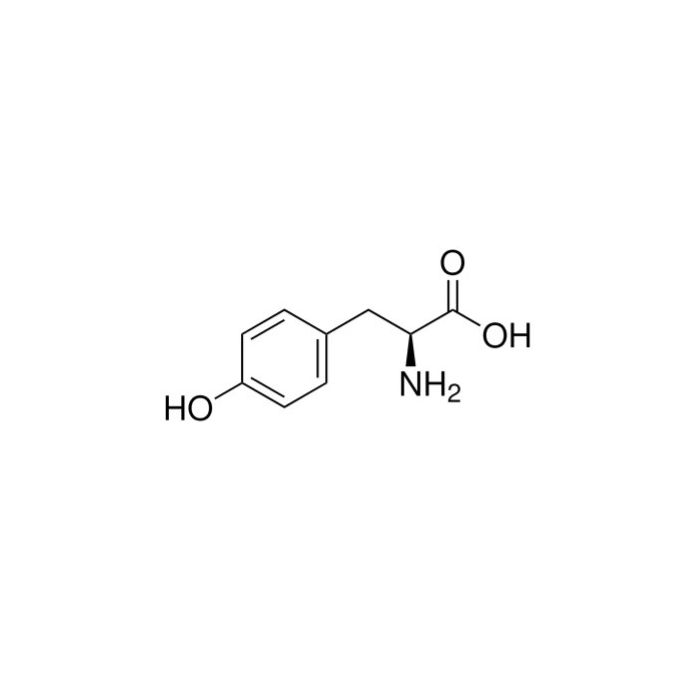
Preferred IUPAC name (literature): (S)-2-amino-3-(4-hydroxyphenyl)propanoic acid
2D description: An α-carbon bearing an amino group, a carboxyl group, a hydrogen, and a benzyl substituent; the benzyl ring carries a phenolic –OH at the para position.
Synthetic Utility
Key reactive elements (literature)
α-Amino acid synthon: Enables amide-bond formation, esterification, and amidation at the carboxylate or amine with orthogonal protecting groups (Fmoc/Boc on N; tBu/Bn on phenol; methyl/allyl on CO2H).
Phenolic ring: Undergoes electrophilic aromatic substitution (EAS), O-alkylation/acylation, and oxidative transformations. Para-OH directs ortho/para in EAS; para position is occupied, favoring ortho substitution.
Chiral pool: The S-configuration can be carried through to complex targets, or the amino acid can serve as a resolving agent or chiral auxiliary in some contexts.
Typical synthetic manipulations
Protection: N-Fmoc L-tyrosine (with tBu-protected phenol) is standard for SPPS; Boc strategies used for solution-phase routes. Phenolic O-protection prevents competitive O-acylation during coupling.
Functionalization: Halogenation (NBS/NIS) at ortho positions; subsequent cross-couplings (Suzuki, Buchwald–Hartwig) from aryl halides allow elaboration to non-natural residues.
Oxidation/reduction: Selective oxidation to catechols (L-DOPA derivatives) or conversion to tyrosine analogs; reduction of carboxylate to alcohol yields tyrosinol for linker chemistry.
Conjugation: Diazotization/azo coupling at the ring for labels; enzymatic tyrosinase-mediated coupling in water as a mild alternative.
Practical advice
Monitor for racemization under basic/thermal conditions; use mild bases and low temperatures during activation/coupling. Control water content to suppress hydrolysis of activated esters.
Target Specificity
Not applicable. This product is a small-molecule amino acid, not an affinity reagent or biologic. No antigen/epitope/clone/isotype information applies.
Häufig gestellte Fragen
How should this product be stored?
Store at room temperature.
How is this product shipped?
This product ships under standard ambient conditions. No temperature-controlled packaging is required.
What are the CAS number, molecular formula and molecular weight?
The CAS Number is 60-18-4, the molecular formula is C9H11NO3, and the molecular weight is 181.19 g/mol. InChIKey OUYCCCASQSFEME-QMMMGPOBSA-N.
Wir verwenden Cookies, um die ordnungsgemäße Funktion der Website sicherzustellen und, soweit zulässig, Ihr Nutzererlebnis zu verbessern. Sie können Ihre Einstellungen jederzeit unter „Einstellungen“ verwalten. Weitere Informationen finden Sie in unserer Cookie-Richtlinie.
Shall we send you a message when we have discounts available?
Remind me later
Thank you! Please check your email inbox to confirm.
Products are supplied to verified businesses, institutions, and qualified professionals for research and development use only. Not for use in humans, animals, diagnosis, or therapy.

 G2511582