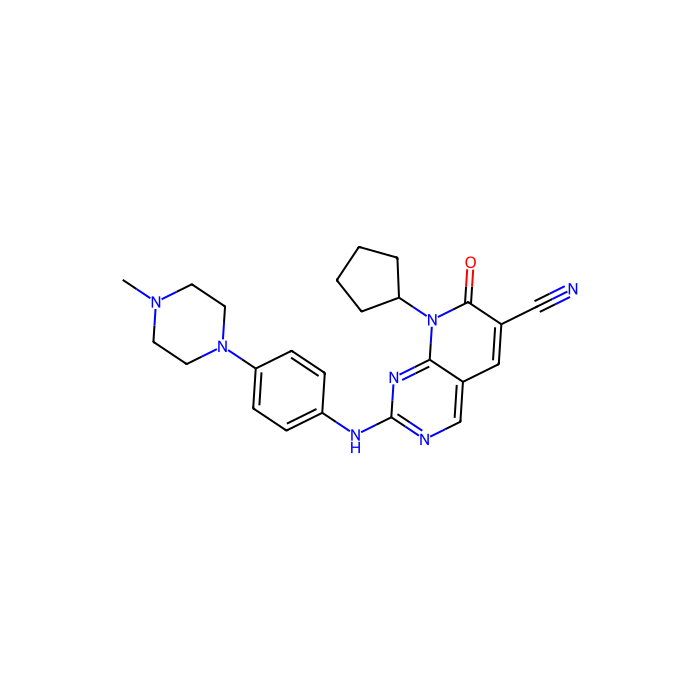
ON-123300 - Moligand™, ≥98% , Inhibitor of cyclin dependent kinase 4;Inhibitor of cyclin dependent kinase 6;Inhibitor of NUAK family kinase 1, CAS No.1357470-29-1, Inhibitor of cyclin dependent kinase 4;Inhibitor of cyclin dependent kinase 6;Inhibitor of NUAK family kinase 1

CAS: 1357470-29-1 Cat. No.: O173545 Summenformel: C24H27N7O Molekulargewicht: 429.5
Zu bestellen verfügbar
GRADE & PURITY Moligand™ ? Moligand™ — Aladdin's line of ligands and bioactive small molecules. Use for receptor, pathway, and binding studies needing defined small-molecule tools. ≥98%
Synonyms
CCG-268995 | SB16989 | 8-cyclopentyl-2-[4-(4-methylpiperazin-1-yl)anilino]-7-oxopyrido[2,3-d]pyrimidine-6-carbonitrile | EN300-53053 | BDBM50447512 | AC-35541 | compound 7x [PMID: 24417566] | EX-A1111 | s8161 | 8-cyclopentyl-2-((4-(4-methylpiperazin-1-yl)
Storage
Store at -20°C
Shipped In
Ice chest + Ice pads
★
Size
Deutschland (EU)
USA*
Price
Qty
5mg
O173545-5mg
—
2 Auf Lager

19,87€

30,28€
Speichern 10,41 € (34.38%)
10mg
O173545-10mg
—
2 Auf Lager

36,36€

54,58€
Speichern 18,22 € (33.39%)
25mg
O173545-25mg
—
2 Auf Lager

78,88€

118,79€
Speichern 39,92 € (33.60%)
50mg
O173545-50mg
—
2 Auf Lager

140,49€

210,77€
Speichern 70,29 € (33.35%)
100mg
O173545-100mg
—
2 Auf Lager

225,53€

338,33€
Speichern 112,81 € (33.34%)
Enter a quantity for the sizes you want to add.
🧪

Why this grade

Moligand™, ≥98% Moligand™ for sensitive chromatographic and analytical workflows requiring minimal baseline interference.

🌡

Storage & shipping

Store at -20°C Ships Ice chest + Ice pads Check lot-specific COA for exact specifications.

📋

Quality documents

SDS, COA, datasheet, and spec sheet available for download. Lot-specific COA accessible via lot number lookup.

📚

Literature proof

Cited in 0 peer-reviewed publications across chromatography, organic synthesis, and cross-coupling reactions.

Specifications

Synonyme
CCG-268995 | SB16989 | 8-cyclopentyl-2-[4-(4-methylpiperazin-1-yl)anilino]-7-oxopyrido[2,3-d]pyrimidine-6-carbonitrile | EN300-53053 | BDBM50447512 | AC-35541 | compound 7x [PMID: 24417566] | EX-A1111 | s8161 | 8-cyclopentyl-2-((4-(4-methylpiperazin-1-yl)
Spezifikationen & Reinheit
Moligand™, ≥98%
Storage
Store at -20°C
Verschickt in
Ice chest + Ice pads
Dieses Produkt erfordert Kühlkettenversand. Grundversand und andere Economy-Optionen sind nicht verfügbar.
Note
Moligand™
Aktionsart
INHIBITOR
Mechanismus der Wirkung
Inhibitor of cyclin dependent kinase 4;Inhibitor of cyclin dependent kinase 6;Inhibitor of NUAK family kinase 1
Reinheit
≥98%
Namen und Kennungen
Pubchem Sid504771428
Pubchem Sid Urlhttps://pubchem.ncbi.nlm.nih.gov/substance/504771428
Kanonisches LächelnCN1CCN(CC1)C2=CC=C(C=C2)NC3=NC=C4C=C(C(=O)N(C4=N3)C5CCCC5)C#N
IUPAC Name8-cyclopentyl-2-[4-(4-methylpiperazin-1-yl)anilino]-7-oxopyrido[2,3-d]pyrimidine-6-carbonitrile
InChIKeyVADOZMZXXRBXNY-UHFFFAOYSA-N
INCHI1S/C24H27N7O/c1-29-10-12-30(13-11-29)20-8-6-19(7-9-20)27-24-26-16-18-14-17(15-25)23(32)31(22(18)28-24)21-4-2-3-5-21/h6-9,14,16,21H,2-5,10-13H2,1H3,(H,26,27,28)
Isomere SMILES CN1CCN(CC1)C2=CC=C(C=C2)NC3=NC=C4C=C(C(=O)N(C4=N3)C5CCCC5)C#N
Alternative CAS-Nummer 1357470-29-1
MeSH-Eintrag ON123300
Molekulargewicht 429.5
Reaxy-Rn 22371471
Reaxys-RN_link_address https://www.reaxys.com/reaxys/secured/hopinto.do?context=S&query=IDE.XRN=22371471&ln=

Documentation

📋 Safety Data Sheet (SDS)

Comprehensive hazard, handling, storage, and regulatory compliance document.

Download SDS →

✅ Certificate of Analysis (COA)

Lot-specific quality data. Enter your lot number to retrieve the exact COA.

Look up COA →

📊 Datasheet

Quick-reference summary of product specifications and applications.

View datasheet →

🔬 Specification Sheet

Full quality attributes and acceptance criteria for this grade.

View spec sheet →

Advanced Data

Taxonomic Classification

Taxonomy Tree

KingdomOrganic compounds
SuperclassOrganoheterocyclic compounds
KlasseDiazinanes
SubclassPiperazines
Intermediate Tree Nodes Not available
Direct ParentPhenylpiperazines
Alternative Parents N-arylpiperazines  Pyrido[2,3-d]pyrimidines  Aniline and substituted anilines  Dialkylarylamines  Aminopyrimidines and derivatives  Pyridinones  N-methylpiperazines  Heteroaromatic compounds  Trialkylamines  Lactams  Azacyclic compounds  Secondary amines  Nitriles  Hydrocarbon derivatives  Organic oxides  Organooxygen compounds  
Molecular FrameworkAromatic heteropolycyclic compounds
Substituents Phenylpiperazine - N-arylpiperazine - Pyrido[2,3-d]pyrimidine - Pyridopyrimidine - Aniline or substituted anilines - Dialkylarylamine - Aminopyrimidine - Pyridinone - N-alkylpiperazine - N-methylpiperazine - Monocyclic benzene moiety - Pyridine - Benzenoid - Pyrimidine - Heteroaromatic compound - Lactam - Tertiary aliphatic amine - Tertiary amine - Azacycle - Nitrile - Carbonitrile - Secondary amine - Hydrocarbon derivative - Organic oxide - Cyanide - Organooxygen compound - Organonitrogen compound - Amine - Organic oxygen compound - Organic nitrogen compound - Aromatic heteropolycyclic compound
BeschreibungThis compound belongs to the class of organic compounds known as phenylpiperazines. These are compounds containing a phenylpiperazine skeleton, which consists of a piperazine bound to a phenyl group.
External Descriptors Not available
3D-Struktur
Interaktives chemisches Strukturmodell


Zugehörige Ziele (menschlich)
CSF1R Tclin Macrophage colony-stimulating factor 1 receptor (1 Activities)
Activity TypeActivity Value -log(M)Mechanism of ActionActivity ReferencePublications (PubMed IDs)
CDK4 Tclin Cyclin-dependent kinase 4 (0 Activities)
Activity TypeActivity Value -log(M)Mechanism of ActionActivity ReferencePublications (PubMed IDs)
FYN Tclin Tyrosine-protein kinase Fyn (1 Activities)
Activity TypeActivity Value -log(M)Mechanism of ActionActivity ReferencePublications (PubMed IDs)
FLT3 Tclin Receptor-type tyrosine-protein kinase FLT3 (1 Activities)
Activity TypeActivity Value -log(M)Mechanism of ActionActivity ReferencePublications (PubMed IDs)
FGFR1 Tclin Fibroblast growth factor receptor 1 (1 Activities)
Activity TypeActivity Value -log(M)Mechanism of ActionActivity ReferencePublications (PubMed IDs)
PDGFRB Tclin Platelet-derived growth factor receptor beta (1 Activities)
Activity TypeActivity Value -log(M)Mechanism of ActionActivity ReferencePublications (PubMed IDs)
CDK6 Tclin Cyclin-dependent kinase 6 (0 Activities)
Activity TypeActivity Value -log(M)Mechanism of ActionActivity ReferencePublications (PubMed IDs)
NUAK1 Tchem NUAK family SNF1-like kinase 1 (1 Activities)
Activity TypeActivity Value -log(M)Mechanism of ActionActivity ReferencePublications (PubMed IDs)
ABL1 Tclin Tyrosine-protein kinase ABL (18331 Activities)
Activity TypeRelationActivity valueUnitsAction TypeJournalPubMed IddoiAssay Aladdin ID
PDGFRB Tclin Platelet-derived growth factor receptor beta (5195 Activities)
Activity TypeRelationActivity valueUnitsAction TypeJournalPubMed IddoiAssay Aladdin ID
FGFR1 Tclin Fibroblast growth factor receptor 1 (9149 Activities)
Activity TypeRelationActivity valueUnitsAction TypeJournalPubMed IddoiAssay Aladdin ID
PIK3CD Tclin PI3-kinase p110-delta subunit (6699 Activities)
Activity TypeRelationActivity valueUnitsAction TypeJournalPubMed IddoiAssay Aladdin ID
FYN Tclin Tyrosine-protein kinase FYN (5308 Activities)
Activity TypeRelationActivity valueUnitsAction TypeJournalPubMed IddoiAssay Aladdin ID
FLT3 Tclin Tyrosine-protein kinase receptor FLT3 (13481 Activities)
Activity TypeRelationActivity valueUnitsAction TypeJournalPubMed IddoiAssay Aladdin ID
CSF1R Tclin Macrophage colony stimulating factor receptor (5179 Activities)
Activity TypeRelationActivity valueUnitsAction TypeJournalPubMed IddoiAssay Aladdin ID
BT-474 (2113 Activities)
Activity TypeRelationActivity valueUnitsAction TypeJournalPubMed IddoiAssay Aladdin ID
COLO 205 (50209 Activities)
Activity TypeRelationActivity valueUnitsAction TypeJournalPubMed IddoiAssay Aladdin ID
DU-145 (51482 Activities)
Activity TypeRelationActivity valueUnitsAction TypeJournalPubMed IddoiAssay Aladdin ID
K562 (73714 Activities)
Activity TypeRelationActivity valueUnitsAction TypeJournalPubMed IddoiAssay Aladdin ID
MCF7 (126967 Activities)
Activity TypeRelationActivity valueUnitsAction TypeJournalPubMed IddoiAssay Aladdin ID
MDA-MB-468 (9477 Activities)
Activity TypeRelationActivity valueUnitsAction TypeJournalPubMed IddoiAssay Aladdin ID
NCI-H417 (34 Activities)
Activity TypeRelationActivity valueUnitsAction TypeJournalPubMed IddoiAssay Aladdin ID
NCI-N87 (850 Activities)
Activity TypeRelationActivity valueUnitsAction TypeJournalPubMed IddoiAssay Aladdin ID
Raji (5516 Activities)
Activity TypeRelationActivity valueUnitsAction TypeJournalPubMed IddoiAssay Aladdin ID
SK-OV-3 (52876 Activities)
Activity TypeRelationActivity valueUnitsAction TypeJournalPubMed IddoiAssay Aladdin ID
SW480 (6023 Activities)
Activity TypeRelationActivity valueUnitsAction TypeJournalPubMed IddoiAssay Aladdin ID
2008 (263 Activities)
Activity TypeRelationActivity valueUnitsAction TypeJournalPubMed IddoiAssay Aladdin ID
A549 (127892 Activities)
Activity TypeRelationActivity valueUnitsAction TypeJournalPubMed IddoiAssay Aladdin ID
A-431 (6446 Activities)
Activity TypeRelationActivity valueUnitsAction TypeJournalPubMed IddoiAssay Aladdin ID
HCT-116 (91556 Activities)
Activity TypeRelationActivity valueUnitsAction TypeJournalPubMed IddoiAssay Aladdin ID
Jurkat (10389 Activities)
Activity TypeRelationActivity valueUnitsAction TypeJournalPubMed IddoiAssay Aladdin ID
HeLa (62764 Activities)
Activity TypeRelationActivity valueUnitsAction TypeJournalPubMed IddoiAssay Aladdin ID
MDA-MB-231 (73002 Activities)
Activity TypeRelationActivity valueUnitsAction TypeJournalPubMed IddoiAssay Aladdin ID
HCT-15 (51914 Activities)
Activity TypeRelationActivity valueUnitsAction TypeJournalPubMed IddoiAssay Aladdin ID
RET Tclin Tyrosine-protein kinase receptor RET (6732 Activities)
Activity TypeRelationActivity valueUnitsAction TypeJournalPubMed IddoiAssay Aladdin ID
NUAK1 Tchem NUAK family SNF1-like kinase 1 (1769 Activities)
Activity TypeRelationActivity valueUnitsAction TypeJournalPubMed IddoiAssay Aladdin ID
HCC70 (557 Activities)
Activity TypeRelationActivity valueUnitsAction TypeJournalPubMed IddoiAssay Aladdin ID
MDA-MB-157 (173 Activities)
Activity TypeRelationActivity valueUnitsAction TypeJournalPubMed IddoiAssay Aladdin ID
CDK5 Tchem Cyclin-dependent kinase 5/CDK5 activator 1 (3697 Activities)
Activity TypeRelationActivity valueUnitsAction TypeJournalPubMed IddoiAssay Aladdin ID
CDK4 Tclin Cyclin-dependent kinase 4/cyclin D1 (2340 Activities)
Activity TypeRelationActivity valueUnitsAction TypeJournalPubMed IddoiAssay Aladdin ID
CDK1 Tchem Cyclin-dependent kinase 1/cyclin B1 (1887 Activities)
Activity TypeRelationActivity valueUnitsAction TypeJournalPubMed IddoiAssay Aladdin ID
CCNE1 Tchem Cyclin-dependent kinase 2/cyclin E1 (1877 Activities)
Activity TypeRelationActivity valueUnitsAction TypeJournalPubMed IddoiAssay Aladdin ID
CCND1 Tchem CDK6/cyclin D1 (322 Activities)
Activity TypeRelationActivity valueUnitsAction TypeJournalPubMed IddoiAssay Aladdin ID
CCNT1 Tchem CDK9/cyclin T1 (2643 Activities)
Activity TypeRelationActivity valueUnitsAction TypeJournalPubMed IddoiAssay Aladdin ID
CDK2 Tchem CDK2/Cyclin A2 (2260 Activities)
Activity TypeRelationActivity valueUnitsAction TypeJournalPubMed IddoiAssay Aladdin ID
CCNH Tbio CDK7/Cyclin H/MNAT1 (693 Activities)
Activity TypeRelationActivity valueUnitsAction TypeJournalPubMed IddoiAssay Aladdin ID
Zugehörige Ziele (nicht menschlich)
Cdk4 Cyclin-dependent kinase 4 (3 Activities)
Activity TypeRelationActivity valueUnitsAction TypeJournalPubMed IddoiAssay Aladdin ID
Hdac6 Histone deacetylase 6 (222 Activities)
Activity TypeRelationActivity valueUnitsAction TypeJournalPubMed IddoiAssay Aladdin ID
Mus musculus (284745 Activities)
Activity TypeRelationActivity valueUnitsAction TypeJournalPubMed IddoiAssay Aladdin ID
rep Replicase polyprotein 1ab (378 Activities)
Activity TypeRelationActivity valueUnitsAction TypeJournalPubMed IddoiAssay Aladdin ID
Wirkungsmechanismen
Zertifikate (CoA, COO, BSE/TSE und Analyse-Diagramm)
C of A & Other Certificates(BSE/TSE, COO):
Analytical Chart:

Find and download the COA for your product by matching the lot number on the packaging.

6 results found

Lot NumberCertificate TypeDatumArtikel
I2621031Certificate of AnalysisSep 28, 2026 O173545
I2203381Certificate of AnalysisJun 09, 2025 O173545
I2203382Certificate of AnalysisJun 09, 2025 O173545
I2205315Certificate of AnalysisJun 09, 2025 O173545
I2205316Certificate of AnalysisJun 09, 2025 O173545
I2205317Certificate of AnalysisJun 09, 2025 O173545
Chemische und physikalische Eigenschaften
Löslichkeit≥21.5 mg/mL in DMSO with gentle warming; insoluble in EtOH; insoluble in H2O
Molekulargewicht429.500 g/mol
XLogP33.100
Hydrogen Bond Donor Count1
Hydrogen Bond Acceptor Count7
Rotatable Bond Count4
Exact Mass429.228 Da
Monoisotopic Mass429.228 Da
Topological Polar Surface Area88.400 Ų
Heavy Atom Count32
Formal Charge0
Complexity754.000
Isotope Atom Count0
Defined Atom Stereocenter Count0
Undefined Atom Stereocenter Count0
Defined Bond Stereocenter Count0
Undefined Bond Stereocenter Count0
The total count of all stereochemical bonds0
Covalently-Bonded Unit Count1
Lösungsrechner
Bewertungen

Kundenbewertungen

Application Protocols

No tested application protocols are provided for this item.

General guidance for small-molecule bioassays

  • Stock preparation: Dissolve in anhydrous DMSO to a convenient high concentration (e.g., 10–50 mM), vortex and, if needed, sonicate briefly. Actual solubility for this item is Not specified; determine empirically.
  • Aliquoting: Dispense single-use aliquots in low-bind tubes or plates and store at the recommended temperature to avoid freeze–thaw cycles.
  • Assay setup: Prepare serial dilutions in assay buffer or media, ensuring the final DMSO percentage is constant across conditions and acceptable for the biological system.
  • Controls: Include vehicle controls, positive/negative pathway controls, and, where possible, an orthogonal readout to confirm mechanism.
  • Data quality: Monitor for precipitation/turbidity, edge effects in plates, and time-dependent potency shifts indicating instability or adsorption.

For detailed, application-specific protocols, consult the literature for ON-123300 and adapt to your assay platform.

Biological Roles

General context (literature background)

  • ON-123300 is described in the public research literature as a bioactive small molecule used to interrogate kinase-driven signaling pathways. Specific molecular targets, binding constants, and selectivity profiles vary by publication and assay format. This listing does not provide verified target data for the supplied item; consult primary sources and confirm with your in-house assays.

Typical research uses for small-molecule inhibitors

  • Probe compound for dissecting cell-cycle or survival signaling cascades in biochemical enzyme assays and in cells.
  • Chemical biology tool for time-resolved pathway perturbation, often in parallel with genetic knockdown/knockout to strengthen mechanism-of-action inferences.
  • Control in target-validation studies and structure–activity relationship (SAR) campaigns when analog series are available.

Good practices

  • Validate identity and purity of the received lot before critical studies.
  • Establish concentration–response curves and determine apparent potency in your specific assay format (biochemical vs. cellular) since transport, metabolism, and protein binding can shift potency from literature values.
  • Use orthogonal readouts (e.g., biochemical phosphorylation assays and phenotypic markers) to confirm on-target effects.

Note: No medical or clinical use is intended. For research use only, as stated by the manufacturer.

Buffer Applications

This product is a bioactive small molecule and is not a buffering agent. There are no item-specific buffer recipes.

Practical notes for assay buffers

  • Dilute DMSO stocks into biologically compatible buffers (e.g., PBS, HBSS, HEPES-buffered media) while keeping the final DMSO percentage as low as your assay allows (commonly ≤0.1–1% v/v).
  • To minimize precipitation upon dilution, add compound stock slowly to vigorously mixed buffer and consider including a small amount of non-ionic surfactant if assay-compatible.
  • Filter final working solutions through a 0.22 µm filter if clarity is required for optical readouts.
Green Alternatives

Green chemistry alternatives are generally discussed for bulk solvents and reagents. For a bioactive screening compound such as ON-123300, the primary environmental considerations are solvent selection and waste minimization rather than substituting the molecule itself.

  • Preferred diluents: Use aqueous buffers and minimal DMSO percentages compatible with your assay to reduce organic solvent use.
  • Waste reduction: Prepare small-volume, high-concentration stock solutions and aliquot to avoid repeated thawing and disposal of degraded material.
  • Safer solvents: When feasible for non-biological tests, consider ethanol or water/ethanol mixtures instead of DMF/DMAC/NMP. Maintain assay performance validation if changing vehicles.
  • Energy use: Store at the recommended temperature but avoid unnecessary ultra-cold storage below the specification to reduce energy consumption.

Because the compound is used at micro- to milligram scale in discovery workflows, the largest “green” gains usually come from solvent and plasticware reductions, right-sizing experiments, and sharing stock solutions across assays to minimize redundant preparations.

Pharmaceutical Uses

Supplied strictly for research use only; no clinical or diagnostic use.

Formulation context (non-clinical research)

  • For preclinical research or exploratory formulation in vitro/in vivo models, small-molecule inhibitors like ON-123300 are commonly formulated as DMSO concentrates for ex vivo dosing or diluted into vehicles such as PEG400/saline, Captisol solutions, or aqueous buffers with minimal organic cosolvent. Item-specific excipient compatibility is not provided and should be established empirically.
  • Pharmacopeial status: Not specified for this item; refer to regulatory databases if needed. This listing provides no pharmacopoeial monograph or GMP status.

Manufacturing/analysis considerations

  • If preparing dosage forms for animal research, characterize concentration by validated analytical methods (e.g., HPLC-UV or LC–MS/MS), assess short-term stability in the selected vehicle, and document lot numbers and storage.

No therapeutic claims are made or implied. All uses are limited to laboratory research.

Physical Properties

Item-specific physical constants are not provided in this listing. Do not treat generic or literature values as product specifications.

  • Appearance: Not specified for this item; refer to CoA/Spec Sheet.
  • Melting point (literature, if applicable): Not specified here; consult authoritative databases for the compound record and cross-check with the item’s CoA.
  • Boiling point: Not specified for this item; refer to CoA/Spec Sheet.
  • Density/refractive index: Not specified for this item; refer to CoA/Spec Sheet.
  • Solubility: For bioactive small molecules of this class, DMSO is typically used to prepare stock solutions; aqueous solubility may be limited. Item-specific solubility limits are Not specified for this item; refer to CoA/Spec Sheet.
  • LogP, pKa: Not specified for this item; consult literature for the named compound and verify against the supplied batch documentation.

Notes for users

  • When physical data are absent, determine working solubility empirically on a small scale (e.g., serial DMSO dilution, followed by cosolvent/vehicle screening) and record the conditions alongside your experimental data.
  • Treat any third-party literature values as guidance only and verify with this item’s CoA for lot-specific properties.
Quality and Grades
  • Grade/Purity: Moligand™

About the Moligand™ designation

  • Moligand™ is used by Aladdin Scientific to denote compounds curated for small-molecule screening, target engagement, and ligand discovery workflows. The emphasis is on identity verification and suitability for biochemical/cellular assays rather than chromatographic solvent performance.

What this implies for users

  • Identity: Supplied with traceability (e.g., CAS/CID) and stored/shipped under conditions suitable for library members.
  • Purity reporting: Item-specific purity, residual solvents, or counter-ion content are Not specified for this item; refer to CoA/Spec Sheet for the batch you receive.
  • Stabilizers/inhibitors: Not specified for this item; refer to CoA/Spec Sheet.
  • UV cutoff/low-UV performance: Not applicable to this grade; if you require HPLC/UV-transparent grade for analytical detection, contact technical support.

Recommended QC on receipt (best practice)

  • Verify identity by orthogonal method when critical (e.g., LC–MS, HPLC retention time vs. standard, or NMR if quantity permits).
  • Establish a working reference vial and maintain aliquots to minimize freeze–thaw cycles.
  • Document lot number and any in-house assay performance for auditability.
Reaction and Applications

This product is supplied as a bioactive small molecule for research screening and target interrogation. It is not typically used as a reagent or catalyst in synthetic organic transformations.

  • Synthetic reaction roles: Not applicable; no manufacturer guidance is provided for using ON-123300 as a nucleophile/electrophile, ligand for metal catalysis, or organocatalyst.
  • If you intend to derivatize or conjugate this molecule: Obtain the full structure (CoA/Spec Sheet) and confirm the presence and accessibility of any functional handles before planning protection/deprotection or coupling steps. Conduct small-scale feasibility tests and monitor by LC–MS.

For applications more relevant to this compound type, see the sections: Solvent Selection, Biological Roles, Target Specificity, and Storage & Reconstitution.

Reaction Conditions

Not applicable. ON-123300 is supplied as a research-grade small molecule for biological studies and is not intended as a reagent in synthetic transformations.

If you intend to modify the molecule chemically

  • Confirm the exact structure and functional groups from the CoA/Spec Sheet.
  • Pilot small-scale reactions and monitor by LC–MS to establish stability windows (temperature, pH, catalysts) appropriate to the scaffold before attempting larger-scale transformations.
Safety and Handling

Safety classification is not provided in this listing; always consult the SDS for authoritative guidance.

  • GHS/CLP: Not specified for this item; refer to SDS.
  • Signal word / H-statements / Pictograms: Not specified for this item; refer to SDS.

Good laboratory practice (general guidance for small-molecule research chemicals)

  • PPE: Wear lab coat, safety glasses, and appropriate gloves (e.g., nitrile). Avoid inhalation, ingestion, and skin/eye contact.
  • Engineering controls: Work in a certified chemical fume hood when handling powders, weighing, or preparing solutions.
  • Handling: Minimize dust/aerosol generation. Use dedicated tools for weighing to avoid cross-contamination of screening libraries.
  • Incompatibilities: Unknown for this specific item; as a precaution, segregate from strong oxidizers and acids/bases until SDS review confirms compatibility.
  • First aid (overview): In case of contact, rinse affected area with water for at least 15 minutes. If inhaled, move to fresh air. Seek medical attention as needed. Defer to SDS for full instructions.
  • Waste: Collect solutions and contaminated disposables as organic hazardous waste in accordance with institutional and local regulations.

Special risks

  • Bioactive small molecules can have potent biological effects at low concentrations. Prevent environmental release and avoid exposure by ingestion or injection. For research use only.
Solvent Selection

This product is a bioactive small molecule; solvent choice is primarily about preparing concentrated stock solutions for screening and assay workflows rather than for use as a reaction solvent.

  • Primary solvent: DMSO is typically preferred for hydrophobic discovery compounds due to high solvating power and assay compatibility at low final percentages (e.g., ≤0.1–1% v/v in biological assays). Item-specific solubility limits are Not specified for this item; verify experimentally.
  • Secondary cosolvents: Ethanol, methanol, or DMF can be used to pre-dissolve stubborn solids before dilution into aqueous buffers with surfactants (e.g., 0.01–0.1% Tween-80) when compatible with the assay.
  • Aqueous vehicles: For cell-based work, dilute DMSO stocks into buffer/media to the minimal DMSO percentage tolerated by your system. Confirm absence of precipitation visually and by light scattering if possible.
  • pH adjustment: If the compound possesses ionizable groups (structure not provided here), modest pH adjustment (e.g., phosphate or HEPES buffers) may improve apparent solubility; confirm chemical stability versus pH in a small-scale study.
  • Filtration: If particulate persists, pass through a 0.22 µm PTFE syringe filter into an amber vial to remove undissolved solids.

Comparison notes

  • DMSO vs. DMF: DMSO is generally better tolerated biologically. DMF may improve solubility in rare cases but is less favored for live-cell assays.
  • PEG400 or Captisol may be explored for in vivo formulation research; ensure compatibility with your application and regulatory framework.
Storage and Reconstitution
  • Storage conditions (as provided): Store at -20°C.
  • Shipping: Shipped in ice chest + ice pads to maintain low temperature during transit.
  • Appearance: Not specified for this item; refer to CoA/Spec Sheet.

Reconstitution and handling

  • Solvent choice: Prepare concentrated stocks in anhydrous DMSO unless your internal data indicate a superior solvent. Item-specific solubility is Not specified for this item; determine empirically.
  • Aliquoting: Immediately aliquot freshly prepared stock solutions into single-use portions to minimize freeze–thaw cycles and headspace moisture uptake.
  • Containers: Use amber vials or foil-wrapped tubes to limit light exposure if the scaffold is photosensitive (verify as needed). Employ low-bind plastics/glass to reduce adsorption losses at low concentrations.
  • Working solutions: Keep on ice during assay setup. Avoid prolonged exposure at room temperature; discard if precipitation or discoloration occurs.

Stability notes

  • Long-term stability, hydrate/solvate state, and sensitivity to air/light are Not specified for this item; refer to CoA/Spec Sheet and SDS. As good practice, document preparation date, solvent, concentration, and number of freeze–thaw cycles for each aliquot.

Research Use Note: For research use only.

Structure and Identity
  • Product name: ON-123300 (SKU: O173545)
  • CAS: 1357470-29-1
  • PubChem CID: 56649281
  • InChIKey: 373771 (truncated/not standard; authoritative identifier not fully provided in this listing)
  • SMILES: Not specified for this item; refer to CoA/Spec Sheet.
  • Molecular formula: Not specified for this item; refer to CoA/Spec Sheet.
  • Molecular weight: Not specified for this item; refer to CoA/Spec Sheet.

Structural features

  • Item-specific structural descriptors are not provided in this listing. Public literature commonly describes ON-123300 as a small-molecule kinase inhibitor scaffold; however, please consult the CoA/SDS or primary database records for definitive structure and stereochemistry for this specific lot.

2D structure (verbal description)

  • Not provided in Product Data. Without a verified structure (SMILES/InChI), a reliable functional-group description cannot be given. For accurate structural information, reference the certificate of analysis (CoA) or a curated database entry corresponding to CAS 1357470-29-1 / CID 56649281.
Synthetic Utility

This compound is offered as a finished bioactive small molecule and is not positioned as a synthetic building block or reagent.

  • Functional group reactivity: Without verified structural information in this listing, no reliable commentary on derivatization handles can be provided. If you plan to synthesize analogs or conjugates, obtain the complete structure and perform standard reactivity scouting (e.g., protection of sensitive groups, compatibility with amide couplings, cross-couplings, or late-stage diversification techniques) based on confirmed functional groups.
  • Purification: Bioactive small molecules are commonly purified by preparative HPLC; replicate conditions may be adapted if you prepare analogs.

For research focused on biological evaluation rather than synthesis, see Biological Roles, Target Specificity, and Application Protocols.

Target Specificity

Item-specific target data are not provided in this listing.

  • Verified molecular targets, binding affinities, and selectivity panels: Not specified for this item; refer to CoA/Spec Sheet and primary literature corresponding to CAS 1357470-29-1 / CID 56649281.
  • If using as a pathway probe: Independently confirm target engagement in your assay system (e.g., enzyme inhibition constants, cellular target modulation) and include orthogonal controls to exclude off-target or assay-interference effects.

Shall we send you a message when we have discounts available?

Remind me later

Thank you! Please check your email inbox to confirm.

Oops! Notifications are disabled.