Determine the necessary mass, volume, or concentration for preparing a solution.
Dilution Calculator
Determine the dilution needed to prepare a stock solution.
Reconstitution Calculator
Bewertungen
Kundenbewertungen
Application Protocols
No manufacturer-validated bioassay protocols are provided for this small molecule.
General laboratory usage notes (non-validated, literature-based):
Derivatization for carbonyl analysis: Prepare fresh solutions of p-anisidine in appropriate solvent (e.g., acetic acid/solvent mixture) under low light. React with sample at defined time/temperature per method, then measure UV-Vis absorbance at the method-specified wavelength. Validate with standards.
Coupling reactions: Dry and degas solvents as needed. Charge base and ligand/catalyst under inert atmosphere for Pd-catalyzed couplings; monitor by TLC/LC–MS.
These are illustrative only. For any critical application, develop and qualify procedures internally. This product is supplied for research use only.
Biological Roles
This product is a synthetic aromatic amine intended for research and materials science applications. It is not a biological buffer or metabolite supplied for cell culture.
General/literature perspective:
Aromatic amines like p-anisidine are not endogenous metabolites in mammalian systems. They can undergo Phase I oxidation (e.g., N-oxidation, O-demethylation) and Phase II conjugation (glucuronidation, sulfation) in vivo; these are mechanistic insights rather than usage guidance.
The strong electron-donating para-methoxy and amino groups render the ring susceptible to oxidative processes, potentially forming quinone-imine intermediates in biochemical contexts. Such species are of interest in toxicology research and environmental fate studies of anilines, but this product is supplied strictly for laboratory use.
In analytical biochemistry, p-anisidine is employed as a derivatization reagent for carbonyl compounds to facilitate spectrophotometric detection, due to formation of conjugated imines with characteristic absorbance. Any such use should be performed under appropriate safety approvals and is not a clinical diagnostic application.
Note: No clinical/therapeutic claims are made or implied. For any work intersecting biological systems, follow institutional biosafety and chemical safety protocols and consult the SDS.
Buffer Applications
Not typically applicable. p-Anisidine is an aromatic amine used as a synthetic intermediate and derivatization reagent, not as a buffering agent. It lacks a suitable conjugate acid/base pair in the physiological pH range with properties (solubility, toxicity, spectral transparency) desirable for routine buffer preparation.
Practical note:
If derivatization in aqueous media is required, transient formation of the anilinium salt in mildly acidic solutions can improve solubility, but this is not intended for buffering purposes. For buffers, select established systems (e.g., phosphate, acetate, HEPES) appropriate to the target pH and analytical method.
Green Alternatives
Greenness considerations involve both solvent choice for reactions with p-anisidine and, where possible, substitution with less hazardous nucleophiles when functionally acceptable.
Solvent substitution (literature guidance):
Replace chlorinated solvents (DCM, CHCl3) with ethyl acetate, isopropyl acetate, 2-MeTHF, or CPME for acylations and extractions, balancing evaporation ease and safety.
For Pd-catalyzed C–N coupling, consider toluene, 2-MeTHF, CPME, or propylene carbonate in place of DMF/DMAc/NMP, acknowledging tradeoffs in solubility and temperature windows.
For SNAr, water/ethanol mixtures or PEG-400 can sometimes be used with phase-transfer or micellar conditions (e.g., surfactant media), though optimization is case-specific.
Reagent/toxicity considerations (general):
Aromatic amines, including p-anisidine, carry health hazards. If the end product tolerates, consider aliphatic amines or anilines with more favorable hazard profiles. However, electronic effects are unique; substitutions may impact reactivity and properties.
Comparison highlights (general):
2-MeTHF vs THF: 2-MeTHF is bio-based, higher bp, easier phase separations; both are peroxide formers (manage accordingly).
EtOAc vs DCM: EtOAc is less toxic, biodegradable, and readily recyclable; DCM offers superior solubility for some substrates.
Toluene vs DMF: Toluene is less problematic for waste but may require higher temperatures; DMF provides excellent solvating power but has regulatory scrutiny.
In all cases, consult process safety, LCA data, and regulatory guidance to balance performance with environmental impact.
Pharmaceutical Uses
This material is not intended for human or veterinary use. No excipient or pharmacopeial grade is specified for this item.
p-Anisidine and its derivatives can serve as chemical building blocks in the synthesis of active pharmaceutical ingredients (APIs), intermediates, and dye/tracer moieties due to the reactive aniline nitrogen and para-methoxy substitution. Examples include formation of anilide pharmacophores via acylation or urea/carbamate linkages.
As a strong UV absorber, anisidine-derived chromophores may be used in analytical method development (e.g., derivatization for HPLC/UV), but such methods are laboratory tools, not dosage form components.
Regulatory considerations: If a synthesis is destined for GMP environments, procure material with appropriate documentation (CoA, impurity profile, residual solvents, elemental impurities). Absent a stated pharmacopeial grade, this catalog item should be treated as research-use only.
No medical or clinical claims are made. Any process development involving this compound must adhere to institutional safety and quality systems.
Physical Properties
Item-specific numeric specifications are not provided in the Product Data. Values below are general literature data for p-anisidine and should be used as guidance only; consult the CoA/Spec Sheet for item-specific specifications.
Appearance: Not specified for this item; refer to CoA/Spec Sheet.
Melting point (literature): ~57–59 °C (solid at ambient lab temperature in many conditions)
Boiling point (literature): ~243–245 °C (at 1 atm)
Density (literature): ~1.08 g/mL at 25 °C (for molten/liquid above mp)
Refractive index (literature): nD20 ~1.589 (liquid above mp)
Aqueous solubility (literature): moderate; increases in acidic media due to protonation of –NH2
Solubility in organic solvents (literature): miscible or highly soluble in alcohols, ethers, chlorinated solvents, and aromatics; soluble in many polar aprotic solvents (DMF, DMSO, NMP)
UV-Vis (literature): strong absorption in near-UV due to π→π* transitions and n→π* contributions; bathochromic shifts in acidic media owing to anilinium formation.
Notes:
The presence of both –OCH3 and –NH2 enhances hydrogen bonding and resonance, impacting melting behavior compared to aniline or anisole. For analytical work (e.g., UV detection), blank baselines should consider intrinsic absorbance in the 230–300 nm region.
Quality and Grades
Grade/Purity: Not specified for this item; refer to CoA/Spec Sheet.
Stabilizers/Inhibitors: Not specified for this item; refer to CoA/Spec Sheet.
Guidance (general):
Research grade p-anisidine is commonly supplied with high assay (≥98–99% by GC/area or NMR). For analytical applications (e.g., colorimetric determinations), low UV-absorbing impurities and controlled aniline/anisole content are important.
UV/Chromatography: For HPLC/UV applications, background absorbance and baseline stability matter more than nominal assay. Trace nitro-, azo-, or quinone-imine impurities can elevate UV background.
Trace metals/ions: Unless specified as “trace metal” or “catalyst screening” grade, assume no special control of metal content. If using in Pd-catalyzed couplings, routine performance is typically unaffected, but sensitive catalysis may benefit from higher purity.
Water/peroxide content: Not specified for this item; refer to CoA/Spec Sheet. Hygroscopicity is low to moderate; however, moisture can influence salt formation under acidic environments.
Batch documentation: For regulated workflows, request CoA with full analytical panel (assay method, NMR, GC, HPLC, water Karl Fischer if applicable, residual solvents, identification tests). If optical or colorimetric work is intended, request color/APHA or Gardner color where available.
Reaction and Applications
This para-activated aniline is a versatile nucleophile and directing group in synthesis.
Typical applications (literature):
Electrophilic acylation/sulfonylation: Rapid formation of amides (acyl chlorides/anhydrides) and sulfonamides (sulfonyl chlorides) with base (e.g., Et3N, pyridine). Methoxy activation increases rate.
Carbamate/urea synthesis: Reaction with phosgene equivalents (triphosgene, CDI), isocyanates, or carbonyldiimidazole-activated alcohols produces carbamates/ureas.
Buchwald–Hartwig amination: Pd-catalyzed C–N coupling to aryl (pseudo)halides; para-methoxy enhances nucleophilicity and sometimes improves coupling efficiency. Ligands: BINAP, XPhos, BrettPhos (system-dependent).
SNAr: Displacement of activated aryl fluorides (e.g., nitro- or perfluoroarenes) proceeds efficiently in polar aprotic solvents.
Diazotization/azo coupling: Formation of diazonium salts under nitrosating conditions (HNO2) followed by coupling to phenols/anilines to yield azo dyes; the para-methoxy can influence coupling orientation and color.
Reductive amination/Schiff base: Condensation with aldehydes/ketones to imines (enhanced rates due to electron donation), then reduction to secondary amines.
Analytical reagent: Widely used in colorimetric assays for carbonyl compounds and lipid oxidation (p-anisidine value) by forming chromophores; follow validated analytical methods.
Practical tips:
Keep material protected from light to limit oxidative discoloration. Deaerated solvents slow oxidative darkening.
For couplings, ensure base choice aligns with ligand system (e.g., NaOtBu, Cs2CO3). Dry solvents improve consistency. Monitor by TLC/LC–MS; anisidine’s strong UV absorbance aids detection.
Reaction Conditions
General literature guidance (optimize for each substrate):
Acylation to amides:
Typical: Acyl chloride (1.1–1.5 equiv), p-anisidine (1.0 equiv), base (1.5–2.0 equiv Et3N or pyridine), solvent DCM or EtOAc, 0 °C to rt, 0.5–4 h. Workup: aqueous acid/base washes. Yields often 80–95% for unhindered systems.
Sulfonamide formation:
Sulfonyl chloride (1.1 equiv), base (2.0 equiv), DCM/MeCN, 0 °C to rt, 1–3 h. Monitor for over-sulfonylation under forcing conditions.
Buchwald–Hartwig amination:
Aryl bromide/chloride (1.0 equiv), p-anisidine (1.2 equiv), Pd source (1–3 mol% Pd2(dba)3 or Pd(OAc)2), ligand (2–6 mol% BINAP/XPhos/BrettPhos), base (2–3 equiv NaOtBu, Cs2CO3, or K3PO4), solvent toluene, dioxane, or CPME, 90–120 °C, 4–18 h. Typical isolated yields 70–95% for activated aryl halides; aryl chlorides may require stronger ligands/higher temperatures.
SNAr to activated aryl fluorides:
Substrate (1.0 equiv), p-anisidine (1.2–2.0 equiv), base (1–2 equiv K2CO3 or DBU), DMF/DMSO/MeCN, 60–120 °C, 2–16 h. Yields 60–90% depending on activation (e.g., nitro groups).
Imine formation/reductive amination:
Carbonyl (1.0 equiv), p-anisidine (1.2 equiv), dehydrating agent or molecular sieves, solvent toluene/EtOH, rt–80 °C, then reduction with NaBH3CN or H2/Pd-C. Yields commonly 70–95%.
Diazotization/azo coupling:
Aniline salt in HCl, 0–5 °C, NaNO2 (1.0–1.1 equiv) to form diazonium, then couple with phenol/aniline partner in buffered solution (pH 8–10). Strict temperature control to avoid decomposition.
Always perform small-scale trials and adapt to substrate electronics/sterics. Maintain light protection to limit discoloration during prolonged heats.
Safety and Handling
Item-specific hazard classifications (GHS, pictograms, H/P statements) are not provided. Always refer to the product SDS for authoritative safety information.
General safety considerations for aromatic amines (literature/typical):
Hazards: May be harmful if inhaled, swallowed, or absorbed through skin; can cause skin/eye irritation. Aromatic amines can induce methemoglobinemia and may exhibit mutagenic potential—exercise stringent control of exposure.
Light sensitivity: Product is specified to be protected from light; store in light-resistant containers and minimize light exposure during handling.
PPE: Lab coat, chemical-resistant gloves (e.g., nitrile), splash goggles. Use in a fume hood to avoid inhalation of vapors/dust.
Incompatibilities: Strong oxidizers (risk of exotherm/oxidation), nitrosating agents (formation of nitrosamines), acyl halides/anhydrides (rapid acylation), strong acids/bases (salt formation or degradation under harsh conditions).
Peroxide formation: Not typically a peroxide-forming substrate (unlike ethers), but oxidation to quinone imines/colored byproducts can occur on air/light exposure.
First aid (overview): Move to fresh air if inhaled. Flush skin/eyes with water for ≥15 min if contacted; remove contaminated clothing. If ingested, rinse mouth—do not induce vomiting—seek medical attention. Provide SDS to responders.
Spill/cleanup: Avoid dust generation. Absorb liquid/molten spills with inert material; for solids, gently sweep using minimal agitation. Dispose of waste per institutional and local regulations.
Solvent Selection
p-Anisidine behaves as a moderately polar aromatic amine with enhanced electron density from the para-methoxy substituent.
General solubility/miscibility profile (literature):
Polar protic: High solubility in methanol, ethanol, isopropanol; forms H-bonds.
Polar aprotic: Highly soluble in DMF, DMSO, NMP, acetonitrile; useful for cross-couplings and SNAr.
Nonpolar/aromatics: Soluble in toluene, xylene, dichloromethane, chloroform, ethyl acetate; limited in alkanes unless warmed.
Aqueous systems: Limited solubility at neutral pH; substantially more soluble in acidic water as the anilinium salt.
Selection tips:
For nucleophilic aromatic substitution or Buchwald–Hartwig amination, polar aprotic solvents (toluene, dioxane, DMF, CPME, Me-THF) are common. Choose higher-boiling solvents (dioxane, NMP) for elevated-temperature protocols.
For acylation/urea formation, dichloromethane, THF, or EtOAc under base/acid catalysis give good rates; in greener paradigms, EtOAc or 2-MeTHF often suffice.
For salt handling/purification, convert to anilinium salts (e.g., HCl) to enhance aqueous handling, then basify to regenerate the free base.
Quick comparison (general):
Toluene: nonpolar aromatic, good for Pd-catalysis at high T.
Dioxane/2-MeTHF: ethers balancing polarity/boiling range; consider peroxide controls for ethers.
DMF/DMSO: very polar; excellent for SNAr but harder to remove.
EtOAc: greener, easy workup; good for acylations and extractions.
Storage and Reconstitution
Storage conditions (item-specific): Protected from light; Store at -80 °C.
Shipped in (item-specific): Dry ice packs + Cold packs.
Appearance: Not specified for this item; refer to CoA/Spec Sheet.
Practical guidance (general):
Light/oxygen sensitivity: Aromatic amines can slowly oxidize and discolor on exposure to light/air. Keep container tightly closed under inert gas (e.g., nitrogen/argon) if feasible, and use amber glass or foil overwrap.
Temperature considerations: Although literature indicates p-anisidine is a stable solid near ambient temperatures, follow the item-specific instruction to store at -80 °C for maximum stability and to match qualification data for this lot.
Handling from cold storage: Allow container to warm in a desiccator to avoid condensation. If the material is a low-melting solid, brief cooling can help manage handling and weighing.
Solution preparation: Prepare stock solutions in dry solvents (e.g., DCM, EtOAc, MeOH, DMF, DMSO) immediately before use. For longer-term solution storage, keep under inert atmosphere in amber vials at low temperature, and verify stability by analytical methods prior to critical use.
Freeze–thaw: Minimize cycles. If repeated access is needed, aliquot into multiple small containers under inert gas.
For item-specific stability window and retest/expiry, consult the CoA/Spec Sheet.
Structure and Identity
Item-specific identifiers
SKU: P661294
Product Name: p-Anisidine (4-methoxyaniline)
CAS: 104-94-9
InChIKey: Not specified for this item; refer to CoA/Spec Sheet.
SMILES: Not specified for this item; refer to CoA/Spec Sheet.
Core structural features (general/literature information)
Molecular formula (literature): C7H9NO (para-anisidine)
Molecular weight (literature): 123.15 g/mol
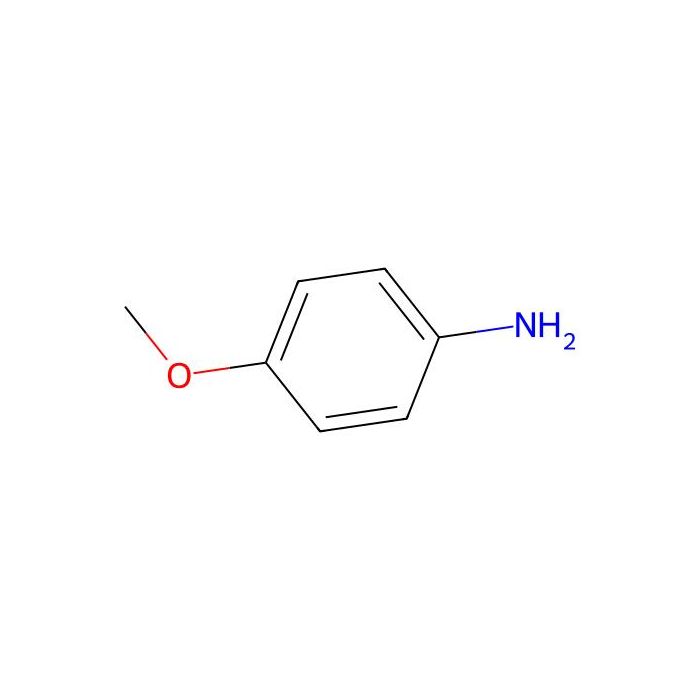
Ring/functional groups: An electron-rich benzene ring para-substituted by an electron-donating methoxy group (–OCH3) and a primary aniline amino group (–NH2). The para arrangement minimizes steric congestion and maximizes resonance donation from both substituents into the ring.
2D description: A monosubstituted aniline in which the –NH2 is at position 1, and a methoxy group at position 4 (para) relative to the amine. No stereogenic centers; planar aromatic core with conjugation between ring, amino lone pair, and methoxy oxygen via resonance.
Common synonyms (general): 4-methoxyaniline, p-methoxyaniline, anisidine (p-isomer).
Chemical class & implications (general)
Class: Aromatic amine; strongly activating and ortho/para-directing in electrophilic aromatic substitution. The para-methoxy further increases ring electron density, enhancing nucleophilicity in coupling and acylation reactions.
Coordination/ligand behavior: The aniline nitrogen can coordinate to metals (soft to borderline Lewis base), relevant in Pd-catalyzed C–N couplings and in forming transient complexes in electrophilic processes.
Synthetic Utility
Functional groups and reactivity (general):
Primary aniline (–NH2): Nucleophilic at nitrogen; readily acylated, sulfonylated, carbamylated; engages in Pd-catalyzed C–N couplings and imine formation.
Para-methoxy (–OMe): Strongly electron-donating, enhancing ring electron density and stabilizing cationic intermediates. Directs electrophilic aromatic substitution ortho/para to itself and the amine; however, with two strong activators, polysubstitution can be an issue without protection.
Strategic roles:
Protecting-group strategies: Convert –NH2 to acetanilide/sulfonamide to modulate reactivity and regiocontrol during electrophilic aromatic substitution; deprotect under standard conditions (acid/base or reductive depending on group).
Cross-coupling handles: Use p-anisidine as the amine partner in Buchwald–Hartwig or Chan–Lam couplings to assemble diarylamines. Methoxy can be retained or demethylated (e.g., BBr3) post-coupling to unveil phenols.
Orthogonal manipulation: O-demethylation to 4-aminophenol enables access to p-aminophenol derivatives; subsequent further functionalization (e.g., etherification, esterification) broadens scaffold space.
Azo dye synthesis: Diazotize and couple to activated rings to generate push–pull azo chromophores; the para alignment enhances bathochromic shifts.
Process considerations:
Oxidation control: Store protected from light/air to limit color formation and oxidative byproducts (quinone-imines).
Workups: Formation of water-soluble anilinium salts enables acid–base extraction; back-extraction with base regenerates free amine.
Target Specificity
Not applicable. This product is a small-molecule aromatic amine, not a biological targeting reagent or antibody. No antigen/epitope specificity, species reactivity, clone, or isotype information applies.
Wir verwenden Cookies, um die ordnungsgemäße Funktion der Website sicherzustellen und, soweit zulässig, Ihr Nutzererlebnis zu verbessern. Sie können Ihre Einstellungen jederzeit unter „Einstellungen“ verwalten. Weitere Informationen finden Sie in unserer Cookie-Richtlinie.
Shall we send you a message when we have discounts available?
Remind me later
Thank you! Please check your email inbox to confirm.
Products are supplied to verified businesses, institutions, and qualified professionals for research and development use only. Not for use in humans, animals, diagnosis, or therapy.