GRADE & PURITYMoligand™?Moligand™ — Aladdin's line of ligands and bioactive small molecules. Use for receptor, pathway, and binding studies needing defined small-molecule tools.10 mM in DMSO
Moligand™, 10 mM in DMSO Moligand™ for sensitive chromatographic and analytical workflows requiring minimal baseline interference.
🌡
Storage & shipping
Store at -80°C Ships Dry ice packs + Cold packs Check lot-specific COA for exact specifications.
📋
Quality documents
SDS, COA, datasheet, and spec sheet available for download. Lot-specific COA accessible via lot number lookup.
📚
Literature proof
Cited in 0 peer-reviewed publications across chromatography, organic synthesis, and cross-coupling reactions.
Übersicht
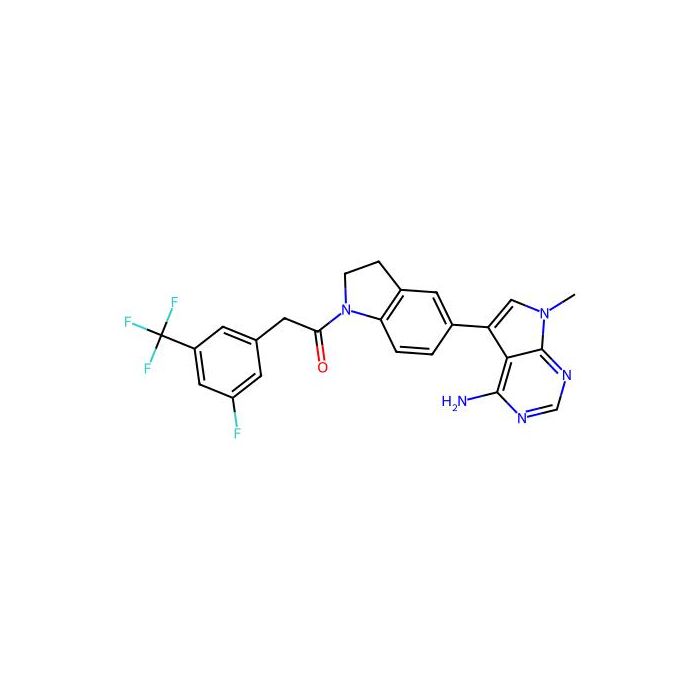
PERK-IN-4 is a potent and selective PERK (protein kinase R (PKR)-like endoplasmic reticulum kinase) inhibitor with an IC 50 of 0.3 nM. PERK is activated in response to a variety of endoplasmic reticulum stresses implicated in numerous disease states.
Specifications
Spezifikationen & Reinheit
Moligand™, 10 mM in DMSO
Storage
Store at -80°C
Verschickt in
Dry ice packs + Cold packs
Dieses Produkt erfordert Kühlkettenversand. Grundversand und andere Economy-Optionen sind nicht verfügbar.
Zertifikate (CoA, COO, BSE/TSE und Analyse-Diagramm)
C of A & Other Certificates(BSE/TSE, COO):
Analytical Chart:
Chemische und physikalische Eigenschaften
Schmelzpunkt (°C)
237-240° C (dec.)
Lösungsrechner
Molarity Calculator
Determine the necessary mass, volume, or concentration for preparing a solution.
Dilution Calculator
Determine the dilution needed to prepare a stock solution.
Reconstitution Calculator
Bewertungen
Kundenbewertungen
Application Protocols
Only application parameters validated for this exact SKU can be listed. None are provided in the Product Data for PERK-IN-4.
Tested applications (WB, IHC, IF, FC, biochemical assays), recommended working concentrations/dilutions, positive controls, and incubation conditions: Not specified for this item; refer to CoA/Spec Sheet.
General suggestion (not a protocol): Establish dose–response in your assay system with careful vehicle controls and orthogonal readouts; confirm stock concentration and solubility empirically.
Biological Roles
Scope: The following provides pathway-level background relevant to PERK-axis research. It is general literature context and not item-specific performance data. No medical or clinical claims are made.
PERK (EIF2AK3) function: PERK is an ER-resident eIF2α kinase that senses unfolded/misfolded proteins and initiates the unfolded protein response (UPR). Upon activation, PERK phosphorylates eIF2α, attenuating global translation while permitting selective translation of stress-responsive mRNAs (e.g., ATF4), which can drive adaptive or pro-apoptotic programs.
Chemical inhibition context: Small-molecule PERK inhibitors are used to dissect UPR signaling, evaluate crosstalk with IRE1/XBP1 and ATF6 branches, and probe downstream transcriptional responses (ATF4, CHOP/DDIT3). Such tools aid in mapping ER-stress tolerance thresholds and translational control mechanisms in diverse cell systems.
Cellular readouts commonly monitored: eIF2α Ser51 phosphorylation levels, ATF4 protein induction, CHOP mRNA/protein, BiP/GRP78 expression, and global translation rates (e.g., S35-methionine incorporation or puromycin-based SUnSET assays).
Off-target/selectivity considerations: Kinase inhibitors can exhibit polypharmacology. Best practice includes kinome profiling, counterscreens against ISR kinases (GCN2, HRI, PKR), and orthogonal validation (genetic knockdown/knockout) to attribute phenotypes specifically to PERK modulation.
Assay caveats: High compound concentrations may induce aggregation or stress responses independent of target inhibition. Maintain low final DMSO and implement detergent (0.01–0.02% nonionic) to curb colloidal artifacts as appropriate.
Buffer Applications
This product is not a buffering reagent and is not used to prepare classical pH buffer systems.
Practical notes for assay buffers (general guidance):
For biochemical kinase assays: use standard buffers (e.g., HEPES or Tris, pH 7.2–7.5) with Mg2+ as required by the enzyme system, plus 0.01–0.1% nonionic surfactant to reduce nonspecific adsorption/aggregation when compatible with the assay readout.
For cellular assays: employ culture media recommended for the cell line; keep final DMSO ≤0.1–0.5% v/v. Consider serum presence/absence effects on free compound concentration due to protein binding.
No item-specific buffer recipes or pKa values are provided for this SKU.
Green Alternatives
Context: As a bioactive screening compound, the key environmental impacts arise from solvent selection and assay format rather than from the molecule’s deployment as a reaction solvent or reagent.
Greener handling strategies (general):
Minimize DMSO usage: prepare higher-concentration master stocks to reduce overall solvent volume; dispense with acoustic or low-volume liquid handlers when available.
Prefer aqueous buffers with minimal cosolvent at the point of use. Validate the lowest DMSO percentage that maintains solubility and assay performance.
Waste reduction: consolidate compatible organic wastes; use microplate-based assays to lower per-experiment solvent consumption.
Comparison of common assay solvents (general guidance)
DMSO: excellent solubilizer; widely biocompatible at ≤0.1–0.5% v/v; not particularly “green,” but practical and controllable.
Ethanol: more benign profile but can perturb membranes and signaling at low percentages; solubilizing power often insufficient for hydrophobic inhibitors.
2‑MeTHF/EtOAc: greener for synthetic steps but generally unsuitable as assay cosolvents.
Operational tips:
Implement plate mapping to minimize dead volumes and replicate failures that lead to repeat runs.
Utilize sealed plates and short exposure of DMSO stocks to ambient humidity to limit water uptake and waste.
Notes: No compound-specific green metrics (E-factor, LCA) are available for this item.
Pharmaceutical Uses
No therapeutic, diagnostic, or clinical use is claimed or supported for this product. It is supplied strictly for research use only.
Relevant non-clinical contexts (general):
Discovery/development workflows: may be used as a reference tool compound in target validation, pathway deconvolution, or as a comparator during medicinal chemistry optimization campaigns focused on PERK/UPR modulation.
Bioanalytical reference: can serve as a system-suitability or positive-control material in qualified research assays investigating PERK signaling where permitted by institutional SOPs.
Regulatory/status notes:
Not formulated to any pharmacopeial monograph; not GMP; no excipient or dosage-form role is implied.
For any GLP-like contexts, ensure suitability by internal qualification: identity confirmation, purity verification, and stability assessment under intended storage/handling conditions.
Physical Properties
Item-specific specifications provided: None.
Appearance: Not specified for this item; refer to CoA/Spec Sheet.
Molecular weight (exact): Not specified for this item; refer to CoA/Spec Sheet.
Molecular formula: Not specified for this item; refer to CoA/Spec Sheet.
Melting point: Not specified for this item; refer to CoA/Spec Sheet.
Boiling point: Not applicable for most high-MW bioactive solids; not specified for this item.
Density: Not specified for this item; refer to CoA/Spec Sheet.
Refractive index: Not applicable (typically a solid); not specified for this item.
Solubility: Not specified for this item; refer to CoA/Spec Sheet.
LogP, pKa: Not specified for this item; refer to CoA/Spec Sheet.
General, literature-style guidance (non-spec, for planning only):
Many kinase inhibitors are sparingly soluble in aqueous media and are typically prepared as concentrated DMSO stocks (e.g., 10–50 mM) and diluted into assay buffers to ≤0.1–0.5% v/v DMSO final.
Typical behavior includes greater solubility in polar aprotic solvents (DMSO, DMF) versus protic solvents; final aqueous formulations often require cosolvent or surfactant (e.g., 0.01–0.1% Tween-20) to minimize precipitation.
Practical tips:
Verify actual solubility with a small-scale test (visual clarity + LC analysis) before preparing working stocks for screening.
For aqueous work, pre-warm (room temperature) and vortex/sonicate gently to ensure complete dissolution after DMSO spiking.
Quality and Grades
Grade/Purity listing: Moligand™.
What Moligand™ implies (general description for this collection):
Moligand compounds are intended for discovery research, screening, and mechanistic studies. They are typically provided as defined chemical entities with analytical identity confirmation (e.g., LC–MS, and/or NMR as applicable) and are suitable for biochemical and cellular assays. Exact analytical acceptance criteria and numerical purity thresholds for this specific SKU are not listed here.
Item-specific details:
Numerical purity, residual solvents, water content, metal content, and stabilizers: Not specified for this item; refer to CoA/Spec Sheet.
Appearance (solid/oil/color): Not specified for this item; refer to CoA/Spec Sheet.
Practical guidance:
For data integrity in screening, verify identity/purity on receipt via your internal QC (e.g., LC–MS single-peak area, HRMS). Archive the batch CoA alongside your ELN entries.
If using for quantitative biology (e.g., IC50/Ki determination), document stock concentration by weight-in and, where possible, by qNMR or UV assay using an extinction coefficient validated for the exact compound.
Notes on stabilizers and additives:
No stabilizers are specified for this item. If long-term storage is planned, consider argon headspace and desiccation to minimize hydrolysis or oxidation risks common to heteroaromatic bioactives.
Reaction and Applications
This product is supplied as a bioactive research compound rather than a general-purpose synthetic reagent. Consequently, classical synthetic “reaction families” (e.g., cross-couplings, reductions) are not the primary use case for this SKU.
Research application context (general, non-clinical):
Intended use: discovery research, target/pathway interrogation, high-content or high-throughput screening, and mechanism-of-action studies related to the PERK arm of the unfolded protein response (UPR).
Typical assays: in vitro biochemical kinase assays (ATP-competitive formats), cellular stress-response readouts (eIF2α phosphorylation status, CHOP induction), and chemoproteomic/target-engagement workflows where permitted by the compound’s physico-chemical profile.
Practical experimental considerations:
Stock preparation: prepare concentrated DMSO aliquots to reduce freeze–thaw. Verify solubility and absence of precipitate after dilution into the assay buffer/media.
Control design: include vehicle (DMSO) controls, counter-screens against unrelated kinases to assess selectivity, and orthogonal readouts to rule out redox/aggregation artifacts.
Adsorption/Carryover: pre-rinse plastic labware with working solutions if adsorption is suspected; glass vials with PTFE-lined caps can reduce variability for hydrophobic compounds.
Note: For chemical synthesis or derivatization of this molecule, consult primary literature and internal route-scouting; the present product is not positioned as a building block.
Reaction Conditions
Not typically applicable: This product is not supplied for use as a reagent in synthetic transformations; therefore, standard reaction conditions (catalysts, temperatures, yields) are not applicable.
If laboratories choose to study or derivatize the compound (outside this product’s intended use), general literature routes for kinase-inhibitor scaffolds involve:
Cross-coupling chemistry (e.g., Pd-catalyzed Suzuki–Miyaura in polar aprotics such as dioxane, DMF, or toluene/water, 60–110°C; bases like K2CO3/Cs2CO3)
Heterocycle construction under dehydrative cyclizations or SNAr conditions
Late-stage amide/urea formation (carbodiimides or CDI) and N-arylation (Buchwald–Hartwig)
These are broad, literature-style notes and not specific to this SKU. For any synthetic use, consult primary sources and perform feasibility and safety assessments.
Safety and Handling
Safety data specific to this item:
GHS classification: Not specified for this item; refer to SDS.
Signal word / Pictograms / H-statements: Not specified for this item; refer to SDS.
General laboratory handling guidance (non-authoritative; always defer to SDS):
Use appropriate PPE: lab coat, safety glasses, and disposable nitrile gloves. Handle powders in a fume hood to avoid inhalation of dust or aerosols.
Avoid repeated freeze–thaw cycles of DMSO stocks; aliquot at first thaw. Minimize skin contact and ingestion; wash thoroughly after handling.
Storage incompatibilities: avoid strong oxidizers and strong acids/bases during storage. Keep container tightly closed, protected from moisture and light.
Spill/accidental release: wet-wipe small spills or absorb with inert material; dispose of as hazardous chemical waste. Prevent dust formation.
First aid overview: after skin contact, wash with soap/water; after eye exposure, rinse cautiously with water for several minutes; if inhaled, move to fresh air. Seek medical attention according to your institutional SOPs and the SDS guidance.
Waste and environmental considerations:
Treat waste solutions as halogen-free organic chemical waste unless your local regulations or SDS indicate otherwise.
Quench or deactivate only if your institutional EHS approves a validated procedure; otherwise dispose via licensed waste contractor.
Solvent Selection
Applicability: PERK-IN-4 is a small-molecule screening compound; solvent choice primarily concerns preparing stable assay stocks and avoiding precipitation in aqueous media.
General guidance (literature-style for kinase inhibitors):
Primary stock solvent: DMSO is typically preferred due to high solvating power for heteroaromatic bioactives and compatibility with biochemical/cell assays at ≤0.1–0.5% v/v final.
Secondary options: DMF or NMP can dissolve challenging solids but are less favored in biology. For synthetic manipulation (if any), polar aprotics (DMSO, DMF, DMAc) and chlorinated solvents (DCM) are common, but this product is not primarily intended as a synthetic reagent.
Aqueous delivery: Dilute DMSO stocks into buffer slowly with vortexing; consider adding 0.01–0.1% nonionic surfactant (e.g., Tween-20) to minimize colloidal aggregation/precipitation artifacts in enzyme or cell assays.
Polarity/miscibility profile (general):
DMSO: polar aprotic; miscible with water and many organics; widely used for 10–50 mM stocks.
Ethanol: sometimes acceptable for short-term exposure assays but may have stronger biological effects; test controls carefully.
Decision tips:
Choose DMSO when running biochemical PERK pathway assays or cell-based readouts; maintain a consistent final DMSO percentage across controls and treatments.
If precipitation occurs on dilution, reduce stock concentration, pre-warm buffer, or introduce a small cosolvent fraction compatible with your assay.
Storage and Reconstitution
Storage conditions (as provided): Store at -80°C.
Shipping: Shipped on dry ice packs + cold packs.
Item-specific reconstitution details:
Recommended reconstitution solvent, concentration, and any stabilizers: Not specified for this item; refer to CoA/Spec Sheet.
General handling guidance (for planning only; not item-specific specifications):
Upon receipt, keep at -80°C until first use. Allow container to equilibrate to room temperature in a desiccator before opening to prevent moisture condensation on cold solids.
For solution stocks, dry, anhydrous DMSO is commonly used for small-molecule inhibitors. Prepare single-use aliquots (e.g., 10–50 mM) in low-bind tubes, purge headspace with inert gas if feasible, and refreeze at -80°C. Avoid repeated freeze–thaw cycles.
Light/moisture sensitivity is common with heteroaromatic bioactives; store in amber vials with desiccant.
Stability notes:
Long-term stability, solution stability, and freeze–thaw tolerance: Not specified for this item; refer to CoA/Spec Sheet. Verify stability in your lab via LC monitoring over time at intended storage conditions.
Structure and Identity
Brief overview: PERK-IN-4 (SKU P1496616) is listed in our Moligand small-molecule collection and associated with PubChem CID 66561167 and CAS 1337531-89-1. It is offered for research use only.
SKU: P1496616
Product name: PERK-IN-4
Category: Small molecules and compound libraries (小分子和化合物库)
CAS: 1337531-89-1
PubChem CID: 66561167
InChIKey: Not specified for this item; refer to CoA/Spec Sheet.
SMILES: Not specified for this item; refer to CoA/Spec Sheet.
Molecular formula: Not specified for this item; refer to CoA/Spec Sheet.
Molecular weight: Not specified for this item; refer to CoA/Spec Sheet.
Structural features (general, literature-style, not item-specific):
PERK-IN-4 is commonly referenced in the literature as a small-molecule kinase inhibitor scaffold targeting the PERK (EIF2AK3) arm of the unfolded protein response. Exact ring systems, heteroatoms, and substitution patterns should be confirmed from the primary reference or CoA for this catalog item.
2D description (generic): typical PERK-inhibitor chemotypes are heteroaromatic-rich, with multiple fused/aromatic rings and H-bond donor/acceptor motifs designed to engage kinase hinge regions. Do not rely on this generic description for structural confirmation of this specific item.
Identity verification guidance:
Confirm structure using the CoA/Spec Sheet (SMILES/InChIKey) and orthogonal methods (LC–MS, HRMS, 1H/13C NMR) as appropriate for your lab’s QC workflows.
Synthetic Utility
This SKU is provided as a finished small-molecule bioactive and is not positioned as a building block or synthetic reagent.
General remarks (chemistry perspective):
Kinase inhibitor chemotypes often feature heteroaromatic cores and hinge-binding motifs (e.g., heterocycles capable of H-bonding). From a retrosynthetic viewpoint, such molecules are assembled via cross-coupling (Suzuki/Negishi/Buchwald–Hartwig), heterocycle formations/annulations, and late-stage functionalization to balance solubility and potency.
If derivatization is desired for probe development (e.g., biotinylation, photoaffinity tags), route scouting should identify vectors remote from the hinge-binding pharmacophore to preserve activity; however, this falls outside the intended use of the catalog item.
Item-specific reactivity, protecting-group strategies, or functional-handle positions: Not specified for this item; refer to primary literature or conduct internal structure–activity assessments.
Target Specificity
Only item-specific target information may be presented here.
Target/epitope, species reactivity, clone/isotype, or biochemical specificity: Not specified for this item; refer to CoA/Spec Sheet.
Note: While the product name suggests association with PERK-related research, Aladdin provides no item-specific binding constants, selectivity panels, or validated targets in this listing. Users should verify biological activity and specificity in their own systems.
Need help choosing the grade?
Our grade selection guide covers purity, stabilizer status, and application suitability for all variants in our catalog.
Wir verwenden Cookies, um die ordnungsgemäße Funktion der Website sicherzustellen und, soweit zulässig, Ihr Nutzererlebnis zu verbessern. Sie können Ihre Einstellungen jederzeit unter „Einstellungen“ verwalten. Weitere Informationen finden Sie in unserer Cookie-Richtlinie.
Shall we send you a message when we have discounts available?
Remind me later
Thank you! Please check your email inbox to confirm.
Products are supplied to verified businesses, institutions, and qualified professionals for research and development use only. Not for use in humans, animals, diagnosis, or therapy.