Phenazinmethosulfat (PMS) wirkt als guter Elektronenakzeptor. PMS wird nicht-enzymatisch durch (Nicotinamid-Adenin-Dinukleotid) NADH und (Nicotinamid-Adenin-Dinukleotid-Phosphat) NADPH reduziert.
This compound belongs to the class of organic compounds known as phenazines and derivatives. These are polycyclic aromatic compounds containing a phenazine moiety, which is a linear tricyclic system that consists of a two benzene rings joined by a pyrazine ring.
External Descriptors
phenazines - azaheterocycle sulfate salt
1. Djoumbou Feunang Y, Eisner R, Knox C, Chepelev L, Hastings J, Owen G, Fahy E, Steinbeck C, Subramanian S, Bolton E, Greiner R, and Wishart DS. ClassyFire: Automated Chemical Classification With A Comprehensive, Computable Taxonomy. Journal of Cheminformatics, 2016, 8:61.
Determine the necessary mass, volume, or concentration for preparing a solution.
Dilution Calculator
Determine the dilution needed to prepare a stock solution.
Reconstitution Calculator
Bewertungen
Kundenbewertungen
Application Protocols
No item-specific, validated protocols are provided for this SKU. The following literature-style outlines can serve as starting points and should be optimized in-house.
Dehydrogenase-coupled microplate assay (example)
Prepare fresh PMS stock (e.g., 10 mM in water) protected from light.
In each well: buffer (e.g., 50 mM phosphate, pH 7.4), substrate for the dehydrogenase, terminal acceptor (e.g., 0.2–0.5 mg/mL MTT), enzyme or cell suspension, and PMS to 20–50 µM final.
Incubate at room temperature in the dark; monitor absorbance increase at the acceptor’s wavelength (e.g., 570 nm for MTT formazan after solubilization).
DCIP reduction assay (example)
Mix enzyme, NADH, DCIP, and PMS (10–30 µM) in suitable buffer; follow decrease at 600 nm.
Notes
Always prepare PMS solutions immediately before use and protect from light.
Include no-enzyme/no-substrate controls to quantify background mediator activity.
These are general literature outlines, not validated methods for this specific product lot. Refer to peer-reviewed protocols for detailed parameters.
Biological Roles
PMS is not a natural metabolite; it functions as an artificial electron carrier to interrogate biological redox processes.
Mechanistic role (literature)
Accepts electrons from reduced cofactors (NADH/NADPH) or dehydrogenase active sites and transfers them to terminal acceptors (e.g., tetrazolium salts), enabling indirect readouts of enzymatic activity or cellular reductive capacity.
In illuminated systems, PMS can participate in photoinduced electron transfer, used to study photosynthetic electron transport and ROS generation.
Impact on biological systems
At assay concentrations, PMS can accelerate dye reduction; however, it may also produce reactive oxygen species upon light exposure, potentially perturbing living cells or enzymes. Shielding from light is therefore essential during biological measurements.
PMS does not substitute for endogenous electron carriers (e.g., ubiquinone, ferredoxin) but can bridge thermodynamic/kinetic gaps in vitro.
Use cases
Microbial and mitochondrial dehydrogenase assays.
Enzyme-coupled detection schemes for metabolites where the terminal readout is a colorimetric or electrochemical signal.
Note: All uses are for research/lab investigation only. Avoid extrapolating mediator behavior to in vivo biology without dedicated studies.
Buffer Applications
PMS is not itself a buffering agent. However, it is routinely used in buffered assay systems. The following are literature-based practices for incorporating PMS into buffers.
Common buffer systems
Phosphate-buffered saline (PBS) or phosphate buffer, pH 6.8–7.6.
Tris-HCl, pH 7.0–8.0 (note: higher pH increases PMS degradation; use promptly and protect from light).
HEPES, pH 7.0–7.5 for improved pH stability during photochemical experiments.
Typical working concentrations (optimize per assay; literature)
10–100 µM for coupling dehydrogenases to tetrazolium dyes in microplate assays.
Up to 0.5 mM in some enzyme-coupled or electrochemical formats when rapid electron shuttling is required.
Practical preparation
Dissolve PMS in deionized water or the target buffer; filter if necessary. Prepare immediately before use and keep on ice, protected from light.
Combine with terminal acceptors (e.g., MTT/XTT, DCIP) only at the point of use to minimize background reduction.
Stability notes
Maintain neutral/slightly acidic pH and protect solutions from light with amberware or foil wrapping.
These ranges are literature guidance, not product specifications; validate in your own system.
Green Alternatives
Greener practice with PMS focuses on minimizing hazardous byproducts (e.g., ROS) and waste, and considering more stable mediators where appropriate.
Alternatives (literature comparison)
PES (phenazine ethosulfate): generally more photostable than PMS, reducing photolytic waste and repeat preparations; similar electron-shuttling function.
Water-soluble viologens (e.g., methyl viologen derivatives): robust mediators but may present higher ecotoxicity; assess risk-benefit.
Direct enzyme–electrode coupling (wired enzymes, redox polymers): can reduce small-molecule mediator waste in electroanalytical setups.
Practical green tips
Prepare the smallest practical batch size; use amber microvials to minimize photodecomposition and disposal volume.
Use aqueous buffers whenever possible; avoid chlorinated solvents for any cleaning/processing.
Implement light controls (amber glass, foil) to extend solution life and reduce reagent consumption.
Comparison snapshot (literature)
PMS: high activity, but light sensitive; may generate ROS on photolysis; frequent remake increases waste.
PES: improved photostability; often interchangeable in assays; slightly different redox kinetics may require re-optimization.
Pharmaceutical Uses
PMS is a research-grade redox mediator and is not used as an approved drug or excipient.
Regulatory/compendial status
No pharmacopeial monograph is typically associated with phenazine methosulfate.
Formulation context
Due to redox activity and photolability, PMS is unsuitable as a pharmaceutical excipient. Its role is confined to in vitro analytical assays and device development (e.g., experimental biosensors) in research settings.
Manufacturing relevance
In process analytics, PMS can be used in laboratory assays to characterize enzyme preparations or monitor redox activity during development; it is not intended for incorporation into therapeutic products.
Research Use Note: For research use only (per Product Data). Not for human or veterinary use, clinical diagnostics, or household applications.
Physical Properties
Item-specific specifications
Appearance: Not specified for this item; refer to CoA/Spec Sheet.
Molecular formula: Not specified for this item; refer to CoA/Spec Sheet.
Molecular weight: Not specified for this item; refer to CoA/Spec Sheet.
Literature/general properties for phenazine methosulfate (PMS) — for reference only
Physical form: typically an orange to red crystalline powder; strongly light sensitive (photodecomposes) (literature).
Solubility: readily soluble in water and polar protic solvents; workable in alcohols; limited in nonpolar media (literature).
Stability: solutions are unstable to light and alkaline pH; dark, cold, neutral/slightly acidic conditions increase stability (literature).
Redox potential: acts as a high-potential artificial electron carrier between reduced pyridine nucleotides (e.g., NADH) and tetrazolium/dye acceptors; specific potentials depend on medium and are reported in bioanalytical literature.
UV-Vis: exhibits visible absorption enabling photoredox; exact λmax depends on solvent and protonation state (literature).
Do not treat these literature values as product specifications. For precise analytical numbers (mp, water content, UV cutoff, residual metals), refer to the item’s CoA/Spec Sheet.
Quality and Grades
Grade/Purity: Not specified for this item; refer to CoA/Spec Sheet.
Interpretation and practical guidance
Without a stated grade, rely on the CoA for assay, residual solvent, water, and inorganic/organic impurity profiles. PMS used in bioassays is often supplied at high chemical purity with low UV-Vis background; however, actual specifications are item-specific.
Light sensitivity and redox lability mean that even high-purity material can degrade if mishandled. Inspect color and UV-Vis profile of reconstituted solutions; fresh solutions should exhibit the expected absorption bands and low baseline drift.
Stabilizers: None indicated. Many users rely on protection from light and low-temperature storage rather than chemical stabilizers to avoid assay interference.
For chromatography or spectroscopy-critical applications, verify:
Extinction coefficient and baseline absorbance of your prepared solution.
Absence of photoproduct peaks after planned handling time.
If you require a specific certification (e.g., low bioburden, endotoxin screening, trace metal limits), contact Aladdin Scientific for the relevant documentation or a custom lot.
Reaction and Applications
Phenazine methosulfate (PMS) is widely used as an artificial electron carrier and photoredox mediator in biochemical and analytical chemistry.
Bioanalytical/electrochemical roles (literature)
Couples dehydrogenase reactions (e.g., NADH/NADPH-dependent) to colorimetric or amperometric readouts by shuttling electrons to terminal acceptors (e.g., tetrazolium salts such as MTT/XTT, or dyes like DCIP).
Facilitates continuous enzymatic assays by mediating electron transfer from reduced cofactors to acceptors without stoichiometric cofactor consumption.
Photoredox activity
Under illumination, PMS can enter excited states forming radical species; used in photosynthetic electron transport studies and in generating superoxide for mechanistic probes (with caution due to ROS).
Practical assay contexts
Dehydrogenase activity measurement in microbial, plant, and mitochondrial preparations.
Coupling reagent in microplate viability assays where endogenous reductants are limiting; PMS accelerates signal formation.
Redox mediator in biosensors and enzyme electrodes.
Tips for reliable performance
Prepare fresh, light-protected solutions just before use; discard if color shifts or baseline drift indicate decomposition.
Control pH (neutral to slightly acidic) and temperature (cold storage, room-temp use) to limit side reactions.
Optimize mediator concentration to minimize background reduction of acceptors while ensuring rapid electron transfer; perform a matrix titration when developing new assays.
Reaction Conditions
General guidance for using PMS as a redox mediator (literature-based; adjust to your system):
Concentration
10–100 µM for coupling dehydrogenases to tetrazolium/dye acceptors in microplates.
Up to 0.5 mM in less sensitive electrochemical or cuvette assays.
Solvent and pH
Aqueous buffers (phosphate, HEPES) at pH 6.8–7.5 are typical. Avoid strong base; degradation accelerates above pH ~8.
Temperature and light
Room temperature operation is common; keep solutions cold and shielded from light until use. For photochemical experiments, control light intensity and wavelength; expect faster decomposition under illumination.
Atmosphere
Ambient air is usually acceptable; however, oxygen can participate in side reactions and ROS generation in illuminated systems. For sensitive enzyme studies, consider low-light conditions rather than deoxygenation.
Kinetics
Electron transfer is rapid; mediator is rarely rate-limiting at the recommended concentrations. Optimize to balance signal strength with background.
Compatibility
Works with NADH/NADPH-dependent enzymes and a variety of terminal acceptors (MTT, XTT, DCIP, ferricyanide). Verify that the acceptor’s redox potential is thermodynamically downhill from PMS under your conditions.
These conditions are literature guidance and not product specifications.
Safety and Handling
Authoritative safety information must be taken from the SDS for this exact SKU. The following are general precautions for phenazine methosulfate-type redox mediators.
GHS and hazard statements
Not specified for this item; refer to SDS for official classification, pictograms, and H/P statements.
Principal hazards (general/literature)
Strongly light sensitive; photodecomposition can generate reactive oxygen species (e.g., superoxide), posing oxidative stress risks to biological samples and potentially irritating to users.
May be harmful if swallowed, inhaled, or in contact with skin; may cause irritation to eyes/skin/respiratory tract.
Oxidizing/redox-active compound; avoid contact with reducing agents unless intended.
PPE and engineering controls
Wear lab coat, safety glasses, and appropriate gloves (e.g., nitrile). Handle powders in a fume hood or well-ventilated area to avoid dust inhalation.
Work under subdued light or use amber containers/foil wrapping to minimize photolysis.
Incompatibilities and storage notes
Avoid bases and strong reducing agents unless part of the experimental design.
Protect from light; store at -20°C (per Product Data). Keep container tightly closed, desiccated if possible.
First-aid overview (general)
Skin/eye contact: rinse with water for several minutes; remove contaminated clothing; seek medical attention as needed.
Inhalation: move to fresh air; seek medical advice if symptoms persist.
Ingestion: rinse mouth; do not induce vomiting; seek medical attention.
Always consult the SDS for spill response, disposal, and transport classifications.
Solvent Selection
This product is a solid redox mediator, not a bulk solvent. Solvent selection refers to preparing stock solutions and working solutions.
Polarity and miscibility (literature)
PMS is readily soluble in water and polar protic solvents (e.g., methanol, ethanol). Solubility in nonpolar solvents is poor.
Aqueous buffers at neutral to slightly acidic pH are commonly used for bioassays.
Choosing a solvent system
For enzymatic assays: prepare fresh aqueous stocks (e.g., deionized water or phosphate buffer) protected from light. Filter-sterilize if sterility is required.
For co-solvent needs: small percentages of ethanol or methanol can help dissolution; verify assay compatibility.
Use amber vials or wrap containers in foil; minimize exposure to room light during weighing and dissolution.
Prepare concentrated stocks (literature: often 1–20 mM) and dilute into the assay buffer immediately before use.
Comparison (general)
PMS vs PES (phenazine ethosulfate): PES is more photostable and often chosen when light exposure is unavoidable; PMS can offer faster electron transfer in some systems but degrades more rapidly under light.
Storage and Reconstitution
Item-specific storage and shipping
Storage conditions: Protected from light, Store at -20°C (per Product Data).
Reconstitution and handling (general guidance; not specifications)
Solvent: Dissolve in deionized water or assay buffer. Small amounts of ethanol or methanol can aid dissolution if needed; verify compatibility with your assay.
Concentrated stocks: Commonly prepared at 1–20 mM. Filter if sterility is required. Dispense into single-use amber aliquots to avoid repeated freeze–thaw and light exposure.
Working solutions: Prepare immediately before use; keep on ice and protected from light. Discard if discoloration or unexpected baseline absorbance appears.
Stability notes
PMS solutions are light sensitive and degrade faster at alkaline pH. Maintain neutral/slightly acidic pH and minimize exposure to light and heat.
If specific shelf-life, assay, or impurity limits are required, consult the CoA/Spec Sheet for this lot. Research use only.
Structure and Identity
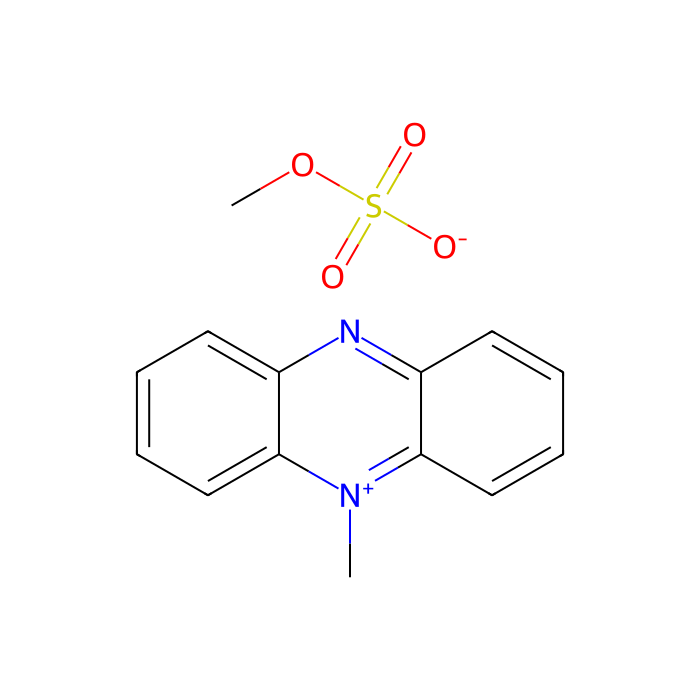
Phenazine methosulfate (PMS) is a heteroaromatic redox mediator derived from the phenazine skeleton and supplied here as a methosulfate salt.
Item-specific identifiers (from Product Data)
SKU: P105579
CAS: 299-11-6
CID: 9285
InChIKey: 328487 (as provided)
SMILES: Not specified for this item; refer to CoA/Spec Sheet.
Literature identifiers and composition (general chemistry knowledge; verify against primary sources for regulatory work)
Typical core: phenazinium (diazabicyclic, fused benzene–pyrazine-like system) bearing alkoxy/methyl substitution, paired with a methosulfate counterion.
Common synonym: 1-methoxy-5-methylphenazinium methyl sulfate (often abbreviated PMS).
Structural features (general description)
Aromatic bicyclic ring system with two ring nitrogens (phenazine core) that can be formally oxidized to a phenazinium cation.
Quaternization yields a permanently charged cation; charge-balanced by the methosulfate anion (MeOSO3−).
Two fused benzene-like rings containing two ring nitrogens (phenazine). One ring nitrogen is quaternized; an O-alkyl substituent and a ring methyl group are commonly depicted. The counterion is methyl sulfate (CH3OSO3−).
Note: Exact substitution pattern and tautomeric/ionic depiction can vary by convention in the literature; consult the product CoA/SDS for the definitive structure representation used for this catalog item.
Synthetic Utility
While PMS is primarily a biochemical reagent, its controlled redox properties lend limited utility in synthetic and mechanistic studies.
Roles in synthesis (literature)
Redox mediator in electron-transfer chains to drive dye or tetrazolium transformations under mild conditions.
Photoredox initiator in aqueous media to generate reactive oxygen species for probing radical mechanisms (less common due to competing side reactions and decomposition).
Considerations
The methosulfate counterion provides water solubility but offers little participation in organic transformations.
Photolability complicates scale-up or prolonged reactions; if a phenazine-based mediator is needed, more stable analogs (e.g., PES) or different photocatalysts (e.g., Ru- or Ir-complexes, organic dyes like eosin Y) may be preferable.
Practical tips
Maintain neutral pH and exclude light unless photoredox is intended.
Monitor reactions via UV-Vis to track mediator integrity; replace or replenish if spectral changes indicate degradation.
Overall, PMS is better suited for analytical coupling than for preparative synthetic chemistry.
Target Specificity
Not applicable. This product is a small-molecule redox mediator, not an antibody, probe, or affinity reagent. It does not possess antigen or species specificity. For usage context, see the Reaction & Applications and Buffer Applications sections.
Häufig gestellte Fragen
What is the purity of this product?
This product is supplied at ≥98% purity (chemical assay). Lot-specific values are stated on the Certificate of Analysis.
How should this product be stored?
Store at ?20 °C, protected from light. The material is light-sensitive — keep it in its original opaque or amber container.
How is this product shipped?
This product ships in an insulated container with ice pads. Unpack on arrival and transfer it to the storage condition stated above.
What are the CAS number, molecular formula and molecular weight?
The CAS Number is 299-11-6, the molecular formula is C14H14N2O4S, and the molecular weight is 306.34 g/mol. InChIKey RXGJTUSBYWCRBK-UHFFFAOYSA-M.
What documentation is provided?
Available product documentation, including Certificates of Analysis (COA), Safety Data Sheets (SDS), and specification sheets, is shown in the product document area. Document availability and access follow the current site policy.
Wir verwenden Cookies, um die ordnungsgemäße Funktion der Website sicherzustellen und, soweit zulässig, Ihr Nutzererlebnis zu verbessern. Sie können Ihre Einstellungen jederzeit unter „Einstellungen“ verwalten. Weitere Informationen finden Sie in unserer Cookie-Richtlinie.
Shall we send you a message when we have discounts available?
Remind me later
Thank you! Please check your email inbox to confirm.
Products are supplied to verified businesses, institutions, and qualified professionals for research and development use only. Not for use in humans, animals, diagnosis, or therapy.

 I2620587