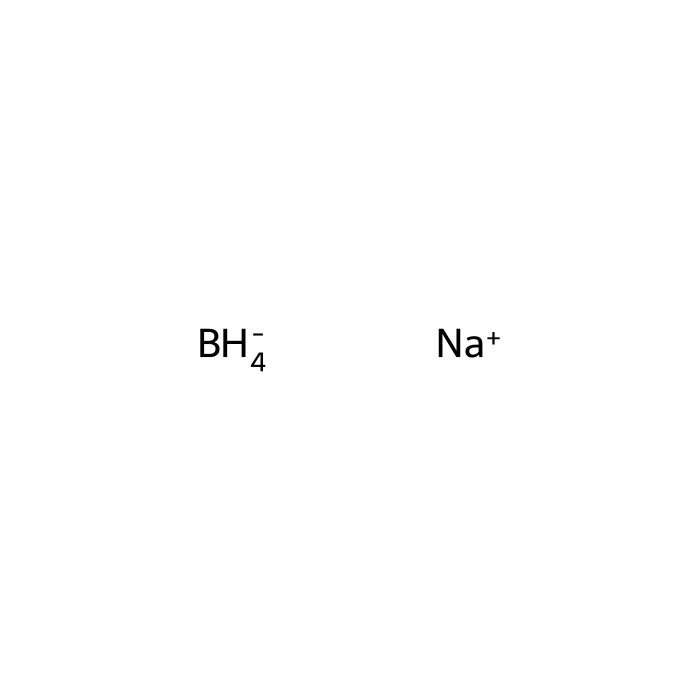
Sodium borohydride solution - 2.0 M in triethylene glycol dimethyl ether , CAS No.16940-66-2

CAS: 16940-66-2 Cat. No.: S432205 Summenformel: NaBH4 Molekulargewicht: 37.83 EG-Nummer: 241-004-4 PubChem CID: 4311764
Zu bestellen verfügbar
QUALITÄT & REINHEIT 2.0 M in triethylene glycol dimethyl ether
Synonyms
BORATE(1-), TETRAHYDRO-, SODIUM (1:1) | EINECS 241-004-4 | sodium;boranuide | O0577 | COLORSTRIP 2000 | sodium boro hydride | sodium boranuide | SODIUM TETRAHYDRIDOBORATE | 87L0B9CPPA | sodium borohydri- de | sodium borohydrid | EC 241-004-4 | NaBH | natr
Storage
Store at 2-8°C,Argon charged
Shipped In
Wet ice,FedEx DG Service
★
Größe
Deutschland (EU)
USA*
Preis
Menge
25ml
S432205-25ml
Auf Bestellung · 8–12 Wochen
75,41€
100ml
S432205-100ml
—
2 Auf Lager

230,73€

269,78€
Speichern 39,05 € (14.47%)
Enter a quantity for the sizes you want to add.
🧪
Warum diese Qualität

2.0 M in triethylene glycol dimethyl ether für empfindliche chromatographische und analytische Workflows, die minimale Basislinieninterferenzen erfordern.

🌡

Lagerung & Versand

Store at 2-8°C,Argon charged Versand Wet ice,FedEx DG Service. Genaue Spezifikationen finden Sie im chargenspezifischen COA.

📋

Qualitätsdokumente

SDS, COA, Datenblatt und Spezifikationsblatt stehen zum Download bereit. Chargenspezifische COA über Chargennummernsuche abrufbar.

📚

Literaturbeleg

In 3036 peer-reviewten Publikationen zu Chromatographie, organischer Synthese und Kreuzkupplungsreaktionen zitiert.

Spezifikationen

Synonyme
BORATE(1-), TETRAHYDRO-, SODIUM (1:1) | EINECS 241-004-4 | sodium;boranuide | O0577 | COLORSTRIP 2000 | sodium boro hydride | sodium boranuide | SODIUM TETRAHYDRIDOBORATE | 87L0B9CPPA | sodium borohydri- de | sodium borohydrid | EC 241-004-4 | NaBH | natr
Spezifikationen & Reinheit
2.0 M in triethylene glycol dimethyl ether
Storage
Store at 2-8°C,Argon charged
Verschickt in
Wet ice,FedEx DG Service
Dieses Produkt erfordert Kühlkettenversand. Grundversand und andere Economy-Optionen sind nicht verfügbar.
Namen und Kennungen
Pubchem Sid
Kanonisches Lächeln
[BH4-].[Na+]
IUPAC Name
sodium;boranuide
InChIKey
YOQDYZUWIQVZSF-UHFFFAOYSA-N
INCHI
1S/BH4.Na/h1H4;/q-1;+1
Isomere SMILES
[BH4-].[Na+]
WGK Deutschland
2
RTECS
ED3325000
PubChem CID
4311764
UN-Nummer
1426
Verpackungsgruppe
I
Molekulargewicht
37.83

Dokumentation

📋 Sicherheitsdatenblatt (SDS)

Umfassendes Dokument zu Gefahren, Handhabung, Lagerung und Einhaltung regulatorischer Vorschriften.

<<<<<<< HEAD SDS herunterladen → ======= SDS herunterladen → >>>>>>> release248-p3

✅ Analysezertifikat (COA)

Chargenspezifische Qualitätsdaten. Geben Sie Ihre Chargennummer ein, um das genaue COA abzurufen.

COA nachschlagen →

📊 Datenblatt

Kurzübersicht über Produktspezifikationen und Anwendungen.

Datenblatt ansehen →

🔬 Spezifikationsblatt

Vollständige Qualitätsmerkmale und Akzeptanzkriterien für diese Qualität.

Spezifikationsblatt ansehen →

Erweiterte Daten

Taxonomic Classification

Taxonomy Tree

KingdomInorganic compounds
SuperclassMixed metal/non-metal compounds
KlasseMiscellaneous mixed metal/non-metals
SubclassNot available
Intermediate Tree Nodes Not available
Direct ParentMiscellaneous mixed metal/non-metals
Alternative Parents Metalloid salts  Inorganic sodium salts  
Molecular FrameworkNot available
Substituents Inorganic sodium salt - Inorganic salt - Miscellaneous mixed metal/non-metal - Inorganic metalloid salt
BeschreibungThis compound belongs to the class of inorganic compounds known as miscellaneous mixed metal/non-metals. These are inorganic compounds containing non-metal as well as metal atoms but not belonging to afore mentioned classes.
External Descriptors inorganic sodium salt - metal tetrahydridoborate
3D-Struktur
Interaktives chemisches Strukturmodell


Zertifikate (CoA, COO, BSE/TSE und Analyse-Diagramm)
C of A & Other Certificates(BSE/TSE, COO):
Analytical Chart:

Find and download the COA for your product by matching the lot number on the packaging.

15 results found

Lot NumberCertificate TypeDatumArtikel
I2622610I2622610Certificate of AnalysisOct 12, 2026 S432205
I2622624I2622624Certificate of AnalysisOct 12, 2026 S432205
G2609536G2609536Certificate of AnalysisJul 21, 2026 S432205
G2609546G2609546Certificate of AnalysisJul 21, 2026 S432205
D2624345D2624345Certificate of AnalysisMay 09, 2026 S432205
D2608214D2608214Certificate of AnalysisApr 13, 2026 S432205
A2623755A2623755Certificate of AnalysisJan 26, 2026 S432205
L2508176L2508176Certificate of AnalysisDec 10, 2025 S432205
I2518496I2518496Certificate of AnalysisSep 19, 2025 S432205
F2503572F2503572Certificate of AnalysisJun 05, 2025 S432205
L2420554L2420554Certificate of AnalysisDec 25, 2024 S432205
C2419356C2419356Certificate of AnalysisMar 30, 2024 S432205
C2404040C2404040Certificate of AnalysisMar 30, 2024 S432205
I2312654I2312654Certificate of AnalysisSep 16, 2023 S432205
E23061314E23061314Certificate of AnalysisMay 09, 2023 S432205
Chemische und physikalische Eigenschaften
EmpfindlichkeitMoisture sensitive;heat sensitive
Siedepunkt (°C)130°C
Schmelzpunkt (°C)-20--10°C
Molekulargewicht37.840 g/mol
XLogP3
Hydrogen Bond Donor Count0
Hydrogen Bond Acceptor Count1
Rotatable Bond Count0
Exact Mass38.0304 Da
Monoisotopic Mass38.0304 Da
Topological Polar Surface Area0.000 Ų
Heavy Atom Count2
Formal Charge0
Complexity2.000
Isotope Atom Count0
Defined Atom Stereocenter Count0
Undefined Atom Stereocenter Count0
Defined Bond Stereocenter Count0
Undefined Bond Stereocenter Count0
The total count of all stereochemical bonds0
Covalently-Bonded Unit Count2
FAQs und Artikel
Professional Guide to Streptavidin-Modified Proteins
Common Reagents for Reducing Protein Disulfide Bonds
Nanowires: Properties, Preparation Routes, and Process Selection (Comprehensive Analysis of Top-Down and Bottom-Up Approaches with Recommended Aladdin Reagents)
How to Choose a Hydrogen Evolution (HER) Catalyst: Kinetic Barriers in Water Electrolysis, AWE/PEM/AEM Pathways, and a Materials-Family Roadmap (with a Product Map)
Installing a Redox Switch on Biomolecules: Principles, Conjugation Essentials, and an Application Guide for ATTO MB2 NHS ester
Selection of Common Research Salts: A Task Map for Alkali Metal Salts & Alkaline Earth Metal Salts (with Product Tables 1–6)
Why Metal Nanocatalysts Can “Save Energy Yet Lose Performance Easily”: Durability Logic from Active Sites to Support/Interface Engineering (Including Selection Guide and Product Tables A–D)
2-Methylpyridine–Borane (2-Picoline·BH₃) Reductive Amination Guide: Process Drivers for Replacing NaBH₃CN, the Practical Operating Window, and Scale-Up/Quench Close-Out Essentials (Including Product Tables 1–3)
Flavones: Structural Features, Physicochemical Properties, and Key Points for Research and Applications
Glutaraldehyde-mediated Microbial Inactivation: Chemical Mechanisms, Determinants, and Key Validation Considerations
Reconsidering N-Acyl Amino Protecting Groups: Deprotection Differences, Strategic Roles, and Experimental Selection of Ac, Bz, and Tfa
Phthaloyl: Its Role in Primary Amine Protection and Practical Considerations for Experimental Selection
Research Value of Polyelectrolyte Multilayers: Layer-by-Layer Design of Interfacial Composition, Mass Transport, and Function
Experimental Selection Logic for Pentafluorophenyl-Based Systems: Practical Judgment from Active Esters and Pre-Activated Monomers to Downstream Transformations
Reaction Selection in Small-Molecule Synthesis: From Transformation-Type Assessment to Experimental Route Screening
Application Differences Among Glutaraldehyde, Paraformaldehyde, and Formalin in Tissue and Cell Sample Fixation
Practical Guide to TSA Tyramide Signal Amplification: How to Select Reagents, Optimize the Workflow, and Reduce Background When Detection Signals Are Weak for Low-Abundance Targets
From Diverse Ketones to Three-Dimensional Spirocyclic Building Blocks: Reaction Design of [1.1.1]Propellane-Involved Ketone Ring Expansion
Sulfonyl Hydrazide-Mediated Introduction of Small C(sp³) Fragments: Nickel-Catalyzed Cross-Coupling, Medicinal Chemistry Applications, and Reagent Selection
Thietanes: Promising Small-Ring Building Blocks with Tunable Physicochemical Properties through Sulfur Oxidation-State Control
Skin Mechanism of Action of Pro-Xylane: From C-Xyloside Priming and CS/DS Chain Remodeling to the Dermal–Epidermal Junction
Design Logic of Fluorinated 3,3-Disubstituted Oxetane Building Blocks: Structural Construction and Modulation of Amine Basicity, Lipophilicity, and Metabolic Stability
Build the Three-Membered Ring First, or Form the Carbon–Nitrogen Bond First?—Retrosynthetic Strategies, Route Selection, and Stereochemical Control in Cyclopropylamine Synthesis
Route Selection for Thiol Synthesis: C–S Bond Construction, Sulfur Source Forms, and Thiol Release
ACT-1014-6470 Kilogram-Scale Synthesis: N7-Selective Reductive Amination of an Unprotected Pyrazole, Subsequent N2 Alkylation, and Intramolecular Urea Formation
MTAD-Mediated Oxidative Dearomatization of Pyridines: Transient para-Cycloaddition, Alkene Oxidation, and Heteroatom Functionalization
Citations of This Product
Lösungsrechner
Bewertungen

Kundenbewertungen

Dürfen wir Sie über Rabattaktionen informieren?

Später erinnern

Vielen Dank! Bitte überprüfen Sie Ihren E-Mail-Posteingang, um zu bestätigen.

Hoppla! Benachrichtigungen sind deaktiviert.