73% in water for sensitive chromatographic and analytical workflows requiring minimal baseline interference.
🌡
Storage & shipping
Store at 2-8°C Ships Wet ice Check lot-specific COA for exact specifications.
📋
Quality documents
SDS, COA, datasheet, and spec sheet available for download. Lot-specific COA accessible via lot number lookup.
📚
Literature proof
Cited in 4 peer-reviewed publications across chromatography, organic synthesis, and cross-coupling reactions.
Übersicht
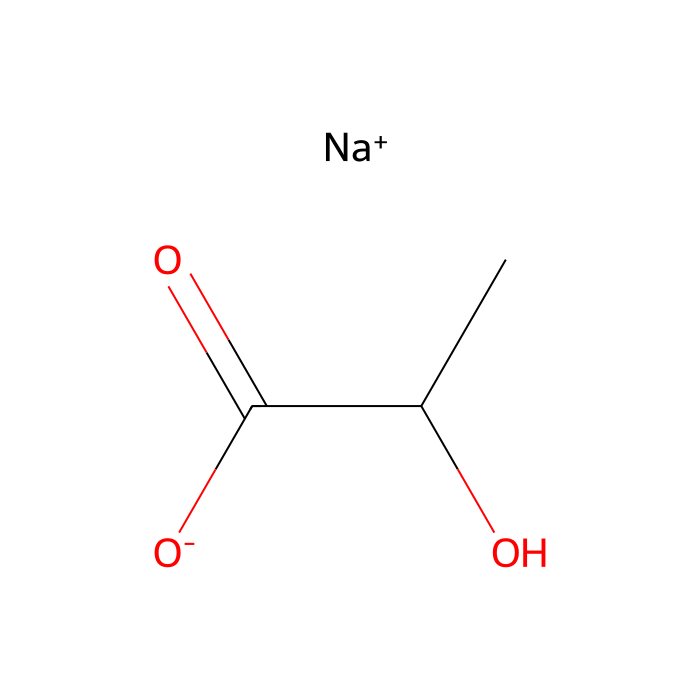
Sodium DL-lactate is an organic, sodium salt of lactic acid. It is a hygroscopic agent and a component of natural moisturizing factor (NMF). It is usually produced by fermentation.
Application
Sodium DL-lactate has been used as a component in Trypticase soy broth to culture P. gingivalis and to observe prolonged methane production in batch assays.
Specifications
Synonyme
Sodium 2-Hydroxypropionate | 2-hydroxypropionic acid sodium salt | DL-Lactic acid sodium salt
Spezifikationen & Reinheit
73% in water
Biochemische und physiologische Mechanismen
Biochem/physiol Actions
Sodium lactate functions as a buffer to maintain osmotic and charge balance. It serves as a humectant, especially in cosmetic preparations. It acts a flavoring agent in meat and poultry products. Sodium lactate also plays a role as
Storage
Store at 2-8°C
Verschickt in
Wet ice
Dieses Produkt erfordert Kühlkettenversand. Grundversand und andere Economy-Optionen sind nicht verfügbar.
Secondary alcohol - Carboxylic acid salt - Organic alkali metal salt - Monocarboxylic acid or derivatives - Carboxylic acid - Organic oxygen compound - Organic oxide - Hydrocarbon derivative - Organic sodium salt - Organic salt - Organic zwitterion - Organooxygen compound - Carbonyl group - Alcohol - Aliphatic acyclic compound
Beschreibung
This compound belongs to the class of organic compounds known as carboxylic acid salts. These are ionic derivatives of carboxylic acid.
External Descriptors
organic sodium salt - lactate salt
1. Djoumbou Feunang Y, Eisner R, Knox C, Chepelev L, Hastings J, Owen G, Fahy E, Steinbeck C, Subramanian S, Bolton E, Greiner R, and Wishart DS. ClassyFire: Automated Chemical Classification With A Comprehensive, Computable Taxonomy. Journal of Cheminformatics, 2016, 8:61.
1.Cheng Guoqing, Ding Huili, Chen Guanglin, Shi Hongjie, Zhang Xu, Zhu Minglong, Tan Wensong. (2022) Effects of cadmium sulfide nanoparticles on sulfate bioreduction and oxidative stress in Desulfovibrio desulfuricans. Bioresources and Bioprocessing, 9 (1):(1-15). [PMID:38647594][10.1186/s40643-022-00523-5]
2.Xue-Meng Wang, Zhi-Xuan Zhang, Lin Chen, Rong Chen, Wen-Wei Li. (2025) Crystal facet optimization in cadmium sulfide/reduced graphene oxide-based photosynthetic biohybrid systems for enhanced light-driven biohydrogen production. BIORESOURCE TECHNOLOGY, [PMID:40692070][10.1016/j.biortech.2025.133017]
3.Zhang Jia, Guo Lu-Yao, Lin Xiao-Qian, Wen Gui-Hua, Zhang Xue-Feng, Yu Li-Hong, He Mei-Qian, He Yu-Mei, Zou Long, Zhang Meng-Tian, Cao Li-Ming, He Chun-Ting. (2025) Microbial-vulcanized organic-inorganic dual-modulated cobalt hydroxide for oxygen evolution reaction. Nature Communications, 16 (1):(10766). [PMID:41315433][10.1038/s41467-025-65807-8]
Wir verwenden Cookies, um die ordnungsgemäße Funktion der Website sicherzustellen und, soweit zulässig, Ihr Nutzererlebnis zu verbessern. Sie können Ihre Einstellungen jederzeit unter „Einstellungen“ verwalten. Weitere Informationen finden Sie in unserer Cookie-Richtlinie.
Shall we send you a message when we have discounts available?
Remind me later
Thank you! Please check your email inbox to confirm.
Products are supplied to verified businesses, institutions, and qualified professionals for research and development use only. Not for use in humans, animals, diagnosis, or therapy.

 E2625518