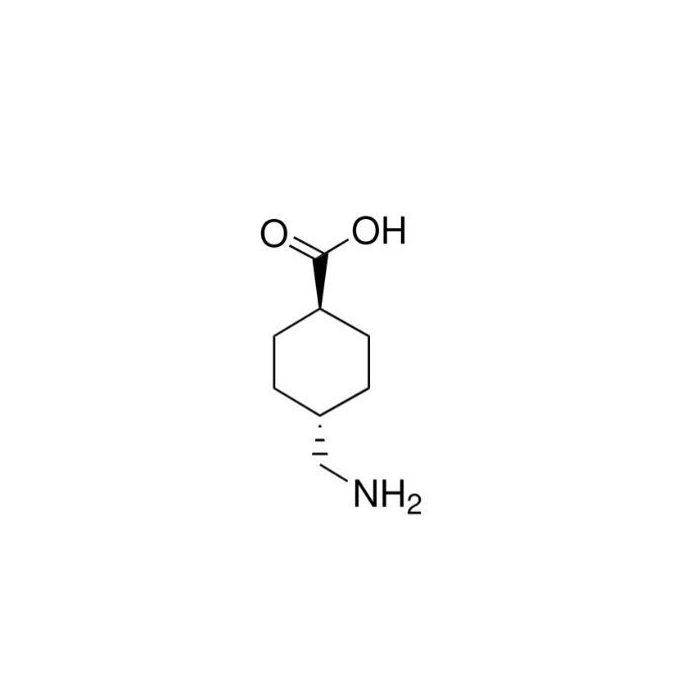
Determine the necessary mass, volume, or concentration for preparing a solution.
| Activity Type | Activity Value -log(M) | Mechanism of Action | Activity Reference | Publications (PubMed IDs) |
|---|

Inhibits plasmin-induced fibrinolysis
Taxonomy Tree
| Kingdom | Organic compounds |
|---|---|
| Superclass | Organic acids and derivatives |
| Klasse | Carboxylic acids and derivatives |
| Subclass | Amino acids, peptides, and analogues |
| Intermediate Tree Nodes | Amino acids and derivatives |
| Direct Parent | Amino acids |
| Alternative Parents | Monocarboxylic acids and derivatives Carboxylic acids Organopnictogen compounds Organic oxides Monoalkylamines Hydrocarbon derivatives Carbonyl compounds |
| Molecular Framework | Aliphatic homomonocyclic compounds |
| Substituents | Amino acid - Monocarboxylic acid or derivatives - Carboxylic acid - Organic nitrogen compound - Organic oxygen compound - Organopnictogen compound - Organic oxide - Hydrocarbon derivative - Primary amine - Organooxygen compound - Organonitrogen compound - Primary aliphatic amine - Carbonyl group - Amine - Aliphatic homomonocyclic compound |
| Beschreibung | This compound belongs to the class of organic compounds known as amino acids. These are organic compounds that contain at least one carboxyl group and one amino group. |
| External Descriptors | Not available |
| Activity Type | Activity Value -log(M) | Mechanism of Action | Activity Reference | Publications (PubMed IDs) |
|---|
Find and download the COA for your product by matching the lot number on the packaging.
| Lot Number | Certificate Type | Datum | Artikel |
|---|---|---|---|
 E2622203 | Certificate of Analysis | May 08, 2026 | A111900 |
| E2622241 | Certificate of Analysis | May 08, 2026 | A111900 |
| E2622242 | Certificate of Analysis | May 08, 2026 | A111900 |
| E2622307 | Certificate of Analysis | May 08, 2026 | A111900 |
| I2505187 | Certificate of Analysis | Aug 23, 2025 | A111900 |
| I2505186 | Certificate of Analysis | Aug 23, 2025 | A111900 |
| I2505188 | Certificate of Analysis | Aug 23, 2025 | A111900 |
| I2505189 | Certificate of Analysis | Aug 23, 2025 | A111900 |
| A2628098 | Certificate of Analysis | Aug 23, 2025 | A111900 |
| I2505190 | Certificate of Analysis | Aug 23, 2025 | A111900 |
| H2515017 | Certificate of Analysis | Jul 12, 2025 | A111900 |
| G2524183 | Certificate of Analysis | Jul 12, 2025 | A111900 |
| G2524182 | Certificate of Analysis | Jul 12, 2025 | A111900 |
| G2524181 | Certificate of Analysis | Jul 12, 2025 | A111900 |
| G2524180 | Certificate of Analysis | Jul 12, 2025 | A111900 |
| B2510160 | Certificate of Analysis | Jan 08, 2025 | A111900 |
| B2510159 | Certificate of Analysis | Jan 08, 2025 | A111900 |
| B2510158 | Certificate of Analysis | Jan 08, 2025 | A111900 |
| B2510157 | Certificate of Analysis | Jan 08, 2025 | A111900 |
| B2510156 | Certificate of Analysis | Jan 08, 2025 | A111900 |
| A2515197 | Certificate of Analysis | Jul 23, 2024 | A111900 |
| F2427092 | Certificate of Analysis | Jun 05, 2024 | A111900 |
| G2410005 | Certificate of Analysis | Jun 05, 2024 | A111900 |
| G2410006 | Certificate of Analysis | Jun 05, 2024 | A111900 |
| G2410045 | Certificate of Analysis | Jun 05, 2024 | A111900 |
| F2427090 | Certificate of Analysis | Apr 25, 2024 | A111900 |
| C2302102 | Certificate of Analysis | Feb 11, 2023 | A111900 |
| L2327030 | Certificate of Analysis | Feb 11, 2023 | A111900 |
| A2424006 | Certificate of Analysis | Feb 11, 2023 | A111900 |
| C2302028 | Certificate of Analysis | Feb 11, 2023 | A111900 |
| C2302029 | Certificate of Analysis | Feb 11, 2023 | A111900 |
| C2302030 | Certificate of Analysis | Feb 11, 2023 | A111900 |
| C2302035 | Certificate of Analysis | Feb 11, 2023 | A111900 |
| C2302036 | Certificate of Analysis | Feb 11, 2023 | A111900 |
| C2302038 | Certificate of Analysis | Feb 11, 2023 | A111900 |
| C2302039 | Certificate of Analysis | Feb 11, 2023 | A111900 |
| C2302041 | Certificate of Analysis | Feb 11, 2023 | A111900 |
| C2302778 | Certificate of Analysis | Feb 11, 2023 | A111900 |
| F2327390 | Certificate of Analysis | Feb 11, 2023 | A111900 |
| C2302103 | Certificate of Analysis | Feb 11, 2023 | A111900 |
| C2302112 | Certificate of Analysis | Feb 11, 2023 | A111900 |
| C2302113 | Certificate of Analysis | Feb 11, 2023 | A111900 |
| Löslichkeit | Soluble in water (167 mg/ml), ethanol (<1 mg/ml at 25°C).Very slightly soluble in ether, DMSO (<1 mg/ml at 25°C), and alcohol. |
|---|---|
| Molekulargewicht | 157.210 g/mol |
| XLogP3 | -2.000 |
| Hydrogen Bond Donor Count | 2 |
| Hydrogen Bond Acceptor Count | 3 |
| Rotatable Bond Count | 2 |
| Exact Mass | 157.11 Da |
| Monoisotopic Mass | 157.11 Da |
| Topological Polar Surface Area | 63.300 Ų |
| Heavy Atom Count | 11 |
| Formal Charge | 0 |
| Complexity | 139.000 |
| Isotope Atom Count | 0 |
| Defined Atom Stereocenter Count | 0 |
| Undefined Atom Stereocenter Count | 0 |
| Defined Bond Stereocenter Count | 0 |
| Undefined Bond Stereocenter Count | 0 |
| The total count of all stereochemical bonds | 0 |
| Covalently-Bonded Unit Count | 1 |
Unser Leitfaden zur Qualitätsauswahl behandelt Reinheit, Stabilisatorstatus und Anwendungseignung für alle Varianten in unserem Katalog.
Moligand™ Qualitätsleitfaden ansehen →