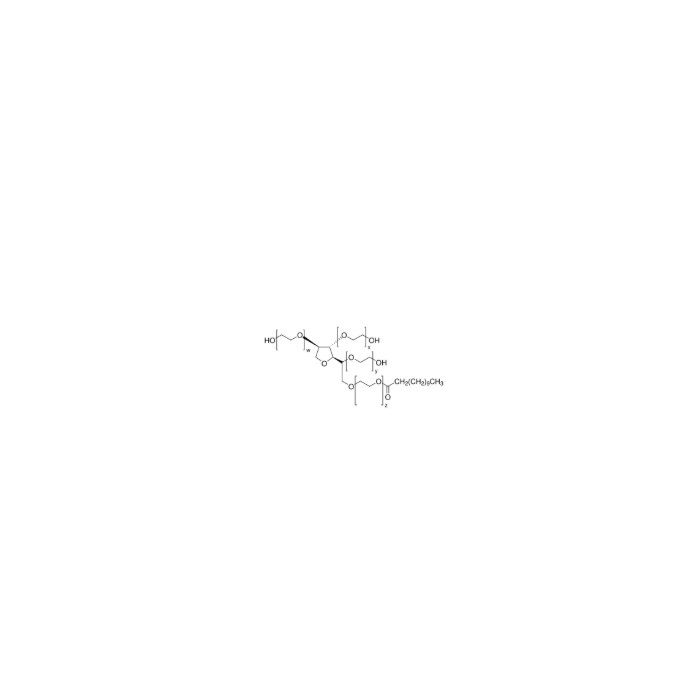
TWEEN® 20 - non-ionic, aqueous solution, 10% (w/v) , CAS No.9005-64-5

CAS: 9005-64-5 Cat. No.: T476411 Summenformel: C58H114O26(for n = 20) Molekulargewicht: 1228 (for n= 20) EG-Nummer: 500-018-3
Zu bestellen verfügbar
QUALITÄT & REINHEIT non-ionic, aqueous solution, 10% (w/v)
Synonyms
POE (6) sorbitol monolaurate|Tween(R) 20|2-{2-[3,4-bis(2-hydroxyethoxy)oxolan-2-yl]-2-(2-hydroxyethoxy)ethoxy}ethyl dodecanoate|Tween 40 (TN)|2-(2-(3,4-bis(2-hydroxyethoxy)tetrahydrofuran-2-yl)-2-(2-hydroxyethoxy)eth
Storage
Store at 2-8°C
Shipped In
Wet ice
★
Größe
Deutschland (EU)
USA*
Preis
Menge
10ml
T476411-10ml
—
3 Auf Lager
45,04€
5×10ml
T476411-5×10ml
Auf Bestellung · 8–12 Wochen
154,37€
Enter a quantity for the sizes you want to add.

Übersicht

Tween 20, also referred to as poly(oxyethylene)n-sorbitan-monolaurate, is a non-ionic surfactant. It is mainly used in membrane research.
Application
Tween 20 is used for:
solubilizing membrane proteins during isolation of membrane-protein complexes.
a subsequent protein detection by UV light absorption, due to its low UV absorbance.
ELISA (enzyme-linked immunosorbent assay) and immunoblots.

Spezifikationen

Synonyme
POE (6) sorbitol monolaurate | Tween(R) 20 | 2-{2-[3,4-bis(2-hydroxyethoxy)oxolan-2-yl]-2-(2-hydroxyethoxy)ethoxy}ethyl dodecanoate | Tween 40 (TN) | 2-(2-(3,4-bis(2-hydroxyethoxy)tetrahydrofuran-2-yl)-2-(2-hydroxyethoxy)eth
Spezifikationen & Reinheit
non-ionic, aqueous solution, 10% (w/v)
Rechtliche Informationen
Storage
Store at 2-8°C
Verschickt in
Wet ice
Dieses Produkt erfordert Kühlkettenversand. Grundversand und andere Economy-Optionen sind nicht verfügbar.
Hinweis
For life science research only. Not for use in diagnostic procedures.', '
Namen und Kennungen
SMILES
CCCCCCCCCCCC(=O)OCCOCC(C1C(C(CO1)OCCO)OCCO)OCCO
IUPAC Name
2-[2-[3,4-bis(2-hydroxyethoxy)oxolan-2-yl]-2-(2-hydroxyethoxy)ethoxy]ethyl dodecanoate
InChIKey
HMFKFHLTUCJZJO-UHFFFAOYSA-N
InChI
1S/C26H50O10/c1-2-3-4-5-6-7-8-9-10-11-24(30)34-19-18-31-20-22(32-15-12-27)26-25(35-17-14-29)23(21-36-26)33-16-13-28/h22-23,25-29H,2-21H2,1H3
Isomere SMILES
CCCCCCCCCCCC(=O)OCCOCC(C1C(C(CO1)OCCO)OCCO)OCCO
WGK Deutschland
1
RTECS
TR7400000
Molekulargewicht
1228 (for n= 20)

Erweiterte Daten

Taxonomic Classification

Taxonomy Tree

KingdomOrganic compounds
SuperclassLipids and lipid-like molecules
KlasseFatty Acyls
SubclassFatty acid esters
Intermediate Tree Nodes Not available
Direct ParentFatty acid esters
Alternative Parents Tetrahydrofurans  Carboxylic acid esters  Oxacyclic compounds  Monocarboxylic acids and derivatives  Dialkyl ethers  Primary alcohols  Organic oxides  Hydrocarbon derivatives  Carbonyl compounds  
Molecular FrameworkAliphatic heteromonocyclic compounds
Substituents Fatty acid ester - Tetrahydrofuran - Carboxylic acid ester - Carboxylic acid derivative - Dialkyl ether - Ether - Monocarboxylic acid or derivatives - Organoheterocyclic compound - Oxacycle - Organic oxide - Carbonyl group - Alcohol - Organooxygen compound - Primary alcohol - Hydrocarbon derivative - Organic oxygen compound - Aliphatic heteromonocyclic compound
BeschreibungThis compound belongs to the class of organic compounds known as fatty acid esters. These are carboxylic ester derivatives of a fatty acid.
External Descriptors a small molecule
3D-Struktur
Interaktives chemisches Strukturmodell


Zertifikate (CoA, COO, BSE/TSE und Analyse-Diagramm)
C of A & Other Certificates(BSE/TSE, COO):
Analytical Chart:

Find and download the COA for your product by matching the lot number on the packaging.

3 results found

Lot NumberCertificate TypeDatumArtikel
H2611486H2611486Certificate of AnalysisAug 18, 2026 T476411
A2627691A2627691Certificate of AnalysisFeb 03, 2026 T476411
F2513001F2513001Certificate of AnalysisJun 13, 2025 T476411
Chemische und physikalische Eigenschaften
Brechungsindex1.4685-1.4715
Flammpunkt (°C)>149℃
Siedepunkt (°C)100°C
Schmelzpunkt (°C)-14 °C
Sicherheit und Gefahren (GHS)
WGK Deutschland
1
RTECS
TR7400000
FAQs und Artikel
Tween 20 and Tween 80 as Non-Ionic Surfactants: Structure, Properties, and Applications
Enzyme Protectants and Common Methods to Prolong Enzymatic Activity
Common Issues for Western Blot (WB)
How to Choose Between Tween 20, Tween 60, and Tween 80?
Buffer Additives to Prevent Protein Precipitation
Common Protectants and Formulations for Protein Storage
11 Common Methods for Protein Concentration Determination
Differences Among Antibodies for WB/FC/IP/ChIP/IF/IHC
Principles and Application Strategies of Common PCR Enhancers
NPE (NP-n) Selection Guide: How EO Number Affects Solubility, HLB, Cloud Point, and CMC | With an Aladdin Product Reference Table
A Practical Guide to Fragrance Compositions: Turning a Black-Box Formula into an Engineerable System—Compatibility, Stability, Controlled Release, Traceability, and Selection
A Panoramic Guide to Surfactants: Definitions & Mechanisms, Key Metrics, Application Scenarios, and Selection Navigation (Tables 1–3)
Protein Tags Demystified: Classification, Properties, and Suitable Experimental Applications
Why Acridine Can Turn “Trace Molecules” into a Measurable Light Signal: A Mechanistic, Selection, and Troubleshooting Guide to Acridinium Ester Chemiluminescent Immunoassays (Including Product Tables 1–4)
Acid Phosphatase: Dephosphorylation Reactions in Acidic Microenvironments and Their Research, Assay, and Detection Applications
Diaphorase: NAD(P)H-Dependent Electron-Transfer Activity and Its Applications in Detection and Research
Haptoglobin (Hp): A Key Carrier in the Free Hemoglobin Clearance–Detoxification Axis, with Assays and Applications
Urinary Follicle-Stimulating Hormone (uFSH): Source Attributes, Molecular Properties, and Research Application Frameworks
Cholesterol Esterase: Mechanistic Insights and Application Frameworks Driven by Interfacial Hydrolysis
Angiotensin-Converting Enzyme (ACE): A Review of Molecular Features, Catalytic Functions, and Research and Translational Applications
Hemicellulases: A Review of Substrate Specificity, Catalytic Systems, and Research and Industrial Applications
Phytase: Enzymological Properties, Mechanism of Action, and Applications in Feed and Food
Chitinases: Substrate-Specific Degradation Mechanisms, Enzymatic Properties, and Application Directions
Review of the Principles, Common Methods, and Key Application Considerations for the Determination of Glycerol and Triglyceride Contents
Glycoprotein Hormone Family: Molecular Features, Signaling Bias, and In Vivo Pharmacokinetics
Tyramide Signal Amplification in In Situ Fluorescence Detection
Selection Strategy for PBS, TBS, PBST, and TBST Washing Systems in IHC
Preparation Methods and Precautions for Silane Coupling Agent Primer Solutions
Solvents, Co-solvents, and Solubilization Systems in Home and Personal Care Formulations: Classification, Functions, and Selection Guide
Practical Guide to TSA Tyramide Signal Amplification: How to Select Reagents, Optimize the Workflow, and Reduce Background When Detection Signals Are Weak for Low-Abundance Targets
Signal Transduction Mechanism of Graphene Biosensors: From Molecular Recognition to Electrical/Optical Signal Readout and Materials Selection
Why Limonene Can Soften Greasy Soils Yet Is Difficult to Dissolve in Water: Understanding the Cleaning Mechanism and Formulation Applications of Naturally Derived Solvents from Molecular Structure
Interfacial Mechanism and Formulation Applications of AEO-9 (Fatty Alcohol Polyoxyethylene Ether): An Analysis of Emulsification, Wetting, Oil Soil Removal, and Co-Formulation Compatibility
Analysis of the Foaming Performance Differences Between K12 and AOS: Structure, Acid–Base Stability, and Formulation Selection
Structural Characteristics, Low-Temperature Flowability, and Home-Care Cleaning Applications of Palm-Derived Isomeric Alcohol Polyoxyethylene Ether PLE-S9
Structural Logic of Nonionic Surfactants: Mechanisms of Action, Classification Features, and Selection Principles
Why Are Daily Chemical Products Prone to Viscosity Thinning in Summer? Core Mechanisms, Troubleshooting Methods, and Solutions
Understanding the Four Classes of Surfactants Through Molecular Charge: Application Logic of Anionic, Cationic, Amphoteric and Zwitterionic, and Nonionic Surfactants in Personal Care and Home Care
Comparison of Bilirubin Detection Methods: Application Selection of the Diazo Method, Vanadate Oxidation Method, Bilirubin Oxidase Method, and HPLC
Antioxidant Mechanisms of Ferulic Acid in Skincare, Vitamin C/E Synergy, and Stable Delivery Applications
Bacterial Cell Wall Degradation Technology
Applications of Cell Permeabilization Technology in Immunofluorescence and Flow Cytometry Detection
Mechanisms of Action, Formulation Screening, and Safety Evaluation of Solubilizers, Hydrotropes, and Cosolvents in Drug-Delivery Systems
Citations of This Product
Lösungsrechner
Bewertungen

Kundenbewertungen

Häufig gestellte Fragen

How should this product be stored?
Store at 2–8 °C. Refrigerated storage is required to maintain the specified shelf life.
How is this product shipped?
This product ships chilled on wet ice. Unpack on arrival and transfer it to the storage condition stated above.
What are the CAS number, molecular formula and molecular weight?
The CAS Number is 9005-64-5, the molecular formula is C58H114O26(for n = 20), and the molecular weight is 1228 (for n= 20) g/mol. InChIKey HMFKFHLTUCJZJO-UHFFFAOYSA-N.
What documentation is provided?
Available product documentation, including Certificates of Analysis (COA), Safety Data Sheets (SDS), and specification sheets, is shown in the product document area. Document availability and access follow the current site policy.

Dürfen wir Sie über Rabattaktionen informieren?

Später erinnern

Vielen Dank! Bitte überprüfen Sie Ihren E-Mail-Posteingang, um zu bestätigen.

Hoppla! Benachrichtigungen sind deaktiviert.