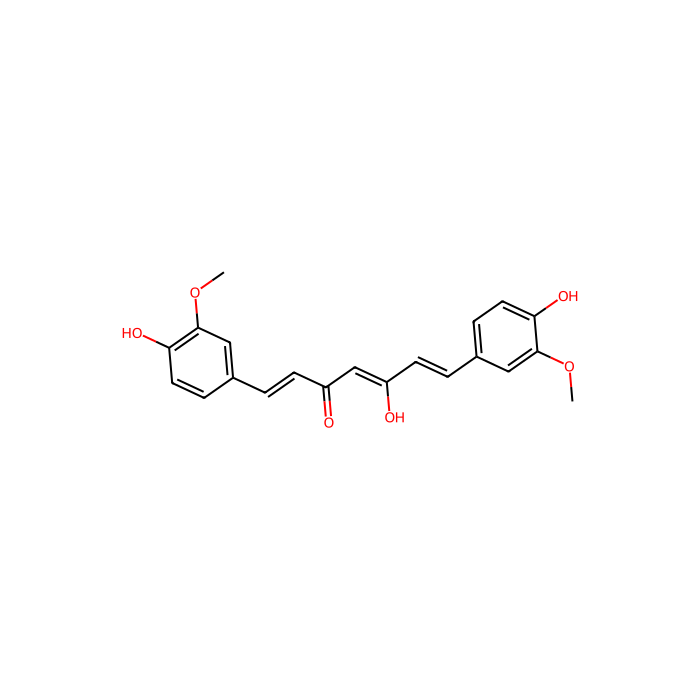
Curcumin - Moligand™, 10mM in DMSO , Inhibitor of E1A binding protein p300;Activator of TRPV4, CAS No.458-37-7, Inhibitor of E1A binding protein p300;Activator of TRPV4

CAS: 458-37-7 Cat. No.: C408195 Formula: C21H20O6 Molecular Weight: 368.38 Beilstein Registry Number: 2306965 EC Number: 207-280-5
AVAILABLE TO ORDER
GRADE & PURITY Moligand™ ? Moligand™ — Aladdin's line of ligands and bioactive small molecules. Use for receptor, pathway, and binding studies needing defined small-molecule tools. 10mM in DMSO
Synonyms
Diferuloylmethane, Natural Yellow 3, Turmeric yellow|(1E,6E)-1,7-bis(4-hydroxy-3-methoxyphenyl)hepta-1,6-diene-3,5-dione
Storage
Store at -80°C
Shipped In
Dry ice packs + Cold packs
★
Size
Germany (EU)
USA*
Price
Qty
1ml
C408195-1ml
Made to order · 8–12 wks

€117.93

€153.50
Save €35.58 (23.18%)
Enter a quantity for the sizes you want to add.

Overview

Information

Curcumin Curcumin (Diferuloylmethane, Natural Yellow 3, Turmeric yellow) is the principal curcuminoid of the popular Indian spice turmeric, which is a member of the ginger family (Zingiberaceae). It is an inhibitor of p300 histone acetylatransferase (IC
In vitro

Curcumin induces the expression of forkhead box protein O1 (FOXO1) through activation of extracellular signal-regulated kinase 1/2 signaling. Curcumin inhibits cell proliferation, which was associated with upregulation of the cyclin-dependent kinase inhibitors, p27 and p21, and downregulation of cyclin D1. Curcumin induces endoplasmic reticulum (ER) stress and mitochondrial dysfunction as evidenced by up-regulation of CCAAT/enhancer binding protein homologous protein (CHOP), phosphorylation of JNK and down-regulation of SERCA2ATPase, release of cytochrome c, decrease of Bcl-2 and reduction of mitochondrial membrane potential in both AGS and HT-29 cells.

In vivo

Chronic treatment with curcumin significantly reverses the CMS-induced behavioral abnormalities in stressed rats. Additionally, curcumin effectively inhibits cytokine gene expression at both the mRNA and the protein level and reduces the activation of NF-κB.
Cell Data

cell lines:T24, BT-474, SK-BR-3, and NCI-H596 cells

Concentrations:0-100 μM

Incubation Time:24-48 h

Powder Purity:≥99%

Specifications

Synonyms
Diferuloylmethane, Natural Yellow 3, Turmeric yellow | (1E,6E)-1,7-bis(4-hydroxy-3-methoxyphenyl)hepta-1,6-diene-3,5-dione
Specifications & Purity
Moligand™, 10mM in DMSO
Biochemical and Physiological Mechanisms
Curcumin (Diferuloylmethane, Natural Yellow 3, Turmeric yellow) is the principal curcuminoid of the popular Indian spice turmeric, which is a member of the ginger family (Zingiberaceae). It is an inhibitor of p300 histone acetylatransferase(IC50~25 μM)and Histone deacetylase (HDAC); activates Nrf2 pathway and supresses the activation of NF-κB. Curcumin induces mitophagy, autophagy, apoptosis, and cell cycle arrest with antitumor activity. Curcumin reduces renal damage associated with rhabdomyolysis by decreasing ferroptosis-mediated cell death. Curcumin exhibits anti-infective properties against various human pathogens like the influenza virus, hepatitis C virus, HIV and so on.
Storage
Store at -80°C
Shipped In
Dry ice packs + Cold packs
This product requires cold chain shipping. Ground and other economy services are not available.
Grade
Moligand™
Action Type
ACTIVATOR, INHIBITOR
Mechanism of action
Inhibitor of E1A binding protein p300;Activator of TRPV4
Names and Identifiers
Isomeric SMILES
COC1=C(C=CC(=C1)/C=C/C(=O)CC(=O)/C=C/C2=CC(=C(C=C2)O)OC)O
WGK Germany
3
RTECS
MI5230000
Alternate CAS
94875-80-6
Molecular Weight
368.38
Beilstein
2306965
Reaxys
2016701
Reaxys-RN_link_address
https://www.reaxys.com/reaxys/secured/hopinto.do?context=S&query=IDE.XRN=2016701&ln=

Advanced Data

Associated Targets(Human)
EP300 Tchem Histone acetyltransferase p300 (0 Activities)
Activity TypeActivity Value -log(M)Mechanism of ActionActivity ReferencePublications (PubMed IDs)
PTGES Tchem Prostaglandin E synthase (3 Activities)
Activity TypeActivity Value -log(M)Mechanism of ActionActivity ReferencePublications (PubMed IDs)
SNCA Tchem Alpha-synuclein (2 Activities)
Activity TypeActivity Value -log(M)Mechanism of ActionActivity ReferencePublications (PubMed IDs)
F3 Tclin Tissue factor (1 Activities)
Activity TypeActivity Value -log(M)Mechanism of ActionActivity ReferencePublications (PubMed IDs)
GLO1 Tchem Lactoylglutathione lyase (1 Activities)
Activity TypeActivity Value -log(M)Mechanism of ActionActivity ReferencePublications (PubMed IDs)
MAOA Tclin Amine oxidase [flavin-containing] A (1 Activities)
Activity TypeActivity Value -log(M)Mechanism of ActionActivity ReferencePublications (PubMed IDs)
APP Tclin Amyloid-beta A4 protein (3 Activities)
Activity TypeActivity Value -log(M)Mechanism of ActionActivity ReferencePublications (PubMed IDs)
CISD1 Tchem CDGSH iron-sulfur domain-containing protein 1 (1 Activities)
Activity TypeActivity Value -log(M)Mechanism of ActionActivity ReferencePublications (PubMed IDs)
Certificates (CoA,COO,BSE/TSE and Analysis Chart)
C of A & Other Certificates(BSE/TSE, COO):
Analytical Chart:
Chemical and Physical Properties
SolubilitySolubility (25°C) In vitro DMSO: 100 mg/mL (60.06 mM);    
Melt Point183°C
Safety and Hazards(GHS)
Pictogram(s)
GHS02,   GHS07
Signal
Warning
Hazard Statements

H227:Combustible liquid

H315:Causes skin irritation

H319:Causes serious eye irritation

H335:May cause respiratory irritation

Precautionary Statements

P261:Avoid breathing dust/fume/gas/mist/vapors/spray.

P264:Wash hands [and …] thoroughly after handling.

P271:Use only outdoors or in a well-ventilated area.

P280:Wear protective gloves/protective clothing/eye protection/face protection.

P321:Specific treatment (see ... on this label).

P302+P352:IF ON SKIN: wash with plenty of water.

P304+P340:IF INHALED: Remove person to fresh air and keep comfortable for breathing.

P305+P351+P338:IF IN EYES: Rinse cautiously with water for several minutes. Remove contact lenses if present and easy to do - continue rinsing.

P362+P364:Take off contaminated clothing and wash it before reuse.

P405:Store locked up.

P403+P233:Store in a well-ventilated place. Keep container tightly closed.

P501:Dispose of contents/container to an approved waste disposal plant.

P264+P265:Wash hands [and …] thoroughly after handling. Do not touch eyes.

P337+P317:If eye irritation persists: Get medical help.

P332+P317:If skin irritation occurs: Get medical help.

P319:Get medical help if you feel unwell.

WGK Germany
3
RTECS
MI5230000
Reaxys
2016701
Reaxys-RN_link_address
https://www.reaxys.com/reaxys/secured/hopinto.do?context=S&query=IDE.XRN=2016701&ln=
Documents & Articles
Hedgehog Signaling
Epigenetic Modifiers
Origins and Structure of Vanillin (Vanillic Aldehyde):Recommended Precursors and Reference Materials
How to Map the NF-κB Pathway and Choose Inhibitors: Bringing Inflammatory Transcriptional Output into a “Controllable Range” (Tables A–F)
Antioxidant Enzyme Networks in Skin Cells and Their Applications in Skincare and Cosmetics
Color-Development Mechanisms, Formulation Forms, and Selection/Application Logic of Colorants in Personal Care Products
Summary of Research Advances in Oxidative Stress
Curcumin
Curcumin
Hedgehog Signaling
If the DNA Sequence Remains Unchanged, Why Does Gene Expression Change? Core Mechanisms and Research Methods of Epigenetic Regulation
Mechanisms of Action, Representative Compounds, and Research Applications of Senolytics
Antidiabetic Mechanisms, Representative Bioactive Compounds, and Research Applications of Natural Products
Regulatory Mechanisms of Aging-Related Nutrient Sensing, Inflammation, and Homeostatic Signaling Pathways
Molecular Mechanisms by Which Natural Products Regulate Adipose Browning
Citations of This Product
Solution Calculators
Reviews

Customer Reviews

Application Protocols

No tested application protocols are provided in the Product Data. The following general research workflows are commonly used with curcumin and may be adapted to your system:

  • Preparation of DMSO stock solution (research practice):
    1. Allow vial to equilibrate to room temperature in the dark. 2) Add anhydrous DMSO to achieve 10–50 mM. 3) Vortex and sonicate briefly; warm to ~35–40 °C if needed. 4) Filter through 0.22 μm PTFE if particulates remain. 5) Aliquot, protect from light, and store at −80 °C.
  • Aqueous dosing into buffers/cell media:
    • Add DMSO stock to vigorous vortexing buffer to reach final vehicle ≤0.1–0.5% v/v. Prepare immediately before use to limit degradation; use amber labware.
  • Fluorescence measurement (literature-based):
    • Excitation: ~420–430 nm; emission collection: ~500–600 nm. Record spectra in your exact solvent/buffer as maxima shift with polarity and pH. Keep concentrations in the low μM range to minimize inner-filter effects.
  • Metal complex formation (qualitative assay):
    • Mix curcumin in EtOH with a slight excess of boric acid under acidic conditions to observe rosocyanine formation (color change); use for qualitative demonstrations or further analytical development.

These are general guidelines and not validated protocols for this specific item; validate and optimize locally.

Biological Roles

Curcumin is a plant-derived diarylheptanoid from turmeric (Curcuma longa). The notes below summarize general biochemical properties from the literature and are provided for research context only (no medical/clinical claims).

  • Physicochemical behavior in biological settings (literature):
    • Lipophilic with poor aqueous solubility; partitions into membranes and hydrophobic protein pockets.
    • Exhibits pH-dependent tautomerism; deprotonation above neutral pH accelerates hydrolytic/oxidative degradation in aqueous media.
  • Molecular interactions (literature):
    • Functions as a Michael acceptor that can form reversible or irreversible adducts with nucleophilic residues (e.g., cysteine) in proteins under certain conditions.
    • Chelates metal ions via the β-diketonate, affecting fluorescence and potentially redox behavior.
  • Spectroscopic utility (literature):
    • Intrinsic fluorescence makes curcumin a probe for hydrophobic environments, amyloid-like aggregates, or lipid phases in model systems.

Research Use Note (from Product Data): For research use only. Not for human or animal therapeutic or diagnostic applications.

Buffer Applications

Curcumin is not a buffering reagent and is not used to set or maintain pH.

  • Practical note: When dosing into buffered aqueous media for research, pre-dissolve in an appropriate organic solvent (commonly DMSO) and add to the buffer with vigorous mixing to avoid precipitation. Maintain low final cosolvent percentages (e.g., ≤0.1–0.5% v/v) to preserve buffer properties.
  • pH considerations (literature): Curcumin degrades more rapidly under basic conditions; neutral to mildly acidic buffers help limit decomposition during short experiments.
Green Alternatives

This product is a solid research compound rather than a solvent. “Green alternatives” are best considered in the context of handling media and processes involving curcumin.

  • Solvent choices (literature guidance):
    • Prefer ethanol or ethyl acetate over chlorinated solvents for recrystallization or handling when feasible.
    • For stock solutions, DMSO is effective but not “green”; consider ethanol for spectroscopic work if solubility allows.
  • Process considerations:
    • Minimize organic solvent volumes by preparing concentrated stocks and diluting into assay media at low vehicle percentages.
    • Protect from light to reduce degradation waste; store at −80 °C to extend lifetime and reduce re-synthesis needs.

Illustrative comparison (literature trends; not item-specific):

  • DMSO: high solubility and stability; low volatility; not renewable and can complicate waste streams.
  • Ethanol: bio-based and low-toxicity; moderate solubility for curcumin; flammable.
  • Ethyl acetate: relatively green for extractions; limited aqueous compatibility.

If your workflow permits, prioritize ethanol/EtOAc for preparative steps and use minimal DMSO for final high-concentration stocks.

Pharmaceutical Uses

No item-specific pharmaceutical excipient status or compendial listings are provided for this product.

  • General/literature context for research formulation work (non-clinical):
    • Curcumin is studied as a hydrophobic payload in model delivery systems (e.g., polymeric nanoparticles, liposomes, cyclodextrin complexes) due to its fluorescence and stability profile, enabling simultaneous tracking and loading assessment.
    • It is also known as a coloring agent in foods; however, this catalog item is designated for research use only and is not supplied for food, cosmetic, or clinical applications.

Item-specific regulatory status, compendial conformity (USP/EP/JP), and allowable impurities: Not specified for this item; refer to CoA/Spec Sheet.

Physical Properties

Item-specific physical constants are not provided in the Product Data. The following are typical literature values for curcumin and should be treated as general guidance only (not item specifications):

  • Appearance: yellow–orange crystalline solid (literature)
  • Melting point: ~183–186 °C, often reported with decomposition and polymorph dependence (literature)
  • Solubility (25 °C, literature):
    • Water: practically insoluble (<0.01 mg/mL); undergoes rapid hydrolytic degradation at basic pH.
    • Organic solvents: soluble in DMSO, DMF, acetone, ethyl acetate; moderately soluble in ethanol and methanol; limited in nonpolar alkanes. Solubility increases with temperature and in the presence of base due to enolate formation.
  • LogP (octanol/water): ~3.3–3.6 (literature), consistent with lipophilic behavior.
  • pKa (literature): enolic/phenolic deprotonations typically pKa1 ~8–8.5, pKa2 ~9–10; deprotonation enhances aqueous solubility but can reduce stability.
  • UV–Vis (literature): strong absorption band near 420–430 nm (π–π*), solvent- and pH-dependent; fluorescence emission commonly ~530–560 nm in polar organics.

Item-specific values (water content, residual solvents, trace metals, UV cutoff, etc.): Not specified for this item; refer to CoA/Spec Sheet.

Quality & Grades
  • Grade/Purity (from Product Data): Moligand™.
    • Moligand™ denotes a small-molecule/ligand library grade intended for screening, SAR exploration, and chemical biology workflows. Lots are typically qualified by identity (e.g., LC–MS/HRMS) and purity by chromatographic methods suitable for library use; however, exact analytical criteria for this catalog item are not provided here.
    • Item-specific purity, residual solvent profile, and analytical methods: Not specified for this item; refer to CoA/Spec Sheet.
  • Stabilizers: Not specified for this item; refer to CoA/Spec Sheet. Curcumin is commonly shipped/stored under light protection to mitigate photodegradation.
  • Implications for use:
    • Library-grade materials are appropriate for primary screening and hit validation, generally as DMSO stocks. For dose–response or mechanistic studies, consult the CoA for exact purity and consider additional purification if needed.
    • Shipped on dry ice/cold packs and stored at −80 °C (per Product Data) to maintain integrity over long-term library storage and minimize oxidative/photo-induced degradation.
  • Documentation: For regulatory or analytical needs (e.g., metal content, water content, polymorph), request the lot-specific CoA and specification sheet.
Reaction & Applications

Curcumin’s β-diketone and conjugated E,E-dienone confer versatile reactivity and useful spectroscopic properties.

  • Chemical reactivity (literature):
    • Enolizable β-diketone: undergoes keto–enol tautomerism; forms metal chelates (e.g., with boron, transition metals), enabling colorimetric/fluorometric complexes.
    • Michael acceptor: the α,β-unsaturated carbonyls can add soft nucleophiles (e.g., thiols), forming conjugate adducts.
    • Phenolic functions: amenable to O-alkylation, O-acylation, and ether cleavage strategies.
  • Representative transformations (literature):
    • Hydrogenation (Pd/C, H2) to di-/tetrahydrocurcumin with altered photophysics.
    • Complexation with boric acid to rosocyanine (basis of boron determination assays).
    • Protection of phenols (Ac2O/pyridine) to enhance stability during further modifications.
    • Heteroatom additions (e.g., thiol–Michael) for probe/bioconjugate synthesis.
  • Analytical/optical applications (literature):
    • Strong absorption ~420–430 nm and green fluorescence (~530–560 nm) enable use as a solvatochromic fluorophore and microenvironment reporter.
  • Practical tips:
    • Work under subdued light; exclude base and oxygen when stability is critical.
    • For metal complexation studies, pre-form enolate under controlled pH or base and use dry, oxygen-free solvents to avoid oxidative side reactions.

Manufacturer applications: Not specified in Product Data; the above reflect common literature uses for curcumin in chemical research.

Reaction Conditions

The following conditions are representative literature guidance for working with curcumin and its common transformations (not item-specific specifications):

  • Stock preparation and handling:
    • Dissolve at 10–50 mM in anhydrous DMSO under subdued light. Gentle warming (≤40 °C) and sonication aid dissolution. Store aliquots at −80 °C.
  • Michael addition to curcumin:
    • Solvent: polar aprotic (DMSO, DMF) or alcohols; base-catalyzed (e.g., Et3N or piperidine, 0.1–1.0 equiv) at rt to 50 °C.
    • Time: 1–24 h depending on nucleophile; monitor by LC–MS/UPLC.
  • Phenolic O-acylation/O-alkylation:
    • Reagents: Ac2O/pyridine or acid chlorides with base (pyridine, Et3N) at 0–25 °C; or alkyl halides with K2CO3 in acetone/DMF.
    • Typical: 1–6 h; protect from light; yields vary with substitution pattern.
  • Hydrogenation/reduction:
    • Catalyst: Pd/C (5–10 wt%) under H2 (1–3 atm) in EtOH/EtOAc at rt to 40 °C.
    • Endpoint: di- or tetrahydrocurcumin; monitor by TLC/HPLC.
  • Metal complexation/chelation:
    • Generate enolate with mild base (e.g., NaOAc) in EtOH or MeOH, then add metal salt under inert atmosphere; isolate complexes by precipitation or chromatography.

Always optimize on small scale, exclude strong base and prolonged light exposure to minimize degradation and side products.

Safety & Handling
  • GHS information (item-specific):
    • Signal word: Not specified for this item; refer to SDS.
    • Hazard statements (H-codes): Not specified for this item; refer to SDS.
    • Pictograms/classification: Not specified for this item; refer to SDS.
  • General handling guidance (good lab practice; not a substitute for SDS):
    • Avoid inhalation of dust and contact with skin/eyes; curcumin is an intense dye and can stain surfaces and PPE.
    • Use in a fume hood or well-ventilated area. Wear appropriate PPE: lab coat, safety glasses, and suitable gloves (e.g., nitrile).
    • Protect from light; the conjugated dienone is photosensitive and can degrade upon prolonged illumination, especially in basic or aqueous media.
    • Avoid strong bases (favoring rapid degradation), strong oxidants, and reactive acylating agents unless intended.
  • First-aid (overview; defer to SDS):
    • Eye/skin contact: Rinse with water for several minutes; remove contaminated clothing. Seek medical attention if irritation persists.
    • Inhalation: Move to fresh air; seek medical attention if symptoms occur.
    • Ingestion: Rinse mouth; seek medical advice.
  • Spill and disposal:
    • Collect solids with minimal dust generation; adsorb solutions with inert material. Dispose of in accordance with institutional and local regulations.
  • Fire safety: Organic solid; use CO2, dry chemical, or foam. Combustion may produce CO/CO2.
Solvent Selection

Curcumin is highly conjugated and moderately lipophilic, with poor aqueous solubility and improved solubility in polar aprotic organics.

  • Polarity & miscibility (literature):
    • Preferred solvents: DMSO, DMF, acetone, ethyl acetate. Ethanol/methanol provide moderate solubility; isopropanol typically lower.
    • Aqueous media: practically insoluble; co-solvent systems (e.g., 0.1–1% DMSO or ethanol) or inclusion complexes (cyclodextrins) are commonly used in research settings.
  • Practical guidance for stock solutions (research practice):
    • Prepare concentrated DMSO stocks (e.g., 10–50 mM). Warm gently (≤40 °C) and vortex/sonicate to assist dissolution. Protect from light.
    • Filter through 0.22 μm PTFE for particulate removal if needed. Avoid extended exposure to basic solutions.
  • When to choose alternatives:
    • For spectroscopic work where DMSO background is undesirable, consider EtOH or MeOH; note pH-dependent spectral shifts.
    • For biological assay dilution, maintain final DMSO ≤0.1–0.5% v/v to minimize vehicle effects; pre-dissolve fully in DMSO before adding to aqueous buffers.
  • Quick comparison (literature trend):
    • DMSO: highest solubility; best for concentrated stocks.
    • Ethanol: acceptable for optical work; lower maximal concentration.
    • Acetone/EtOAc: good solubilizers for synthetic manipulations; limited compatibility with aqueous systems.
Storage & Reconstitution
  • Storage conditions (from Product Data):
    • Store at −80 °C. Shipments are made on dry ice packs + cold packs to maintain low temperature.
  • Light and atmosphere:
    • Protect from light at all times. Keep containers tightly closed; use inert gas backfill (e.g., argon) for long-term storage of opened solids or DMSO stocks to limit oxidation.
  • Reconstitution (research guidance):
    • Solvents: DMSO is recommended for concentrated stocks; ethanol or DMF can be alternatives depending on application. Water solubility is extremely low.
    • Procedure: Bring container to room temperature before opening to avoid moisture condensation. Add solvent to target concentration (e.g., 10–50 mM), vortex/sonicate, and warm gently (≤40 °C) if needed. Filter if necessary through PTFE (0.22 μm).
    • Aliquoting: Dispense into amber, airtight vials (single-use aliquots). Avoid repeated freeze–thaw cycles; thaw on ice and use promptly.
  • Stability notes (literature):
    • Degrades more rapidly at basic pH and in aqueous solutions; prepare working dilutions immediately before use. Store frozen stocks in the dark to maximize shelf life.
  • Item-specific stabilizers, peroxides, water content: Not specified for this item; refer to CoA/Spec Sheet.

Research Use Note: For research use only.

Structure & Identity

Curcumin is a diarylheptanoid natural product composed of two 4-hydroxy-3-methoxyphenyl rings bridged by a conjugated hepta-1,6-diene-3,5-dione (β-diketone) linker.

  • Item identifiers (from Product Data):
    • Product name: Curcumin (SKU: C408195)
    • CAS: 458-37-7
    • Category: Small molecule library (Moligand™)
  • Structural features (general/literature description):
    • Core: 1,7-bis(4-hydroxy-3-methoxyphenyl)-1,6-heptadiene-3,5-dione
    • Functional groups: two phenols, two anisoles (methoxyaryl), and one β-diketone (enolizable), with an extended conjugated E,E-dienone system.
    • 2D description: two substituted phenyl rings connected by –CH=CH–CO–CH2–CO–CH=CH–; each ring bears para–OH and meta–OCH3.
  • Molecular identifiers (literature; not item-specific specs):
    • Molecular formula: C21H20O6 (literature)
    • Molecular weight: ~368.38 g/mol (literature)
    • Canonical SMILES: often reported as COc1cc(/C=C/C(=O)CC(=O)/C=C/c2ccc(OC)c(O)c2)ccc1O or close variants (literature)
    • InChIKey: commonly cited as VZRDQGMWRZOLNZ-UHFFFAOYSA-N (literature)

Note: Exact structural identifiers (SMILES/InChIKey) for this catalog item are not specified; refer to CoA/Spec Sheet for item-specific confirmation.

Synthetic Utility

Curcumin serves as both a substrate and a scaffold for derivatization in organic synthesis.

  • Functional group reactivity (literature):
    • β-Diketone: enolization enables chelation, acylation/alkylation at the active methylene (under controlled conditions), and formation of heterocycles.
    • Conjugated dienone: undergoes Michael additions (e.g., thiols, amines) and can be selectively hydrogenated.
    • Phenolic groups: platforms for etherification/esterification to modulate solubility, stability, and electronic properties.
  • Scaffold modification (literature examples):
    • O-alkyl/O-acyl curcumins for improved lipophilicity or protection during multistep synthesis.
    • Metal–curcumin complexes (e.g., Cu, Zn) as coordination compounds with distinct optical/redox properties.
    • Click-ready derivatives via introduction of azide/alkyne handles on aromatic substituents.
  • Retrosynthetic insight:
    • Classical access via Claisen–Schmidt or Knoevenagel-type condensations between substituted benzaldehydes and 1,3-dicarbonyl precursors, followed by controlled dehydration.

These features make curcumin a versatile building block for probe development, coordination chemistry, and structure–property exploration.

Target Specificity

This product is a small molecule, not a biological targeting reagent (e.g., antibody/ligand with defined epitope). No item-specific target specificity data are provided.

  • General note (literature): Curcumin can interact with diverse proteins and membranes via hydrophobic and Michael-acceptor interactions; these are broad and not target-specific. Any binding or activity assessments should be experimentally determined in the user’s system.

Shall we send you a message when we have discounts available?

Remind me later

Thank you! Please check your email inbox to confirm.

Oops! Notifications are disabled.