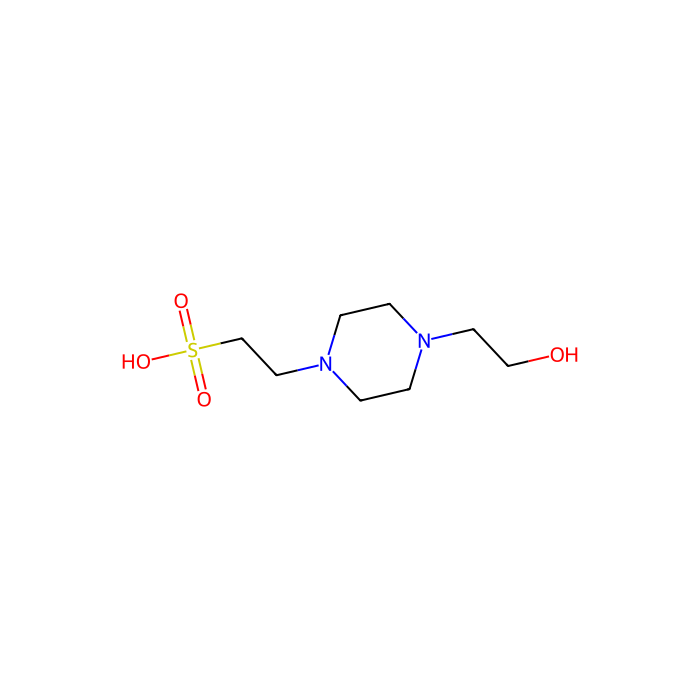
HEPES solution(HEPES) - BioReagent, for cell culture, sterile-filtered, 1 M , CAS No.7365-45-9

CAS: 7365-45-9 Cat. No.: H433401 Formula: C8H18N2O4S Molecular Weight: 238.30 EC Number: 230-907-9
AVAILABLE TO ORDER
GRADE & PURITY BioReagent ? BioReagent grade — tested suitable for life-science and molecular-biology use. Use for cell culture, assays, and biochemical work needing biological compatibility. for Cell culture ? Cell-culture grade — low endotoxin and contaminants to support viable cell growth. Use in mammalian/other cell culture media and supplements. sterile-filtered, 1 M
Synonyms
2-[4-(2-hydroxyethyl)piperazin-1-yl]ethanesulfonic acid|HEPES, biochemical grade|4-(2-Hydroxyethyl)piperazine-1-(2-ethanesulfonic acid)|HEPES, dry powder|2-[4-(2-hydroxyethyl)-1-piperazinyl] ethanesulfonic acid|(4-(2-Hydroxyethyl)-1-piperazineethanesulfonic acid|HEPES (D18)|4-(2-HYDROXYETHYL)-1-PIPERAZINE ETHANESULFONIC ACID|4-(2-Hydroxyethyl)piperazin-1-ylethanesulphonic acid|15(R)-hydroperoxy-EPE|4-(2-hydroxyerhyl)piperazine-1-erhanesulfonic acid|N-2-Hydroxyethylpiperazine-N'-2-ethanesulfonic acid|N-2-Hydroxyethylpiperazine-N-2-ethanesulfonic acid|HeBES|2-(4-(2-Hydroxyethyl)piperazin-1-yl)ethane-1-sulfonic acid|hepes (4-(2-hydroxyethyl)-1-piperazineethanesulfonic acid)|2-[4-(2-Hydroxyethyl)-1-piperazinyl]ethanesulfonic acid|4-(2-Hydroxyethyl)-1-piperazineethane sulfonic acid|HYDROXYETHYLPIPERAZINE ETHANE SULFONIC ACID [II]|4-(2-Hydroxyethyl)piperazine-1-ethanesulfonic acid, HEPES, N-(2-Hydroxyethyl)piperazine-N'-(2-ethanesulfonic acid)|hydroxyethylpiperazine ethane sulfonic acid|N-2-Hydroxyethylpiperazine N',2'-ethanesulfonic acid|4-(2-Hydroxyethyl)-1-piperazineethane sulphonate|N-(2-Hydroxyethyl)piperazine-N'-(2-ethanesulfonic acid)|2-(4-(2-Hydroxyethyl)piperazin-1-yl)ethanesulfonicacid|N-2-Hydroxyethylpiperazine-N'-ethanesulfonic acid|1-Piperazineethanesulfonic acid, 4-(2-hydroxyethyl)-|4-(2-hydroxylethyl)piperazine-1-ethanesulfonic acid|N-2 hydroxyethylpiperazine-N-2-ethane-sulfonic acid|4-(2-Hydroxyethyl)-1-piperazineethane sulfonate|4-(2-Hydroxyethyl)-1-piperazineethanesulfonic acid|HEPES|2-(4-(2-Hydroxyethyl)piperazin-1-yl)ethanesulfonic acid|2-[4-(2-hydroxyethyl)-1-piperazinyl]ethane sulfonic acid|4-(2-hydroxyethyl)-1-piperazine ethanesulphonate|4-(2-hydroxyethyl)-1-piperazine ethanesulphonic acid|HEPES buffered saline|n-(2-hydroxyethyl)-piperazine-n'-ethanesulfonic acid|HYDROXYETHYLPIPERAZINE ETHANE SULFONIC ACID [INCI]|2-[4-(2-Hydroxyethyl)-1-piperazinyl]ethanesulfonic acid #|4-(2-hydroxyethyl)-1-piperazine ethanesulfonate|HEPES-buffered saline, pH 6.5 (5X)|N-2-Hydroxyethylpiperazine-N'-ethanesulfonate|N-2-HYDROXYETHYLPIPERAZINE N'-2'-ETHANESULPHONIC ACID|N-2-Hydroxyethylpiperazino-N'-2-ethanesulfonic acid|2-(4-(2-hydroxyethyl)piperazinyl)ethanesulfonic acid (HEPES)|2-[4-(2-hydroxyethyl)piperazin-1-yl]ethane-1-sulfonic acid|Hepes,4-(2-hydroxyethyl)-1-piperazineethanesulfonic acid|HEPES-buffered saline, pH 7.0 (2X for transfection)|N-2-Hydroxyethylpiperazine-N-ethane sulfonic acid
Storage
Store at 2-8°C
Shipped In
Wet ice
★
Size
Germany (EU)
USA*
Price
Qty
20ml
H433401-20ml
—
2 In stock

€47.64

€56.32
Save €8.68 (15.41%)
100ml
H433401-100ml
—
2 In stock

€230.73

€269.78
Save €39.05 (14.47%)
20×100ml
H433401-20×100ml
Made to order · 8–12 wks

€3,114.23

€4,856.65
Save €1,742.42 (35.88%)
Enter a quantity for the sizes you want to add.

Overview

HEPES has been described as one of the best all-purpose buffers available for biological research. At biological pH, the molecule is zwitterionic, and is effective as a buffer at pH 6.8 to 8.2 (pKa 7.55). It is typically used in cell culture at concentration between 5mM to 30 mM. HEPES has been used in a wide variety of applications, including tissue culture. It is commonly used to buffer cell culture media in air. HEPES finds its usage in in vitro experiments on Mg.


Application

HEPES has been used as a component of: Hank′s balanced salt solution, Dulbecco′s modified eagle′s medium and no-glucose DMEM, which are used for the preparation of tissue slices Buffers used in localized conductance measurements on the basolateral side of culture inserts to examine cation selectivity

Specifications

Synonyms
2-[4-(2-hydroxyethyl)piperazin-1-yl]ethanesulfonic acid | HEPES, biochemical grade | 4-(2-Hydroxyethyl)piperazine-1-(2-ethanesulfonic acid) | HEPES, dry powder | 2-[4-(2-hydroxyethyl)-1-piperazinyl] ethanesulfonic acid | (4-(2-Hydroxyethyl)-1-piperazineethanesulfonic acid | HEPES (D18) | 4-(2-HYDROXYETHYL)-1-PIPERAZINE ETHANESULFONIC ACID Show more
Specifications & Purity
BioReagent, for cell culture, sterile-filtered, 1 M
Storage
Store at 2-8°C
Shipped In
Wet ice
This product requires cold chain shipping. Ground and other economy services are not available.
Grade
BioReagent, for Cell culture
Note
Note: HEPES concentrations exceeding 40 mM may be toxic to certain cell types.
Names and Identifiers
Pubchem Sid
Pubchem Sid Url
https://pubchem.ncbi.nlm.nih.gov/substance/528774701
SMILES
C1CN(CCN1CCO)CCS(=O)(=O)O
IUPAC Name
2-[4-(2-hydroxyethyl)piperazin-1-yl]ethanesulfonic acid
InChIKey
JKMHFZQWWAIEOD-UHFFFAOYSA-N
InChI
1S/C8H18N2O4S/c11-7-5-9-1-3-10(4-2-9)6-8-15(12,13)14/h11H,1-8H2,(H,12,13,14)
Isomeric SMILES
C1CN(CCN1CCO)CCS(=O)(=O)O
RTECS
TL6809000
Molecular Weight
238.30
Reaxys
883043
Reaxys-RN_link_address
https://www.reaxys.com/reaxys/secured/hopinto.do?context=S&query=IDE.XRN=883043&ln=

Advanced Data

Taxonomic Classification

Taxonomy Tree

KingdomOrganic compounds
SuperclassOrganoheterocyclic compounds
ClassDiazinanes
SubclassPiperazines
Intermediate Tree Nodes Not available
Direct ParentN-alkylpiperazines
Alternative Parents Sulfonyls  Organosulfonic acids  Alkanesulfonic acids  Trialkylamines  1,2-aminoalcohols  Azacyclic compounds  Primary alcohols  Organopnictogen compounds  Organic zwitterions  Organic oxides  Hydrocarbon derivatives  
Molecular FrameworkAliphatic heteromonocyclic compounds
Substituents N-alkylpiperazine - Organic sulfonic acid or derivatives - Organosulfonic acid or derivatives - Organosulfonic acid - Sulfonyl - Alkanesulfonic acid - 1,2-aminoalcohol - Tertiary amine - Tertiary aliphatic amine - Alkanolamine - Azacycle - Hydrocarbon derivative - Organic oxide - Organopnictogen compound - Organic oxygen compound - Primary alcohol - Organosulfur compound - Organooxygen compound - Organonitrogen compound - Amine - Organic nitrogen compound - Alcohol - Organic zwitterion - Aliphatic heteromonocyclic compound
DescriptionThis compound belongs to the class of organic compounds known as n-alkylpiperazines. These are organic compounds containing a piperazine ring where the nitrogen ring atom carries an alkyl group.
External Descriptors organosulfonic acid - HEPES
3D Structure
Interactive Chemical Structure Model


Mechanisms of Action
Certificates (CoA,COO,BSE/TSE and Analysis Chart)
C of A & Other Certificates(BSE/TSE, COO):
Analytical Chart:

Find and download the COA for your product by matching the lot number on the packaging.

5 results found

Lot NumberCertificate TypeDateItem
I2603859I2603859Certificate of AnalysisSep 04, 2026 H433401
G2614068G2614068Certificate of AnalysisJul 16, 2026 H433401
D23211371D23211371Certificate of AnalysisMar 05, 2026 H433401
D2308616D2308616Certificate of AnalysisJan 24, 2026 H433401
A2604021A2604021Certificate of AnalysisJan 09, 2026 H433401
Chemical and Physical Properties
Melt Point210 °C
Molecular Weight238.31
XLogP3-4.000
Hydrogen Bond Donor Count2
Hydrogen Bond Acceptor Count6
Rotatable Bond Count5
Exact Mass238.099 Da
Monoisotopic Mass238.099 Da
Topological Polar Surface Area89.500 Ų
Heavy Atom Count15
Formal Charge0
Complexity267.000
Isotope Atom Count0
Defined Atom Stereocenter Count0
Undefined Atom Stereocenter Count0
Defined Bond Stereocenter Count0
Undefined Bond Stereocenter Count0
The total count of all stereochemical bonds0
Covalently-Bonded Unit Count1
Safety and Hazards(GHS)
Signal
Warning
Hazard Statements

H315:Causes skin irritation

H319:Causes serious eye irritation

H335:May cause respiratory irritation

Precautionary Statements

P261:Avoid breathing dust/fume/gas/mist/vapors/spray.

P305+P351+P338:IF IN EYES: Rinse cautiously with water for several minutes. Remove contact lenses if present and easy to do - continue rinsing.

RTECS
TL6809000
Reaxys
883043
Reaxys-RN_link_address
https://www.reaxys.com/reaxys/secured/hopinto.do?context=S&query=IDE.XRN=883043&ln=
Merck Index
4654
Documents & Articles
Guidelines For Common Cell Culture Media
For Cell Culture
Buffer exchange of a sample using a dialysis bag
Professional Guide to Streptavidin-Modified Proteins
Common Types of Buffer Solutions
Common Protectants and Formulations for Protein Storage
Why Did My Ni-Agarose Beads Turn Black or Brown?
Good’s buffers
Differences Between Transformation and Transfection
FAQs on Animal Cell Culture Media
CRISPR Gene-Editing Therapies
How to Choose the Best Protein Purification Technique
FAQ on Cell Culture Serum
What is Ion Exchange Chromatography Used For? 4 Important Applications for Protein Purification
Mag-Fluo-4 AM Magnesium/Calcium Ion Fluorescent Probe: Properties, Experimental Use, and Aladdin Metal Ion Fluorescent Probe Selection Guide
Protease & Phosphatase Inhibitor Cocktails: Research Applications and Principles
Scientific Decision-Making for Chromatography Buffer Selection: Tris-HCl vs Phosphate Systems
How to Purify Proteins by Ion-Exchange Chromatography Under Denaturing Condition
A Review of Ten Commonly Used Techniques for Detection, Quantification, and Interaction Analysis in Nucleic Acid Research
How Organic Acids “Stabilize a System”: Selection Logic via the pH Window, Salt Forms, and Metal-Ion Management (with a navigation guide to Tables A–E)
Phycocyanin: A Review of Sources, Structural Features, Production Processes, Applications, and Claimed Benefits
Angiotensin-Converting Enzyme (ACE): A Review of Molecular Features, Catalytic Functions, and Research and Translational Applications
Piperazine Selection Guide: Using a “Six-Membered Diaza Ring” to Make Salt Forms and Linking Strategies More Controllable (Appendix Tables 1–4 Product Navigator)
Review of Chymotrypsin: Enzymological Properties, Catalytic Mechanism, and Research Applications
Invertebrate Oxygen Carrier Proteins in Immunology and Vaccine Research
Roles of the Carboxypeptidase Family in Protein C-Terminal Processing and Experimental Analysis
Sulfation Landscape Remodeling and Its Biological Effects
The Methodological Value of DSC: Building NHS-Type Activated Intermediates and Deciding When to Use Them
Acetyl-Group Metabolic Enzyme Network and In Vitro Enzymology Analysis
Research Framework for Multi-Enzyme Digestion Strategies and Optimization of Proteomic Coverage
Structural Characteristics, Operational Methods, and Separation Applications of Dextran Gels
Selection Logic, Operating Parameters, and Application Boundaries of Common Cell Culture Coating Solutions
Effects of Cell Sample Preservation Systems on Morphological Integrity, Anticoagulant Stability, and Analytical Results
Selection Strategies for Animal-Derived Serum, Functionalized Serum, and Non-Animal-Derived Culture Supplementation Systems in Cell Culture
Protein Structure Analysis: An Experimental Path from Defining the Question to Functional Validation
From Functional Groups to Experimental Decision-Making: Protein Crosslinker Selection and Experimental Essentials
Signal Transduction Mechanism of Graphene Biosensors: From Molecular Recognition to Electrical/Optical Signal Readout and Materials Selection
What Is Synthetic Biology? The Industrialization Pathway from Upstream Reagent Toolchains to Biomanufacturing Applications
β-1,4-Galactosyltransferase 1: A Precise Glycosyltransferase in Glycan Biosynthesis
Exosome-Related Ingredients in Skincare Products: Sources and Preparation, Quality Control, Evidence of Efficacy, and Safety Assessment
Citations of This Product
Solution Calculators
Reviews

Customer Reviews

Shall we send you a message when we have discounts available?

Remind me later

Thank you! Please check your email inbox to confirm.

Oops! Notifications are disabled.