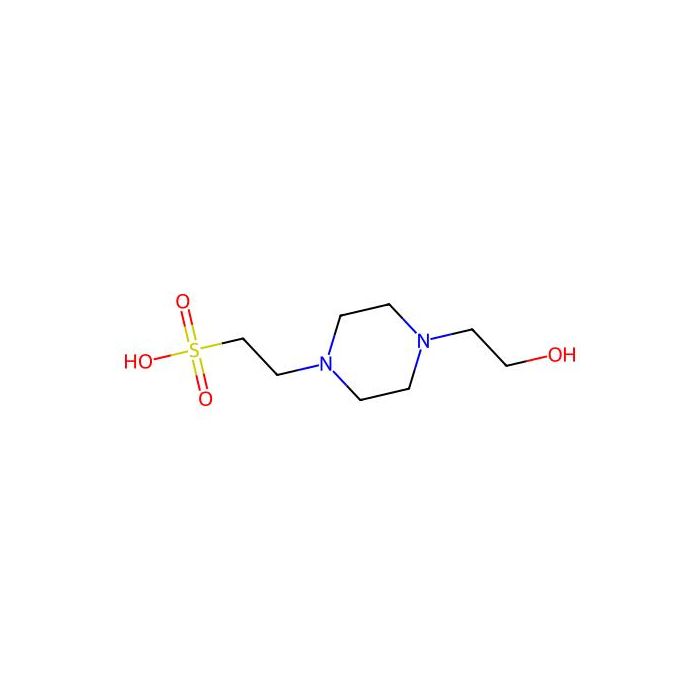
HEPES solution(HEPES) - for cell culture, CellGuard Certified, 1 M, 0.2 μm filtered , CAS No.7365-45-9

CAS: 7365-45-9 Cat. No.: H755905 Formula: C8H18N2O4S Molecular Weight: 238.30 EC Number: 230-907-9
AVAILABLE TO ORDER
GRADE & PURITY for Cell culture ? Cell-culture grade — low endotoxin and contaminants to support viable cell growth. Use in mammalian/other cell culture media and supplements. CellGuard Certified ? CellGuard Certified — certified quality assuring excellence in biological/cell applications. Use when certified performance for cell-based work is required. 1 M, 0.2 μm filtered
Storage
Room temperature
Shipped In
Normal
★
Size
Germany (EU)
USA*
Price
Qty
100ml
H755905-100ml
Made to order · 8–12 wks
€161.31
500ml
H755905-500ml
Made to order · 8–12 wks
€476.30
Enter a quantity for the sizes you want to add.
🧪
Why this grade

for cell culture, CellGuard Certified, 1 M, 0.2 μm filtered CellGuard Certified,for Cell culture for sensitive chromatographic and analytical workflows requiring minimal baseline interference.

🌡

Storage & shipping

Room temperature Ships Normal Check lot-specific COA for exact specifications.

📋

Quality documents

SDS, COA, datasheet, and spec sheet available for download. Lot-specific COA accessible via lot number lookup.

📚

Literature proof

Cited in 588 peer-reviewed publications across chromatography, organic synthesis, and cross-coupling reactions.

Overview

HEPES has been described as one of the best all-purpose buffers available for biological research. At biological pH, the molecule is zwitterionic, and is effective as a buffer at pH 6.8 to 8.2. HEPES has been used in a wide variety of applications, including tissue culture. It is commonly used to buffer cell culture media in air. HEPES finds its usage in in vitro experiments on Mg.
Application:
RNAse HEPES has been used:
  • To supplement Dulbecco′smodified Eagle′smedium for maintenance of cell line and RPMI medium to wash rat islets
  • To recover purified ribonucleotide
  • As a component of HEPES/KOH buffer and adenylation buffer for small RNA isolation and sequencing
  • As a component in buffers used for nuclear extract preparation and also to supplement RPMI-1640 medium for maintenance of islets

Specifications

Specifications & Purity
for cell culture, CellGuard Certified, 1 M, 0.2 μm filtered
Useful PH Range
6.8-8.2
Storage
Room temperature
Shipped In
Normal
Grade
CellGuard Certified, for Cell culture
Names and Identifiers
PH
5.0-6.0
Isomeric SMILES
C1CN(CCN1CCO)CCS(=O)(=O)O
RTECS
TL6809000
Molecular Weight
238.30
Reaxy-Rn
883043
Reaxys-RN_link_address
https://www.reaxys.com/reaxys/secured/hopinto.do?context=S&query=IDE.XRN=883043&ln=

Documentation

📋 Safety Data Sheet (SDS)

Comprehensive hazard, handling, storage, and regulatory compliance document.

Download SDS →

✅ Certificate of Analysis (COA)

Lot-specific quality data. Enter your lot number to retrieve the exact COA.

Look up COA →

📊 Datasheet

Quick-reference summary of product specifications and applications.

View datasheet →

🔬 Specification Sheet

Full quality attributes and acceptance criteria for this grade.

View spec sheet →

Advanced Data

Certificates(CoA,COO,BSE/TSE and Analysis Chart)
C of A & Other Certificates(BSE/TSE, COO):
Analytical Chart:
Chemical and Physical Properties
Melt Point(°C)210 °C
Documents & Articles
CellGuard Certified: Ensuring Excellence in Biological Applications
For Cell Culture
Buffer exchange of a sample using a dialysis bag
Professional Guide to Streptavidin-Modified Proteins
Common Types of Buffer Solutions
Common Protectants and Formulations for Protein Storage
Why Did My Ni-Agarose Beads Turn Black or Brown?
Good’s buffers
Differences Between Transformation and Transfection
FAQs on Animal Cell Culture Media
CRISPR Gene-Editing Therapies
How to Choose the Best Protein Purification Technique
FAQ on Cell Culture Serum
What is Ion Exchange Chromatography Used For? 4 Important Applications for Protein Purification
Mag-Fluo-4 AM Magnesium/Calcium Ion Fluorescent Probe: Properties, Experimental Use, and Aladdin Metal Ion Fluorescent Probe Selection Guide
Protease & Phosphatase Inhibitor Cocktails: Research Applications and Principles
Scientific Decision-Making for Chromatography Buffer Selection: Tris-HCl vs Phosphate Systems
How to Purify Proteins by Ion-Exchange Chromatography Under Denaturing Condition
A Review of Ten Commonly Used Techniques for Detection, Quantification, and Interaction Analysis in Nucleic Acid Research
How Organic Acids “Stabilize a System”: Selection Logic via the pH Window, Salt Forms, and Metal-Ion Management (with a navigation guide to Tables A–E)
Phycocyanin: A Review of Sources, Structural Features, Production Processes, Applications, and Claimed Benefits
Angiotensin-Converting Enzyme (ACE): A Review of Molecular Features, Catalytic Functions, and Research and Translational Applications
Piperazine Selection Guide: Using a “Six-Membered Diaza Ring” to Make Salt Forms and Linking Strategies More Controllable (Appendix Tables 1–4 Product Navigator)
Review of Chymotrypsin: Enzymological Properties, Catalytic Mechanism, and Research Applications
Invertebrate Oxygen Carrier Proteins in Immunology and Vaccine Research
Roles of the Carboxypeptidase Family in Protein C-Terminal Processing and Experimental Analysis
Sulfation Landscape Remodeling and Its Biological Effects
The Methodological Value of DSC: Building NHS-Type Activated Intermediates and Deciding When to Use Them
Acetyl-Group Metabolic Enzyme Network and In Vitro Enzymology Analysis
Research Framework for Multi-Enzyme Digestion Strategies and Optimization of Proteomic Coverage
Structural Characteristics, Operational Methods, and Separation Applications of Dextran Gels
Selection Logic, Operating Parameters, and Application Boundaries of Common Cell Culture Coating Solutions
Effects of Cell Sample Preservation Systems on Morphological Integrity, Anticoagulant Stability, and Analytical Results
Selection Strategies for Animal-Derived Serum, Functionalized Serum, and Non-Animal-Derived Culture Supplementation Systems in Cell Culture
Protein Structure Analysis: An Experimental Path from Defining the Question to Functional Validation
From Functional Groups to Experimental Decision-Making: Protein Crosslinker Selection and Experimental Essentials
Signal Transduction Mechanism of Graphene Biosensors: From Molecular Recognition to Electrical/Optical Signal Readout and Materials Selection
What Is Synthetic Biology? The Industrialization Pathway from Upstream Reagent Toolchains to Biomanufacturing Applications
β-1,4-Galactosyltransferase 1: A Precise Glycosyltransferase in Glycan Biosynthesis
Exosome-Related Ingredients in Skincare Products: Sources and Preparation, Quality Control, Evidence of Efficacy, and Safety Assessment
Citations of This Product
Solution Calculators
Reviews

Customer Reviews

Shall we send you a message when we have discounts available?

Remind me later

Thank you! Please check your email inbox to confirm.

Oops! Notifications are disabled.