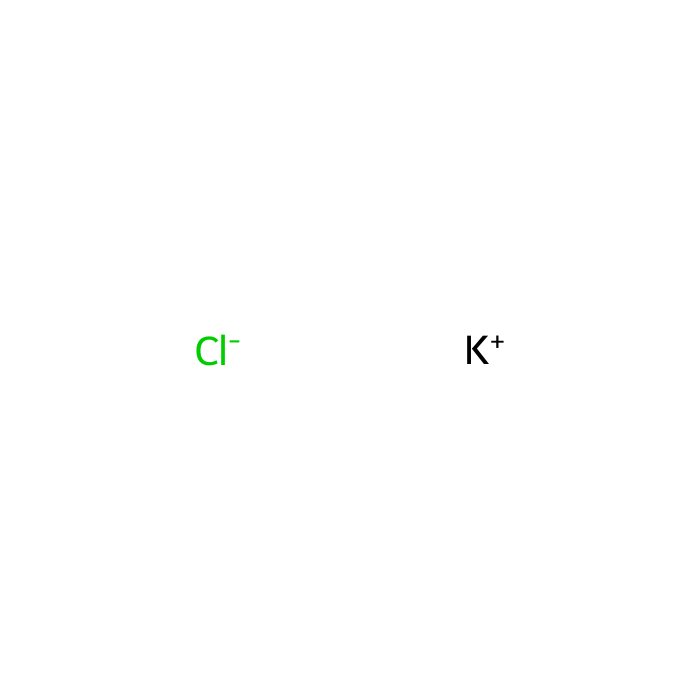
Potassium Chloride - ≥99%(T) , CAS No.7447-40-7

CAS: 7447-40-7 Cat. No.: P433501 Formula: KCl Molecular Weight: 74.55 EC Number: 231-211-8
AVAILABLE TO ORDER
GRADE & PURITY ≥99%(T)
Synonyms
Enpott | Chlorid draselny | Kaon-Cl 10 | Kay-EM | potassium chloride | Steropotassium | Durules-K | Kaliduron | Acronitol | Kay-Cee-L | KCl-retard Zyma | Leo-K | Durekal | Kali Chloratum | Kalitabs | Kalium-R | Super K (salt) | K-Sol | Rekawan | Ultra K C
Storage
Room temperature
Shipped In
Normal
★
Size
Germany (EU)
USA*
Price
Qty
250g
P433501-250g
—
4 In stock
€13.80
Enter a quantity for the sizes you want to add.
🧪
Why this grade

≥99%(T) for sensitive chromatographic and analytical workflows requiring minimal baseline interference.

🌡

Storage & shipping

Room temperature Ships Normal Check lot-specific COA for exact specifications.

📋

Quality documents

SDS, COA, datasheet, and spec sheet available for download. Lot-specific COA accessible via lot number lookup.

📚

Literature proof

Cited in 3194 peer-reviewed publications across chromatography, organic synthesis, and cross-coupling reactions.

Overview

General Description

Has an optimal pH of 5.0-8.0.


Application

May be used for the preparation of phosphate buffered saline, and for the extraction and solubilization of proteins.Warning': 'Toxicity: Standard Handling (A)

Specifications

Synonyms
Enpott | Chlorid draselny | Kaon-Cl 10 | Kay-EM | potassium chloride | Steropotassium | Durules-K | Kaliduron | Acronitol | Kay-Cee-L | KCl-retard Zyma | Leo-K | Durekal | Kali Chloratum | Kalitabs | Kalium-R | Super K (salt) | K-Sol | Rekawan | Ultra K C
Specifications & Purity
≥99%(T)
Storage
Room temperature
Shipped In
Normal
Purity
≥99%(T)
Names and Identifiers
Pubchem Sid
Pubchem Sid Url
https://pubchem.ncbi.nlm.nih.gov/substance/504750822
Canonical Smiles
[Cl-].[K+]
IUPAC Name
potassium;chloride
InChIKey
WCUXLLCKKVVCTQ-UHFFFAOYSA-M
INCHI
1S/ClH.K/h1H;/q;+1/p-1
Isomeric SMILES
[Cl-].[K+]
WGK Germany
1
Molecular Weight
74.55

Documentation

📋 Safety Data Sheet (SDS)

Comprehensive hazard, handling, storage, and regulatory compliance document.

Download SDS →

✅ Certificate of Analysis (COA)

Lot-specific quality data. Enter your lot number to retrieve the exact COA.

Look up COA →

📊 Datasheet

Quick-reference summary of product specifications and applications.

View datasheet →

🔬 Specification Sheet

Full quality attributes and acceptance criteria for this grade.

View spec sheet →

Advanced Data

Taxonomic Classification

Taxonomy Tree

KingdomInorganic compounds
SuperclassMixed metal/non-metal compounds
ClassAlkali metal salts
SubclassAlkali metal chlorides
Intermediate Tree Nodes Not available
Direct ParentAlkali metal chlorides
Alternative Parents Inorganic chloride salts  
Molecular FrameworkNot available
Substituents Alkali metal chloride - Inorganic chloride salt - Inorganic salt
DescriptionThis compound belongs to the class of inorganic compounds known as alkali metal chlorides. These are inorganic compounds in which the largest halogen atom is Chlorine, and the heaviest metal atom is an alkali metal.
External Descriptors potassium salt - inorganic chloride
3D Structure
Interactive Chemical Structure Model


Associated Targets(Human)
CA2 Tclin Carbonic anhydrase II (17698 Activities)
Activity TypeRelationActivity valueUnitsAction TypeJournalPubMed IddoiAssay Aladdin ID
CA1 Tclin Carbonic anhydrase I (13240 Activities)
Activity TypeRelationActivity valueUnitsAction TypeJournalPubMed IddoiAssay Aladdin ID
CA5A Tclin Carbonic anhydrase VA (1168 Activities)
Activity TypeRelationActivity valueUnitsAction TypeJournalPubMed IddoiAssay Aladdin ID
CA9 Tclin Carbonic anhydrase IX (8255 Activities)
Activity TypeRelationActivity valueUnitsAction TypeJournalPubMed IddoiAssay Aladdin ID
TAS2R31 Tchem Taste receptor type 2 member 31 (86 Activities)
Activity TypeRelationActivity valueUnitsAction TypeJournalPubMed IddoiAssay Aladdin ID
TAS2R14 Tchem Taste receptor type 2 member 14 (240 Activities)
Activity TypeRelationActivity valueUnitsAction TypeJournalPubMed IddoiAssay Aladdin ID
TAS2R16 Tchem Taste receptor type 2 member 16 (102 Activities)
Activity TypeRelationActivity valueUnitsAction TypeJournalPubMed IddoiAssay Aladdin ID
TAS2R4 Tchem Taste receptor type 2 member 4 (14 Activities)
Activity TypeRelationActivity valueUnitsAction TypeJournalPubMed IddoiAssay Aladdin ID
TAS2R41 Tchem Taste receptor type 2 member 41 (57 Activities)
Activity TypeRelationActivity valueUnitsAction TypeJournalPubMed IddoiAssay Aladdin ID
TAS2R60 Tchem Taste receptor type 2 member 60 (8 Activities)
Activity TypeRelationActivity valueUnitsAction TypeJournalPubMed IddoiAssay Aladdin ID
TAS2R9 Tchem Taste receptor type 2 member 9 (14 Activities)
Activity TypeRelationActivity valueUnitsAction TypeJournalPubMed IddoiAssay Aladdin ID
TAS2R10 Tchem Taste receptor type 2 member 10 (51 Activities)
Activity TypeRelationActivity valueUnitsAction TypeJournalPubMed IddoiAssay Aladdin ID
TAS2R20 Tchem Taste receptor type 2 member 20 (10 Activities)
Activity TypeRelationActivity valueUnitsAction TypeJournalPubMed IddoiAssay Aladdin ID
TAS2R50 Tchem Taste receptor type 2 member 50 (12 Activities)
Activity TypeRelationActivity valueUnitsAction TypeJournalPubMed IddoiAssay Aladdin ID
TAS2R8 Tchem Taste receptor type 2 member 8 (387 Activities)
Activity TypeRelationActivity valueUnitsAction TypeJournalPubMed IddoiAssay Aladdin ID
TAS2R38 Tchem Taste receptor type 2 member 38 (37 Activities)
Activity TypeRelationActivity valueUnitsAction TypeJournalPubMed IddoiAssay Aladdin ID
TAS2R39 Tchem Taste receptor type 2 member 39 (48 Activities)
Activity TypeRelationActivity valueUnitsAction TypeJournalPubMed IddoiAssay Aladdin ID
TAS2R40 Tchem Taste receptor type 2 member 40 (10 Activities)
Activity TypeRelationActivity valueUnitsAction TypeJournalPubMed IddoiAssay Aladdin ID
TAS2R43 Tchem Taste receptor type 2 member 43 (15 Activities)
Activity TypeRelationActivity valueUnitsAction TypeJournalPubMed IddoiAssay Aladdin ID
TAS2R45 Tchem Taste receptor type 2 member 45 (8 Activities)
Activity TypeRelationActivity valueUnitsAction TypeJournalPubMed IddoiAssay Aladdin ID
TAS2R46 Tchem Taste receptor type 2 member 46 (155 Activities)
Activity TypeRelationActivity valueUnitsAction TypeJournalPubMed IddoiAssay Aladdin ID
TAS2R30 Tchem Taste receptor type 2 member 30 (12 Activities)
Activity TypeRelationActivity valueUnitsAction TypeJournalPubMed IddoiAssay Aladdin ID
TAS2R19 Tchem Taste receptor type 2 member 19 (20 Activities)
Activity TypeRelationActivity valueUnitsAction TypeJournalPubMed IddoiAssay Aladdin ID
TAS2R42 Tchem Taste receptor type 2 member 42 (6 Activities)
Activity TypeRelationActivity valueUnitsAction TypeJournalPubMed IddoiAssay Aladdin ID
TAS2R13 Tchem Taste receptor type 2 member 13 (13 Activities)
Activity TypeRelationActivity valueUnitsAction TypeJournalPubMed IddoiAssay Aladdin ID
TAS2R7 Tchem Taste receptor type 2 member 7 (31 Activities)
Activity TypeRelationActivity valueUnitsAction TypeJournalPubMed IddoiAssay Aladdin ID
TAS2R5 Tchem Taste receptor type 2 member 5 (11 Activities)
Activity TypeRelationActivity valueUnitsAction TypeJournalPubMed IddoiAssay Aladdin ID
TAS2R3 Tchem Taste receptor type 2 member 3 (12 Activities)
Activity TypeRelationActivity valueUnitsAction TypeJournalPubMed IddoiAssay Aladdin ID
TAS2R1 Tchem Taste receptor type 2 member 1 (37 Activities)
Activity TypeRelationActivity valueUnitsAction TypeJournalPubMed IddoiAssay Aladdin ID
SLC24A2 Tbio Sodium/potassium/calcium exchanger 2 (1 Activities)
Activity TypeRelationActivity valueUnitsAction TypeJournalPubMed IddoiAssay Aladdin ID
Associated Targets(non-human)
CA4 Carbonic anhydrase IV (1713 Activities)
Activity TypeRelationActivity valueUnitsAction TypeJournalPubMed IddoiAssay Aladdin ID
Mechanisms of Action
Certificates(CoA,COO,BSE/TSE and Analysis Chart)
C of A & Other Certificates(BSE/TSE, COO):
Analytical Chart:

Find and download the COA for your product by matching the lot number on the packaging.

4 results found

Lot NumberCertificate TypeDateItem
C2314560Certificate of AnalysisDec 10, 2025 P433501
B24231082Certificate of AnalysisMar 04, 2024 P433501
B24231081Certificate of AnalysisFeb 29, 2024 P433501
C2314562Certificate of AnalysisMar 17, 2023 P433501
Chemical and Physical Properties
Solubilitywater: soluble
Boil Point(°C)1413 °C/1013 hPa
Melt Point(°C)770 °C (lit.)
Molecular Weight74.550 g/mol
XLogP3
Hydrogen Bond Donor Count0
Hydrogen Bond Acceptor Count1
Rotatable Bond Count0
Exact Mass73.9326 Da
Monoisotopic Mass73.9326 Da
Topological Polar Surface Area0.000 Ų
Heavy Atom Count2
Formal Charge0
Complexity2.000
Isotope Atom Count0
Defined Atom Stereocenter Count0
Undefined Atom Stereocenter Count0
Defined Bond Stereocenter Count0
Undefined Bond Stereocenter Count0
The total count of all stereochemical bonds0
Covalently-Bonded Unit Count2
Documents & Articles
Citations of This Product
Solution Calculators
Reviews

Customer Reviews

Application Protocols

No assay-specific, item-validated protocols are provided in the Product Data for this product. The following general-use solution preparations are common in research (literature; not item-specific specs):

  • Preparation of 3 M KCl (salt bridge): Weigh 223.65 g KCl, dissolve in ~700 mL water, warm gently if needed, cool to room temperature, bring to 1.00 L, 0.22 µm filter. Store in a sealed bottle to limit evaporation and crystallization.
  • 1 M KCl stock for buffers: Weigh 74.55 g KCl, dissolve and QS to 1.00 L with water. For sterile work, prepare under aseptic conditions and filter-sterilize.
  • Saturated KCl for calibration: Add excess KCl to water with stirring until some undissolved solid remains; equilibrate at 25 °C, then decant/filter the saturated solution.

Usage notes

  • Label solutions with concentration, date, and preparer; record lot number of solid KCl for traceability.
  • Verify concentrations gravimetrically and, if critical, by conductivity or argentometric titration.
  • For biological assays, adjust pH with dedicated buffers; KCl does not buffer pH.
Biological Roles

General biochemical context (literature; not a medical claim)

  • Potassium ion (K+) is the principal intracellular cation in most cells, essential for maintaining resting membrane potential, regulating cell volume, and supporting enzyme function (e.g., K+-dependent kinases and ribosomal activity).
  • Chloride ion (Cl−) is a major extracellular anion involved in acid–base balance, electrical neutrality, and transmembrane transport via channels (e.g., GABA_A receptor-associated channels, ClC family transporters).
  • Many enzymes and transporters are sensitive to the identity and concentration of monovalent ions; replacing Na+ with K+ can alter protein stability and activity in vitro.
  • In nucleic acid biochemistry, monovalent cations influence duplex stability and G-quadruplex topology; K+ often stabilizes G-quadruplexes more strongly than Na+.

Laboratory implications

  • Typical buffer systems incorporate 1–200 mM KCl to mimic physiological conditions or tune ionic strength while avoiding sodium-specific effects.
  • High KCl concentrations can screen electrostatic interactions, reducing nonspecific binding in chromatography and immunoassays.

Notes

  • The above describes natural roles of K+ and Cl− in cells and in vitro systems. It is provided for research planning and does not imply suitability for clinical applications. Always validate ion concentrations empirically for each assay.
Buffer Applications

Applicability

  • KCl is widely used to adjust ionic strength, osmolarity, and conductivity in biological and analytical buffers. It does not itself provide buffering capacity.

Common formulations (literature examples; not item-specific specs)

  • PBS (1×): 137 mM NaCl, 2.7 mM KCl, 10 mM phosphate (pH 7.4). KCl contributes physiological K+ while keeping chloride constant.
  • TBS variants: Often include 2–5 mM KCl when potassium is desired; otherwise NaCl-only.
  • Electrophysiology/internal solutions: 100–140 mM KCl frequently used to approximate cytosolic K+ and set Cl− reversal potentials.
  • Nuclease buffers: 50–200 mM KCl used to modulate protein–nucleic acid interactions and reduce nonspecific binding.

Preparation guidance (literature)

  • 1 M KCl: Dissolve 74.55 g KCl in water and bring to 1.00 L; filter-sterilize if needed. Store at 2–8 °C.
  • 3 M KCl: Dissolve 223.65 g KCl per liter of final solution; warm gently to aid dissolution.
  • Saturated KCl (25 °C): Prepare by adding excess KCl to water with stirring until undissolved solid persists; allow to equilibrate and decant/filter the clear supernatant.

Practical tips

  • Adjust pH with separate buffering agents (HEPES, Tris, phosphate) as KCl does not control pH.
  • Verify osmolality when preparing cell-compatible media; chloride impacts membrane transport and channel activity.
Green Alternatives

Context

  • Potassium chloride is an inorganic salt with low inherent hazard and excellent atom economy in its intended roles (electrolyte, ionic strength adjuster). Its environmental footprint primarily derives from mining/processing and solution disposal, rather than toxicity.

Comparative considerations (literature)

  • Versus NaCl: Similar environmental and safety profile; choice is driven by cation requirements. NaCl is typically more abundant/cheaper; KCl may be preferable for potassium-balanced systems.
  • Versus nitrate/sulfate salts (KNO3, K2SO4): Chloride has minimal buffering capacity and generally lower eutrophication potential than nitrate; sulfates avoid chloride-sensitive corrosion but can acidify slightly at high concentration.
  • Organic additives (e.g., tetrabutylammonium salts for phase-transfer): KCl is a far greener electrolyte alternative in purely aqueous systems due to lower persistence and toxicity.

Green lab tips

  • Prepare only the volume needed; store concentrates to reduce waste.
  • Reuse electrode fill solutions when permissible by SOPs; filter if particulate appears.
  • Avoid discharging concentrated saline directly to drains; follow local regulations—dilute and neutralize as required.

Quick comparison table (literature; qualitative)

  • KCl: Low hazard, high aqueous solubility, minimal volatility, low persistence.
  • NaCl: Similar profile; sodium-specific biological/analytical effects.
  • TBACl (tetrabutylammonium chloride): Higher toxicity/organic load; use only when quaternary ammonium ions are mechanistically required.
Pharmaceutical Uses

Scope note

  • For research use only (per Product Data). The following describes general manufacturing/formulation roles from the literature and pharmacopeial practice; it is not a claim of suitability for therapeutic use for this specific item.

Typical excipient/formulation roles (literature)

  • Electrolyte/osmotic agent: Adjusts tonicity in aqueous formulations and calibration standards.
  • Component of parenteral/oral rehydration concentrates and dialysis concentrates in GMP settings when conforming to pharmacopeial monographs (e.g., USP/Ph. Eur.)—grade-dependent.
  • Process aid: Provides ionic strength in purification steps (e.g., precipitation, chromatography) during upstream/downstream manufacturing.
  • Tablet coating/processing water additive: Controls ionic strength to influence polymer behavior in some aqueous film coatings.

Quality considerations

  • Pharmacopeial grades (e.g., USP, Ph. Eur.) specify assay, identification, pH of solution, acidity/alkalinity, bromide/iodide limits, heavy metals, iron, aluminum, insoluble matter, and loss on drying.
  • Microbial/endotoxin limits are critical when used in parenteral-grade solutions.

For this catalog item

  • No pharmacopeial grade or purity is specified in the provided Product Data. Users requiring GMP or clinical manufacturing suitability must obtain and review the lot-specific CoA/Spec Sheet and ensure compliance with relevant monographs and regulatory standards.
Physical Properties

Item-specific specifications

  • Unless otherwise stated on the CoA/Spec Sheet, detailed physical specs (water content, trace metals, particle size, etc.) are: Not specified for this item; refer to CoA/Spec Sheet.

Literature/general physicochemical properties (for reference; not item-specific specs)

  • Appearance: white, crystalline solid; odorless (literature)
  • Melting point: ~770 °C (literature)
  • Boiling point: ~1420 °C (literature; decomposition/volatilization at high T)
  • Density: ~1.98 g/cm³ at 20 °C (literature)
  • Solubility in water (approx.): 28 g/100 g H2O at 10 °C; 34 g/100 g at 20 °C; 45 g/100 g at 40 °C; 56 g/100 g at 100 °C (literature)
  • Solubility in organic solvents: essentially insoluble in ethanol, acetone, diethyl ether; soluble in glycerol (literature)
  • Partition coefficient (logP): not applicable (fully ionic) (literature)
  • pKa: not applicable (salt of strong acid/base) (literature)
  • Refractive index: not applicable to solids; aqueous solutions nD increases with concentration (literature)
  • Crystal structure: rock-salt (fcc) lattice; each ion octahedrally coordinated (literature)

Practical notes

  • Hygroscopicity: low to slight; may cake on prolonged exposure to humid air (literature)
  • Conductivity: aqueous KCl is a standard conductivity/electrolyte calibrant (literature)
  • These values are typical references to aid method development and are not guaranteed specifications for this catalog item.
Quality & Grades

Item-specific grade/purity

  • Grade/Purity: Not specified for this item; refer to CoA/Spec Sheet.

What grade typically implies (general guidance)

  • ACS/AR grade potassium chloride typically meets defined assay limits (often ≥99.0%) and tight controls on heavy metals and insoluble matter to support analytical work.
  • BioReagent/Cell culture grades emphasize bioburden/endotoxin and trace metal limits suitable for biological buffers and media preparation.
  • Electronic/semiconductor grades specify ultralow metals/alkali contaminants for materials processing.
  • HPLC/Trace analysis grades may include low levels of UV-absorbing impurities and particulates, relevant when KCl is used in ion chromatography or as a conductivity standard.

Stabilizers and additives

  • KCl is inherently stable and typically supplied without stabilizers. Any anti-caking agents, if present, would be declared on the CoA/label. For this item: Not specified for this item; refer to CoA/Spec Sheet.

How to verify quality on receipt

  • Check lot-specific CoA for assay, insolubles in water, sulfate, heavy metals (e.g., Pb), loss on drying, and bioburden/endotoxin if applicable.
  • For critical applications, perform a quick conductivity blank test on water vs. prepared KCl solution and assess insoluble residues by filtration and gravimetry.
Reaction & Applications

Focus areas where KCl is routinely used (literature/practice)

  • Electrochemistry: Preparation of saturated and defined-molarity KCl solutions for Ag/AgCl reference electrodes and salt bridges (reduces junction potentials). Saturated KCl fills are a standard choice in potentiometry.
  • Ionic strength control: Widely used in analytical chemistry to fix ionic strength in potentiometric titrations (e.g., ISE measurements) and in kinetic studies to decouple activity effects.
  • Chromatography/biochemistry: Employed in lysis buffers and protein/nucleic acid purification to modulate solubility and binding (e.g., 0.1–1.0 M KCl in ion-exchange and heparin columns).
  • Precipitation/metathesis: Drives halide metathesis (e.g., precipitation of AgCl from Ag+ solutions). Useful for exchanging counterions to chloride in some quaternary ammonium salts via simple partitioning/washing.
  • Drying/“salting-out”: High-concentration KCl solutions can effect phase separation in aqueous biphasic systems and influence protein precipitation; however, NaCl or (NH4)2SO4 more strongly salt-out proteins.
  • Thermal processing: Component in molten salt baths (with KNO3/NaNO3, etc.) for heat transfer and as electrolytes in high-temperature electrochemical cells.

Practical tips

  • Use high-purity water (18 MΩ·cm) when preparing standards; filter through 0.22 µm for sensitive applications.
  • For Ag/AgCl electrodes, avoid contamination with sulfide/phosphate that can foul the junction.
  • Account for temperature-dependent solubility and density when preparing volumetric standards; allow solutions to equilibrate to 25 °C before final volume adjustment.
Reaction Conditions

Typical solution preparations (literature; general guidance)

  • 1.0 M KCl: 74.55 g KCl to 1.00 L with water; dissolve with stirring. For sterile applications, 0.22 µm filter. Store 2–8 °C.
  • 3.0 M KCl: 223.65 g/L final; useful for salt bridges and some chromatography steps.
  • 0.1 M KCl: 7.455 g/L; common for conductivity and ISE calibrations.

Electrochemical use

  • Reference electrodes: Saturated or 3 M KCl fills minimize liquid junction potentials. Maintain a small headspace and periodically replenish to compensate for evaporation/creep.
  • Temperature: Conductivity of KCl solutions increases with temperature (~2% per °C around room temp); standardize at 25 °C for comparative measurements.

Ionic strength control in biochemical assays

  • Typical ranges: 50–200 mM KCl for protein–nucleic acid interactions; higher salt (0.5–1.0 M) to disrupt nonspecific binding. Optimize empirically.

Precipitations/metathesis

  • Argentometric titration: Titrate Cl− with AgNO3; KCl standards prepared gravimetrically ensure accurate endpoint detection (Mohr/Volhard methods).

Notes

  • The above are literature norms offered for planning. They are not item-specific specifications. Always verify concentration by mass and volume, and consult SOPs for your method.
Safety & Handling

Item-specific hazard statements from Product Data

  • Signal word: Not specified for this item; refer to SDS.
  • H-statements: Not specified for this item; refer to SDS.
  • GHS classification/pictograms: Not specified for this item; refer to SDS.

General safety information (literature/practice; defer to SDS for authority)

  • GHS status: Potassium chloride is often not classified as hazardous under GHS in many jurisdictions, but may cause mechanical/ionic irritation to eyes/skin and GI upset if ingested in quantity. Always consult the SDS for your specific lot.
  • PPE: Wear lab coat, safety glasses, and appropriate gloves (e.g., nitrile). Avoid creating dust; use local exhaust if dust generation is possible.
  • Incompatibilities: Strong acids at elevated temperature (KCl + hot H2SO4 can liberate HCl gas); avoid contact with silver salts (forms insoluble AgCl precipitate) when this would interfere with analytical work. Avoid mixing with strong oxidizers only as a general good practice.
  • Handling: Minimize dust. Use clean, dry tools. For sterile applications, dissolve in high-purity water and sterile-filter (0.22 µm).
  • First aid (overview): If inhaled—move to fresh air; if on skin/eyes—rinse with water for several minutes; if ingested—rinse mouth. Seek medical attention if symptoms persist. Follow SDS guidance.
  • Fire: Nonflammable inorganic salt; use extinguishing media suitable for surrounding fire.
  • Spills: Sweep up avoiding dust; collect for disposal according to local regulations.
  • Environmental: Low environmental hazard; avoid uncontrolled releases to waterways.
Solvent Selection

Applicability

  • Potassium chloride is a solid inorganic electrolyte, not a solvent. This section addresses selection of dissolution media and compatibility for solution preparation.

Dissolution media (literature)

  • Water: primary solvent; high solubility that increases with temperature. Suitable for buffers, calibration solutions, and electrolyte preparations.
  • Alcohols (methanol, ethanol), ethers, ketones: essentially insoluble—avoid for stock solutions.
  • Polyols (glycerol): appreciable solubility; viscosity may limit use.
  • Mixed aqueous-organic systems: Solubility largely governed by water content; high water fraction recommended.

Polarity and ionic strength considerations (literature)

  • KCl fully dissociates to K+ and Cl− in water, contributing directly to ionic strength, conductivity, and activity coefficients in solution.
  • For enzyme assays and protein formulations, moderate ionic strength (e.g., 50–200 mM KCl) can stabilize proteins and modulate binding; optimize empirically.

When to choose KCl vs. alternatives (literature)

  • Versus NaCl: KCl is preferred when potassium is the physiological cation of interest or where Na+ interferes with transporters/enzymes.
  • Versus other potassium salts (e.g., KNO3, K2SO4): Choose KCl when chloride is desired or when minimal buffering action is needed.

Quick comparison (literature)

  • Water miscibility: complete for KCl; negligible in common organics.
  • Dielectric constant of water (~78 at 25 °C) supports high KCl solubility and complete dissociation.
Storage & Reconstitution

Item-specific storage/shipping (from Product Data)

  • Storage conditions: Room temperature.
  • Shipped in: Normal.

General guidance (literature/practice; not item-specific specs)

  • Solid KCl: Store tightly closed in a clean, dry container at ambient temperature. Protect from prolonged exposure to high humidity to prevent caking. No special light protection required.
  • Shelf life: Inorganic salts are typically long-lived if kept dry and uncontaminated. For this item, specific retest or expiration dating is: Not specified for this item; refer to CoA/Spec Sheet.

Reconstitution/preparation

  • Aqueous solutions: Prepare with high-purity water. For sterile applications, prepare aseptically and filter through 0.22 µm membranes. Common stocks include 1 M and 3 M KCl.
  • Storage of solutions: Store at 2–8 °C in corrosion-resistant, well-sealed containers (HDPE, PP, or glass). To avoid composition drift, minimize evaporation and crystallization by using airtight caps and allowing solutions to warm to room temperature before opening.
  • Compatibility: Avoid storing concentrated KCl in containers with silver-containing components (risk of AgCl formation). Stainless steel and common lab plastics/glass are generally compatible.

Disposal

  • Dispose of saline solutions according to local regulations. Although KCl is of low hazard, avoid uncontrolled discharge of high-salinity solutions to drains without authorization.

Note

  • For research use only (per Product Data). Always consult the product SDS and lot-specific CoA for definitive instructions.
Structure & Identity

Item-specific identifiers (from Product Data)

  • SKU: P433501
  • Product name: Potassium Chloride
  • CAS: 7447-40-7
  • PubChem CID: 4873
  • InChIKey (as provided): 395011
  • SMILES: Not specified for this item; refer to CoA/Spec Sheet.

Literature identity and structural description (general reference)

  • Molecular formula: KCl (literature)
  • Molecular weight: 74.551 g/mol (literature)
  • Preferred IUPAC name: potassium chloride (literature)
  • Common ions: K+ (potassium cation), Cl− (chloride anion) (literature)
  • Structure (2D, described): An ionic compound composed of a spherical monovalent potassium cation electrostatically associated with a spherical monovalent chloride anion, adopting the rock-salt (NaCl-type) lattice in the solid state (literature). No covalent bonds, no stereocenters, no ring systems.

Notes

  • The information above under “literature” is provided for general context and is not an item-specific specification. Consult the CoA/SDS for definitive identifiers for this lot/item.
Synthetic Utility

General roles in synthesis and analysis (literature)

  • Counterion exchange: KCl can exchange with other halides/anions to generate chloride salts of quaternary ammonium/phosphonium compounds via biphasic washes or ion-exchange resins.
  • Precipitation/metathesis: Drives formation of insoluble chlorides (e.g., AgCl, TlCl, PbCl2 under certain conditions), enabling separations and gravimetric/volumetric analyses.
  • Electrolyte: Provides supporting ionic strength in aqueous electrochemical reactions (electrosynthesis, electrodeposition) where non-coordinating, inexpensive electrolytes are needed.
  • Phase behavior modifier: High ionic strength KCl solutions can modulate aqueous biphasic systems (e.g., polymer–salt ATPS) for biomolecule partitioning.
  • Reference solutions: Standard KCl solutions underpin pH, ISE, and conductivity calibrations; while not a “reagent” in a reaction, these standards are essential for accurate kinetic/thermodynamic work.

Practical guidance

  • Use chloride-compatible materials (avoid Ag/AgCl contact when precipitation is undesired).
  • For electrodeposition, degas solutions if oxygen-sensitive substrates are involved; maintain constant temperature to stabilize conductivity and mass transport.
  • When performing ion-exchange, ensure adequate phase transfer (e.g., add small water content or phase-transfer catalysts if required) and verify complete chloride incorporation by ion chromatography or argentometric titration.
Target Specificity

This product is an inorganic salt, not an antibody, enzyme, or affinity reagent. No antigen/epitope/clone/isotype information applies.

Item-specific data

  • Target/epitope: Not applicable.
  • Species reactivity: Not applicable.
  • Clone/isotype: Not applicable.
  • Any such details are not applicable to this compound type and are not provided in the Product Data.

Shall we send you a message when we have discounts available?

Remind me later

Thank you! Please check your email inbox to confirm.

Oops! Notifications are disabled.