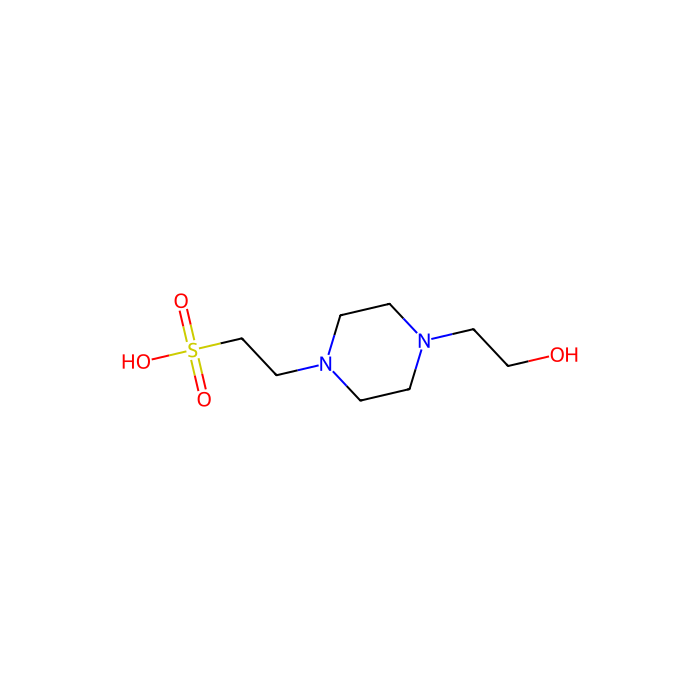
HEPES(HEPES) - UltraBio™, Ultra pure, ≥99.5%(T), pH 5.0-6.5 (1 M in H2O) , CAS No.7365-45-9

CAS: 7365-45-9 Cat. No.: H433403 Formule: C8H18N2O4S Poids moléculaire: 238.30 Numéro CE: 230-907-9
DISPONIBLE À COMMANDE
QUALITÉ & PURETÉ UltraBio™ ? UltraBio™ — Aladdin's line for molecular-biology applications. Use for nuclease-free, high-consistency reagents across molecular workflows. Ultra pure ? Ultra-pure grade with very low impurity content across the board. Use for trace analysis, electronics, or processes intolerant of contamination. ≥99.5%(T) pH 5.0-6.5 (1 M in H2O)
Synonyms
HEPES, BioXtra, pH 5.0-6.5 (1 M in H2O), >=99.5% (titration) | 1d1p | STK033062 | 2-[4-(2-hydroxyethyl)piperazin-1-yl]ethanesulfonic acid | HEPES, biochemical grade | 4-(2-Hydroxyethyl)piperazine-1-(2-ethanesulfonic acid) | AMY23345 | DTXSID5040382 | Epit
Storage
Room temperature
★
Taille
Allemagne (EU)
USA*
Prix
Qté
50g
H433403-50g
Sur commande · 8–12 semaines

341,80€

399,07€
Enregistrer 57,27 € (14.35%)
250g
H433403-250g
Sur commande · 8–12 semaines

1 364,87€

1 596,55€
Enregistrer 231,69 € (14.51%)
Enter a quantity for the sizes you want to add.

Vue d’ensemble

HEPES has been described as one of the best all-purpose buffers available for biological research. At biological pH, the molecule is zwitterionic, and is effective as a buffer at pH 6.8 to 8.2. HEPES has been used in a wide variety of applications, including tissue culture. It is commonly used to buffer cell culture media in air. HEPES finds its usage in in vitro experiments on Mg.


Application

HEPES has been used: As a component of homogenisation buffer used in protein sample preparation To neutralise PRP (platelet-rich plasma) solution as part of PRP preparation As a component in 2X PBS buffer, which is used in phosphate calcium transfection in cell line preparation As a supplement in RPMI 1640 medium used to culture human umbilical vein endothelial cells (HUVEC) and in M199 complete medium for ex-vivo treatment of testicular tissue.


Other Notes

Easily compare specifications for HEPES products with the HEPES specification table .

Spécifications

Synonymes
HEPES, BioXtra, pH 5.0-6.5 (1 M in H2O), >=99.5% (titration) | 1d1p | STK033062 | 2-[4-(2-hydroxyethyl)piperazin-1-yl]ethanesulfonic acid | HEPES, biochemical grade | 4-(2-Hydroxyethyl)piperazine-1-(2-ethanesulfonic acid) | AMY23345 | DTXSID5040382 | Epit
Spécifications et pureté
UltraBio™, Ultra pure, ≥99.5%(T), pH 5.0-6.5 (1 M in H2O)
Conditions de stockage de stockage
Room temperature
Grade
Ultra pure, UltraBio™
Pureté
≥99.5%(T)
Noms et identifiants
Sourires canoniques
C1CN(CCN1CCO)CCS(=O)(=O)O
IUPAC Name
2-[4-(2-hydroxyethyl)piperazin-1-yl]ethanesulfonic acid
InChIKey
JKMHFZQWWAIEOD-UHFFFAOYSA-N
INCHI
1S/C8H18N2O4S/c11-7-5-9-1-3-10(4-2-9)6-8-15(12,13)14/h11H,1-8H2,(H,12,13,14)
Isomères SMILES
C1CN(CCN1CCO)CCS(=O)(=O)O
RTECS
TL6809000
Poids moléculaire
238.30
Reaxy-Rn
883043
Reaxys-RN_link_address
https://www.reaxys.com/reaxys/secured/hopinto.do?context=S&query=IDE.XRN=883043&ln=

Données avancées

Taxonomic Classification

Taxonomy Tree

KingdomOrganic compounds
SuperclassOrganoheterocyclic compounds
ClasseDiazinanes
SubclassPiperazines
Intermediate Tree Nodes Not available
Direct ParentN-alkylpiperazines
Alternative Parents Sulfonyls  Organosulfonic acids  Alkanesulfonic acids  Trialkylamines  1,2-aminoalcohols  Azacyclic compounds  Primary alcohols  Organopnictogen compounds  Organic zwitterions  Organic oxides  Hydrocarbon derivatives  
Molecular FrameworkAliphatic heteromonocyclic compounds
Substituents N-alkylpiperazine - Organic sulfonic acid or derivatives - Organosulfonic acid or derivatives - Organosulfonic acid - Sulfonyl - Alkanesulfonic acid - 1,2-aminoalcohol - Tertiary amine - Tertiary aliphatic amine - Alkanolamine - Azacycle - Hydrocarbon derivative - Organic oxide - Organopnictogen compound - Organic oxygen compound - Primary alcohol - Organosulfur compound - Organooxygen compound - Organonitrogen compound - Amine - Organic nitrogen compound - Alcohol - Organic zwitterion - Aliphatic heteromonocyclic compound
DescriptionThis compound belongs to the class of organic compounds known as n-alkylpiperazines. These are organic compounds containing a piperazine ring where the nitrogen ring atom carries an alkyl group.
External Descriptors organosulfonic acid - HEPES
Structure 3D
Modèle de structure chimique interactif


Mécanismes d'action
Certificats (CoA, COO, BSE/TSE et tableau d'analyse)
C of A & Other Certificates(BSE/TSE, COO):
Analytical Chart:
Propriétés chimiques et physiques
SolubilitéH2O: 1M, clear, colorless
Point de fusion (°C)210 °C
Poids moléculaire238.310 g/mol
XLogP3-4.000
Hydrogen Bond Donor Count2
Hydrogen Bond Acceptor Count6
Rotatable Bond Count5
Exact Mass238.099 Da
Monoisotopic Mass238.099 Da
Topological Polar Surface Area89.500 Ų
Heavy Atom Count15
Formal Charge0
Complexity267.000
Isotope Atom Count0
Defined Atom Stereocenter Count0
Undefined Atom Stereocenter Count0
Defined Bond Stereocenter Count0
Undefined Bond Stereocenter Count0
The total count of all stereochemical bonds0
Covalently-Bonded Unit Count1
FAQ et articles
UltraBio™: Defining Excellence in Molecular Biology Applications
Buffer exchange of a sample using a dialysis bag
Professional Guide to Streptavidin-Modified Proteins
Common Types of Buffer Solutions
Common Protectants and Formulations for Protein Storage
Why Did My Ni-Agarose Beads Turn Black or Brown?
Good’s buffers
Differences Between Transformation and Transfection
FAQs on Animal Cell Culture Media
CRISPR Gene-Editing Therapies
How to Choose the Best Protein Purification Technique
FAQ on Cell Culture Serum
What is Ion Exchange Chromatography Used For? 4 Important Applications for Protein Purification
Mag-Fluo-4 AM Magnesium/Calcium Ion Fluorescent Probe: Properties, Experimental Use, and Aladdin Metal Ion Fluorescent Probe Selection Guide
Protease & Phosphatase Inhibitor Cocktails: Research Applications and Principles
Scientific Decision-Making for Chromatography Buffer Selection: Tris-HCl vs Phosphate Systems
How to Purify Proteins by Ion-Exchange Chromatography Under Denaturing Condition
A Review of Ten Commonly Used Techniques for Detection, Quantification, and Interaction Analysis in Nucleic Acid Research
How Organic Acids “Stabilize a System”: Selection Logic via the pH Window, Salt Forms, and Metal-Ion Management (with a navigation guide to Tables A–E)
Phycocyanin: A Review of Sources, Structural Features, Production Processes, Applications, and Claimed Benefits
Angiotensin-Converting Enzyme (ACE): A Review of Molecular Features, Catalytic Functions, and Research and Translational Applications
Piperazine Selection Guide: Using a “Six-Membered Diaza Ring” to Make Salt Forms and Linking Strategies More Controllable (Appendix Tables 1–4 Product Navigator)
Review of Chymotrypsin: Enzymological Properties, Catalytic Mechanism, and Research Applications
Invertebrate Oxygen Carrier Proteins in Immunology and Vaccine Research
Roles of the Carboxypeptidase Family in Protein C-Terminal Processing and Experimental Analysis
Sulfation Landscape Remodeling and Its Biological Effects
The Methodological Value of DSC: Building NHS-Type Activated Intermediates and Deciding When to Use Them
Acetyl-Group Metabolic Enzyme Network and In Vitro Enzymology Analysis
Research Framework for Multi-Enzyme Digestion Strategies and Optimization of Proteomic Coverage
Structural Characteristics, Operational Methods, and Separation Applications of Dextran Gels
Selection Logic, Operating Parameters, and Application Boundaries of Common Cell Culture Coating Solutions
Effects of Cell Sample Preservation Systems on Morphological Integrity, Anticoagulant Stability, and Analytical Results
Selection Strategies for Animal-Derived Serum, Functionalized Serum, and Non-Animal-Derived Culture Supplementation Systems in Cell Culture
Protein Structure Analysis: An Experimental Path from Defining the Question to Functional Validation
From Functional Groups to Experimental Decision-Making: Protein Crosslinker Selection and Experimental Essentials
Signal Transduction Mechanism of Graphene Biosensors: From Molecular Recognition to Electrical/Optical Signal Readout and Materials Selection
What Is Synthetic Biology? The Industrialization Pathway from Upstream Reagent Toolchains to Biomanufacturing Applications
β-1,4-Galactosyltransferase 1: A Precise Glycosyltransferase in Glycan Biosynthesis
Exosome-Related Ingredients in Skincare Products: Sources and Preparation, Quality Control, Evidence of Efficacy, and Safety Assessment
Citations of This Product
Calculateurs de solution
Avis

Avis des clients

Souhaitez-vous que nous vous envoyions un message lorsque des réductions seront disponibles?

Me rappeler plus tard

Merci ! Veuillez vérifier votre boîte de réception e-mail pour confirmer.

Oups ! Les notifications sont désactivées.