Determine the necessary mass, volume, or concentration for preparing a solution.
Moligand™, ≥99% Moligand™ for sensitive chromatographic and analytical workflows requiring minimal baseline interference.
Store at -20°C,Argon charged,Desiccated Ships Ice chest + Ice pads Check lot-specific COA for exact specifications.
SDS, COA, datasheet, and spec sheet available for download. Lot-specific COA accessible via lot number lookup.
Cited in 0 peer-reviewed publications across chromatography, organic synthesis, and cross-coupling reactions.
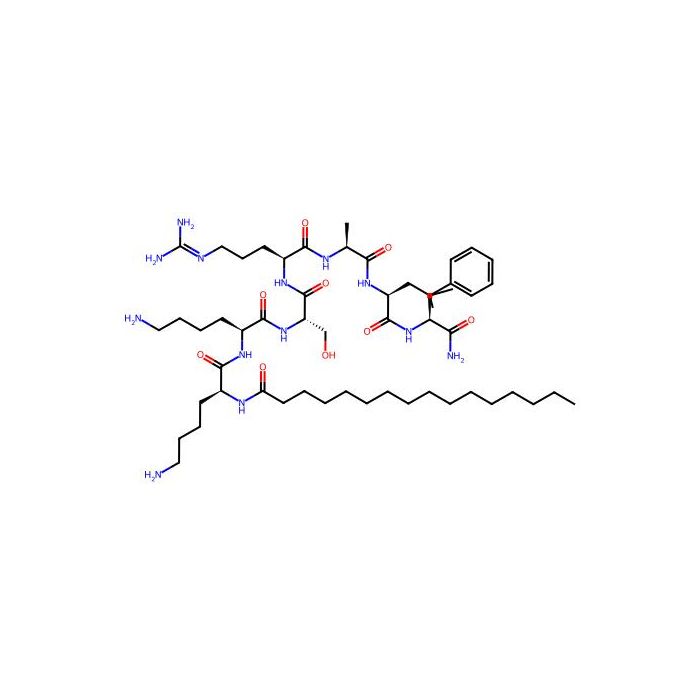
PZ-128 (P1pal-7), a cell-penetrating lipopeptide pepducin, is a first-in-class, specific and reversible protease-activated receptor-1 (PAR1) antagonist. PZ-128 targets the cytoplasmic surface of PAR1 and interrupts signaling to internally-located G (PAR1-G) proteins. PZ-128 has antiplatelet, anti-metastatic, anti-angiogenic and anticancer effects
In Vitro
PZ-128 (P1pal-7; 3 μM) blocks 90-94% of OVCAR-4 migration toward human ovarian ascites and fibroblast conditioned media. The OVCAR4-treated peritoneal fibroblast conditioned media elicits a 2.2-fold increase in endothelial barrier permeability which could be nearly completely inhibited by PZ-128. PZ-128 is a lipidated ‘pepducin’ which targets the cytoplasmic surface of PAR1 and interrupts signaling to internally-located G proteins. The structure of PZ-128 is found to mimic the off-state of the corresponding intracellular region of PAR1 which is critical for coupling to G proteins. MCE has not independently confirmed the accuracy of these methods. They are for reference only.
In Vivo
PZ-128 (P1pal-7; 10 mg/kg; intraperitoneal injection; every other day; for 6 weeks) treatment significantly reduces mean ascites fluid volume by 60%. PZ-128 treatment also causes a highly significant 84-96% reduction in blood vessel density in both the center and edge of the OVCAR-4 tumors . MCE has not independently confirmed the accuracy of these methods. They are for reference only. Animal Model: Female NCR Nu/Nu mice (5-7 weeks) injected with OVCAR-4 or SKOV-3 cells Dosage: 10 mg/kg Administration: Intraperitoneal injection; every other day; for 6 weeks Result: Significantly reduced mean ascites fluid volume by 60%.
Form:Solid
IC50& Target:PAR1
Comprehensive hazard, handling, storage, and regulatory compliance document.
Download SDS →Lot-specific quality data. Enter your lot number to retrieve the exact COA.
Look up COA →Full quality attributes and acceptance criteria for this grade.
View spec sheet →Taxonomy Tree
| Kingdom | Organic compounds |
|---|---|
| Superclass | Organic acids and derivatives |
| Classe | Carboxylic acids and derivatives |
| Subclass | Amino acids, peptides, and analogues |
| Intermediate Tree Nodes | Peptides |
| Direct Parent | Oligopeptides |
| Alternative Parents | Phenylalanine and derivatives Leucine and derivatives N-acyl-alpha amino acids and derivatives Serine and derivatives Alpha amino acid amides Alanine and derivatives Amphetamines and derivatives N-acyl amines Secondary carboxylic acid amides Guanidines Primary carboxylic acid amides Carboximidamides Propargyl-type 1,3-dipolar organic compounds Organopnictogen compounds Monoalkylamines Primary alcohols Hydrocarbon derivatives Carbonyl compounds Organic oxides |
| Molecular Framework | Aromatic homomonocyclic compounds |
| Substituents | Alpha-oligopeptide - Phenylalanine or derivatives - Leucine or derivatives - N-acyl-alpha amino acid or derivatives - Alpha-amino acid amide - Serine or derivatives - Alanine or derivatives - N-substituted-alpha-amino acid - Alpha-amino acid or derivatives - Amphetamine or derivatives - N-acyl-amine - Fatty amide - Monocyclic benzene moiety - Benzenoid - Fatty acyl - Secondary carboxylic acid amide - Primary carboxylic acid amide - Guanidine - Amino acid or derivatives - Carboxamide group - Carboximidamide - Propargyl-type 1,3-dipolar organic compound - Organic 1,3-dipolar compound - Alcohol - Primary aliphatic amine - Organonitrogen compound - Organooxygen compound - Primary alcohol - Carbonyl group - Primary amine - Hydrocarbon derivative - Organic oxide - Amine - Organopnictogen compound - Organic oxygen compound - Organic nitrogen compound - Aromatic homomonocyclic compound |
| Description | This compound belongs to the class of organic compounds known as oligopeptides. These are organic compounds containing a sequence of between three and ten alpha-amino acids joined by peptide bonds. |
| External Descriptors | Not available |
| Solubilité | DMSO : 100 mg/mL (92.04 mM; Need ultrasonic) |
|---|---|
| Sensibilité | Moisture sensitive |
| Poids moléculaire | 1086.500 g/mol |
| XLogP3 | 4.900 |
| Hydrogen Bond Donor Count | 13 |
| Hydrogen Bond Acceptor Count | 12 |
| Rotatable Bond Count | 45 |
| Exact Mass | 1085.77 Da |
| Monoisotopic Mass | 1085.77 Da |
| Topological Polar Surface Area | 383.000 Ų |
| Heavy Atom Count | 77 |
| Formal Charge | 0 |
| Complexity | 1750.000 |
| Isotope Atom Count | 0 |
| Defined Atom Stereocenter Count | 7 |
| Undefined Atom Stereocenter Count | 0 |
| Defined Bond Stereocenter Count | 0 |
| Undefined Bond Stereocenter Count | 0 |
| The total count of all stereochemical bonds | 0 |
| Covalently-Bonded Unit Count | 1 |
Our grade selection guide covers purity, stabilizer status, and application suitability for all variants in our catalog.
View Moligand™ grade guide →