Determine the necessary mass, volume, or concentration for preparing a solution.
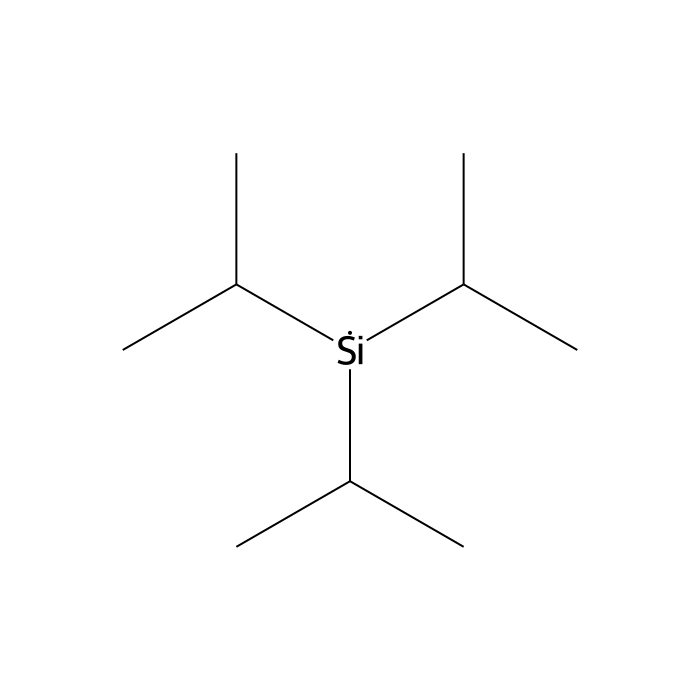
Triisopropylsilane (TIPS) is an organosilicon compound used as a reducing agent in organic synthesis due to its relatively low toxicity, ease of handling, and its ability to selectively reduce various functional groups. It is used in the presence of a Lewis acid such as titanium (IV) chloride to selectively reduce ketones and aldehydes to their corresponding alkanes and selective reduction of epoxides to the corresponding alcohols.
Purpose
Triisopropylsilane can be used as a reducing agent:
To synthesize 4-pyrrole phenylacyl peptide during solid-phase peptide synthesis.
In transition metal complex-catalyzed reaction of amides with hydrosilanes.
For the selective reduction of C-arylglucosides into β-C-aryl glucosides.
To facilitate the cleavage of acetamidomethyl (Acm), 4-methoxybenzyl (Mob), and tert-butyl (But) protecting groups from cysteine (Cys) residues in the presence of trifluoroacetic acid.
For the reduction of amides to corresponding amines in the presence of transition-metal catalysts.
Taxonomy Tree
| Kingdom | Organic compounds |
|---|---|
| Superclass | Hydrocarbon derivatives |
| Classe | Not available |
| Subclass | Not available |
| Intermediate Tree Nodes | Not available |
| Direct Parent | Hydrocarbon derivatives |
| Alternative Parents | Organosilicon compounds |
| Molecular Framework | Aliphatic acyclic compounds |
| Substituents | Hydrocarbon derivative - Organosilicon compound - Organic metalloid moeity - Aliphatic acyclic compound |
| Description | This compound belongs to the class of organic compounds known as hydrocarbon derivatives. These are derivatives of hydrocarbons obtained by substituting one or more carbon atoms by an heteroatom. They contain at least one carbon atom and heteroatom. |
| External Descriptors | Not available |
Find and download the COA for your product by matching the lot number on the packaging.
| Lot Number | Certificate Type | Date | Article |
|---|---|---|---|
| Certificate of Analysis | Sep 04, 2026 | T420182 | |
| Certificate of Analysis | Jun 08, 2026 | T420182 | |
| Certificate of Analysis | Jun 08, 2026 | T420182 | |
| Certificate of Analysis | Jun 08, 2026 | T420182 | |
| Certificate of Analysis | Jun 08, 2026 | T420182 | |
| Certificate of Analysis | Jun 08, 2026 | T420182 | |
| Certificate of Analysis | Jun 08, 2026 | T420182 | |
| Certificate of Analysis | Sep 19, 2025 | T420182 | |
| Certificate of Analysis | Sep 19, 2025 | T420182 | |
| Certificate of Analysis | Sep 19, 2025 | T420182 | |
| Certificate of Analysis | Sep 19, 2025 | T420182 | |
| Certificate of Analysis | Sep 19, 2025 | T420182 | |
| Certificate of Analysis | Sep 19, 2025 | T420182 | |
| Certificate of Analysis | Sep 19, 2025 | T420182 | |
| Certificate of Analysis | Nov 21, 2024 | T420182 | |
| Certificate of Analysis | Nov 21, 2024 | T420182 | |
| Certificate of Analysis | Nov 21, 2024 | T420182 | |
| Certificate of Analysis | Jun 19, 2024 | T420182 | |
| Certificate of Analysis | Jun 19, 2024 | T420182 | |
| Certificate of Analysis | Jun 19, 2024 | T420182 | |
| Certificate of Analysis | Jun 19, 2024 | T420182 | |
| Certificate of Analysis | Jun 19, 2024 | T420182 | |
| Certificate of Analysis | Jun 19, 2024 | T420182 | |
| Certificate of Analysis | Mar 21, 2024 | T420182 | |
| Certificate of Analysis | Mar 21, 2024 | T420182 | |
| Certificate of Analysis | Mar 21, 2024 | T420182 | |
| Certificate of Analysis | Mar 21, 2024 | T420182 | |
| Certificate of Analysis | Feb 29, 2024 | T420182 | |
| Certificate of Analysis | Feb 29, 2024 | T420182 | |
| Certificate of Analysis | Feb 29, 2024 | T420182 | |
| Certificate of Analysis | Feb 29, 2024 | T420182 | |
| Certificate of Analysis | Feb 29, 2024 | T420182 | |
| Certificate of Analysis | Feb 29, 2024 | T420182 | |
| Certificate of Analysis | Oct 13, 2023 | T420182 | |
| Certificate of Analysis | Oct 13, 2023 | T420182 | |
| Certificate of Analysis | Oct 13, 2023 | T420182 | |
| Certificate of Analysis | Sep 09, 2023 | T420182 | |
| Certificate of Analysis | Sep 09, 2023 | T420182 | |
| Certificate of Analysis | Sep 09, 2023 | T420182 | |
| Certificate of Analysis | Sep 09, 2023 | T420182 | |
| Certificate of Analysis | Jul 15, 2023 | T420182 | |
| Certificate of Analysis | Jul 15, 2023 | T420182 | |
| Certificate of Analysis | Jul 15, 2023 | T420182 | |
| Certificate of Analysis | Jul 15, 2023 | T420182 | |
| Certificate of Analysis | Jul 15, 2023 | T420182 | |
| Certificate of Analysis | Jul 01, 2022 | T420182 |
| Solubilité | Immiscible with water. |
|---|---|
| Sensibilité | Moisture sensitive. |
| Indice de réfraction | 1.434 |
| Point d'éclair (°F) | 100.4 °F |
| Point d'éclair (°C) | 38 °C |
| Point d'ébullition (°C) | 84-86 °C/35 mmHg (lit.) |
| Poids moléculaire | 157.35 |
| XLogP3 | |
| Hydrogen Bond Donor Count | 0 |
| Hydrogen Bond Acceptor Count | 0 |
| Rotatable Bond Count | 3 |
| Exact Mass | 157.141 Da |
| Monoisotopic Mass | 157.141 Da |
| Topological Polar Surface Area | 0.000 Ų |
| Heavy Atom Count | 10 |
| Formal Charge | 0 |
| Complexity | 65.700 |
| Isotope Atom Count | 0 |
| Defined Atom Stereocenter Count | 0 |
| Undefined Atom Stereocenter Count | 0 |
| Defined Bond Stereocenter Count | 0 |
| Undefined Bond Stereocenter Count | 0 |
| The total count of all stereochemical bonds | 0 |
| Covalently-Bonded Unit Count | 1 |
H225:Highly Flammable liquid and vapor
H226:Flammable liquid and vapor
H315:Causes skin irritation
H319:Causes serious eye irritation
H335:May cause respiratory irritation
P210:Keep away from heat, hot surface, sparks, open flames and other ignition sources. - No smoking.
P233:Keep container tightly closed.
P240:Ground/bond container and receiving equipment.
P241:Use explosion-proof [electrical/ventilating/lighting/.../] equipment.
P242:Use only non-sparking tools.
P243:Take precautionary measures against static discharge.
P261:Avoid breathing dust/fume/gas/mist/vapors/spray.
P264:Wash hands [and …] thoroughly after handling.
P271:Use only outdoors or in a well-ventilated area.
P280:Wear protective gloves/protective clothing/eye protection/face protection.
P321:Specific treatment (see ... on this label).
P302+P352:IF ON SKIN: wash with plenty of water.
P303+P361+P353:IF ON SKIN (or hair): Take off Immediately all contaminated clothing. Rinse SKIN with water [or shower].
P304+P340:IF INHALED: Remove person to fresh air and keep comfortable for breathing.
P305+P351+P338:IF IN EYES: Rinse cautiously with water for several minutes. Remove contact lenses if present and easy to do - continue rinsing.
P362+P364:Take off contaminated clothing and wash it before reuse.
P370+P378:In case of fire: Use ... to extinguish.
P405:Store locked up.
P403+P233:Store in a well-ventilated place. Keep container tightly closed.
P403+P235:Store in a well-ventilated place. Keep cool.
P501:Dispose of contents/container to an approved waste disposal plant.
P264+P265:Wash hands [and …] thoroughly after handling. Do not touch eyes.
P337+P317:If eye irritation persists: Get medical help.
P332+P317:If skin irritation occurs: Get medical help.
P319:Get medical help if you feel unwell.