
How to Select Morpholine Intermediates: From Connection Sites and Target Bond Types to Synthetic Route Design
How to Select Morpholine Intermediates: From Connection Sites and Target Bond Types to Synthetic Route Design
The synthetic design of morpholine-containing compounds cannot be based solely on the fact that the target molecule “contains a morpholine ring.” In a given structure, the morpholine unit may be connected to the main scaffold through the ring nitrogen, the terminus of a side chain, or a ring carbon. These three connection modes correspond to different target chemical bonds, reaction mechanisms, and types of intermediates.
Route analysis can be performed in the following sequence:
Determine the connection site → Identify the target bond type → Select the intermediate → Select the bond-forming method → Check protecting groups, salt forms, and stereochemistry
Among these steps, identifying the connection site is the starting point of the entire selection process.
1 First Determine Where the Morpholine Unit Is Connected
Morpholine is a six-membered saturated heterocycle composed of one oxygen atom, one nitrogen atom, and four methylene groups. According to heterocycle numbering rules, oxygen is assigned position 1 and nitrogen position 4; positions 2 and 6 are adjacent to oxygen, whereas positions 3 and 5 are adjacent to nitrogen.[1]
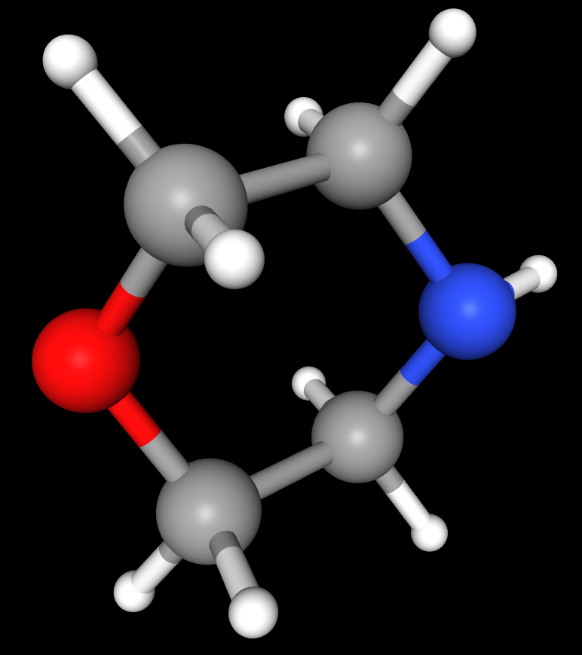
1.1 Connection through the Morpholine Nitrogen
When the main scaffold is directly connected to the morpholine nitrogen, common target structures include aryl–N-morpholine, alkyl–N-morpholine, N-acylmorpholine, and N-sulfonylmorpholine derivatives.
Although all of these structures involve nitrogen-based connection, the bonds that need to be formed are different:
Target structure | Target bond type | Common bond-forming method |
Aryl or heteroaryl–N-morpholine | Aryl C–N bond | Nucleophilic aromatic substitution, metal-catalyzed amination |
Alkyl or benzyl–N-morpholine | Aliphatic C–N bond | Bimolecular nucleophilic substitution, reductive amination |
R–C(O)–N-morpholine | Amide C(O)–N bond | Acylation |
R–SO₂–N-morpholine | Sulfonamide S(O)₂–N bond | Sulfonylation |
1.2 Connection through the Terminus of a Side Chain
Side-chain intermediates consist of a “morpholine ring–carbon chain–terminal functional group” arrangement, such as 4-(2-aminoethyl)morpholine, 4-(2-hydroxyethyl)morpholine, and 4-(3-chloropropyl)morpholine.
In these intermediates, the morpholine ring nitrogen is generally already a tertiary amine, while the terminal amino group, hydroxy group, or halogen-bearing carbon is the principal site involved in formation of the target bond.
For example, when 4-(2-aminoethyl)morpholine reacts with a carboxylic acid derivative, the amide bond is formed through the terminal primary amine of the side chain:
R–C(O)–X + H₂N–CH₂CH₂–N(morpholine ring) → R–C(O)–NH–CH₂CH₂–N(morpholine ring)
Therefore, side-chain intermediates should be selected according to the terminal functional group and the length of the connecting chain.
1.3 Connection through a Morpholine Ring Carbon
If the substituent is directly located at position 2, position 3, or another carbon atom of the morpholine ring, the structure is classified as a ring-carbon-substituted morpholine, such as a 2-arylmorpholine, 2-hydroxymethylmorpholine, or 3-aminomorpholine.
These structures cannot be obtained through conventional N-alkylation of the parent morpholine ring. Two general strategies are commonly used:
1. Use a morpholine building block that already contains the required ring-carbon substituent;
2. Reconstruct the morpholine ring from an amino alcohol, epoxide, or amino carbonyl precursor.
In such cases, particular attention must be paid to the substitution position, the C–O or C–N bond formed during ring construction, and any configurational changes occurring during cyclization.
1.4 Differences among the Three Connection Modes
Connection site | Main point to determine | Direction for intermediate selection |
Morpholine nitrogen | Which type of N-linked bond must be formed | Morpholine free base, or a morpholine acid-addition salt from which the free amine can be released with a base |
Side-chain terminus | Which reaction will involve the terminal functional group | Amino-, hydroxy-, haloalkyl-, or carboxyl-functionalized morpholines |
Morpholine ring carbon | Substitution position and stereochemistry | 2-/3-substituted building blocks or cyclization precursors |
2 Connection through the Morpholine Nitrogen: Route Selection Based on the Target Bond Type
2.1 Aryl and Heteroaryl C–N Bonds
2.1.1 Nucleophilic Aromatic Substitution
Nucleophilic aromatic substitution (S_NAr) is suitable for electron-deficient aryl or heteroaryl substrates:
Electron-deficient Ar–X + morpholine → Ar–N(morpholine ring)
Here, Ar represents an aryl or heteroaryl group, and X represents a halogen or another leaving group.
The reacting carbon in a conventional aryl halide is sp²-hybridized and therefore cannot undergo backside attack in the same manner as a primary alkyl halide in an S_N2 reaction. In many electron-deficient substrates, morpholine undergoes nucleophilic addition to the aryl carbon bearing the leaving group, followed by elimination of the leaving group and restoration of aromaticity.
Electron-withdrawing groups such as nitro, cyano, and carbonyl groups can lower the electron density at the reaction site and promote nucleophilic attack when they are positioned appropriately relative to the leaving group. The activating effect of nitrogen atoms within a heteroaromatic ring depends on their position, the type of heterocycle, and the substitution pattern. Studies have shown that some representative S_NAr reactions can proceed through a concerted pathway without forming a long-lived, discrete addition intermediate.[3] Concerted S_NAr processes have also been reported in specialized aromatic deoxyfluorination systems.[2] When selecting morpholine intermediates, the electronic properties of the reaction site, the type of leaving group, and steric hindrance must still be evaluated carefully.
In some electron-deficient aryl systems, aryl fluorides may react faster than the corresponding chlorides. This behavior arises from the electronic effects governing nucleophilic aromatic substitution and cannot be predicted directly from the leaving-group order observed in aliphatic substitution reactions.
2.1.2 Metal-Catalyzed Amination
When an aryl halide lacks sufficient electronic activation, palladium-catalyzed Buchwald–Hartwig amination may be evaluated:
Ar–X + morpholine — palladium catalyst, ligand, base → Ar–N(morpholine ring)
The palladium catalytic cycle includes oxidative addition of the aryl–halogen bond, amine coordination and deprotonation, and reductive elimination to form the C–N bond.[4–6]
This route activates the aryl–leaving-group bond through a metal catalyst and is less dependent on electron deficiency in the aromatic ring than S_NAr. Copper-catalyzed C–N coupling may also be used for certain substrates, but its catalytic mechanism should not be interpreted simply by applying the palladium catalytic cycle.
The two routes can initially be distinguished according to the following principles:
Substrate characteristics | Route that may be evaluated first |
Electron-deficient fluoro- or chloro-substituted heteroaromatic ring | S_NAr |
Strong electron-withdrawing group ortho or para to the leaving group | S_NAr |
Conventional aryl bromide or aryl chloride | Metal-catalyzed amination |
Polyhalogenated heteroaromatic ring | Compare the electronic properties and steric hindrance at the different positions |
2.2 Alkyl and Benzyl C–N Bonds
2.2.1 Bimolecular Nucleophilic Substitution
Bimolecular nucleophilic substitution (S_N2) is commonly used for reactions of morpholine with primary alkyl halides, benzyl halides, or sulfonate esters:
R–CH₂–X + morpholine → R–CH₂–N(morpholine ring)
In an S_N2 reaction, the morpholine nitrogen attacks the saturated carbon bearing the leaving group, and formation of the C–N bond occurs concertedly with cleavage of the C–X bond.
Primary alkyl, benzyl, and allyl substrates are generally suitable for this route. Secondary substrates may undergo competing elimination, whereas sterically hindered tertiary substrates are generally unsuitable for conventional S_N2 reactions.
The N-alkylmorpholine formed in the first alkylation remains a tertiary amine containing a nitrogen lone pair. When the alkylating reagent is used in excess or its local concentration is high, the product may undergo further alkylation to form a quaternary ammonium salt. Controlling the amount of electrophile, the order of addition, and the reaction time is important for reducing quaternization.
2.2.2 Reductive Amination
When the target alkyl fragment can be supplied by an aldehyde or ketone, reductive amination may be selected. Morpholine is a secondary amine and condenses with an aldehyde or ketone to form an iminium-type intermediate, which is then reduced to give an N-alkylmorpholine.
For an aldehyde:
R–CHO + morpholine ⇌ [R–CH=N⁺(morpholine ring)] + H₂O — reduction → R–CH₂–N(morpholine ring)
For a ketone:
R¹–C(O)–R² + morpholine ⇌ [R¹R²C=N⁺(morpholine ring)] + H₂O — reduction → R¹–CH(R²)–N(morpholine ring)
The carbonyl carbon is ultimately converted into a saturated carbon connected to the morpholine nitrogen. In the ketone route, a new stereogenic center may also be formed at this carbon.
Reaction performance depends on iminium formation and reduction selectivity. Insufficient acidity may not favor dehydration, whereas excessive acidity can cause overprotonation of morpholine. The reducing agent must also avoid reducing unreacted aldehydes, ketones, or other sensitive functional groups too rapidly. Mild reducing agents such as sodium triacetoxyborohydride are commonly used for direct reductive amination.[7]
Comparison item | S_N2 alkylation | Reductive amination |
Source of the carbon fragment | Halide or sulfonate ester | Aldehyde or ketone |
Core process | Nucleophilic substitution | Reduction after iminium formation |
Main issues | Quaternization, elimination | Direct carbonyl reduction, insufficient condensation |
Stereochemistry | If the carbon bearing the leaving group is a stereogenic center and the reaction proceeds mainly through S_N2, inversion of configuration occurs | The ketone route may form a new stereogenic center |
When the corresponding halide is prone to elimination or lacks sufficient stability, while the aldehyde or ketone is readily available, the reductive amination route may be compared.
2.3 Carbonyl and Sulfonyl Linkages
Morpholine can serve as the amine component in reactions with acid chlorides, activated esters, isocyanates, or sulfonyl chlorides.
Reagent type | Main product | Reaction characteristics |
R–C(O)–X + morpholine | R–C(O)–N-morpholine | Forms an N-acylmorpholine |
R–N=C=O + morpholine | R–NH–C(O)–N-morpholine | Forms an unsymmetrical urea |
R–SO₂Cl + morpholine | R–SO₂–N-morpholine | Forms an N-morpholine sulfonamide |
After N-acylation, the lone pair on the morpholine nitrogen is conjugated with the carbonyl group, and the basicity and nucleophilicity of the nitrogen are substantially reduced. It should therefore no longer be regarded as an ordinary N-alkylmorpholine-type tertiary amine.
Morpholine-4-carbonyl chloride and morpholine-4-sulfonyl chloride are functional-group transfer reagents:
Morpholine–N–C(O)–Cl + amine or alcohol → urea or carbamate
Morpholine–N–SO₂Cl reacts with an amine to form an N,N′-substituted sulfamide derivative and with an alcohol to form a sulfamate.
3 Morpholine Intermediates Bearing Linkers or Ring-Carbon Substituents
3.1 Intermediates Bearing Linkers
Side-chain intermediates should be selected according to the terminal functional group:
Terminal functional group | Main synthetic task | Main consideration |
–NH₂ | Amide, urea, sulfonamide formation, reductive amination | Difference in reactivity between the terminal primary amine and the morpholine tertiary amine |
–OH | Ester, ether, carbonate formation, and subsequent activation | Compatibility of hydroxy-group activation conditions with the morpholine nitrogen |
–CH₂X | Construction of C–N, C–O, and C–S bonds | Alkylation at multiple sites, elimination, and salt form |
–CO₂H or –CO₂R | Construction of amides or esters after carboxylic acid activation; carboxylic esters may undergo hydrolysis, aminolysis, or transesterification | Carboxylic acid activation method, ester stability, and protonation of the ring nitrogen |
The main reaction site of 4-(2-aminoethyl)morpholine and 4-(3-aminopropyl)morpholine is the terminal primary amine. The difference between a two-carbon and three-carbon chain affects the connection distance and conformational freedom and may be compared as a structural variable.
Hydroxyalkylmorpholines may undergo further esterification, etherification, or functional-group activation, although acidic or strongly alkylating conditions may also affect the morpholine ring nitrogen.
Haloalkylmorpholines act as electrophilic linkers and react with nucleophiles such as amines, alcohols, phenols, or thiols. When selecting a chloro or bromo derivative, reaction activity, stability, and side reactions must all be considered. For 4-(2-haloethyl)morpholines, the possibility of neighboring-group participation by the ring nitrogen to form an aziridinium-type intermediate should also be considered, because this process may affect the reaction rate and the composition of side products.
3.2 2-/3-Substituted Morpholines
Morpholine ring numbering can be represented as:
O¹–C²–C³–N⁴–C⁵–C⁶
Positions 2 and 6 are adjacent to oxygen, whereas positions 3 and 5 are adjacent to nitrogen. In unsubstituted morpholine, positions 2 and 6 are equivalent, and positions 3 and 5 are equivalent.
Ring-carbon substitution and N-substitution are different retrosynthetic problems. For example, 4-benzylmorpholine can be constructed by N-alkylation or reductive amination, whereas 2-benzylmorpholine requires a preformed ring-carbon-substituted building block or installation of the benzyl group on the corresponding precursor carbon before ring formation.
Common strategies for constructing ring-carbon-substituted morpholines include:
Amino alcohol or a related bifunctional precursor → selective activation of one reaction site → intramolecular formation of a C–N or C–O bond → substituted morpholine
Alternatively, a substituted amino alcohol may first be prepared by epoxide ring opening and then subjected to intramolecular cyclization. The key to route design is not simply selecting an “amino alcohol cyclization,” but mapping each atom of the target ring onto the precursor and determining which carbon will ultimately become position 2 or position 3.
3.3 Regioselectivity and Stereochemistry
If an epoxide can be attacked at either of its two carbon atoms, the position of ring opening will affect whether the substituent ultimately occupies position 2 or position 3 of the morpholine ring.
When ring opening or ring closure proceeds through an S_N2 process, the attacked stereogenic carbon generally undergoes inversion of configuration. Therefore, a chiral morpholine route requires sequential tracking of:
Precursor configuration → site of nucleophilic attack → configurational change → final morpholine configuration
When multiple peaks are observed during analysis, positional isomers, diastereomers, and enantiomers should be distinguished. A single peak in conventional liquid chromatography or a standard nuclear magnetic resonance spectrum generally cannot, by itself, establish enantiomeric purity. Chiral products must also be evaluated by chiral chromatography or other appropriate methods.
4 Protecting Groups, Salt Forms, and Reaction Sequence
4.1 When the Morpholine Nitrogen Requires Protection
An N-unsubstituted morpholine contains an N–H bond. N-protection may be considered when the free nitrogen interferes with ring-carbon functionalization, reacts with strong bases or organometallic reagents, or competes with other amines in the molecule.
Common protecting groups include tert-butoxycarbonyl, benzyloxycarbonyl, 9-fluorenylmethoxycarbonyl, and benzyl groups. Selection should take into account both the conditions used in intermediate steps and the deprotection conditions, so that acidic, basic, or hydrogenolytic treatment does not affect the target structure.
In intermediates such as 4-(2-aminoethyl)morpholine, the ring nitrogen is already a tertiary amine. In such cases, the group that generally requires protection is the terminal primary amine of the side chain rather than the morpholine ring nitrogen.
4.2 Free-Base and Salt Forms
A free base can be used directly as a nucleophile, although some intermediates may be liquids, low-melting materials, or hygroscopic. Hydrochloride and hydrobromide salts are often easier to isolate as stable solids, but the free amine must be released with a base before the compound can participate in a nucleophilic reaction.
When an amine salt reacts with an acid chloride, the base must both release the free amine and neutralize the acid generated during acylation. The amount of base should therefore not be calculated solely from the equivalents of acid chloride; the acid equivalents associated with the amine salt must also be considered.
Salt formation mainly improves storage and handling and does not indicate that the salt is more nucleophilic than the corresponding free base.
4.3 How to Arrange the Reaction Sequence
The reaction sequence should prioritize steps with more demanding selectivity or purification requirements.
Structural characteristics | Possible sequence |
The ring-carbon structure is already established, and late-stage N-substitution is straightforward | Construct the ring first, followed by N-substitution |
Ring-carbon reactions are disrupted by a free nitrogen | Protect the nitrogen before ring-carbon functionalization |
Early-stage conditions may cause morpholine quaternization or interfere with metal catalysis | Construct the main scaffold first, followed by installation of the morpholine unit |
The terminal functional group of the linker is compatible with the preceding reaction conditions | The linker may be installed first, followed by terminal coupling; if the terminal functional group undergoes competing reactions, it should be protected first or the linker should be introduced at a later stage |
5 Working Backward from the Target Structure to the Synthetic Route
5.1 Selection Workflow
Step 1: Determine the connection site
Morpholine nitrogen, side-chain terminus, or morpholine ring carbon
Step 2: Determine the target bond type
Aryl C–N, alkyl C–N, C(O)–N, S(O)₂–N, C–O, or C–S
Step 3: Select the intermediate
Parent morpholine, a functionalized linker, or a 2-/3-substituted building block
Step 4: Select the bond-forming method
S_NAr, catalytic amination, S_N2, reductive amination, acylation, sulfonylation, or intramolecular cyclization
Step 5: Refine the implementation conditions
Protecting groups, salt forms, positional selectivity, stereochemistry, and purification methods
5.2 Common Problems and Diagnostic Directions
Experimental observation | Main cause | Diagnostic and adjustment direction |
The aryl halide shows little or no reaction | The electronic properties of the aromatic ring are unsuitable for S_NAr, or the amine has not been released from its salt form | Reassess the bond-forming mechanism and compare metal-catalyzed amination if necessary |
A highly polar quaternary ammonium salt is formed | The N-alkylmorpholine undergoes further reaction with the electrophile | Adjust the equivalents, order of addition, concentration, and reaction time |
Multiple isomers are formed | Substitution at multiple sites, different epoxide ring-opening positions, or formation of a new stereogenic center | Distinguish positional isomers, diastereomers, and enantiomers |
Conversion is high, but purification is difficult | Excess morpholine, tailing caused by the basic nitrogen, an oily product, or the presence of multiple salt forms | Compare acid–base extraction, salt crystallization, and chromatographic conditions |
6 Classification and Research Applications of Representative Chemicals Related to Morpholine Intermediate Connection Sites, Functional Group Types, and Synthetic Routes
Table 1. Morpholine Parent Scaffold, N-Substituted Derivatives, Protected Forms, and Analytical Reference Products
Classification | CAS No. | Aladdin Catalog No. | Name | Specification or Purity | Product Features and Applications |
Morpholine parent scaffold | 110-91-8 | Morpholine | Distillation grade, ≥99.5% | Used in nucleophilic aromatic substitution, metal-catalyzed amination, aliphatic nucleophilic substitution, acylation, and sulfonylation; serves as a fundamental amine source for constructing N-linked morpholine structures. | |
Morpholine acid-addition salt | 10024-89-2 | Morpholine hydrochloride | ≥98% | Used for salt-form storage, release of the free amine, acid–base equivalent calculations, and studies of the influence of salt form on reaction conversion. | |
N-Alkylated tertiary amine | 109-02-4 | N-Methylmorpholine | Distillation grade, ≥99.5% | Used as a reference for N-alkylated structures, as an acid scavenger in acylation and sulfonylation reactions, and in screening condensation conditions. | |
N-Alkylated tertiary amine | 100-74-3 | N-Ethylmorpholine | ≥99% | Used to study N-alkyl substitution effects, steric hindrance, and differences in basicity; may also serve as an organic base and acid scavenger. | |
N-Acylated compound | 4394-85-8 | N-Formylmorpholine | ≥99% | Used in studies of N-acylated morpholine structures, amide conjugation effects, and high-boiling polar reaction media. | |
N-Aryl-linked compound | 92-53-5 | 4-Phenylmorpholine | ≥98% | Used as a reference for N-aryl-linked structures, for validation of aryl C–N bond-forming methods, and for structural differentiation from ring-carbon aryl-substituted morpholines. | |
N-Protected building block | 220199-85-9 | tert-Butyl morpholine-4-carboxylate | ≥97% | Used to temporarily suppress the nucleophilicity of the morpholine nitrogen in studies of ring-carbon functionalization, selective bond formation, and deprotection sequence design. | |
Isotopically labeled analytical reagent | 342611-02-3 | Morpholine-d8 | — | Used as an isotopic internal standard in studies of morpholine residues, reaction monitoring, and quantitative gas or liquid chromatography–mass spectrometry. |
Table 2. Amino, Hydroxy, and Haloalkyl Linkers and Functional-Group Transfer Reagents
Classification | CAS No. | Aladdin Catalog No. | Name | Specification or Purity | Product Features and Applications |
Two-carbon amino linker | 2038-03-1 | 4-(2-Aminoethyl)morpholine | ≥98% | Used in amide, urea, sulfonamide, and reductive amination linkages, and to study the effects of two-carbon chain length and dual basic centers on reaction behavior and purification. | |
Three-carbon amino linker | 123-00-2 | N-Aminopropylmorpholine | ≥98% | Used in amide, urea, sulfonamide, and reductive amination linkages, and to study the influence of three-carbon chain flexibility and spatial distance on bond formation and conformation. | |
Two-carbon hydroxy linker | 622-40-2 | 4-(2-Hydroxyethyl)morpholine | ≥99% | Used in esterification, etherification, carbonate formation, and studies of conversion to halides or sulfonate esters after hydroxy-group activation. | |
Two-carbon chloro linker salt | 3647-69-6 | 4-(2-Chloroethyl)morpholine hydrochloride | ≥99% | Used to introduce a two-carbon morpholine linker through nucleophilic substitution and to study salt form, base loading, and selectivity among nitrogen, oxygen, and sulfur nucleophiles. | |
Two-carbon chloro linker | 3240-94-6 | 4-(2-Chloroethyl)morpholine | ≥98% | Used in nucleophilic substitution involving a two-carbon electrophilic linker and in studies of neighboring-group participation and the reaction behavior of the free-base form. | |
Two-carbon bromo linker salt | 42802-94-8 | 4-(2-Bromoethyl)morpholine hydrobromide | ≥96% | Used in nucleophilic substitution involving a two-carbon morpholine linker and to examine the bromo leaving group, salt form, and quaternization side reactions. | |
Three-carbon chloro linker salt | 57616-74-7 | 4-(3-Chloropropyl)morpholine hydrochloride | ≥97% | Used to introduce a three-carbon morpholine linker through nucleophilic substitution and to examine salt form, base loading, and competition between substitution and elimination. | |
Three-carbon chloro linker | 7357-67-7 | 4-(3-Chloropropyl)morpholine | ≥95% | Used in constructing three-carbon electrophilic linkers and in studies of substitution by nitrogen, oxygen, and sulfur nucleophiles under free-base conditions. | |
Carbamoyl-transfer reagent | 15159-40-7 | Morpholine-4-carbonyl chloride | ≥97% | Used to transfer a morpholine carbamoyl group to amines or alcohols, thereby constructing unsymmetrical ureas and carbamates. | |
Sulfamoyl-transfer reagent | 1828-66-6 | Morpholine-4-sulfonyl chloride | ≥97% | Used with amines or alcohols to construct N,N′-substituted sulfamide derivatives or sulfamates and to investigate sulfamoyl-group transfer. |
Table 3. Ring-Carbon-Substituted Morpholine Building Blocks and Carboxylic Acid Activation/Coupling Reagents
Classification | CAS No. | Aladdin Catalog No. | Name | Specification or Purity | Product Features and Applications |
2-Position ring-carbon aryl building block | 23972-41-0 | 2-Phenylmorpholine | ≥97% | Used in studies of aryl substitution at the 2-position ring carbon, morpholine ring numbering, positional-isomer differentiation, and conformational behavior of ring-carbon-substituted morpholines. | |
3-Position ring-carbon benzyl building block | 7684-27-7 | 3-Benzylmorpholine | ≥95% | Used in studies of benzyl substitution at the 3-position ring carbon, positional-isomer comparison between the 2- and 3-positions, and the conformation and stereochemistry of ring-carbon-substituted morpholines. | |
Triazine precursor for carboxylic acid activation | 3140-73-6 | 2-Chloro-4,6-dimethoxy-1,3,5-triazine | ≥97% | Used in carboxylic acid activation and amide and ester condensation, and as a triazine precursor for the preparation of morpholinium-type coupling reagents and in situ activation studies. | |
Morpholinium-type coupling reagent | 3945-69-5 | 4-(4,6-Dimethoxy-1,3,5-triazin-2-yl)-4-methylmorpholinium chloride hydrate (DMTMM) | ≥97% | Used in carboxylic acid activation, amide coupling of aminoalkylmorpholines, and studies of esterification and amidation conditions. |
Note: The products listed above are representative Aladdin products related to scientific research and formulation studies. Additional product specifications, grades, and COA information can be retrieved from the Aladdin website using the product name, CAS number, or catalog number.
References
[1] Favre H A, Powell W H. Nomenclature of Organic Chemistry: IUPAC Recommendations and Preferred Names 2013. Cambridge: The Royal Society of Chemistry, 2014.
[2] Neumann C N, Hooker J M, Ritter T. Concerted nucleophilic aromatic substitution with ¹⁹F⁻ and ¹⁸F⁻. Nature, 2016, 534: 369–373. DOI: 10.1038/nature17667.
[3] Kwan E E, Zeng Y, Besser H A, Jacobsen E N. Concerted nucleophilic aromatic substitutions. Nature Chemistry, 2018, 10: 917–923. DOI: 10.1038/s41557-018-0079-7.
[4] Paul F, Patt J, Hartwig J F. Palladium-catalyzed formation of carbon-nitrogen bonds: reaction intermediates and catalyst improvements in the hetero cross-coupling of aryl halides and tin amides. Journal of the American Chemical Society, 1994, 116: 5969–5970. DOI: 10.1021/ja00092a058.
[5] Guram A S, Buchwald S L. Palladium-catalyzed aromatic aminations with in situ generated aminostannanes. Journal of the American Chemical Society, 1994, 116: 7901–7902. DOI: 10.1021/ja00096a059.
[6] Louie J, Hartwig J F. Palladium-catalyzed synthesis of arylamines from aryl halides: mechanistic studies lead to coupling in the absence of tin reagents. Tetrahedron Letters, 1995, 36: 3609–3612. DOI: 10.1016/0040-4039(95)00605-C.
[7] Abdel-Magid A F, Carson K G, Harris B D, Maryanoff C A, Shah R D. Reductive amination of aldehydes and ketones with sodium triacetoxyborohydride: studies on direct and indirect reductive amination procedures. The Journal of Organic Chemistry, 1996, 61: 3849–3862. DOI: 10.1021/jo960057x.
For more related articles, see below:
Applications of imidazole and its derivatives
Substituted Azetidines in pharmaceutical chemistry, organic synthesis, and biochemistry