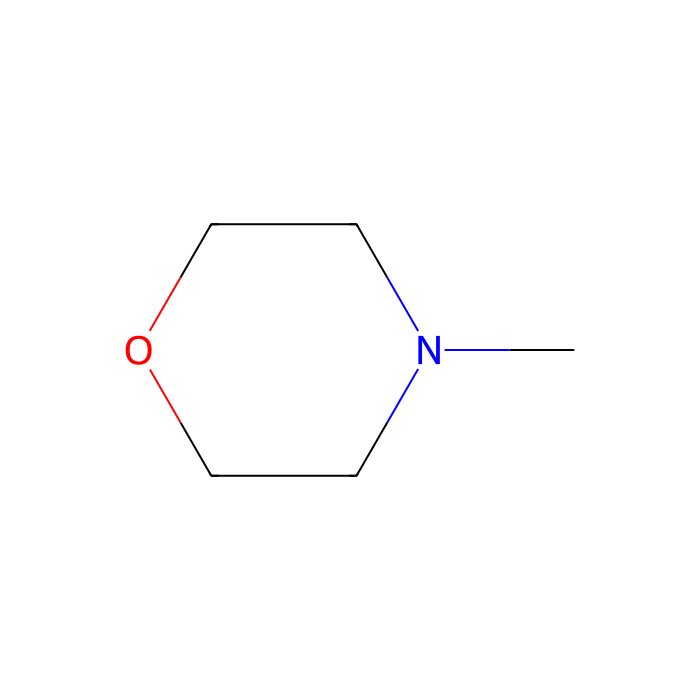
N-Methyl morpholine - Distillation grade, ≥99.5% , CAS No.109-02-4

CAS: 109-02-4 Cat. No.: M104643 Formula: C5H11NO Molecular Weight: 101.15 Beilstein Registry Number: 102719 EC Number: 203-640-0
AVAILABLE TO ORDER
GRADE & PURITY Distillation grade ? Distillation grade — purified by/for distillation with controlled volatile profile. Use where distillation behavior and low residue are important. ≥99.5%
Synonyms
N-methyimorpholine|4-methymorpholine|N-Methyl morphofine pound>>Morpholine, 4-methyl-|N-methylmorphline|4-methlmorpholine|4-Methylmorpholine or n-methylmorpholine|N-methylmopholine|N-methyl-mopholine|N-metylmorpholine|N-metyl-morpholine|N-mehtyl morpholine|4 -methylmorpholine|4-N-methylmorpholine|N-Methylmorpholin|N-methyl-morpholin|N-methymorpholine|4-Methyl-1-oxa-4-azacyclohexane|4-methylmopholine|N-methyl morpholine|N-methyl -morpholine|4-Methylmorfolin [Czech]|4-methyl morpholin|1-Methylmorpholine|N- methylmorpholine|N -methylmorpholine|4-Methylmorpholine, redistilled|morpholine, 4-methyl|Morpholine, 4-methyl-|N-methyhnorpholine|N-methyl morpholine hydrochloride|N-METHYLMORPHOLINE [MI]|Methylmorpholine|methyl-morpholine|N-METHYLMORPHOLINE|N--methylmorpholine|N-methylmor-pholine|N-methylmorpho-line|4-(methyl)morpholine|N-methyl morpholin|N- methyl morpholine|p-Methyl morpholine|4-Methylmorpholine or n-methylmorpholine [UN2535] [Flammable liquid]|NMM|4-Methylmorfolin|4methylmorpholine|4-Methylmorpholine|4-methyl-morpholine|Morpholine, N-methyl-|Texacat NMM
Storage
Protected from light,Room temperature
Shipped In
FedEx DG Service
★
Size
USA
Germany (EU)*
Price
Qty
100ml
M104643-100ml
5 In stock
—
$49.90
500ml
M104643-500ml
In stock ≥10
5 In stock

$141.90

$169.90
Save $28.00 (16.48%)
Enter a quantity for the sizes you want to add.

Overview

product describtion:

N-Methylmorpholine is a morpholine-containing compound used for protein sequencing analysis
4-Methylmorpholine is an economical cation useful for the preparation of morpholinium cation-based ionic liquids. The experimental FT-IR and FT-Raman spectra of 4-methylmorpholine has been recorded over the range 4000-400cm-1 and 3500-100cm-1 respectively. It undergoes fluorination with cobalt(III) fluoride to afford highly fluorinated morpholines, which were characterized by mass and NMR spectroscopy.


Product Application:
4-Methylmorpholine may be used in the preparation of N-ethyl-N-methylmorpholinium bis(trifluoromethanesulfonyl)imide.A morpholine-containing compound used for protein sequencing analysis

Specifications

Synonyms
N-methyimorpholine | 4-methymorpholine | N-Methyl morphofine pound>>Morpholine, 4-methyl- | N-methylmorphline | 4-methlmorpholine | 4-Methylmorpholine or n-methylmorpholine | N-methylmopholine | N-methyl-mopholine | N-metylmorpholine | N-metyl-morpholine | N-mehtyl morpholine | 4 -methylmorpholine | 4-N-methylmorpholine | N-Methylmorpholi Show more
Specifications & Purity
Distillation grade, ≥99.5%
Storage
Protected from light,Room temperature
Shipped In
FedEx DG Service
Grade
Distillation grade
Purity
≥99.5%
Names and Identifiers
Pubchem Sid
SMILES
CN1CCOCC1
IUPAC Name
4-methylmorpholine
InChIKey
SJRJJKPEHAURKC-UHFFFAOYSA-N
InChI
1S/C5H11NO/c1-6-2-4-7-5-3-6/h2-5H2,1H3
Isomeric SMILES
CN1CCOCC1
WGK Germany
1
RTECS
QE5775000
UN Number
2535
Packing Group
II
Molecular Weight
101.15
Beilstein
102719
Reaxys
102719
Reaxys-RN_link_address
https://www.reaxys.com/reaxys/secured/hopinto.do?context=S&query=IDE.XRN=102719&ln=

Advanced Data

Taxonomic Classification

Taxonomy Tree

KingdomOrganic compounds
SuperclassOrganoheterocyclic compounds
ClassOxazinanes
SubclassMorpholines
Intermediate Tree Nodes Not available
Direct ParentMorpholines
Alternative Parents Trialkylamines  Oxacyclic compounds  Dialkyl ethers  Azacyclic compounds  Organopnictogen compounds  Hydrocarbon derivatives  
Molecular FrameworkAliphatic heteromonocyclic compounds
Substituents Morpholine - Tertiary aliphatic amine - Tertiary amine - Oxacycle - Azacycle - Ether - Dialkyl ether - Organic nitrogen compound - Organic oxygen compound - Organopnictogen compound - Hydrocarbon derivative - Organooxygen compound - Organonitrogen compound - Amine - Aliphatic heteromonocyclic compound
DescriptionThis compound belongs to the class of organic compounds known as morpholines. These are organic compounds containing a morpholine moiety, which consists of a six-member aliphatic saturated ring with the formula C4H9NO, where the oxygen and nitrogen atoms lie at positions 1 and 4, respectively.
External Descriptors Not available
3D Structure
Interactive Chemical Structure Model


Mechanisms of Action
Certificates (CoA,COO,BSE/TSE and Analysis Chart)
C of A & Other Certificates(BSE/TSE, COO):
Analytical Chart:

Find and download the COA for your product by matching the lot number on the packaging.

15 results found

Lot NumberCertificate TypeDateItem
J2627151J2627151Certificate of AnalysisOct 20, 2026 M104643
D2602181D2602181Certificate of AnalysisMar 10, 2026 M104643
B2625061B2625061Certificate of AnalysisMar 04, 2026 M104643
L2122539L2122539Certificate of AnalysisOct 11, 2025 M104643
I2502215I2502215Certificate of AnalysisAug 04, 2025 M104643
L2417271L2417271Certificate of AnalysisDec 09, 2024 M104643
L2417272L2417272Certificate of AnalysisDec 09, 2024 M104643
G2321858G2321858Certificate of AnalysisJul 14, 2023 M104643
G2321875G2321875Certificate of AnalysisJul 14, 2023 M104643
G2321885G2321885Certificate of AnalysisJul 14, 2023 M104643
D23181238D23181238Certificate of AnalysisApr 10, 2023 M104643
D23181259D23181259Certificate of AnalysisApr 10, 2023 M104643
B1926128B1926128Certificate of AnalysisDec 12, 2022 M104643
K2216269K2216269Certificate of AnalysisJun 15, 2022 M104643
L2122533L2122533Certificate of AnalysisNov 30, 2021 M104643
Chemical and Physical Properties
SolubilityMiscible with water, soluble in benzene.Dissolved in ether, methanol
SensitivityLight sensitive.
Refractive Index1.4332
Flash Point12℃
Boil Point111-114°C
Melt Point-65°C
Molecular Weight101.15
XLogP3-0.300
Hydrogen Bond Donor Count0
Hydrogen Bond Acceptor Count2
Rotatable Bond Count0
Exact Mass101.084 Da
Monoisotopic Mass101.084 Da
Topological Polar Surface Area12.500 Ų
Heavy Atom Count7
Formal Charge0
Complexity50.000
Isotope Atom Count0
Defined Atom Stereocenter Count0
Undefined Atom Stereocenter Count0
Defined Bond Stereocenter Count0
Undefined Bond Stereocenter Count0
The total count of all stereochemical bonds0
Covalently-Bonded Unit Count1
Safety and Hazards(GHS)
Pictogram(s)
GHS02,   GHS05,   GHS07
Signal
Danger
Hazard Statements

H225:Highly Flammable liquid and vapor

H302:Harmful if swallowed

H312:Harmful in contact with skin

H314:Causes severe skin burns and eye damage

H318:Causes serious eye damage

H332:Harmful if inhaled

H373:May causes damage to organs through prolonged or repeated exposure

Precautionary Statements

P210:Keep away from heat, hot surface, sparks, open flames and other ignition sources. - No smoking.

P233:Keep container tightly closed.

P240:Ground/bond container and receiving equipment.

P241:Use explosion-proof [electrical/ventilating/lighting/.../] equipment.

P242:Use only non-sparking tools.

P243:Take precautionary measures against static discharge.

P260:Do not breathe dust/fume/gas/mist/vapors/spray.

P261:Avoid breathing dust/fume/gas/mist/vapors/spray.

P264:Wash hands [and …] thoroughly after handling.

P270:Do not eat, drink or smoke when using this product.

P271:Use only outdoors or in a well-ventilated area.

P280:Wear protective gloves/protective clothing/eye protection/face protection.

P321:Specific treatment (see ... on this label).

P330:Rinse mouth.

P363:Wash contaminated clothing before reuse.

P301+P330+P331:IF SWALLOWED: Rinse mouth. Do NOT induce vomiting.

P302+P352:IF ON SKIN: wash with plenty of water.

P303+P361+P353:IF ON SKIN (or hair): Take off Immediately all contaminated clothing. Rinse SKIN with water [or shower].

P304+P340:IF INHALED: Remove person to fresh air and keep comfortable for breathing.

P362+P364:Take off contaminated clothing and wash it before reuse.

P370+P378:In case of fire: Use ... to extinguish.

P405:Store locked up.

P403+P235:Store in a well-ventilated place. Keep cool.

P501:Dispose of contents/container to an approved waste disposal plant.

P264+P265:Wash hands [and …] thoroughly after handling. Do not touch eyes.

P301+P317:IF SWALLOWED: Get medical help.

P305+P354+P338:IF IN EYES: Immediately rinse with water for several minutes. Remove contact lenses if present and easy to do. Continue rinsing.

P317:Get emergency medical help.

P302+P361+P354:IF ON SKIN: Take off Immediately all contaminated clothing. Immediately rinse with water for several minutes.

P316:Get emergency medical help immediately.

P319:Get medical help if you feel unwell.

WGK Germany
1
RTECS
QE5775000
Reaxys
102719
Reaxys-RN_link_address
https://www.reaxys.com/reaxys/secured/hopinto.do?context=S&query=IDE.XRN=102719&ln=
Class
3(8)
Merck Index
6277
Documents & Articles
Distillation Grade Reagents: Definition, Quality Control and Representative Aladdin Products
Why Do So Many Molecules Incorporate an “Oxadiazole Ring”? A Stability-Oriented Design Guide from Structural Effects to Application Storylines (with Product Navigation Tables 1–3)
β-Acyloxy Alkenyl Amides (AAAs): A New Approach to Amide Bond and Peptide Bond Construction Worth Attention
Understanding ATD-DMAP: From Reagent Design to Esterification, Amidation, and Stereochemical Integrity
A New Balance in Coupling Reagents: How DMT-TU Balances Reactivity, Racemization Control, and Thermal Hazard
The Positioning of TBTU in Practice: Racemization Risk, Extended Uses, and Selection Criteria
The Methodological Value of HATU in Difficult Couplings: Reactivity Advantages, Stereochemical Retention, and Condition Management
The Methodological Value of Boc-Oxyma: Low-Racemization Coupling, Route Continuity, and Extended Applications
Low Racemization in Peptide Synthesis Is Not Just About Reagent Choice: Stereochemical Risk During the Activation Stage and Practical Strategies for Experimental Control
The Methodological Value of TCFH: Advantages in Challenging Amidation and the Switching Logic of Carboxylic Acid Activation Pathways
Decision Logic for Peptide Synthesis Routes: Applicability and Criteria for Choosing among SPPS, LPPS, and Recombinant Expression
Decision Logic for Selecting Coupling Reagents in Amide Bond Formation: Activation Pathways, Side Reactions, Epimerization, Workup, and Safety
Experimental Selection Logic for Carboxylic Acid Preactivation Pathways: Differences and Suitable Use Cases for Classical Mixed Anhydrides, CDI, Sulfonyl Chloride Systems, and the Yamaguchi System
Boc₂O Selection Cannot Be Judged by Protection Installation Alone: Experimental Decision-Making from Substrate Nucleophilicity and Medium Effects to Deprotection Pathways
DMAP Is More Than Just an Organic Base: Experimental Judgment from Nucleophilic Acyl Transfer to Esterification and Macrolactonization
Experimental Evaluation of Triphosgene in Organic Synthesis: Understanding Its Selection Logic Through Reaction Tasks
Experimental Judgment for TFPN in Carboxylic Acid Activation: Suitable Scenarios, Intermediate Distribution, and Nucleophile Compatibility
Selective Acylation of Less Reactive Amines in Complex Substrates: Strategies for N/O and N/N Selectivity Control This article draws on the work of Li et al. on the TCFH/catalytic Oxyma system and transient imine protection, and summarizes design strateg
How to Troubleshoot Abnormal Impurities in Peptide Synthesis? Locating Process Issues Through Amino-Related Side Reactions
Peptide Intermediates Difficult to Dissolve and Separate? Route Design and Workup Strategies for Tag-Assisted Liquid-Phase Peptide Synthesis (TAG-LPPS)
AITF-Mediated Carboxylic Acid Activation for the Synthesis of Amides, Peptides, and Esters: Activation Mechanism and Applicable Scenarios
Formation and Control of Carboxyl- and Hydroxyl-Related Impurities in Peptide Synthesis — Using Asp/Glu and Ser/Thr Residue Side Reactions as Examples
Logic for Selecting Amidation Reagents in Aqueous Media: Competing Reactions, Activated Intermediates, and Substrate Effects
How to Select Morpholine Intermediates: From Connection Sites and Target Bond Types to Synthetic Route Design
Citations of This Product
Solution Calculators
Reviews

Customer Reviews

Shall we send you a message when we have discounts available?

Remind me later

Thank you! Please check your email inbox to confirm.

Oops! Notifications are disabled.