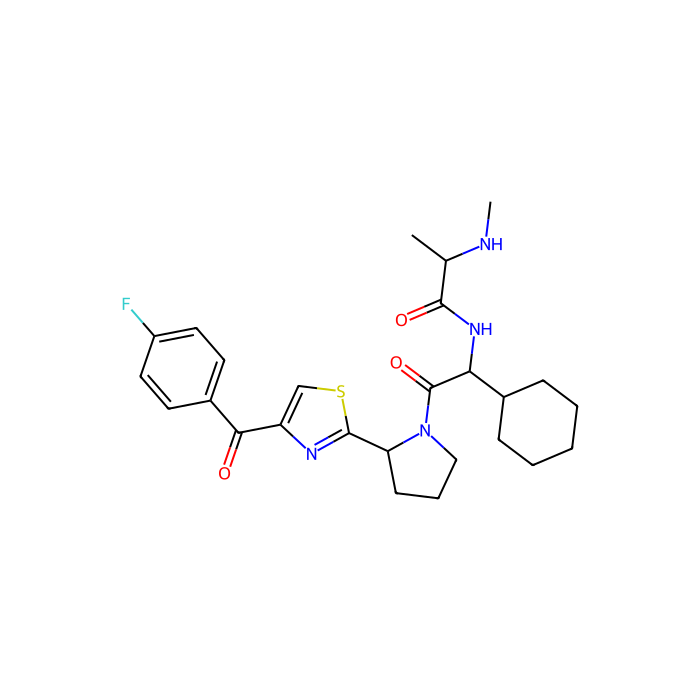
LCL161 - Moligand™, 10mM in DMSO , Inhibitor of baculoviral IAP repeat containing 2;Inhibitor of X-linked inhibitor of apoptosis, CAS No.1005342-46-0, Inhibitor of baculoviral IAP repeat containing 2;Inhibitor of X-linked inhibitor of apoptosis

CAS: 1005342-46-0 Cat. No.: L420283 Fórmula: C26H33FN4O3S Peso molecular: 500.63 Número EC: 811-361-6
Disponible para pedir
GRADE & PURITY Moligand™ ? Moligand™ — Aladdin's line of ligands and bioactive small molecules. Use for receptor, pathway, and binding studies needing defined small-molecule tools. 10mM in DMSO
Synonyms
LCL 161 [WHO-DD] | (2S)-N-[(1S)-1-cyclohexyl-2-[(2S)-2-[4-(4-fluorobenzoyl)-1,3-thiazol-2-yl]pyrrolidin-1-yl]-2-oxoethyl]-2-methylaminopropanamide | NCGC00378579-07 | 1005342-46-0 | N-[(1S)-1-cyclohexyl-2-{(2S)-2-[4-(4-fluorobenzoyl)-1,3-thiazol-2-yl]pyrr
Storage
Store at -80°C
Shipped In
Dry ice packs + Cold packs
★
Size
USA
Alemania (EU)*
Price
Qty
1ml
L420283-1ml
Fabricado bajo pedido · 8–12 semanas

205,90US$

241,90US$
Guardar 36,00 US$ (14.88%)
Enter a quantity for the sizes you want to add.
🧪
Why this grade

Moligand™, 10mM in DMSO Moligand™ for sensitive chromatographic and analytical workflows requiring minimal baseline interference.

🌡

Storage & shipping

Store at -80°C Ships Dry ice packs + Cold packs Check lot-specific COA for exact specifications.

📋

Quality documents

SDS, COA, datasheet, and spec sheet available for download. Lot-specific COA accessible via lot number lookup.

📚

Literature proof

Cited in 0 peer-reviewed publications across chromatography, organic synthesis, and cross-coupling reactions.

Descripción general

LCL161, a SMAC mimetic, potently binds to and inhibits multiple IAPs (i.e. XIAP, c-IAP). Phase 2.

Specifications

Sinónimos
LCL 161 [WHO-DD] | (2S)-N-[(1S)-1-cyclohexyl-2-[(2S)-2-[4-(4-fluorobenzoyl)-1,3-thiazol-2-yl]pyrrolidin-1-yl]-2-oxoethyl]-2-methylaminopropanamide | NCGC00378579-07 | 1005342-46-0 | N-[(1S)-1-cyclohexyl-2-{(2S)-2-[4-(4-fluorobenzoyl)-1,3-thiazol-2-yl]pyrr
Especificaciones y pureza
Moligand™, 10mM in DMSO
Mecanismos bioquímicos y fisiológicos
Description:IC50 Value: N/ALCL161 is an oral small molecule antagonist of Inhibitor of Apoptosis Proteins (IAPs) that sensitizes a subset of tumors from diverse lineages to treatment with cytotoxic therapies.in vitro: Huh-7 cells co-treated with LCL161 an
Condiciones de almacenamiento de almacenamiento
Store at -80°C
Enviado en
Dry ice packs + Cold packs
Este producto requiere envío en cadena de frío. Los servicios terrestres y otros servicios económicos no están disponibles.
Grado
Moligand™
Tipo de acción
INHIBITOR
Mecanismo de acción
Inhibitor of baculoviral IAP repeat containing 2;Inhibitor of X-linked inhibitor of apoptosis
Nombres e identificadores
Sonrisas canónicas
CC(C(=O)NC(C1CCCCC1)C(=O)N2CCCC2C3=NC(=CS3)C(=O)C4=CC=C(C=C4)F)NC
IUPAC Name
(2S)-N-[(1S)-1-cyclohexyl-2-[(2S)-2-[4-(4-fluorobenzoyl)-1,3-thiazol-2-yl]pyrrolidin-1-yl]-2-oxoethyl]-2-(methylamino)propanamide
InChIKey
UFPFGVNKHCLJJO-SSKFGXFMSA-N
INCHI
1S/C26H33FN4O3S/c1-16(28-2)24(33)30-22(17-7-4-3-5-8-17)26(34)31-14-6-9-21(31)25-29-20(15-35-25)23(32)18-10-12-19(27)13-11-18/h10-13,15-17,21-22,28H,3-9,14H2,1-2H3,(H,30,33)/t16-,21-,22-/m0/s1
Isómeros SMILES
C[C@@H](C(=O)N[C@@H](C1CCCCC1)C(=O)N2CCC[C@H]2C3=NC(=CS3)C(=O)C4=CC=C(C=C4)F)NC
Peso molecular
500.63
Reaxy-Rn
26411523
Reaxys-RN_link_address
https://www.reaxys.com/reaxys/secured/hopinto.do?context=S&query=IDE.XRN=26411523&ln=

Documentation

📋 Safety Data Sheet (SDS)

Comprehensive hazard, handling, storage, and regulatory compliance document.

Download SDS →

✅ Certificate of Analysis (COA)

Lot-specific quality data. Enter your lot number to retrieve the exact COA.

Look up COA →

📊 Datasheet

Quick-reference summary of product specifications and applications.

View datasheet →

🔬 Specification Sheet

Full quality attributes and acceptance criteria for this grade.

View spec sheet →

Advanced Data

Taxonomic Classification

Taxonomy Tree

KingdomOrganic compounds
SuperclassOrganic acids and derivatives
ClaseCarboxylic acids and derivatives
SubclassAmino acids, peptides, and analogues
Intermediate Tree Nodes Peptides
Direct ParentDipeptides
Alternative Parents Aryl-phenylketones  N-acyl-alpha amino acids and derivatives  Alpha amino acid amides  Alanine and derivatives  Benzoyl derivatives  N-acylpyrrolidines  Fluorobenzenes  2,4-disubstituted thiazoles  Aryl fluorides  Heteroaromatic compounds  Tertiary carboxylic acid amides  Secondary carboxylic acid amides  Dialkylamines  Azacyclic compounds  Hydrocarbon derivatives  Organofluorides  Organic oxides  
Molecular FrameworkAromatic heteromonocyclic compounds
Substituents Alpha-dipeptide - Aryl-phenylketone - N-acyl-alpha amino acid or derivatives - Alpha-amino acid amide - Alanine or derivatives - N-substituted-alpha-amino acid - Alpha-amino acid or derivatives - Benzoyl - Aryl ketone - N-acylpyrrolidine - 2,4-disubstituted 1,3-thiazole - Fluorobenzene - Halobenzene - Aryl fluoride - Aryl halide - Monocyclic benzene moiety - Benzenoid - Tertiary carboxylic acid amide - Pyrrolidine - Thiazole - Azole - Heteroaromatic compound - Secondary carboxylic acid amide - Amino acid or derivatives - Ketone - Carboxamide group - Secondary amine - Organoheterocyclic compound - Azacycle - Secondary aliphatic amine - Organooxygen compound - Organic oxide - Carbonyl group - Organic oxygen compound - Organic nitrogen compound - Hydrocarbon derivative - Amine - Organohalogen compound - Organofluoride - Organonitrogen compound - Aromatic heteromonocyclic compound
DescripciónThis compound belongs to the class of organic compounds known as dipeptides. These are organic compounds containing a sequence of exactly two alpha-amino acids joined by a peptide bond.
External Descriptors Not available
Estructura 3D
Modelo de Estructura Química Interactiva


Objetivos asociados (humanos)
BIRC2 Tchem Baculoviral IAP repeat-containing protein 2 (8 Activities)
Activity TypeActivity Value -log(M)Mechanism of ActionActivity ReferencePublications (PubMed IDs)
BIRC3 Tchem Baculoviral IAP repeat-containing protein 3 (3 Activities)
Activity TypeActivity Value -log(M)Mechanism of ActionActivity ReferencePublications (PubMed IDs)
XIAP Tchem E3 ubiquitin-protein ligase XIAP (11 Activities)
Activity TypeActivity Value -log(M)Mechanism of ActionActivity ReferencePublications (PubMed IDs)
ABL1 Tclin Tyrosine-protein kinase ABL (18331 Activities)
Activity TypeRelationActivity valueUnitsAction TypeJournalPubMed IddoiAssay Aladdin ID
GSK3B Tclin Glycogen synthase kinase-3 beta (11785 Activities)
Activity TypeRelationActivity valueUnitsAction TypeJournalPubMed IddoiAssay Aladdin ID
CSNK1D Tchem Casein kinase I delta (4546 Activities)
Activity TypeRelationActivity valueUnitsAction TypeJournalPubMed IddoiAssay Aladdin ID
CDK2 Tchem Cyclin-dependent kinase 2 (9050 Activities)
Activity TypeRelationActivity valueUnitsAction TypeJournalPubMed IddoiAssay Aladdin ID
CYP3A4 Tclin Cytochrome P450 3A4 (53859 Activities)
Activity TypeRelationActivity valueUnitsAction TypeJournalPubMed IddoiAssay Aladdin ID
AURKA Tchem Serine/threonine-protein kinase Aurora-A (10240 Activities)
Activity TypeRelationActivity valueUnitsAction TypeJournalPubMed IddoiAssay Aladdin ID
XIAP Tchem Inhibitor of apoptosis protein 3 (3673 Activities)
Activity TypeRelationActivity valueUnitsAction TypeJournalPubMed IddoiAssay Aladdin ID
AGS (1999 Activities)
Activity TypeRelationActivity valueUnitsAction TypeJournalPubMed IddoiAssay Aladdin ID
BXPC-3 (2997 Activities)
Activity TypeRelationActivity valueUnitsAction TypeJournalPubMed IddoiAssay Aladdin ID
CAPAN-1 (772 Activities)
Activity TypeRelationActivity valueUnitsAction TypeJournalPubMed IddoiAssay Aladdin ID
CCRF-CEM (65223 Activities)
Activity TypeRelationActivity valueUnitsAction TypeJournalPubMed IddoiAssay Aladdin ID
PC-3 (62116 Activities)
Activity TypeRelationActivity valueUnitsAction TypeJournalPubMed IddoiAssay Aladdin ID
SK-MEL-28 (48833 Activities)
Activity TypeRelationActivity valueUnitsAction TypeJournalPubMed IddoiAssay Aladdin ID
SK-MES-1 (413 Activities)
Activity TypeRelationActivity valueUnitsAction TypeJournalPubMed IddoiAssay Aladdin ID
SK-OV-3 (52876 Activities)
Activity TypeRelationActivity valueUnitsAction TypeJournalPubMed IddoiAssay Aladdin ID
U2OS (164939 Activities)
Activity TypeRelationActivity valueUnitsAction TypeJournalPubMed IddoiAssay Aladdin ID
A549 (127892 Activities)
Activity TypeRelationActivity valueUnitsAction TypeJournalPubMed IddoiAssay Aladdin ID
HepG2 (196354 Activities)
Activity TypeRelationActivity valueUnitsAction TypeJournalPubMed IddoiAssay Aladdin ID
MDA-MB-231 (73002 Activities)
Activity TypeRelationActivity valueUnitsAction TypeJournalPubMed IddoiAssay Aladdin ID
SW-620 (52400 Activities)
Activity TypeRelationActivity valueUnitsAction TypeJournalPubMed IddoiAssay Aladdin ID
HCT-15 (51914 Activities)
Activity TypeRelationActivity valueUnitsAction TypeJournalPubMed IddoiAssay Aladdin ID
BIRC3 Tchem Baculoviral IAP repeat-containing protein 3 (320 Activities)
Activity TypeRelationActivity valueUnitsAction TypeJournalPubMed IddoiAssay Aladdin ID
BIRC2 Tchem Baculoviral IAP repeat-containing protein 2 (984 Activities)
Activity TypeRelationActivity valueUnitsAction TypeJournalPubMed IddoiAssay Aladdin ID
BIRC7 Tchem Baculoviral IAP repeat-containing protein 7 (64 Activities)
Activity TypeRelationActivity valueUnitsAction TypeJournalPubMed IddoiAssay Aladdin ID
U-118-MG (352 Activities)
Activity TypeRelationActivity valueUnitsAction TypeJournalPubMed IddoiAssay Aladdin ID
BRD4 Tchem Bromodomain-containing protein 4 (13122 Activities)
Activity TypeRelationActivity valueUnitsAction TypeJournalPubMed IddoiAssay Aladdin ID
BIRC3 Tchem cIAP1/cIAP2 (2 Activities)
Activity TypeRelationActivity valueUnitsAction TypeJournalPubMed IddoiAssay Aladdin ID
TRIM24 Tchem Transcription intermediary factor 1-alpha (2087 Activities)
Activity TypeRelationActivity valueUnitsAction TypeJournalPubMed IddoiAssay Aladdin ID
BRPF1 Tchem Peregrin (2217 Activities)
Activity TypeRelationActivity valueUnitsAction TypeJournalPubMed IddoiAssay Aladdin ID
HEK-293T (167025 Activities)
Activity TypeRelationActivity valueUnitsAction TypeJournalPubMed IddoiAssay Aladdin ID
Objetivos asociados (no humanos)
Mapk1 MAP kinase ERK2 (650 Activities)
Activity TypeRelationActivity valueUnitsAction TypeJournalPubMed IddoiAssay Aladdin ID
Hdac6 Histone deacetylase 6 (222 Activities)
Activity TypeRelationActivity valueUnitsAction TypeJournalPubMed IddoiAssay Aladdin ID
Fgfr3 Fibroblast growth factor receptor 3 (21 Activities)
Activity TypeRelationActivity valueUnitsAction TypeJournalPubMed IddoiAssay Aladdin ID
Mus musculus (284745 Activities)
Activity TypeRelationActivity valueUnitsAction TypeJournalPubMed IddoiAssay Aladdin ID
Genome polyprotein (620 Activities)
Activity TypeRelationActivity valueUnitsAction TypeJournalPubMed IddoiAssay Aladdin ID
rep Replicase polyprotein 1ab (378 Activities)
Activity TypeRelationActivity valueUnitsAction TypeJournalPubMed IddoiAssay Aladdin ID
Plasma (328 Activities)
Activity TypeRelationActivity valueUnitsAction TypeJournalPubMed IddoiAssay Aladdin ID
Mecanismos de acción
Certificados (CoA, COO, BSE/TSE y tabla de análisis)
C of A & Other Certificates(BSE/TSE, COO):
Analytical Chart:
Propiedades químicas y físicas
Peso molecular500.600 g/mol
XLogP34.300
Hydrogen Bond Donor Count2
Hydrogen Bond Acceptor Count7
Rotatable Bond Count8
Exact Mass500.226 Da
Monoisotopic Mass500.226 Da
Topological Polar Surface Area120.000 Ų
Heavy Atom Count35
Formal Charge0
Complexity757.000
Isotope Atom Count0
Defined Atom Stereocenter Count3
Undefined Atom Stereocenter Count0
Defined Bond Stereocenter Count0
Undefined Bond Stereocenter Count0
The total count of all stereochemical bonds0
Covalently-Bonded Unit Count1
Preguntas frecuentes y artículos
Calculadoras de soluciones
Reseñas

Reseñas de cliente

Application Protocols
  • Item-specific validated applications and dilutions

    • Not specified for this item; refer to CoA/Spec Sheet.
  • General starting points (non-item-specific)

    • Prepare 10 mM DMSO master stock (if soluble) and perform serial dilutions to generate concentration–response curves. Keep final DMSO consistent across wells.
    • Include appropriate controls: vehicle-only, positive controls for pathway activation (e.g., TNFα where relevant), and orthogonal readouts to confirm on-target effects (e.g., cIAP1 depletion by immunoblot).
    • For biochemical assays, confirm absence of aggregation (use detergent, perform light-scattering checks) and verify counter-screens to detect assay interference.
  • Documentation

    • Record lot number, exact concentration, solvent, and storage conditions for reproducibility.
Biological Roles
  • General biological context (literature; not item-specific claims)

    • SMAC mimetics are designed to mimic the endogenous mitochondrial protein SMAC/DIABLO, which antagonizes inhibitor of apoptosis proteins (IAPs) by engaging BIR domains. This antagonism relieves caspase inhibition and can tip signaling toward apoptosis under appropriate stimuli (e.g., TNFα), or toward other death pathways depending on cellular context.
    • In many cell systems, engagement of cIAP1/2 triggers their E3 ligase–mediated autoubiquitination and proteasomal degradation, reshaping TNF receptor signaling complexes and modulating canonical/non-canonical NF-κB signaling.
  • Use of LCL161 as a tool compound (literature/general)

    • Employed to probe IAP dependency, cIAP1/2 turnover kinetics, caspase activation cascades, and crosstalk with innate immune signaling.
    • Serves as a reference in SAR, target engagement, and combination studies (e.g., co-treatment with cytokines, pattern-recognition agonists, or kinase inhibitors) to map pathway liabilities and synthetic lethal interactions.
  • Important caveats

    • Outcomes are highly cell-type and context dependent; assay conditions (presence of TNFα, cellular IAP expression, and death pathway competence) will drive phenotype. Avoid extrapolating to clinical settings—this product is for research use only.
Buffer Applications
  • Not typically applicable. LCL161 is a hydrophobic bioactive small molecule rather than a buffering agent.
  • Practical note (general)
    • Prepare concentrated DMSO stocks and dilute into the desired biological buffer or culture medium, keeping final DMSO low (commonly ≤0.1–0.5% v/v, assay permitting). If precipitation occurs after dilution, increase dilution steps, add compatible carrier proteins (e.g., low BSA), or mildly warm and mix thoroughly.
  • No item-specific buffer recipes are provided; refer to your assay’s validated buffer system.
Green Alternatives

This section is generally less applicable because LCL161 is a targeted bioactive screening molecule, not a bulk solvent or commodity reagent where greener drop-in substitutes are practical.

  • Context (general)

    • The main environmental lever in work with such probes is solvent and process choice rather than replacing the active itself.
  • Greener handling strategies (general, non-item-specific)

    • Prefer high-purity DMSO with controlled water content; minimize DMF or chlorinated co-solvents for biological assays.
    • Reduce solvent volumes via higher-concentration master stocks and miniaturized assay formats (e.g., 384- or 1536-well plates).
    • Use sealed plates and acoustic dispensing to limit waste and exposure.
    • Implement waste segregation for halogenated vs non-halogenated streams and consider solvent recovery where regulations permit.
  • Illustrative comparison (general)

    • DMSO vs DMF for stock solutions: DMSO is typically less hazardous for cell-based work and offers better biocompatibility; DMF may solubilize stubborn compounds but can be more cytotoxic and is less favored in green chemistry frameworks.
  • Procurement & lifecycle

    • Order quantities aligned with project scope to minimize expired/unopened inventory; maintain cold-chain integrity to extend shelf life and reduce re-synthesis demand.
Pharmaceutical Uses
  • Scope of this listing

    • This product is supplied strictly for research use (screening, target validation, mechanism studies). It is not an API, not GMP, and not intended for human or veterinary use.
  • General formulation context (non-item-specific)

    • As a discovery-stage tool compound, LCL161-like molecules are commonly handled as DMSO concentrates for in vitro studies and occasionally formulated for preclinical research using solubilizing vehicles (e.g., cosolvent systems, cyclodextrins, lipid-based carriers). Such practices are highly protocol-specific and outside the scope of this catalog entry.
  • Pharmacopeial status

    • Not specified for this item; no pharmacopeial monograph is indicated.
  • Manufacturing/analytical considerations (general)

    • For rigorous research data, confirm identity and purity of the received lot (LC–MS/HPLC). Track vehicle composition, concentration, and storage history, as these can influence assay reproducibility and interpretation.
Physical Properties
  • Item-specific (Product Data)

    • Appearance: Not specified for this item; refer to CoA/Spec Sheet.
    • Physical state: Not specified for this item; refer to CoA/Spec Sheet.
  • Literature/general properties (for SMAC mimetic research probes; not item-specific for this listing)

    • Many SMAC mimetics are crystalline or amorphous solids supplied for screening, formulated for DMSO stock solutions due to limited aqueous solubility. Exact solubility and polymorph data are compound-specific and should be confirmed experimentally.
    • Typical handling concentration for screening stocks: 1–10 mM in anhydrous DMSO (general practice; confirm solubility prior to preparation).
    • Photostability: Aromatic/peptidomimetic small molecules can exhibit light sensitivity; amber storage is prudent unless stability is documented.
  • Numerical values (BP, MP, density, logP, pKa, refractive index)

    • Not specified for this item; refer to CoA/Spec Sheet.
  • Practical notes

    • Prior to biological assays, dissolve to a clear, homogeneous solution; if needed, warm gently (≤37 °C) and vortex/sonicate briefly. Filter (0.22 μm) for cell-based work if compatible. Record exact solvent batch and concentration for data integrity.
Quality and Grades
  • Item-specific designation (Product Data)

    • Grade/Purity: Moligand™
  • What Moligand™ generally implies (general description, not a specification for this item)

    • Moligand™ indicates a research-grade screening compound suitable for ligand discovery, target validation, and profiling in biochemical or cell-based assays.
    • Typical quality controls for screening compounds may include identity confirmation by LC–MS and/or 1H NMR, and an assay of purity by HPLC/UPLC at an appropriate UV wavelength. Exact test methods and thresholds are item-specific—refer to the CoA/Spec Sheet for this SKU.
  • Practical implications for users

    • Expect material intended for research use, not clinical or GMP applications.
    • UV background and residual solvent profiles can influence assay readouts (fluorescence/absorbance). If your assay is spectroscopic, verify background in the relevant window using a blank with matched vehicle.
    • If orthogonal confirmation is required (e.g., for SAR or hit confirmation), request or generate independent QC data (LC–MS/NMR) on your received lot.
  • Stabilizers/antioxidants

    • Not specified for this item; refer to CoA/Spec Sheet. If stabilizers are present, consider their potential to interfere with downstream assays.
Reaction and Applications
  • Item-specific applications from catalog

    • Manufacturer applications: Not specified beyond product categorization as a small-molecule library member. Use and expand as: research tool compound for target/pathway interrogation in discovery biology.
  • Research applications (literature/general; not item-specific)

    • Widely used as a SMAC mimetic probe to interrogate inhibitor of apoptosis protein (IAP) biology, including modulation of cIAP1/2- and XIAP-regulated signaling.
    • Enables mechanism-focused studies such as: TNFα-dependent apoptosis or necroptosis modeling, monitoring of cIAP1 autoubiquitination and proteasomal degradation, and NF-κB pathway modulation.
    • Supports chemical biology workflows: target engagement assays (e.g., CETSA, fluorescence polarization with BIR domains), chemoproteomic pull-downs (when derivatized), and combination-modality studies with cytokines or pathway inhibitors.
  • Not a synthetic reagent

    • This compound is not typically employed as a transformation reagent or catalyst. For synthetic organic applications, see the Synthetic Utility section (not generally applicable here).
  • Practical assay tips (general)

    • Start with a DMSO stock and perform serial dilutions to define concentration–response curves. Include vehicle controls and, where relevant, cytokine co-treatment controls. Track lot and exact concentration to ensure reproducibility.
Reaction Conditions
  • Not applicable in the conventional synthetic sense. LCL161 is supplied as a bioactive end compound rather than a reagent used to mediate chemical reactions.

  • Assay-condition guidance (general, not item-specific)

    • Cell-based assays: Define vehicle tolerance (DMSO%), add cytokines or co-stimuli as required by the biological question, and monitor endpoints such as viability, caspase activity, cIAP1 levels (e.g., by Western blot), or transcriptional readouts (e.g., NF-κB reporters).
    • Biochemical binding assays: Determine Kd/IC50 via fluorescence polarization, TR-FRET, or SPR using isolated BIR domains where appropriate. Ensure compound solubility and avoid aggregation (include low detergent if compatible).
    • Stability: Verify compound integrity over assay timescales by re-injecting samples on LC–MS when feasible.
  • Numerical ranges (temperature, catalysts, yields) typical for synthetic reactions are not applicable here.

Safety and Handling
  • Item-specific hazard information (Product Data)

    • Signal word: Not specified for this item; refer to SDS.
    • H-statements: Not specified for this item; refer to SDS.
    • GHS classification: Not specified for this item; refer to SDS.
    • Pictograms: Not specified for this item; refer to SDS.
  • General laboratory safety guidance (non-item-specific)

    • Treat as a bioactive small molecule of unknown toxicity. Avoid inhalation, ingestion, skin/eye contact. Use in a chemical fume hood.
    • Recommended PPE: lab coat, safety glasses, and appropriate chemically resistant gloves (e.g., nitrile). For weighed powders, consider dust mask/respirator per institutional policy.
    • First aid (general): In case of skin/eye contact, rinse with water for ≥15 minutes; remove contaminated clothing. If inhaled, move to fresh air. If swallowed, rinse mouth and seek medical attention. Always consult the SDS for authoritative guidance.
    • Incompatibilities: Avoid strong oxidizers and strong acids/bases unless compatibility is documented for your solvent system. Prevent prolonged exposure to heat, light, and moisture.
    • Environmental precautions: Prevent release to the environment; collect waste in properly labeled containers for disposal per local regulations.
    • Thermal hazards: Avoid heating to dryness in open vessels; some bioactive compounds may decompose, generating irritant fumes.
  • Peroxide formation/pressurization

    • Not typically applicable to this class unless formulated in peroxide-forming solvents; manage solvents accordingly.
Solvent Selection
  • Item-specific (Product Data)

    • No solvent recommendations are specified for this item; refer to CoA/Spec Sheet.
  • General guidance for bioactive screening compounds like LCL161 (non-item-specific)

    • Primary stock solvent: anhydrous DMSO is commonly used due to broad solvating power and compatibility with biological assays at low final percentages (e.g., ≤0.1–0.5% v/v in wells). Confirm your assay’s DMSO tolerance.
    • Co-solvent strategies: For difficult solubilization, small amounts of co-solvents such as ethanol or DMF may assist, followed by dilution into aqueous buffers containing carrier proteins or surfactants (e.g., 0.01–0.1% Tween-20). Validate biological compatibility.
    • Aqueous media: Direct water or buffer dissolution is often limited for hydrophobic SMAC mimetics; pre-dissolve in DMSO before aqueous dilution to avoid precipitation. Use serial dilution to maintain homogeneity.
  • Comparison (general)

    • DMSO: highest success rate for stocks; minimal UV background above ~260 nm; miscible with water.
    • Ethanol: acceptable in some biochemical assays; volatility can change concentrations.
    • DMF: effective solvent but less favored for live-cell work; evaluate cytotoxicity carefully.
  • Practical tips

    • Warm to room temperature before opening to prevent moisture ingress (especially for frozen DMSO stocks). Inspect for crystals/precipitates after dilution.
Storage and Reconstitution
  • Item-specific (Product Data)

    • Storage conditions: Store at -80°C.
    • Shipped in: Dry ice packs + Cold packs.
  • General handling guidance (non-item-specific)

    • Upon receipt: Keep frozen. Allow the container to equilibrate to room temperature in a desiccated environment before opening to minimize moisture condensation.
    • Aliquoting: If supplied as a solid, promptly prepare small aliquots after first opening to reduce freeze–thaw cycles. If supplied in solution, dispense into single-use aliquots under dry, inert conditions if feasible.
    • Reconstitution: Not specified for this item; refer to CoA/Spec Sheet. As a general practice for SMAC mimetic probes, dissolve in anhydrous DMSO to a convenient concentration (e.g., 5–10 mM) once solubility is confirmed, then store aliquots at -80°C.
    • Stability: Long-term stability data are not provided. Protect from light and moisture; avoid repeated freeze–thaw. Inspect for precipitation or discoloration before use and verify integrity by LC–MS/HPLC as needed.
    • Working solutions: Keep on ice or at 2–8°C during use; return unused aliquots to -80°C promptly. Discard solutions showing visible precipitation or microbial contamination.
Structure and Identity
  • Item-specific (Product Data)

    • SKU: L420283
    • Product name: LCL161
    • CAS: 1005342-46-0
    • PubChem CID: 24737642
    • InChIKey: 358645 (as provided)
    • Molecular formula: Not specified for this item; refer to CoA/Spec Sheet.
    • Molecular weight: Not specified for this item; refer to CoA/Spec Sheet.
    • SMILES: Not specified for this item; refer to CoA/Spec Sheet.
  • Literature/general identity notes (non-item-specific)

    • Compound class: small-molecule SMAC mimetic/IAP pathway ligand used as a bioactive screening tool in apoptosis and TNF/NF-κB signaling research.
    • Typical structural features (literature): Many SMAC mimetics incorporate peptidomimetic or heteroaromatic scaffolds that present a dipeptide-like pharmacophore to BIR domains of IAP proteins; functional groups often include amide/urea motifs and hydrophobic aromatic systems to mimic the AVPI N-terminus of SMAC. Exact functional groups for this specific item are not provided here; consult CoA/structure file for definitive details.
  • 2D structure description (general): SMAC mimetics commonly display a central scaffold bearing multiple heteroatoms (H-bond donors/acceptors) arranged to engage IAP BIR pockets, plus lipophilic substituents. Without an item-specific structure file, a precise atom-by-atom description cannot be provided here.

Synthetic Utility
  • Not a general-purpose synthetic reagent.

  • Rationale

    • LCL161 is a finished, target-focused bioactive compound used as a ligand/probe in chemical biology, not as a building block or catalyst.
  • If derivatization is desired (general guidance)

    • Researchers occasionally prepare affinity probes or imaging conjugates by introducing reporter handles (e.g., alkynes/azides for click chemistry, biotin linkers). Such modifications require access to the detailed structure and SAR to avoid disrupting critical binding interactions. No item-specific functional handles are provided here.
  • Recommendation

    • For synthetic campaigns (e.g., SAR around the SMAC mimetic scaffold), consult the primary literature/patents for routes, protecting-group strategies, and late-stage diversification tactics. This catalog entry does not provide a synthetic route or reactive handle information for the SKU.
Target Specificity
  • Item-specific target data

    • Not specified for this item; refer to CoA/Spec Sheet.
  • Note

    • While literature discusses targets for SMAC mimetics broadly, this section reports only product-specific, supplier-validated target details. None are provided in the Product Data for SKU L420283.

Need help choosing the grade?

Our grade selection guide covers purity, stabilizer status, and application suitability for all variants in our catalog.

View Moligand™ grade guide →

Shall we send you a message when we have discounts available?

Remind me later

Thank you! Please check your email inbox to confirm.

Oops! Notifications are disabled.