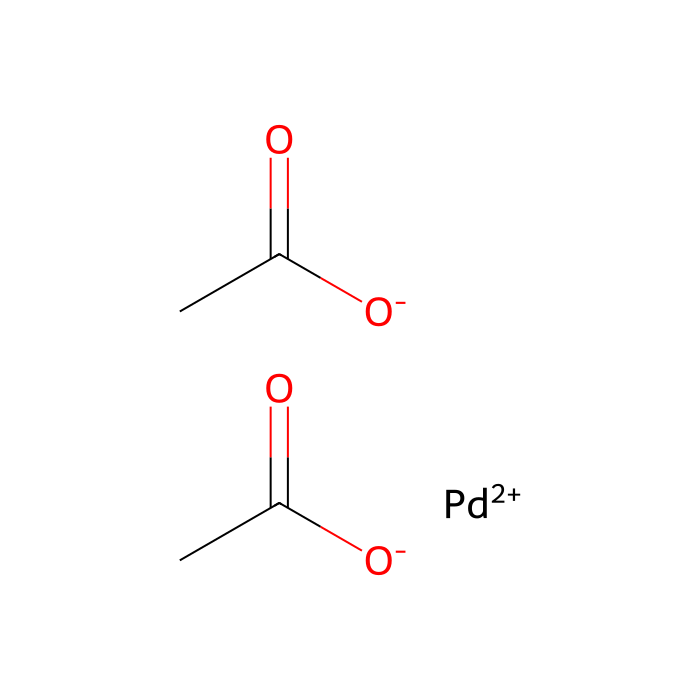
Palladium acetate - ≥99.98% metals basis , CAS No.3375-31-3

CAS: 3375-31-3 Cat. No.: P111486 Fórmula: C4H6O4Pd Peso molecular: 224.51 Beilstein Registry Number: 6086766 Número EC: 222-164-4
Disponible para pedir
GRADE & PURITY ≥99.98% metals basis
Synonyms
Palladium (II) acetate | SR-01000389719 | EU-0040175 | BCP05504 | Palladium(II) acetate | palladium-(II) acetate | UNII-0LTG3460Y5 | Bis(acetato)palladium | Acetic Acid Palladium(II) Salt | AMY1789 | AC-677 | Diacetatopalladium | Acetic acid palladium sal
Storage
Room temperature,Desiccated
Shipped In
Normal
★
Size
USA
Alemania (EU)*
Price
Qty
250mg
P111486-250mg
Fabricado bajo pedido · 8–12 semanas
79,90US$
1g
P111486-1g
3 Disponible
—
209,90US$
5g
P111486-5g
2 Disponible
—
839,90US$
Enter a quantity for the sizes you want to add.
🧪
Why this grade

≥99.98% metals basis for sensitive chromatographic and analytical workflows requiring minimal baseline interference.

🌡

Storage & shipping

Room temperature,Desiccated Ships Normal Check lot-specific COA for exact specifications.

📋

Quality documents

SDS, COA, datasheet, and spec sheet available for download. Lot-specific COA accessible via lot number lookup.

📚

Literature proof

Cited in 159 peer-reviewed publications across chromatography, organic synthesis, and cross-coupling reactions.

Descripción general

Product class
M-O, Homogeneous Catalysts, Acetate Ligands


Reaction type
Cross Coupling Reactions with Arenes, CH-Activation, Carbonylation, Mizoroki Heck Coupling Reaction, Sonogashira-Hagihara Coupling Reaction, Suzuki-Miyaura Coupling Reaction, Oxidation


Chemical properties

Chemical formula

C12H18O12Pd3

Empirical formula

[Pd(OAc)2]3

Molecular weight

673.53

Metal

Pd

Theoretical metal content

47

Physical state

powder

Color

red brown

Applications & references

Synthesis of 2-(4-{2-[(2R)-2-Cyclopentyl-5-(5,7-dimethyl-[1,2,4]triazolo[1,5-a]pyrimidin-2-ylmethyl)-4-hydroxy-6-oxo-3,6-dihydro-2H-pyran-2-yl]-ethyl}-2-fluoro-phenyl)-2-methyl-propionitrile on multikilogram scale using a merging Heck coupling reaction. Compound is an inhibitor of the hepatitis C viral polymerase (HCVP) enzyme.


Reference: Org. Proc. Res. Dev. 2006, 10, 814. (DOI: 10.1021/op0600761)


Reductive carbonylation of aryl halides as an alternative and mild route for the introduction of aldehyde functionality, which is mostly desired for fine chemical and pharmaceutical intermediates to open up the wide range of further possible transformations.


Reference: Org. Proc. Res. Dev. 2007, 11, 39. (DOI: 10.1021/op060193w)


Synthesis of the pyrazolopyridinone-based p38 mitogen-activated protein kinase inhibitor including a Suzuki coupling reaction. p38 MAP kinases are intercellular serine/threonine kinases which certainly regulate the production and action of several pro-inflammatory mediators. They are also involved in disease states such as rheumatoid arthritis, Crohn’s diseases and psoriasis.


Reference: Org. Proc. Res. Dev. 2011, 15, 31. (DOI: 10.1021/op100205s)


Efficient hydroformylation of aryl triflates.

Reference: Synthesis 1996, 470 (DOI: 10.1055/s-1996-4246)


Deacetylation-Diazotation-Heck-Sequence: Carbon-Carbon bond formation with acetanilides as formal leaving groups


Reference: Adv. Synth. Catal. 2013, 355, 463 (DOI: 10.1002/adsc.201200929)


Deacetylation-Diazotation-Suzuki-Sequence: Carbon-Carbon bond formation with acetanilides as formal leaving groups.


Reference: Adv. Synth. Catal. 2013, 355, 463 (DOI: 10.1002/adsc.201200929)


Deacetylation-Diazotation-[2+2+1]-Cycloaddition:


Reference: Adv. Synth. Catal. 2013, 355, 463 (DOI: 10.1002/adsc.201200929)

Specifications

Sinónimos
Palladium (II) acetate | SR-01000389719 | EU-0040175 | BCP05504 | Palladium(II) acetate | palladium-(II) acetate | UNII-0LTG3460Y5 | Bis(acetato)palladium | Acetic Acid Palladium(II) Salt | AMY1789 | AC-677 | Diacetatopalladium | Acetic acid palladium sal
Especificaciones y pureza
≥99.98% metals basis
Información jurídica
Product of Umicore
Condiciones de almacenamiento de almacenamiento
Room temperature,Desiccated
Enviado en
Normal
Pureza
≥99.98% metals basis
Nombres e identificadores
Pubchem Sid
Pubchem Sid Url
https://pubchem.ncbi.nlm.nih.gov/substance/528776022
Sonrisas canónicas
CC(=O)[O-].CC(=O)[O-].[Pd+2]
IUPAC Name
palladium(2+);diacetate
InChIKey
YJVFFLUZDVXJQI-UHFFFAOYSA-L
INCHI
1S/2C2H4O2.Pd/c2*1-2(3)4;/h2*1H3,(H,3,4);/q;;+2/p-2
Isómeros SMILES
CC(=O)[O-].CC(=O)[O-].[Pd+2]
WGK Alemania
3
RTECS
AJ1900000
Número ONU
3077
Grupo de embalaje
III
Peso molecular
224.51
Beilstein
6086766
Reaxy-Rn
3602276
Reaxys-RN_link_address
https://www.reaxys.com/reaxys/secured/hopinto.do?context=S&query=IDE.XRN=3602276&ln=

Documentation

📋 Safety Data Sheet (SDS)

Comprehensive hazard, handling, storage, and regulatory compliance document.

Download SDS →

✅ Certificate of Analysis (COA)

Lot-specific quality data. Enter your lot number to retrieve the exact COA.

Look up COA →

📊 Datasheet

Quick-reference summary of product specifications and applications.

View datasheet →

🔬 Specification Sheet

Full quality attributes and acceptance criteria for this grade.

View spec sheet →

Advanced Data

Taxonomic Classification

Taxonomy Tree

KingdomOrganic compounds
SuperclassOrganic acids and derivatives
ClaseCarboxylic acids and derivatives
SubclassCarboxylic acids
Intermediate Tree Nodes Not available
Direct ParentCarboxylic acids
Alternative Parents Monocarboxylic acids and derivatives  Organic salts  Organic oxides  Hydrocarbon derivatives  Carbonyl compounds  
Molecular FrameworkNot available
Substituents Monocarboxylic acid or derivatives - Carboxylic acid - Organic oxygen compound - Organic oxide - Hydrocarbon derivative - Organic salt - Organooxygen compound - Carbonyl group - Aliphatic acyclic compound
DescripciónThis compound belongs to the class of organic compounds known as carboxylic acids. These are compounds containing a carboxylic acid group with the formula -C(=O)OH.
External Descriptors Not available
Estructura 3D
Modelo de Estructura Química Interactiva


Certificados (CoA, COO, BSE/TSE y tabla de análisis)
C of A & Other Certificates(BSE/TSE, COO):
Analytical Chart:

Find and download the COA for your product by matching the lot number on the packaging.

15 results found

Lot NumberCertificate TypeFechaArticulo
K2208405Certificate of AnalysisAug 03, 2026 P111486
K2208465Certificate of AnalysisAug 03, 2026 P111486
B2628585Certificate of AnalysisFeb 09, 2026 P111486
B2628586Certificate of AnalysisFeb 09, 2026 P111486
B2628607Certificate of AnalysisFeb 09, 2026 P111486
B2628608Certificate of AnalysisFeb 09, 2026 P111486
B2628609Certificate of AnalysisFeb 09, 2026 P111486
B2628610Certificate of AnalysisFeb 09, 2026 P111486
B2628611Certificate of AnalysisFeb 09, 2026 P111486
A2627073Certificate of AnalysisFeb 03, 2026 P111486
L2102656Certificate of AnalysisSep 09, 2025 P111486
F2512033Certificate of AnalysisJun 24, 2025 P111486
I2522050Certificate of AnalysisJun 24, 2025 P111486
F2215226Certificate of AnalysisMay 31, 2022 P111486
F2215238Certificate of AnalysisMay 31, 2022 P111486
Propiedades químicas y físicas
Punto de fusión (°C)216.3-223.7°C
Peso molecular224.510 g/mol
XLogP3
Hydrogen Bond Donor Count0
Hydrogen Bond Acceptor Count4
Rotatable Bond Count0
Exact Mass223.93 Da
Monoisotopic Mass223.93 Da
Topological Polar Surface Area80.300 Ų
Heavy Atom Count9
Formal Charge0
Complexity25.500
Isotope Atom Count0
Defined Atom Stereocenter Count0
Undefined Atom Stereocenter Count0
Defined Bond Stereocenter Count0
Undefined Bond Stereocenter Count0
The total count of all stereochemical bonds0
Covalently-Bonded Unit Count3
Preguntas frecuentes y artículos
Interleukins - the communications arm of the immune response
Acrylonitrile
N-Fluoro-2,4,6-trimethylpyridinium triflate
White Catalyst
PMHS, Polymethylhydrosiloxane
One-Stop Handbook for Palladium-Catalyzed Reactions: Catalytic Cycles, Deactivation Troubleshooting, Ligand/Precatalyst Selection, and an Aladdin Reference List
From Piperidine to Pyridine: The “Most Common N-Heterocycle” Shift in FDA Small-Molecule New Drugs (2013–2023) and a Selection Guide (Tables 1–4)
A Practical Guide to Organozinc Reagents for Synthesis (Organozinc Reagents): Structural Features, Key Reactions, and a Practical Selection Navigation (Including Aladdin Product Tables)
Selection Guide to Precious-Metal Salts & Precursors: From Speciation to a Reproducible Starting Point (with Product Navigator and Tables 1–3)
Transition-Metal Salts/Precursor Selection Guide: How “Different Salts of the Same Metal” Start from Different Chemical Realities—and How to Reproduce Results (including a Selection Navigator and Product Tables 1–5)
Make “Aryl Chlorides + Low Pd Loading + Scale-Up Reproducibility” Reliable: The Initiation and Durability Logic of Pd–NHC (Palladium–N-Heterocyclic Carbene) Cross-Coupling (with Selection Navigation and Product Tables)
Choosing Boron Sources to Make Reactions Robust: How Boronic Acids, Boronate Esters, BF₃K Salts, and MIDA Improve Suzuki–Miyaura Start-Up and Scale-Up Reproducibility (with Product Tables 1–5)
How to Make the Suzuki–Miyaura Reaction Robust: Pinpoint the Bottleneck and Lock in a Reproducible Operating Window (with Selection Navigation and Product Tables 1–5)
How to Construct Nitriles: Route Selection Across Direct Introduction, Precursor Dehydration, Oxidation/Dehydrogenation, and Cyanide-Free Processes
Experimental Selection Logic for C-C Bond Construction: Understanding Fragment Coupling, Carbonyl Chain Extension, Olefination, and Late-Stage Bond-Forming Pathways by Bond-Forming Task
Reaction Selection in Small-Molecule Synthesis: From Transformation-Type Assessment to Experimental Route Screening
Experimental Selection Logic for Transition-Metal-Catalyzed C–H Functionalization: When It Is Worth Pursuing and How to Assess Site Selectivity and Conditions
Experimental Decision-Making for Cross-Coupling Reactions: Target Bond Type, Substrate Combination, and Catalytic System Selection
Deoxyfluorination of Hydroxyalkyl-Substituted Aryl/Alkenyl Boronates: C–F Bond Construction and C–B Bond Retention via a BF3K Intermediate
CTSOBt Benzotriazole–Sulfonate Coupling Reagent: Carboxylic Acid Activation and Synthetic Application Value
Medicinal Chemistry Design of the Indazole Scaffold: Tautomerism, Molecular Recognition, Substitution-Site Design, and Synthetic Strategies
Where Does the Selectivity in Piperidine C–H Functionalization Come From? — Nitrogen Effects, Chair Conformations, and Four Classes of Key Intermediates
Air Decomposition of Solid Sodium Methoxide and Sodium Ethoxide—Effects on Cross-Coupling Reaction Optimization and Reproducibility
Citations of This Product
Calculadoras de soluciones
Reseñas

Reseñas de cliente

Shall we send you a message when we have discounts available?

Remind me later

Thank you! Please check your email inbox to confirm.

Oops! Notifications are disabled.