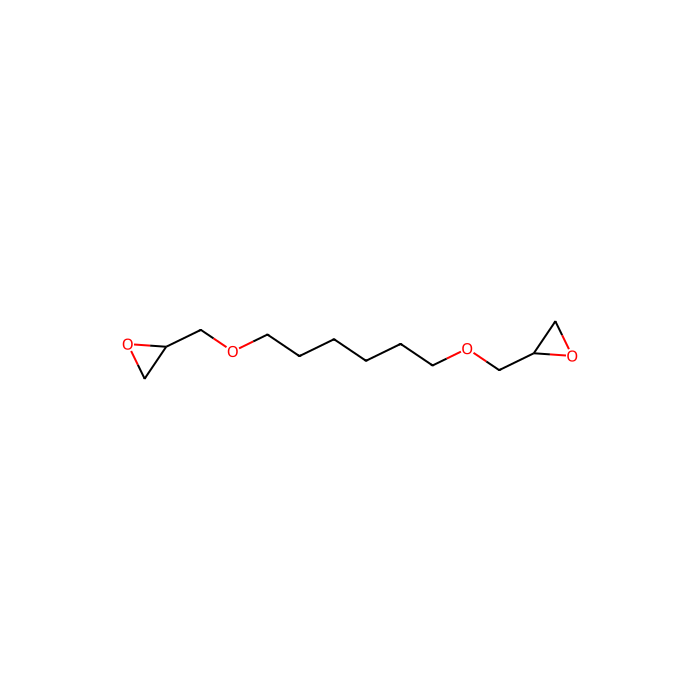
This compound belongs to the class of organic compounds known as epoxides. These are compounds containing a cyclic ether with three ring atoms(one oxygen and two carbon atoms).
External Descriptors
Not available
1. Djoumbou Feunang Y, Eisner R, Knox C, Chepelev L, Hastings J, Owen G, Fahy E, Steinbeck C, Subramanian S, Bolton E, Greiner R, and Wishart DS. ClassyFire: Automated Chemical Classification With A Comprehensive, Computable Taxonomy. Journal of Cheminformatics, 2016, 8:61.
Determine the necessary mass, volume, or concentration for preparing a solution.
Dilution Calculator
Determine the dilution needed to prepare a stock solution.
Reconstitution Calculator
Reviews
Customer Reviews
Application Protocols
Item-specific, validated application protocols and dilutions are not provided for this product.
General procedural outlines (literature; adjust to your system)
Amine-mediated coupling to a surface/polymer
Dissolve HDDGE (0.05–0.2 M) in dry ACN or acetone.
Apply to hydroxylated surface/polyol in presence of a catalytic base (e.g., 0.01–0.05 M tertiary amine) or pre-activate the surface by mild base treatment; allow to react 1–4 h at RT.
Rinse, then couple amine-bearing ligand (10–100 mM in pH 8.5 bicarbonate buffer, 10–30% ACN) for 1–2 h.
Quench residual epoxides with ethanolamine (0.5–1 M, pH 8.5), rinse thoroughly.
Prepare a solution of HDDGE (10–50 mM) in DMF or ACN; add thiol partner (1.0–2.2 eq/epoxide) and catalytic base (e.g., 5–10 mol% DBU or TEA).
Stir at 20–30 °C for 1–3 h; monitor by LC/MS or NMR; quench and purify by chromatography or precipitation.
Hydrogel crosslinking (materials R&D)
Dissolve polymer bearing amines or hydroxyls (e.g., gelatin, PVA) in buffer (pH 8.0–9.0) with 10–40% ACN.
Add HDDGE dropwise (0.5–1.5 eq of epoxide per nucleophile equivalent) under stirring; allow gelation at RT to 37 °C.
Wash gels extensively to remove unreacted monomer and solvents before characterization.
These are general starting points; optimize stoichiometry, pH, and temperature for your specific substrates.
Biological Roles
Item-specific biological role data are not provided for this product.
General/literature context
HDDGE is a synthetic aliphatic diepoxide and does not have a known natural biological role or metabolic pathway.
In laboratory biochemistry and biomaterials research, HDDGE is used as a bifunctional crosslinker/spacer to covalently connect biomolecules or to form/modify polymeric matrices (e.g., polysaccharides, proteins). The underlying chemistry is nucleophilic epoxide ring opening to yield stable β‑substituted alcohol linkages (β‑amino alcohols with amines; thioethers with thiols; β‑hydroxy esters with carboxylates under activation).
Reactivity toward biological nucleophiles makes it useful for immobilization of enzymes/ligands on supports, fabrication of hydrogels, and modulation of material properties (stiffness, porosity) in cell‑free model systems. Reaction conditions are typically tuned to minimize uncontrolled hydrolysis and preserve biomolecule functionality (pH 7.5–9.0, buffered; aqueous‑organic mixtures).
Toxicology considerations: Low-molecular‑weight epoxides are generally irritants and potential sensitizers; direct use with living systems is outside the scope of this product. All uses are for research/lab applications with appropriate containment and PPE.
Note: No clinical or in vivo biological roles/applications are claimed for this product. For conjugation or hydrogel protocols, see Reaction Conditions and Application Protocols sections for general best practices.
Buffer Applications
This product is not a buffering reagent and does not establish pH. However, buffer choice is critical when using HDDGE as a crosslinker in aqueous systems because epoxide ring-opening is pH‑dependent.
Practical guidance (general)
pH window: mild basic conditions (pH ~7.5–9.0) generally afford efficient coupling to amines/thiols while limiting uncontrolled hydrolysis; strongly basic conditions (pH >10) accelerate non‑selective ring opening.
Common buffers (literature; choose based on nucleophile and biomolecule stability)
Phosphate (PBS, pH 7.4–8.0): good general buffer; minimal nucleophilicity; may require longer reaction times.
Bicarbonate/Carbonate (pH 8.3–9.5): increases rate of epoxide opening by amines/thiols; watch for hydrolysis.
HEPES/Tris: HEPES is largely non‑nucleophilic; Tris contains a primary amine and can compete with coupling—avoid Tris when targeting amines.
Co-solvents: add 10–50% acetonitrile or acetone to improve HDDGE solubility while maintaining buffer capacity; keep ionic strength moderate.
Additives: salt (e.g., 0.15 M NaCl) to maintain protein stability; avoid strong nucleophilic catalysts (e.g., imidazole) unless part of the strategy.
Operational tips
Pre-dissolve HDDGE in dry ACN/acetone; add slowly to buffered solution with stirring.
Keep reactions protected from CO2 uptake if carbonate buffers are used (to maintain pH).
Quench unreacted epoxide with excess ethanolamine or glycine after coupling, if compatible with downstream use.
Always verify that the chosen buffer does not contain nucleophiles that interfere with your intended coupling reaction.
Green Alternatives
Context: HDDGE is an effective aliphatic diepoxide, but epoxide manufacture (often via epichlorohydrin) raises concerns about chlorinated feedstocks and EHS profiles. Greener choices can be considered depending on performance needs.
Potential alternatives (literature; selection depends on application)
Glycerol diglycidyl ether (GDE): bio‑based glycerol feedstock; higher functionality potential; may increase crosslink density; usually higher water compatibility but can be more brittle.
Diglycidyl ether of polyethylene glycol (PEGDGE): improved water miscibility and flexibility; good for aqueous systems; higher molar mass and lower epoxy content per gram.
1,4-Butanediol diglycidyl ether (BDDGE): shorter aliphatic spacer; can reduce overall solvent use via lower viscosity; may increase network Tg and stiffness.
Non-epoxy crosslinkers (for certain uses): enzymatic crosslinkers (e.g., laccase/HRP systems), citric acid or genipin for biopolymers—greener toxicological profile but different kinetics/chemistries.
Solvent and process choices
Replace chlorinated solvents (e.g., DCM) with greener options like ethyl acetate, 2‑MeTHF, CPME, propylene carbonate, or dimethyl carbonate when compatible.
Use waterborne or high‑solids formulations to reduce VOCs; PEGDGE can enable aqueous systems.
Catalysis: employ benign bases (carbonate, bicarbonate, tertiary amines) and lower temperatures to reduce energy input.
Trade‑offs
Bio‑based epoxies may have wider impurity profiles and variable color.
Select the green alternative that meets your mechanical, cure, and regulatory targets while maintaining performance.
Pharmaceutical Uses
Item-specific pharmacopeial status or excipient grade is not provided for this product; it is supplied for research use only.
General formulation/manufacturing context (no therapeutic claims)
Crosslinking agent in research on polymeric excipients: HDDGE can be used in R&D to crosslink polyols, polyamines, or polysaccharides to tailor mechanical properties, swelling, and permeability of matrices intended for solid dosage prototypes, coatings, or encapsulation systems.
Surface modification: creates epoxy-activated or subsequently functionalized surfaces in process development (e.g., column packings, filtration media) for ligand immobilization feasibility.
Process aids: as a reactive diluent model compound in development of epoxy-based coatings/liners used in equipment studies (not as a drug substance or excipient in finished products).
Regulatory and quality notes
No USP/Ph. Eur. monograph is implied. For any work advancing toward regulated manufacturing, evaluate: residual epichlorohydrin/chlorohydrins, total chlorine, EEW, low-molecular-weight epoxide content, and extractables/leachables from cured systems.
Biocompatibility and extractables testing are required for device- or packaging-related applications; such use is outside the scope of this research-grade listing.
Conclusion: Use this product strictly for research and development in materials and process studies. It is not intended for use in human or veterinary applications.
Physical Properties
Item-specific values (from Product Data)
Appearance: Not specified for this item; refer to CoA/Spec Sheet.
Boiling point, melting point, density, refractive index, viscosity, water/peroxide content, UV cutoff: Not specified for this item; refer to CoA/Spec Sheet.
General/literature characteristics for 1,6-hexanediol diglycidyl ether (informational; not Aladdin specifications)
Physical state: typically a colorless to pale yellow, low- to medium-viscosity liquid at ambient temperature.
Odor: faint, characteristic of epoxy monomers.
Miscibility/solubility: miscible with many polar aprotic and moderately polar organic solvents (e.g., acetone, acetonitrile, THF, ethyl acetate, DCM, DMF, DMSO); limited solubility in water but can be formulated in aqueous-organic mixtures. Epoxide ring-opening occurs in water under acidic or basic conditions.
Hygroscopicity: moisture-reactive at elevated pH; keep dry to preserve epoxy functionality.
Thermal behavior: epoxides may polymerize upon heating, especially with amine, acid, or anhydride catalysts; avoid unnecessary heat exposure without inhibitors/curatives control.
Practical notes
For accurate property values relevant to your lot (e.g., density, refractive index, EEW), consult the CoA/Spec Sheet and SDS. Handle and store under dry conditions to minimize hydrolysis of epoxide groups.
Viscosity decreases with mild warming; if crystallization or high viscosity is observed at low temperature, gentle warming (e.g., 30–40 °C) with exclusion of moisture can aid handling.
Quality & Grades
Item-specific (Product Data)
Grade/purity: Not specified for this item; refer to CoA/Spec Sheet.
General guidance for this compound class
Epoxy content/EEW: Commercial diglycidyl ethers are commonly qualified by epoxy equivalent weight (EEW, g/eq) and epoxy value (mol/100 g). Lower EEW typically indicates higher mono-/diepoxide content and lower oligomer content. Request EEW/epoxy value when stoichiometric precision is critical.
Residuals and impurities: Trace epichlorohydrin, glycols, chlorohydrins, and oligomers may be present depending on synthesis and purification. For sensitive applications (bioconjugation, microelectronics), review residual chloride and hydrolyzable chloride data on the CoA.
Color/absorbance: Color (APHA/Hazen) and UV absorbance are often reported for epoxy monomers used in optical/electronic applications. Not specified for this item; refer to CoA/Spec Sheet.
Stabilization: Some lots are shipped without inhibitors; others may contain trace stabilizers. Presence/absence and identity of any stabilizer are Not specified for this item; refer to CoA/Spec Sheet.
What the grade implies
Research grade: suitable for R&D and general synthesis; not intended for medical/clinical use.
High-purity/low-ion grades (when offered) are tailored for analytical/semiconductor use with tighter specs on metals, halides, and UV absorbance.
Recommendation: Verify EEW, epoxy value, residual solvent/halide, water content, and UV absorbance (if relevant) on the lot-specific CoA/Spec Sheet to set stoichiometry and ensure compatibility with your process.
Reaction & Applications
Core reactivity (general)
HDDGE is a bifunctional electrophile. Each glycidyl (oxirane) ring undergoes nucleophilic ring opening to form β‑substituted alcohols. Common nucleophiles: primary/secondary amines, thiols, carboxylates, and alcohols (the last typically base-catalyzed).
The six‑carbon spacer provides flexibility and spacing between two functional attachment points, useful for crosslinking and surface modification.
Representative applications (research and manufacturing R&D)
Polymer crosslinking/curing: reacts with polyamines, anhydrides (via alcohol formation then esterification), and thiols to form networks with low Tg and good flexibility.
Hydrogel formation: crosslinks poly(vinyl alcohol), gelatin, chitosan, dextran, and other polyols/amine-bearing biomaterials under mild conditions (pH-controlled aqueous/organic media) for material studies.
Surface and particle functionalization: immobilizes ligands on silica, cellulose, and polymer films by sequential epoxy activation and nucleophile coupling.
Spacer/linker in bioconjugation: forms stable β‑amino alcohol or thioether linkages; C6 spacer reduces steric hindrance between conjugated partners compared to shorter diglycidyl ethers.
Preparative synthesis: access to β‑hydroxy ethers, amino alcohols, and diols (via hydrolysis), enabling iterative functionalization.
Practical tips
Control pH and solvent to steer selectivity. Amines react rapidly near neutral to slightly basic pH; thiols react efficiently under mild base; alcohols generally require stronger base or elevated temperature.
Use stoichiometry based on epoxy equivalent weight (EEW) from the CoA, not nominal MW.
To minimize side reactions (etherification, oligomerization), avoid strong acids/bases unless catalysis is intended; exclude water unless it is part of the design.
For patterned/stepwise functionalization, protect one epoxide via reversible adducts or use sub‑stoichiometric nucleophile under kinetic control.
Reaction Conditions
General conditions (literature guidance; optimize per system)
Amine curing/crosslinking
Solvent: neat, or MEK, toluene, THF, ACN, or DMSO.
Temperature: ambient to 60 °C for primary amines; higher temperatures accelerate cure with hindered amines.
Catalysis: tertiary amines or imidazoles can accelerate; control exotherm in bulk systems.
Stoichiometry: set by epoxy equivalent weight (EEW) vs amine hydrogen equivalent weight (AHEW). Slight epoxy excess can improve shelf life in 2K systems.
Thiol–epoxy coupling
Base: TEA, DBU, or carbonate/bicarbonate (aqueous-organic) to generate thiolate in situ.
Solvent: polar aprotic (DMF, DMSO, ACN) or mixed aqueous media.
Temperature: 20–40 °C commonly sufficient; proceed rapidly with catalytic base.
Alcoholysis (β‑alkoxy alcohol formation)
Base: alkoxides or strong organic bases; phase-transfer catalysts for heterogeneous systems.
Temperature: 40–80 °C typically needed for reasonable rates.
Carboxylate opening
Activate with base/DMAP; elevated temperature (50–90 °C) in polar aprotic solvents.
Aqueous bioconjugation/crosslinking
Buffer: pH 7.5–9.0 (phosphate, bicarbonate). Include 10–50% co‑solvent (ACN/acetone) to solubilize HDDGE.
Nucleophiles: lysine side chains (amines) or thiols on biomolecules; control stoichiometry and time to minimize over‑crosslinking.
Monitoring and workup
Track epoxide consumption by FT‑IR (disappearance of ~915 cm⁻¹ band, literature) and 1H NMR.
Quench: ethanolamine or glycine for residual epoxides in bioconjugation; aqueous carbonate wash for small‑molecule synthesis.
Purification: remove catalysts by aqueous workup; products often isolated by precipitation or chromatography depending on polarity.
Note: Values above are general literature guidance, not product specifications. Validate on small scale.
Safety & Handling
Item-specific (Product Data)
GHS classification, signal word, hazard (H) statements, and pictograms: Not specified for this item; refer to the SDS supplied with the product.
Storage conditions: Room temperature, desiccated.
Shipped in: Normal.
General safety guidance for aliphatic diglycidyl ethers (literature; defer to SDS for authoritative data)
Likely hazards: skin and eye irritation; skin sensitization; respiratory irritation with aerosols/vapors; harmful if swallowed. Epoxides are electrophilic and can alkylate biological nucleophiles.
Special risks: uncontrolled exotherm/polymerization if mixed with concentrated amine or acid curatives without temperature control. Hydrolysis under acidic/basic aqueous conditions.
PPE: lab coat, chemical-resistant gloves (e.g., nitrile; change regularly), splash goggles; use in a fume hood.
Handling: avoid skin contact; do not breathe mist/vapor; keep containers tightly closed and dry. Use clean, dry tools and syringes; purge headspace with inert gas when practical.
First aid (overview):
Skin: remove contaminated clothing; wash with soap and water. Seek medical advice if irritation/sensitization develops.
Eyes: rinse cautiously with water for several minutes; remove contact lenses; seek medical attention.
Inhalation: move to fresh air; seek medical attention if symptoms persist.
Ingestion: rinse mouth; do not induce vomiting; seek medical attention.
Spill/cleanup: absorb with inert material (vermiculite/diatomaceous earth); collect for disposal. Prevent entry to drains. Decontaminate tools with suitable solvent followed by detergent and water.
Always consult the SDS for this specific item for definitive hazard classification and response measures.
Solvent Selection
Relevance: HDDGE is typically supplied as a liquid monomer/crosslinker rather than used as a bulk solvent. However, effective co-solvent selection is important for formulation, curing, and reaction control.
Polarity/miscibility (general)
Miscible with many organic solvents: acetone, MEK, acetonitrile, THF, CPME, EtOAc, DCM/CH2Cl2, toluene, DMF, DMSO.
Partially miscible with lower alcohols (MeOH, EtOH, i-PrOH); alcohols promote ring opening under basic conditions.
Limited solubility in water; forms workable solutions in water–miscible organic solvents (e.g., acetone/water, ACN/water) for bioconjugation at controlled pH.
Selection guidance by application
Amine curing (coatings/adhesives): use low–medium polarity solvents with appropriate evaporation profile (MEK, methyl isobutyl ketone, toluene, PM/DPG methyl ethers). Avoid strongly basic alcohols unless intended to accelerate.
Nucleophilic ring opening (thiol/amine chemistry): polar aprotic solvents (DMF, DMSO, ACN) enhance rates and solubilize salts/catalysts; add base as needed.
Aqueous bioconjugation: buffer with ACN or acetone as co-solvent (10–50%) to solubilize HDDGE; maintain pH 7.5–9.0 to balance reactivity and selectivity.
Comparison notes (general)
Relative to aromatic epoxies (e.g., DGEBA), HDDGE is more flexible and often more soluble in aliphatic solvents; it also shows better low-temperature handling due to lower viscosity.
If very fast cure is undesirable, select less polar diluents and minimize protic solvents to moderate ring-opening rates.
Always verify solvent compatibility with substrates, catalysts, and desired cure kinetics.
Storage & Reconstitution
Item-specific (Product Data)
Storage conditions: Room temperature, desiccated.
Shipping: Normal.
General handling guidance
Moisture sensitivity: Epoxide groups undergo hydrolysis/ring opening under acidic or basic aqueous conditions. Keep container tightly closed in a dry environment. Use desiccant and, if practical, store under inert gas (N2/Ar) to limit moisture uptake.
Light/temperature: Store at ambient temperature away from direct sunlight and heat sources. Avoid prolonged exposure above ~40 °C to minimize self‑polymerization.
After opening: Reseal promptly. If available, use septum caps and dry gas headspace. Record opening date and track epoxy value periodically for long‑term projects.
If material becomes viscous/crystallizes: Warm gently (e.g., 30–40 °C) to reduce viscosity before dispensing. Do not overheat and avoid introducing moisture.
Reconstitution/dispensing
Typically supplied as a ready‑to‑use liquid; no reconstitution is required.
For solution preparation, pre‑dry glassware/solvents. Dissolve in a dry, compatible solvent (e.g., ACN, acetone, THF, DCM, DMF) immediately before use.
For aqueous formulations, prepare a concentrated stock in dry organic solvent, then add to buffered aqueous media under vigorous stirring to minimize local over‑concentration and premature gelation.
Disposal
Collect waste as halogen‑free organic waste unless mixed with other classes. Quench residual epoxides where appropriate (e.g., ethanolamine) before disposal per institutional and regulatory guidelines.
Structure & Identity
Overview: 1,6-Hexanediol diglycidyl ether (HDDGE) is an aliphatic diepoxide featuring two terminal glycidyl (oxirane) groups separated by a flexible six‑carbon spacer. It functions as a bifunctional electrophile and spacer/crosslinker in polymer and bioconjugation chemistry.
Item-specific (Product Data)
Product name: 1,6-Hexanediol Diglycidyl Ether
SKU: H305078
CAS: 16096-31-4
PubChem CID: 85960
InChIKey: 408030 (provided; truncated/not the standard 27-character format)
Molecular formula: Not specified for this item; refer to CoA/Spec Sheet.
Molecular weight: Not specified for this item; refer to CoA/Spec Sheet.
SMILES: Not specified for this item; refer to CoA/Spec Sheet.
Structural features (general/literature)
Functional groups: two epoxide (oxirane) rings; two ether linkages; aliphatic C6 chain linker.
Connectivity (described): epoxide–CH2–O–(CH2)6–O–CH2–epoxide (symmetrical diepoxide with terminal glycidyl ether moieties).
Stereochemistry: none specified (epoxide carbons are prochiral; commercial materials are typically racemic at each epoxide center upon reaction).
Chemical class: aliphatic diglycidyl ether; diepoxy crosslinker.
Notes
HDDGE is commonly characterized in practice by its epoxide equivalent weight (EEW) and epoxy content rather than by a single structural descriptor, due to potential low-level oligomers/impurities in some grades.
Synthetic Utility
Functional group leverage
Dual epoxides act as masked 1,2-diols upon hydrolysis, or as handles for convergent bond formation with diverse nucleophiles.
The internal C6 aliphatic spacer provides flexibility and hydrophobic separation, useful for constructing linkers with defined length between conjugation points.
Transformations (literature examples)
Aminolysis: primary/secondary amines afford β‑amino alcohols. With diamines, step-growth polymerization yields poly(β‑hydroxy amines). Selectivity can be tuned via temperature and base catalysis.
Thiol–epoxy coupling: base-catalyzed conjugation with thiols gives thioethers; often near‑quantitative and compatible with many functional groups.
Carboxylate opening: using nucleophilic carboxylates or via in situ activation (e.g., DMAP/base) to form β‑hydroxy esters.
Sequential/orthogonal functionalization: exploit differential rates of nucleophiles (thiol > primary amine > secondary amine ≫ alcohol) to attach two different partners stepwise.
Retrosynthetic value
HDDGE serves as a versatile difunctional electrophile for assembling linear or network structures; it can be viewed as a synthon for HO–(CH2)6–O–CH2–CH(OH)–CH2–X motifs after single-ring opening.
Practical guidance
Use lot-specific EEW to set precise stoichiometry. Exclude moisture to avoid competitive hydrolysis unless intentional.
For stepwise derivatization, conduct the first ring opening at low temperature with the more reactive nucleophile, purify, then perform the second under adjusted conditions.
Monitor conversions by 1H NMR (disappearance of epoxide protons ~2.5–3.3 ppm, literature) and by epoxy titration methods (ASTM D1652 or analogous).
Target Specificity
This product is a small‑molecule crosslinker (not an antibody, enzyme, or nucleic acid). Target specificity parameters such as antigen/epitope, clone, isotype, and species reactivity do not apply.
Item-specific data: Not applicable; none provided in Product Data.
For chemical selectivity, see Reaction & Applications and Synthetic Utility for nucleophile preferences (thiols > primary amines > secondary amines ≫ alcohols, general literature trend).
We use cookies to ensure the website functions properly and, where permitted, to improve your experience. You can manage your preferences at any time in Settings. Learn more in our Cookie Policy.
Shall we send you a message when we have discounts available?
Remind me later
Thank you! Please check your email inbox to confirm.
Products are supplied to verified businesses, institutions, and qualified professionals for research and development use only. Not for use in humans, animals, diagnosis, or therapy.

 F2623229