
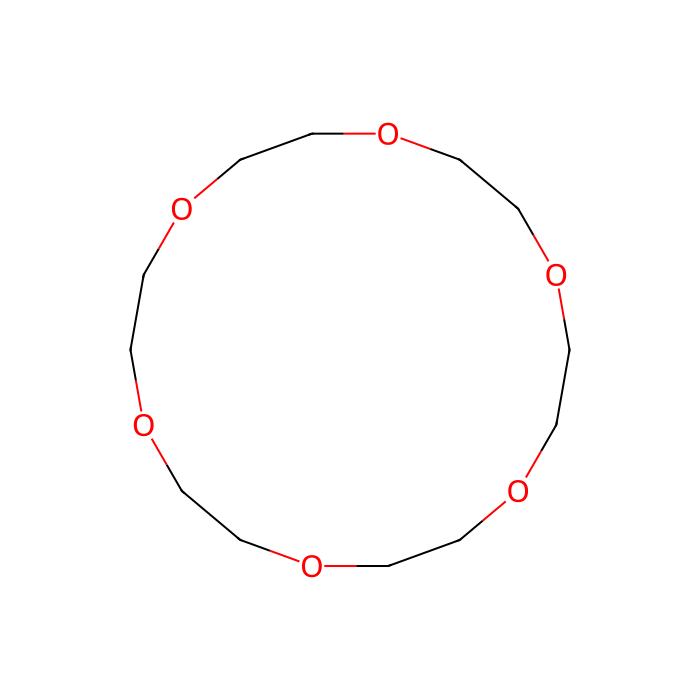
Determine the necessary mass, volume, or concentration for preparing a solution.
| Activity Type | Relation | Activity value | Units | Action Type | Journal | PubMed Id | doi | Assay Aladdin ID |
|---|
Taxonomy Tree
| Kingdom | Organic compounds |
|---|---|
| Superclass | Organic oxygen compounds |
| Class | Organooxygen compounds |
| Subclass | Ethers |
| Intermediate Tree Nodes | Not available |
| Direct Parent | Dialkyl ethers |
| Alternative Parents | Oxacyclic compounds Hydrocarbon derivatives |
| Molecular Framework | Aliphatic heteromonocyclic compounds |
| Substituents | Oxacycle - Organoheterocyclic compound - Dialkyl ether - Hydrocarbon derivative - Aliphatic heteromonocyclic compound |
| Description | This compound belongs to the class of organic compounds known as dialkyl ethers. These are organic compounds containing the dialkyl ether functional group, with the formula ROR', where R and R' are alkyl groups. |
| External Descriptors | saturated organic heteromonocyclic parent - crown ether |
| Activity Type | Relation | Activity value | Units | Action Type | Journal | PubMed Id | doi | Assay Aladdin ID |
|---|
| Activity Type | Relation | Activity value | Units | Action Type | Journal | PubMed Id | doi | Assay Aladdin ID |
|---|
| Activity Type | Relation | Activity value | Units | Action Type | Journal | PubMed Id | doi | Assay Aladdin ID |
|---|
| Activity Type | Relation | Activity value | Units | Action Type | Journal | PubMed Id | doi | Assay Aladdin ID |
|---|
| Activity Type | Relation | Activity value | Units | Action Type | Journal | PubMed Id | doi | Assay Aladdin ID |
|---|
| Activity Type | Relation | Activity value | Units | Action Type | Journal | PubMed Id | doi | Assay Aladdin ID |
|---|
| Activity Type | Relation | Activity value | Units | Action Type | Journal | PubMed Id | doi | Assay Aladdin ID |
|---|
Find and download the COA for your product by matching the lot number on the packaging.
| Lot Number | Certificate Type | Date | Item |
|---|---|---|---|
 G2213477 | Certificate of Analysis | Apr 07, 2026 | C124569 |
| G2213479 | Certificate of Analysis | Apr 07, 2026 | C124569 |
| G2213541 | Certificate of Analysis | Apr 07, 2026 | C124569 |
| C2605370 | Certificate of Analysis | Jun 03, 2025 | C124569 |
| C2605371 | Certificate of Analysis | Jun 03, 2025 | C124569 |
| C2605372 | Certificate of Analysis | Jun 03, 2025 | C124569 |
| E2517008 | Certificate of Analysis | Jul 04, 2022 | C124569 |
| Flash Point | >235.4 °F |
|---|---|
| Flash Point | >113 °C |
| Boil Point | 190°C/0.7mmHg |
| Melt Point | 38-41°C |
| Molecular Weight | 264.31 |
| XLogP3 | -0.700 |
| Hydrogen Bond Donor Count | 0 |
| Hydrogen Bond Acceptor Count | 6 |
| Rotatable Bond Count | 0 |
| Exact Mass | 264.157 Da |
| Monoisotopic Mass | 264.157 Da |
| Topological Polar Surface Area | 55.400 Ų |
| Heavy Atom Count | 18 |
| Formal Charge | 0 |
| Complexity | 108.000 |
| Isotope Atom Count | 0 |
| Defined Atom Stereocenter Count | 0 |
| Undefined Atom Stereocenter Count | 0 |
| Defined Bond Stereocenter Count | 0 |
| Undefined Bond Stereocenter Count | 0 |
| The total count of all stereochemical bonds | 0 |
| Covalently-Bonded Unit Count | 1 |
H302:Harmful if swallowed
H315:Causes skin irritation
H319:Causes serious eye irritation
H335:May cause respiratory irritation
P261:Avoid breathing dust/fume/gas/mist/vapors/spray.
P264:Wash hands [and …] thoroughly after handling.
P270:Do not eat, drink or smoke when using this product.
P271:Use only outdoors or in a well-ventilated area.
P280:Wear protective gloves/protective clothing/eye protection/face protection.
P321:Specific treatment (see ... on this label).
P330:Rinse mouth.
P302+P352:IF ON SKIN: wash with plenty of water.
P304+P340:IF INHALED: Remove person to fresh air and keep comfortable for breathing.
P305+P351+P338:IF IN EYES: Rinse cautiously with water for several minutes. Remove contact lenses if present and easy to do - continue rinsing.
P362+P364:Take off contaminated clothing and wash it before reuse.
P405:Store locked up.
P403+P233:Store in a well-ventilated place. Keep container tightly closed.
P501:Dispose of contents/container to an approved waste disposal plant.
P264+P265:Wash hands [and …] thoroughly after handling. Do not touch eyes.
P301+P317:IF SWALLOWED: Get medical help.
P337+P317:If eye irritation persists: Get medical help.
P332+P317:If skin irritation occurs: Get medical help.
P319:Get medical help if you feel unwell.
No immunoassay or bioanalytical antibody protocols apply. For chromatography and synthetic uses, general, literature-based starting points are provided:
HPLC ion-interaction additive (general):
KF-mediated nucleophilic substitution (general):
KOtBu-promoted elimination (general):
These protocols are illustrative literature-style starting points and must be adapted/validated for specific systems. They are not item-specific specifications.
This product is intended for research and laboratory use only. 18-Crown-6 does not serve a native biological role; however, crown ethers are used as chemical tools in biochemistry and membrane research (literature/general):
18-Crown-6 is not a buffering agent and does not establish defined pH ranges. Consequently, it is not typically used to prepare biological or analytical buffers.
Context: 18-Crown-6 is an effective, non-volatile macrocyclic polyether. Its environmental profile is governed more by solvent choice and waste minimization than by volatility.
Greener strategies (literature/general):
Tradeoffs:
Small comparison (general, literature-informed):
No therapeutic/clinical uses are claimed. 18-Crown-6 is occasionally employed in pharmaceutical R&D and QC workflows (literature/general):
Excipient status, pharmacopeial monographs, residual limits: Not specified for this item; consult regulatory guidance and the CoA/SDS when evaluating for GMP or QC use.
The following are literature/typical properties of 18-Crown-6; they are provided for general reference and method development. They are not item-specific specifications.
Item-specific numerical specifications (e.g., exact solubility, water content, metals, UV cutoff): Not specified for this item; refer to CoA/Spec Sheet.
Item-specific grade:
What this grade typically implies (general guidance; not item-specific specifications):
UV absorbance, water content, residual metals, and stabilizers:
Suitability notes:
Chromatography (manufacturer use case):
General synthetic applications (literature):
Selectivity control:
Practical guidance:
Workup considerations:
General literature guidance for 18-Crown-6–enabled reactions (adapt to substrate and scale):
Loadings: 5–20 mol% catalytic relative to the K+ salt or base; up to 1.0 equiv for poorly soluble salts.
Solvents: Dry THF, MeCN, DMSO, DMF, dioxane, or glymes. For KF-mediated reactions, polar aprotics (DMSO, MeCN) often perform best.
Temperatures: 0–80 °C typical; room temperature for many SN2 transformations. Elevated temperatures (50–80 °C) may be required for less reactive substrates or poorly soluble salts.
Atmosphere: Generally ambient; for air/moisture-sensitive anions (e.g., enolates), employ inert gas and rigorously dry glassware/solvents.
Times: 0.5–24 h depending on substrate, nucleophile strength, and temperature.
Examples (literature):
Workup and purification:
These are literature-derived ranges and should be optimized experimentally; they are not product specifications.
GHS/SDS status for this specific item:
General safety considerations for crown ethers (literature/good practice):
Incompatibilities and reactivity (general):
First-aid (general guidance; consult SDS):
Fire safety: Organic combustible solid; use CO2, dry chemical, or foam. Thermal decomposition may release irritating fumes (literature). Always defer to the product SDS for authoritative information.
18-Crown-6 is a neutral, strongly Lewis basic polyether with excellent solubility in polar organic solvents and moderate solubility in water.
Polarity/miscibility (literature):
Choosing solvents by application:
Comparative notes (literature):
Practical tips:
Item-specific storage and shipping (from Product Data):
General handling recommendations (literature/good practice):
Preparation of solutions (for chromatography or synthesis; general guidance):
Stability:
Any item-specific limits on water, metals, UV absorbance, or stabilizers: Not specified for this item; refer to CoA/Spec Sheet.
A classical macrocyclic polyether (crown ether) optimized for complexing alkali-metal cations, especially K+. The ring comprises six ethyleneoxy units forming an 18‑membered heterocycle.
Item-specific identifiers from Product Data:
Literature/commonly reported identifiers (for reference; not item-specific specifications):
Structural features (general description):
Category/Type: Crown ether; neutral oxygen donor ligand; phase-transfer/ion-complexing agent.
Functional profile: Neutral, multidentate oxygen donor ligand with strong affinity for K+; forms 1:1 complexes typically. By sequestering the cation, it reduces ion pairing and enhances the effective basicity/nucleophilicity of counteranions.
Transformations (literature examples):
Retrosynthetic value:
Practical points:
Not applicable. This product is a small-molecule crown ether, not a biological affinity reagent. No antigen/epitope, species reactivity, clone, or isotype data apply.
Our grade selection guide covers purity, stabilizer status, and application suitability for all variants in our catalog.
View for Ion pair chromatography grade guide →