≥98%(HPLC) for sensitive chromatographic and analytical workflows requiring minimal baseline interference.
🌡
Storage & shipping
Argon charged,Room temperature Ships Normal Check lot-specific COA for exact specifications.
📋
Quality documents
SDS, COA, datasheet, and spec sheet available for download. Lot-specific COA accessible via lot number lookup.
📚
Literature proof
Cited in 1 peer-reviewed publications across chromatography, organic synthesis, and cross-coupling reactions.
Overview
Reactant involved in the synthesis of biologically active molecules including: . 2,4,6-trichlorophenyl hydrazones with potential inhibition of protein glycation . Esculentoside A derivatives with haemolytic activity and LPS-induced nitric oxide production inhibition . α-Nucleophiles for hydrolysis of organophosphorus nerve agents . Xanthine oxidase inhibitors . Non-complexes Schiff base hydrazones . Methylated (±)-epigallocatechin gallate library for anticancer activity studies
This compound belongs to the class of organic compounds known as acylphloroglucinols and derivatives. These are phloroglucinol derivatives characterized by the presence of a COR group.
External Descriptors
Not available
1. Djoumbou Feunang Y, Eisner R, Knox C, Chepelev L, Hastings J, Owen G, Fahy E, Steinbeck C, Subramanian S, Bolton E, Greiner R, and Wishart DS. ClassyFire: Automated Chemical Classification With A Comprehensive, Computable Taxonomy. Journal of Cheminformatics, 2016, 8:61.
Determine the necessary mass, volume, or concentration for preparing a solution.
Dilution Calculator
Determine the dilution needed to prepare a stock solution.
Reconstitution Calculator
Reviews
Customer Reviews
Application Protocols
No application protocols are defined for this small-molecule reagent (e.g., no WB/IHC/FC conditions). Typical laboratory uses are in organic synthesis and materials/analytical research.
General handling protocol (suggested best practice):
Open under inert atmosphere where possible (argon or nitrogen) to minimize oxidation, consistent with the argon-charged packaging.
If preparing stock solutions, use dry EtOH, MeCN, DMF, or DMSO; filter through a 0.2 μm PTFE syringe filter if needed. Record concentration gravimetrically for quantitative work.
For water-sensitive transformations, charge vessels with molecular sieves and maintain positive inert-gas pressure.
Refer to primary literature or your internal SOPs for reaction-specific procedures.
Biological Roles
This section provides general biochemical context for phenolic benzaldehydes; it does not imply any therapeutic or diagnostic use.
Phenolic motif:
Trihydroxybenzene cores (phloroglucinol-type) are common in plant-derived polyphenols and can participate in redox and hydrogen-bonding interactions with proteins and polysaccharides.
The aldehyde group can form reversible adducts (Schiff bases) with primary amines (e.g., lysine residues) in vitro, underlying some analytical derivatizations.
Redox/antioxidant behavior (literature/general):
Polyphenols may undergo single-electron transfer and H-atom donation; the 2,4,6-trihydroxy pattern stabilizes phenoxyl radicals through resonance. Such chemistry is context dependent and sensitive to pH and metal ions.
Metal binding:
Deprotonated phenolic oxygens can chelate hard metal ions (e.g., Fe3+, Al3+) forming colored complexes; this underpins some colorimetric assays in analytical chemistry.
Enzymatic relevance:
Phenolic aldehydes can serve as substrates or inhibitors in model enzyme studies (e.g., oxidases, dehydrogenases) for mechanistic research.
Research use only: Any biological interactions described here are for in vitro or analytical contexts and are not medical claims.
Buffer Applications
Not typically used as a buffering agent. 2,4,6-Trihydroxybenzaldehyde lacks a conjugate acid/base pair with a narrow, well-defined buffering window in physiological ranges and is not a standard biochemical buffer.
Practical note: If using in aqueous biochemical assays, prepare in an appropriate organic co-solvent (e.g., DMSO or ethanol) and dilute into the assay buffer, keeping final organic content low (commonly ≤1–2%). Adjust pH of the buffer independently using established systems (phosphate, HEPES, Tris, acetate).
Green Alternatives
Because this is a solid building block rather than a process solvent, “greener” considerations focus on solvent/catalyst choices and minimizing protecting-group steps.
Greener solvent choices (relative guidance):
Prefer ethanol or isopropanol for condensations and recrystallizations over DMF/DMSO where feasible.
Use acetonitrile or acetone (easier recovery) instead of chlorinated solvents.
Employ water/ethanol mixtures for imine/Knoevenagel reactions with phase-transfer catalysis when compatible.
Catalysis and process intensification:
Organocatalysts (piperidine, proline derivatives) or ammonium acetate can replace strong inorganic bases, reducing waste.
Microwave or mechanochemical (solvent-minimized) protocols have been reported for related phenolic aldehydes; consider for rapid screens.
Example comparison (general):
DMF vs Ethanol in imine formation:
EHS profile: DMF (toxic/reprotoxic concerns) vs EtOH (preferable green solvent).
Workup: DMF removal energy-intensive; EtOH easy to strip/recycle.
Reaction rate: Often comparable when water is efficiently removed (sieves/azeotrope).
Waste minimization:
Use solid-supported scavengers to quench excess amines or bases.
Design convergent routes that exploit the inherent activation of the 3,5-positions to avoid harsh nitration/sulfonation steps.
Note: Balance green metrics with product quality; confirm impurity profiles and color stability, especially for polyphenolics.
Pharmaceutical Uses
No pharmacopeial excipient status or formulation role is specified for this item; refer to CoA/Spec Sheet. The information below is general for research and process development contexts only.
Potential roles in R&D (general):
Synthetic intermediate toward polyphenolic ligands, crosslinkers, and fluorescent imines used in materials or analytical probes.
Model aldehyde substrate for screening of biocatalysts (oxidases, reductases) or for derivatization of primary amines in analytical workflows.
Formulation considerations (if incorporated into experimental systems):
Low aqueous solubility; typically formulated from EtOH, PEG-400, or DMSO stocks followed by dilution.
Phenolic groups may interact with excipients (e.g., PVP, polysorbates) via H-bonding; evaluate stability against oxidation (antioxidants, inert headspace).
Research use only: Not for human or veterinary therapeutic applications.
Physical Properties
Note: Numerical values below are literature/typical for the compound class and are NOT item specifications unless explicitly stated as Product Data.
Melting point: typical 200–205 °C (literature; often reported ~201–204 °C); may darken on heating near mp.
Boiling point: Not commonly distilled; expected decomposition before boiling at ambient pressure (literature).
Density: Not well established for the solid; Not specified for this item; refer to CoA/Spec Sheet.
Solubility (literature/general):
Water: sparingly soluble; increased solubility in warm or basic aqueous media due to phenol deprotonation.
Organic: soluble in polar organics (MeOH, EtOH, acetone, acetonitrile, DMSO, DMF); limited solubility in nonpolar solvents (hexanes, toluene) unless warmed or with H-bonding co-solvent.
pKa (phenolic OH, literature): multiple phenolic pKa values typically in the 7–10 range; deprotonation is facilitated by the electron-withdrawing formyl substituent and intramolecular H-bonding; exact values vary by source.
LogP (literature/estimated): low to moderate hydrophilicity; estimated logP circa 1 (qualitative; depends on tautomer/H-bonding).
UV-Vis (literature/general): phenolic benzaldehydes show π→π* bands in the near-UV (ca. 260–320 nm) with bathochromic shifts in basic media; exact λmax depends on solvent and pH.
Refractive index: Not applicable (solid) / Not specified for this item; refer to CoA/Spec Sheet.
Always consult the item’s CoA/Spec Sheet for lot-specific values.
Quality & Grades
Item-specific: Grade/Purity not specified for this item; refer to CoA/Spec Sheet for assay, impurity profile, and residual solvent limits.
Interpreting grades for this compound class (general guidance):
Research grade: Suitable for most synthetic and analytical workflows. For sensitive catalysis or photophysical studies, confirm trace-metal/UV-cutoff specs on the CoA.
Low-UV/HPLC grade (if offered): Optimized for chromatographic applications with minimized background absorbance; beneficial for UV-detection methods involving phenolic analytes.
Stabilization: No stabilizer is indicated in the Product Data. Phenolic aldehydes can slowly oxidize; inert-atmosphere packaging (argon charged per Product Data) helps preserve quality.
Practical quality notes:
Appearance can range from off-white to tan crystalline solid depending on trace oxidation; Appearance is not specified for this item; refer to CoA/Spec Sheet.
Typical impurities (literature): parent phenol oxidation products (carboxylic acid), oligomeric/resinous material; trace moisture uptake in hygroscopic forms. Verify by 1H NMR (formyl singlet ~9.5–10.0 ppm), HPLC, and IR (C=O ~1665–1690 cm−1; phenolic O–H broad ~3200–3600 cm−1).
If conducting air/moisture-sensitive transformations (e.g., base-catalyzed condensations), consider repurification (recrystallization from EtOH/MeOH) and handle under inert gas.
Reaction & Applications
This phenolic benzaldehyde is a versatile electrophile and polyphenolic scaffold.
Condensations (literature):
Knoevenagel and related condensations with active methylene compounds (malononitrile, cyanoacetates, barbiturates) to give benzylidene derivatives; base catalysts (piperidine, ammonium acetate, DBU) in EtOH, MeCN, or AcOH.
Aldol-type extensions with enolates/enamines, often leveraging intramolecular H-bonding to orient the electrophile.
Schiff base formation (imines) with primary amines/anilines; water removal (molecular sieves or Dean–Stark) recommended for high conversions.
Phenolic transformations (literature):
O-alkylation/acylation to install protecting groups or tailor solubility; typical bases: K2CO3, Cs2CO3, NaH in DMF/acetone.
Electrophilic substitution at the activated 3,5-positions (Mannich, nitration under controlled conditions), guided by ortho/para-directing phenols.
Oxidation of –CHO to the corresponding acid (e.g., with Ag2O, TEMPO/bleach) when carboxyl analogs are desired.
Coordination/ligand chemistry (literature):
Precursor to salicylaldehyde-type ligands; O-alkylation followed by imine formation affords salen/salophen analogs; metal chelation exploited in catalysis/materials.
Materials and dyes (literature):
Building block for phenolic resins, fluorescent Schiff bases, and donor–acceptor systems; phenolic triad enables H-bonding networks in supramolecular assemblies.
Practical tips:
Dry, oxygen-lean conditions minimize side oxidation. Charge the headspace with argon (as supplied) and use freshly dried solvents. Monitor by TLC/HPLC; formyl proton (1H NMR ~9.5–10 ppm) is a sensitive handle.
Reaction Conditions
The following are literature-style general conditions for reactions involving 2,4,6-trihydroxybenzaldehyde; optimize per substrate and scale.
Imine (Schiff base) formation:
Solvent: EtOH, i-PrOH, or toluene (Dean–Stark) or MeCN; 3 Å molecular sieves recommended.
Catalyst: Trace acid (AcOH) or none; for anilines, a few mol% p-toluenesulfonic acid can accelerate.
Temperature/time: 25–80 °C, 1–12 h; monitor by TLC/NMR (disappearance of formyl singlet ~9.5–10 ppm).
Typical outcomes: High conversions when water is removed; phenolic OH may H-bond and stabilize imine.
Temperature: 0–25 °C (NaH) or reflux (carbonate bases) for 1–6 h; control stoichiometry for mono-/poly-alkylation.
Oxidation/reduction of –CHO:
Oxidation: TEMPO/NaOCl (pH ~9), Ag2O, or Pinnick conditions to acid.
Reduction: NaBH4 or catalytic hydrogenation to benzyl alcohol derivative; protect phenols if required to avoid side reactions.
Note: Minimize oxygen exposure; use argon headspace and dry solvents to suppress byproduct formation.
Safety & Handling
Product Data (item-specific):
GHS Classification: Not specified for this item; refer to SDS.
Signal Word / H-Statements / Pictograms: Not specified for this item; refer to SDS.
General safety guidance for phenolic aldehydes (literature/chemical best practices):
Hazards: May cause skin/eye irritation and respiratory irritation; aldehydes can be sensitizers in some cases; phenols are irritant/corrosive at higher concentrations.
Special risks: Air/oxidation sensitivity of phenolic aldehydes; slow oxidation to acids/quinonoid species possible. Product is recommended to be kept under inert gas (argon) per Product Data.
PPE: Lab coat, safety glasses or face shield, appropriate gloves (e.g., nitrile); handle in a fume hood to avoid inhalation of dust/vapors.
First aid (overview; defer to SDS):
Skin/eye contact: Rinse with water for ≥15 minutes; remove contaminated clothing; seek medical evaluation.
Inhalation: Move to fresh air; monitor breathing; seek medical attention if symptoms persist.
Ingestion: Rinse mouth; do not induce vomiting; seek medical attention.
Fire safety: Combustible organic solid; use CO2, dry chemical, or foam. Thermal decomposition may release CO/CO2 and phenolic vapors.
Always consult the Safety Data Sheet for authoritative hazard classifications and response procedures.
Solvent Selection
Polarity and interactions (general):
The molecule is moderately polar with multiple hydrogen-bond donors and one acceptor. It dissolves well in polar protic (MeOH, EtOH) and polar aprotic (DMSO, DMF, acetonitrile) solvents; sparingly soluble in water; poorly soluble in nonpolar hydrocarbons.
Practical selection by task:
Recrystallization: Ethanol, methanol, or ethanol–water mixtures often afford good crystals; acetone or acetonitrile can be alternatives.
Reaction medium for condensations (e.g., Knoevenagel): Ethanol, methanol, or acetonitrile with catalytic base (piperidine, ammonium acetate); DMF/DMSO for poorly soluble partners.
Imine formation with amines: Toluene or benzene with Dean–Stark to remove water if the substrate solubility allows; otherwise MeOH/EtOH with molecular sieves.
Metal complexation/ligand synthesis (via O-alkylation then condensation): Polar aprotics (DMF, DMSO) enhance phenoxide formation and nucleophilicity.
Comparison (general guidance):
MeOH/EtOH: Green(er), easy removal; promote H-bonding and sometimes faster rates.
Acetone/MeCN: Volatile, aprotic media that can moderate side reactions; MeCN offers broader temperature range.
DMSO/DMF: Excellent solubilizers; consider workup burden and safety profiles.
Note: Select solvent considering base/acid catalysts and water management (sieves or azeotropic removal) to suppress side oxidation/oligomerization.
Storage & Reconstitution
Item-specific storage (from Product Data):
Store at room temperature, Argon charged. Ship: Normal.
General storage guidance for phenolic aldehydes:
Keep tightly closed in original container with inert-gas headspace (argon or nitrogen) to limit oxidation.
Protect from light and moisture; use a desiccator or include a desiccant pack if frequently opened.
Avoid prolonged exposure to elevated temperatures; store away from bases and oxidizing agents.
Reconstitution/stock solutions (general):
Solvents: Ethanol, methanol, acetonitrile, DMSO, or DMF (anhydrous preferred).
Typical concentrations: 10–100 mM for screening or 10–100 mg/mL for synthetic use, depending on solvent and application.
Filtration: If needed, clarify solutions with a 0.2 μm PTFE filter.
Stability: Solutions are more prone to oxidation; prepare fresh when possible or store aliquots under inert gas at 2–8 °C or −20 °C (protect from light). Check by HPLC/NMR before critical use.
Disposal: Follow institutional and local regulations for organic chemical waste; segregate from oxidizers and strongly basic wastes.
Research Use Note: For research use only.
Structure & Identity
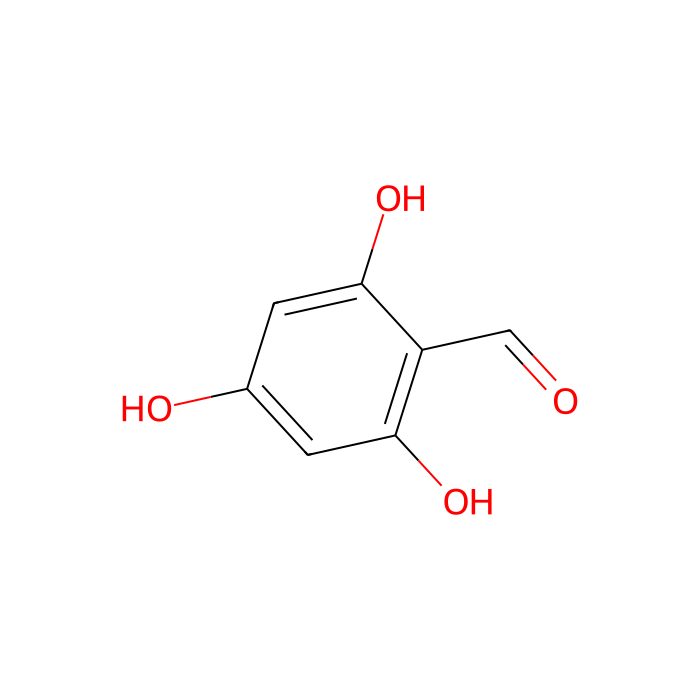
Brief description: 2,4,6-Trihydroxybenzaldehyde is a phenolic benzaldehyde bearing three phenolic OH groups (at the 2-, 4-, and 6-positions) and one formyl group (at the 1-position); often considered a phloroglucinol-derived aldehyde.
Item-specific (Product Data):
SKU: T161492
CAS: 487-70-7
CID: 68099
InChIKey: 34003 (as provided)
Storage: Room temperature, Argon charged; Shipped: Normal
Grade/Purity: Not specified for this item; refer to CoA/Spec Sheet.
Appearance: Not specified for this item; refer to CoA/Spec Sheet.
Literature/Computed identifiers (for reference; not item specifications):
Preferred IUPAC name (literature): 2,4,6-trihydroxybenzaldehyde
Molecular formula (literature): C7H6O4
Molecular weight (literature): ~154.12 g/mol
SMILES (literature): O=Cc1c(O)cc(O)c(O)c1
Structural features (general description):
Aromatic ring with a formyl (–CHO) at C-1 and phenolic OH groups at C-2, C-4, and C-6.
Functional groups: one aldehyde (electrophilic carbonyl), three phenols (acidic, hydrogen-bond donors; intramolecular H-bonding possible with the aldehyde).
Symmetry: 2,4,6-substitution pattern imparts C2-like symmetry across the 1–4 axis; positions 3 and 5 remain unsubstituted and are strongly activated by ortho/para-directing phenols.
2D structure (in words): A benzene ring bearing –CHO at the top carbon; adjacent left, para, and adjacent right carbons each carry –OH groups.
Synthetic Utility
Functional groups and their reactivity make this compound a compact, high-information building block.
Aldehyde handle:
Electrophilic center for imine (Schiff base) formation, Knoevenagel condensations, and Wittig/Still–Gennari olefinations (where tolerated by phenolic OH, often after protection as methyl/benzyl ethers or as carbonates).
Oxidation to acid or reduction to alcohol (NaBH4/CN, catalytic hydrogenation) expands accessible chemical space.
Phenolic triad (2,4,6-OH):
Strongly activating, ortho/para-directing; enables selective functionalization at 3,5-positions (Mannich, halogenation under mild conditions).
O-alkylation/acylation for protecting-group strategies or to tune electronics/solubility; benzyl ethers removable by hydrogenolysis.
Phenoxide formation (with K2CO3, NaH) enables nucleophilic substitution on activated electrophiles to build diaryl ethers and aryl–O linkages.
Retrosynthetic value:
Serves as a convergent node to access salicylaldehyde-like ligands after mono- or di-O-functionalization, or as a precursor to coumarin/benzofuran frameworks via condensation with β-dicarbonyls (Pechmann- or Knoevenagel-type sequences).
Orthogonality tips:
Sequence O-protection before base-sensitive condensations to avoid polymerization.
Use transient silyl protection (TBDMS, TIPS) when strong bases or low-nucleophilicity media are required.
Target Specificity
Not applicable. This product is a small-molecule research reagent, not an antibody, enzyme, or affinity reagent. No antigen/epitope or species specificity data apply.
We use cookies to ensure the website functions properly and, where permitted, to improve your experience. You can manage your preferences at any time in Settings. Learn more in our Cookie Policy.
Shall we send you a message when we have discounts available?
Remind me later
Thank you! Please check your email inbox to confirm.
Products are supplied to verified businesses, institutions, and qualified professionals for research and development use only. Not for use in humans, animals, diagnosis, or therapy.

 L2209291