This compound belongs to the class of organic compounds known as alkyl-phenylketones. These are aromatic compounds containing a ketone substituted by one alkyl group, and a phenyl group.
External Descriptors
Not available
1. Djoumbou Feunang Y, Eisner R, Knox C, Chepelev L, Hastings J, Owen G, Fahy E, Steinbeck C, Subramanian S, Bolton E, Greiner R, and Wishart DS. ClassyFire: Automated Chemical Classification With A Comprehensive, Computable Taxonomy. Journal of Cheminformatics, 2016, 8:61.
Determine the necessary mass, volume, or concentration for preparing a solution.
Dilution Calculator
Determine the dilution needed to prepare a stock solution.
Reconstitution Calculator
Reviews
Customer Reviews
Application Protocols
No application protocols are specified for this catalog item. As a small-molecule building block, typical operations include:
Preparing stock solutions in DMSO, methanol, ethanol, or acetonitrile for analytical assays.
Carrying out O-alkylation/O-acylation reactions under base with appropriate solvent selection (see Reaction Conditions tab).
Performing carbonyl derivatizations (oxime/hydrazone) for characterization or conjugation.
For laboratory methods, consult peer-reviewed procedures using 2,5-dihydroxyacetophenone or closely related dihydroxyacetophenones and adapt to your scale and equipment. Always validate conditions with small-scale trials before scale-up.
Biological Roles
This product is intended for research use only. No medical or clinical claims are made.
General biochemical context (literature):
Phenolic acetophenones, including dihydroxy-substituted variants, are encountered as secondary metabolites or biosynthetic intermediates in plants and microorganisms. Their functions often involve redox chemistry and defense signaling, attributable to phenolic hydrogen-donor capacity and resonance-stabilized phenoxyl radicals.
The presence of two phenolic –OH groups and an aryl ketone creates a conjugated system that can chelate metal ions after deprotonation (as phenolates), potentially modulating redox activity in model systems.
In enzymology studies, dihydroxyacetophenones are used as substrates or inhibitors to probe phenol oxidases, peroxidases, and ketone-reducing enzymes (AKRs) in vitro. Reactivity and binding depend strongly on substitution patterns (e.g., 2,5- vs 3,4-dihydroxy).
Spectroscopic probes: The UV–Vis absorbance of phenolic aryl ketones is sensitive to pH (phenol/phenolate equilibria), making them useful as model chromophores to characterize microenvironments or determine pKa values via spectrophotometric titration.
Note: Specific biological occurrence and activities vary by substitution and organism; users should consult primary literature for mechanistic studies relevant to their research system.
Buffer Applications
Not typically applicable. 2',5'-Dihydroxyacetophenone is not a buffering reagent and does not define a specific pH range. However, its phenolic groups can ionize around typical phenolic pKa values (~10, literature), which may be exploited in spectrophotometric pKa determinations using standard buffers (e.g., borate for alkaline range). For preparative work, select a buffer that maintains the desired ionization state (neutral phenol vs phenolate) without nucleophilic interference (avoid strong nucleophilic amines during acylation studies).
Green Alternatives
Perspective: Green chemistry strategies pertain to solvents, reagents, and process design when using 2',5'-dihydroxyacetophenone as a substrate or building block. The compound itself is a conventional aromatic phenolic ketone; improvements focus on how it is processed.
Greener solvent choices (literature guidance):
Replace polar aprotics of high concern (DMF, NMP, DMAc) with safer alternatives where feasible:
2-MeTHF, CPME, ethyl acetate, propylene carbonate, and Cyrene for certain O-alkylations/esterifications.
Aqueous ethanol or isopropanol for extractions/crystallizations.
For base-promoted O-alkylation, use K2CO3 in acetone/MEK or acetonitrile instead of NaH/DMF when substrate reactivity allows.
Energy and waste minimization:
Employ solvent-free or mechanochemical O-acylations when possible; ball milling with benign bases has precedent for phenols.
Utilize flow chemistry for exothermic acylations or halogenations to enhance heat/mass transfer and reduce overreaction.
Comparison snapshot (general):
Conventional: O-alkylation with NaH in DMF, room temp to reflux; effective but uses a reproductive toxin solvent and pyrophoric base.
Greener: K2CO3 or Cs2CO3 in acetone/MeCN or 2-MeTHF, phase-transfer catalysis (TBAB) in aqueous ethanol; slightly longer reaction times but safer solvent profile and simpler workup.
Trade-offs:
Greener solvents may reduce substrate solubility; adjust temperature or concentration.
Base strength affects selectivity between the two phenols; greener conditions may require optimization to preserve regioselectivity.
Pharmaceutical Uses
Research-use note: For research and laboratory use only. Not for human or veterinary use.
Formulation/manufacturing context (general):
Small-molecule intermediate: 2',5'-Dihydroxyacetophenone can serve as a synthetic intermediate toward more complex active pharmaceutical ingredient (API) candidates featuring diaryl ether/ester linkages or chalcone/flavonoid-like frameworks, by leveraging its dihydroxy pattern and aryl ketone.
Excipient role: Not typical. Phenolic aromatics are generally not used as excipients due to reactivity, color formation, and potential for peroxide/quinone impurities upon oxidation.
Analytical reference material: Can be used as a system suitability or impurity reference when studying related API syntheses that generate dihydroxyacetophenone motifs.
Impurity marker/degradant studies: Phenolic acetophenones can arise as process-related impurities in phenolic API syntheses. Availability of a well-characterized reference aids method development and stability-indicating assays.
Caveats:
Regulatory status: No pharmacopeial monograph is known for this specific compound; if intended for GMP-process development, define internal specifications (purity, related substances, residual solvents, heavy metals) and qualify the source.
Safety in manufacturing: Phenolic solids may discolor on storage; control oxygen/light and set appropriate retest periods. Validate cleaning procedures due to strong UV absorption that can leave trace residues detectable by swab testing.
Physical Properties
Item-specific specifications (from Product Data):
Appearance: Not specified for this item; refer to CoA/Spec Sheet.
Molecular formula: Not specified for this item; refer to CoA/Spec Sheet.
Molecular weight: Not specified for this item; refer to CoA/Spec Sheet.
Literature/general properties (for context only; verify prior to critical use):
Physical state: typically a crystalline organic solid (phenolic aromatic ketone).
Melting point: reported for 2,5-dihydroxyacetophenone in the literature; consult primary references/CoA for exact value relevant to a given lot.
Boiling point: not commonly used due to solid nature and potential decomposition; literature values, if available, should be treated cautiously.
Density: not broadly tabulated for this solid; expect typical aromatic solid density (~1.2–1.4 g/cm3) — verify experimentally.
Solubility profile (qualitative):
Water: low to moderate solubility expected due to two phenolic –OH groups but overall aromaticity; solubility may increase in warm water or at elevated pH (phenolate formation).
Organic solvents: generally soluble in polar protic and aprotic organics (e.g., ethanol, methanol, acetone, acetonitrile, ethyl acetate, DMSO). Limited solubility in nonpolar hydrocarbons.
Acid–base behavior: phenolic –OH groups are weakly acidic (typical phenol pKa ~10; substitution may shift pKa). Deprotonation enhances water solubility and nucleophilicity.
Partitioning: dihydroxy substitution reduces hydrophobicity vs acetophenone; logP expected to be modest (literature estimates typically in the 1–2 range for related dihydroxyacetophenones).
UV–Vis: aromatic phenols and aryl ketones show π→π* bands in the near-UV; exact λmax depends on solvent and ionization state.
Notes: Use the Certificate of Analysis for lot-specific data if property thresholds are critical for your application.
Quality & Grades
Item-specific information (from Product Data):
Grade/purity: Not specified for this item; refer to CoA/Spec Sheet.
Guidance on quality considerations for 2',5'-dihydroxyacetophenone (general):
Purity metrics: For synthetic and analytical applications, typical characterization includes HPLC/GC purity, 1H/13C NMR, HRMS, and water content (KF) for hygroscopicity assessment. Given the phenolic functionality, trace moisture primarily affects reactivity in base-promoted transformations.
UV profile: For chromatography applications, a clean UV baseline in the 200–300 nm region is desirable; impurities with extended conjugation can elevate background.
Metals and inorganic residues: Usually not critical for this type of small-molecule building block unless used in metal-catalyzed reactions where chelating phenols could affect catalysis; request ICP data if relevant for your process validation.
Stabilizers: None are typically required for dihydroxyacetophenones; the compound is generally stable under ambient conditions. If a stabilizer is used, it would be disclosed on the CoA—verify before sensitive assays.
Batch-to-batch consistency: Check melting range and chromatographic profile to confirm lot uniformity. Phenolic solids can show slight color variation (off-white to light tan) without impacting performance; correlate with purity data.
Recommendations:
If using as a calibration standard or in quantitative analysis, request a lot with certified purity and uncertainty.
For scale-up synthesis, obtain a detailed specification sheet (assay, related substances, residual solvents, and moisture) to align with internal QC criteria.
Reaction & Applications
Use cases (general, expanding on typical catalog use of dihydroxyacetophenone building blocks):
Building block for polyphenolic scaffolds: The 2,5-dihydroxy pattern enables divergent O-functionalization (selective mono- or di-ether/ester synthesis) to access ligands, UV-absorbers, and polymer additives.
Chelating ligands and materials: After O-alkylation or Schiff base formation on the acetyl-derived oxime, products can act as bidentate/tridentate ligands in coordination chemistry.
Electrophilic aromatic substitution (EAS): The phenolic –OH groups activate ortho/para positions toward halogenation, nitration, or sulfonylation. The carbonyl group is meta-directing and deactivating—site selectivity reflects the combined directing effects and existing 2,5 substitution.
Nucleophilic transformations at oxygen: Phenolate generation (NaH, K2CO3, Cs2CO3) enables O-alkylation (Williamson ether), O-acylation, and carbonate/carbamate formation. Protecting group strategies (e.g., benzyl, MOM) allow orthogonal manipulation of each phenol.
Carbonyl chemistry: The acetyl group participates in oxime formation, hydrazone derivatization (for conjugation or crystallization), and α-functionalization (e.g., halogenation, aldol-type reactions) under controlled conditions.
Cross-coupling (indirect): While the parent lacks a halogen handle, selective halogenation (e.g., at 4-position) followed by Suzuki/Miyaura coupling enables diversified aromatic substitution.
Polymer and dye precursors: O-alkylated/esterified derivatives are used in UV-curable systems and as chromophore components due to phenolic/aryl–CO conjugation.
Practical tips:
Drying: While not strongly hygroscopic, dry the solid under vacuum at ambient or mild heat prior to base-mediated reactions to ensure reproducible deprotonation.
Regioselectivity: Differentiate the two phenols by temporary protecting groups or through kinetic vs thermodynamic O-alkylation (base choice and solvent polarity can bias outcome).
Monitoring: TLC with UV254 and ferric chloride staining can aid in tracking phenolic intermediates.
Reaction Conditions
General literature guidance (typical ranges; optimize per substrate and scale):
O-Alkylation (ether formation):
Base: K2CO3 (2–3 equiv) or Cs2CO3 in acetone, acetonitrile, or DMF; 40–80°C, 2–16 h. For challenging electrophiles, NaH (60% in oil) in THF/DMF at 0–25°C to start, then warm.
Selectivity: Stepwise protection allows mono- vs di-alkylation. Lower base equivalents and shorter times favor mono-substitution.
O-Acylation (ester formation):
Reagents: Acyl chloride/anhydride (1.1–2.0 equiv) with pyridine or triethylamine in DCM/EtOAc; 0°C to rt, 0.5–4 h. Alternatively, DIC/DMAP in EtOAc or MeCN for mild conditions.
Electrophilic aromatic substitution:
Bromination: NBS in acetic acid or DMF at rt to 60°C; monitor closely to avoid polybromination. Phenolic protection may be required for regioselectivity.
Nitration: AcOH/HNO3 mixtures at 0–5°C; strong conditions risk oxidation—protect phenols if needed.
Carbonyl derivatization:
Oxime: Hydroxylamine·HCl (1.2–1.5 equiv) with AcONa or pyridine in EtOH or MeOH; 25–60°C, 1–3 h.
Hydrazone: Hydrazine or arylhydrazines in ethanol with catalytic acid/base; rt to reflux.
Cross-coupling (after halogenation):
Suzuki–Miyaura: Pd(PPh3)4 (1–3 mol%), K2CO3 or K3PO4, dioxane/water or toluene/EtOH/water; 60–100°C, 2–12 h.
Workup/purification tips:
Phenolic products often crystallize well from EtOAc/hexanes or EtOH/water.
Use bicarbonate washes to remove acidic residues; avoid strong base washes if ester-protected phenols are present.
Note: These are representative literature conditions; verify compatibility with your specific substitution pattern and scale.
Safety & Handling
Item-specific hazard information (from Product Data):
Signal word: Not specified for this item; refer to SDS.
H-statements: Not specified for this item; refer to SDS.
GHS classification: Not specified for this item; refer to SDS.
Pictograms: Not specified for this item; refer to SDS.
General safety guidance for phenolic aromatic ketones (literature/industrial hygiene best practice):
Likely hazards: May cause skin/eye irritation; dust may irritate respiratory tract. Phenolic compounds can be harmful if ingested in significant quantities. Avoid formation of dust and inhalation of particulates.
PPE: Use lab coat, safety glasses or chemical splash goggles, and appropriate gloves (e.g., nitrile). Employ local exhaust ventilation when weighing or transferring powders.
Handling: Avoid contact with strong oxidizers and strong bases in the presence of air, which can promote oxidative darkening. Phenolic compounds can form phenolates under basic conditions—control pH accordingly.
First aid (overview; defer to SDS):
Inhalation: Move to fresh air; seek medical attention if symptoms persist.
Skin contact: Wash with soap and water; remove contaminated clothing.
Eye contact: Rinse cautiously with water for several minutes; remove contact lenses if present and easy; seek medical attention for persistent irritation.
Ingestion: Rinse mouth; seek medical advice.
Fire safety: Organic solid; combustible. Use CO2, dry chemical, or foam. Thermal decomposition may release CO/CO2 and phenolic vapors.
Storage: Keep tightly closed in a cool, dry, well-ventilated place at room temperature (per Product Data). Protect from moisture and excessive light to minimize oxidative discoloration.
Waste: Dispose of according to local regulations for organic laboratory chemicals; collect residues/contaminated materials in appropriate containers.
Always consult the product-specific SDS for authoritative hazard classification and emergency measures.
Solvent Selection
Compound class and polarity (general):
2',5'-Dihydroxyacetophenone is an aromatic dihydroxy ketone. The two phenolic –OH groups impart hydrogen-bonding ability and moderate polarity compared with acetophenone. It is typically handled as a solid dissolved in polar solvents.
Miscibility and solvent preferences (literature/experience):
Good solvents: methanol, ethanol, isopropanol, acetone, acetonitrile, ethyl acetate, DMSO, DMF, and dioxane. Warming often accelerates dissolution.
Limited/slow dissolution: toluene, chlorinated solvents (e.g., DCM) may dissolve upon heating; solubility often insufficient at room temperature for concentrated solutions.
Water: low to moderate solubility as the neutral phenol; solubility increases markedly in basic aqueous media due to phenolate formation.
Selection guidance by application:
Analytical prep (HPLC/LC–MS): Start with acetonitrile/water or methanol/water with 0.1% formic acid for positive-mode ionization or 5–10 mM ammonium acetate for negative-mode (phenolate) detection. DMSO stock solutions are convenient for high-concentration standards.
Synthetic transformations: Use polar aprotic solvents (DMF, DMSO, NMP, MeCN, dioxane) for O-alkylation/acylation and SNAr couplings; protic alcohols for selective esterifications or transesterifications. For electrophilic aromatic substitutions, acetic acid or nitrobenzene can be used depending on conditions.
Crystallization: Ethyl acetate/hexanes or ethanol/water mixtures commonly provide good crystallization windows.
Comparative notes:
Versus monohydroxyacetophenones: the dihydroxy compound is less soluble in nonpolar media and more reactive under base due to two acidic sites.
Versus catechols/resorcinols: the ketone reduces overall nucleophilicity of the ring; choose stronger base or higher temperature for O-functionalization compared to resorcinol.
Storage & Reconstitution
Item-specific (from Product Data):
Storage conditions: Room temperature.
Shipped in: Normal.
General guidance for this compound class:
Container: Store in a tightly sealed amber glass bottle to minimize light exposure and oxidative discoloration. Include a desiccant if long-term storage is anticipated.
Environment: Keep in a cool, dry place with low humidity. Avoid prolonged exposure to air if frequent base-mediated reactions are planned; mild vacuum-drying (e.g., 20–40°C under reduced pressure) prior to use can improve reproducibility.
Stability: Phenolic aromatic ketones are generally stable at ambient temperature. Over time, slight color change (off-white to tan) may occur without significant impact on purity; confirm by HPLC/NMR.
Reconstitution/solution preparation: For analytical or synthetic use, prepare solutions in suitable solvents (e.g., DMSO, methanol, ethanol, acetone, acetonitrile). Filter through a PTFE syringe filter (0.2–0.45 μm) if particulate is present. For aqueous work, dissolve in minimal organic co-solvent or adjust pH to mildly basic to enhance solubility (phenolate formation), being mindful of subsequent reactions.
Freeze–thaw: Not generally applicable to solids. If preparing stock solutions for repeated use, aliquot and store at 2–8°C or −20°C (depending on solvent stability) to minimize degradation; allow to equilibrate to room temperature before opening to reduce moisture ingress.
Always refer to the product’s CoA/SDS for any lot-specific storage or stability notes.
Structure & Identity
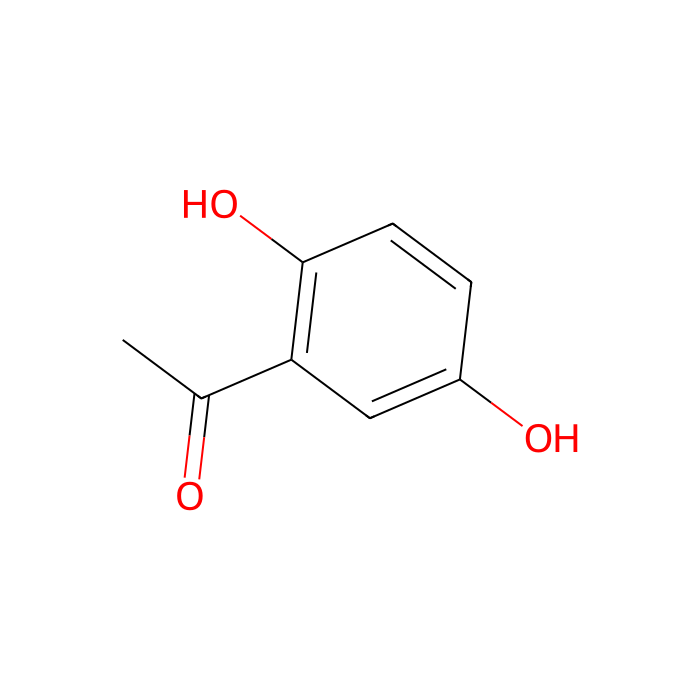
Brief description: 2',5'-Dihydroxyacetophenone is a dihydroxy-substituted acetophenone (a phenolic aromatic methyl ketone) useful as a building block and ligand precursor in organic synthesis and materials chemistry.
Item-specific (from Product Data):
SKU: D113510
Product name: 2',5'-Dihydroxyacetophenone
CAS: 490-78-8
PubChem CID: 10279
InChIKey: 401335 (as provided; consult CoA/SDS for confirmation)
Storage conditions: Room temperature
Shipped in: Normal
Literature/Computed identity (general reference, not item-specific specs):
SMILES (literature): CC(=O)C1=C(O)C=CC(O)=C1 (one of several equivalent representations; exact tautomer/format may vary)
InChIKey (literature): representative keys reported for 2,5-dihydroxyacetophenone exist; verify on CoA/Spec Sheet for the exact string used in our listing.
Structural features (general chemistry):
Core: a benzene ring bearing a methyl ketone (acetyl) substituent.
Functional groups: one aryl ketone (–COCH3) and two phenolic hydroxyls (–OH) at the 2 and 5 positions relative to the acetyl group.
Directing effects: phenolic –OH groups are ortho/para directing and activating; the aryl ketone is meta directing and deactivating. The 2,5-substitution pattern reflects the interplay of these effects.
2D description: a six-membered aromatic ring with an acetyl at position 1; an –OH ortho (2-position) to the acetyl and another –OH meta (5-position) to the acetyl, yielding a resorcinol-like substitution pattern.
Synthetic Utility
Functional handles and their reactivity (general):
Phenolic –OH (two sites):
O-alkylation (Williamson ether) with alkyl halides or sulfates under K2CO3/Cs2CO3 or NaH; phase-transfer catalysis can enhance selectivity.
O-acylation with acyl chlorides/anhydrides to form diesters; stepwise protection allows mono-selective derivatives.
Carbonate/carbamate formation (e.g., with CDI or triphosgene equivalents) for protecting or linking strategies.
Aryl ketone (acetyl):
Oxime/hydrazone formation for derivatization or ligation; subsequent Beckmann rearrangement or Wolff–Kishner-type transformations available if needed.
α-Functionalization (enolization) enabling halogenation or aldol-type couplings; the adjacent phenol at C2 can influence enol stability and chelation.
Strategic applications:
Diversification platform: Halogenate the ring (e.g., selective bromination para to an –OH) then perform cross-couplings (Suzuki, Buchwald–Hartwig after further activation) to introduce diverse aryl/heteroaryl groups.
Ligand and polymer precursors: Sequential O-alkylation with differing chains yields amphiphilic or dendritic motifs. Chelation to metals after deprotonation affords complexes for catalysis studies.
Protecting group logic: Differentiate the two phenols via steric/electronic bias—benzylation often occurs faster at the more activated site; employ orthogonal deprotection (hydrogenolysis vs acid-labile groups) to access regioisomers.
Analytical and process notes:
Monitor O-functionalization by 1H NMR (downfield phenolic singlets) and by LC–MS (mass additions of +14, +28, etc., for Me/Ac groups).
Control moisture and base strength to manage competitive C- vs O-alkylation and minimize over-alkylation.
Target Specificity
Not applicable. This product is a small-molecule chemical building block, not a biological targeting reagent (e.g., antibody, enzyme inhibitor standard with defined target binding). No antigen/epitope, species reactivity, or isotype information applies.
We use cookies to ensure the website functions properly and, where permitted, to improve your experience. You can manage your preferences at any time in Settings. Learn more in our Cookie Policy.
Shall we send you a message when we have discounts available?
Remind me later
Thank you! Please check your email inbox to confirm.
Products are supplied to verified businesses, institutions, and qualified professionals for research and development use only. Not for use in humans, animals, diagnosis, or therapy.

 K1411026