This compound belongs to the class of organic compounds known as alkylthiols. These are organic compounds containing the thiol functional group linked to an alkyl chain.
External Descriptors
alkanethiol
1. Djoumbou Feunang Y, Eisner R, Knox C, Chepelev L, Hastings J, Owen G, Fahy E, Steinbeck C, Subramanian S, Bolton E, Greiner R, and Wishart DS. ClassyFire: Automated Chemical Classification With A Comprehensive, Computable Taxonomy. Journal of Cheminformatics, 2016, 8:61.
Determine the necessary mass, volume, or concentration for preparing a solution.
Dilution Calculator
Determine the dilution needed to prepare a stock solution.
Reconstitution Calculator
Reviews
Customer Reviews
Application Protocols
No item-specific tested application protocols are provided for this reagent. It is a general-purpose small-molecule thiol for synthetic chemistry.
General laboratory practices (guidance)
Use gastight syringes or cannula transfer under inert gas to minimize odor and oxidation.
For photochemical thiol–ene: degas solvent (freeze–pump–thaw or sparge with argon), add initiator (1–2 mol%), irradiate with 365–405 nm LEDs while maintaining temperature; monitor by GC or NMR.
For S-alkylation: premix base and solvent, cool if exotherm anticipated, add electrophile last; monitor for disulfide by GC.
For detailed, validated protocols relevant to your substrates, consult the primary literature or contact technical support with your intended transformation and scale.
Biological Roles
This product is supplied for research use only; no clinical or diagnostic use is intended or implied.
General biochemical context (literature)
Low-molecular-weight aliphatic thiols can arise from metabolism of sulfur-containing amino acids and from fermentation byproducts, but isopropanethiol is not a major endogenous metabolite in mammalian systems.
Thiols participate in redox chemistry (thiol–disulfide exchange) and nucleophilic reactions, serving as models for cysteine-like reactivity in mechanistic studies.
In flavor/aroma chemistry, short-chain thiols are notable for extremely low odor thresholds; trace formation has been reported in certain fermented foods and beverages (literature context), but such occurrences are matrix- and process-dependent.
Laboratory relevance
Often used as a small-molecule probe for investigating thiol reactivity, soft–soft interactions with electrophiles, and radical transfer kinetics.
Can form mixed disulfides with biological thiols in model systems; these studies help understand protein thiol modifications without implying any therapeutic application.
Cautions
Due to potent odor and volatility, biological lab areas require stringent containment and waste management when using aliphatic thiols to avoid pervasive contamination of incubators and analytical instruments.
Item-specific biological data: Not specified for this item; refer to CoA/Spec Sheet if any biological testing information is provided.
Buffer Applications
2-Propanethiol is not a buffering agent and is not typically used to prepare aqueous buffer systems.
Relevance
As a volatile, reactive thiol, it is generally incompatible with standard biological buffer applications. If used in aqueous studies, it is usually as a reactive additive (e.g., nucleophile/reductant analog) rather than a buffering component.
Guidance
If an aqueous environment is necessary (e.g., kinetic assays), prepare fresh solutions in closed vessels under inert gas to limit oxidation and volatilization. Choose buffers that do not contain strong oxidants or transition metals that catalyze thiol oxidation.
Item-specific buffer data: Not specified for this item; refer to CoA/Spec Sheet.
Green Alternatives
Motivation
2-Propanethiol is effective but highly volatile and odorous. Green-by-design improvements focus on solvent choice, process containment, and less-volatile thiol sources rather than replacing the functionality outright.
Greener media (literature guidance)
Replace chlorinated solvents with ethyl acetate, 2-methyltetrahydrofuran (2-MeTHF), or cyclopentyl methyl ether (CPME) where compatible (thiol–ene, Michael additions, and many S-alkylations tolerate these).
Employ aqueous/bi-phasic conditions with phase-transfer catalysts to reduce organic solvent volume for SN2 S-alkylations.
Reagent alternatives and surrogates
Thioacetate pathway: use isopropyl thioacetate as a bench-stable, lower-odor surrogate; deprotect to the thiol in situ (basic methanolysis) when needed.
Solid-supported thiols or masked thiols (e.g., S-aryl xanthates) can mitigate odor and facilitate purification in polymer/surface work.
Process/containment improvements
Closed-loop or microreactor photochemistry for thiol–ene minimizes emissions and improves light utilization.
Odor abatement: activated carbon traps and sodium hypochlorite scrubbers (with appropriate engineering controls and quench design) for off-gas treatment.
Comparison (literature; qualitative)
2-Propanethiol: high reactivity, very high odor/volatility.
Longer-chain thiols (e.g., 1-hexanethiol): reduced volatility/odor but slower kinetics and higher hydrophobicity.
Thioacetate surrogates: lower odor, add deprotection step; suitable for many S-alkylations.
Trade-offs
Greener solvents may alter rates/selectivity; validate with small-scale screens. Surrogates add steps but often improve EHS profiles.
Pharmaceutical Uses
No excipient or pharmacopeial status is specified for this item; refer to CoA/Spec Sheet.
General context (non-clinical; literature)
Short-chain aliphatic thiols are not commonly employed as pharmaceutical excipients due to intense odor, volatility, and potential irritation. When thiol functionality is desired in formulations (e.g., for mucoadhesive polymers), it is typically incorporated covalently into high-MW backbones rather than added as a free volatile thiol.
Process chemistry relevance
In drug substance route scouting, small thiols are occasionally used for S-alkylation/masking steps, disulfide model studies, or polymerization control during material preparation. Such uses are confined to synthetic operations with stringent odor control, not to finished dosage form components.
Compliance/Safety
Any use in GMP contexts would require tight specifications for residual solvents, identity/purity by validated methods, and robust containment controls. None of these specifications are provided for this catalog entry.
Reminder
For research use only, as stated in the Product Data. No therapeutic, diagnostic, or clinical claims are made or implied.
Physical Properties
Item-specific specifications: Not specified for this item; refer to CoA/Spec Sheet.
Literature/typical values (for context only; not specifications for this item)
Readily oxidizes in air to the corresponding disulfide (diisopropyl disulfide), especially in the presence of base or trace metal catalysts; exclude oxygen for stability.
High vapor flammability typical of low-MW thiols; treat as a flammable liquid even when exact flash point is not specified here (consult SDS for authoritative data).
Quality & Grades
Grade/Purity for this item: Not specified for this item; refer to CoA/Spec Sheet.
Interpreting grades (general guidance)
Research or reagent grade indicates suitability for standard synthetic and analytical workflows. For air-sensitive/odor-critical thiols, packaging integrity (septum/seal quality) is often as important as nominal purity.
High-purity or GC-assayed thiols may specify low levels of disulfide, moisture, and residual solvents; these details are not provided here for this catalog entry and should be verified on the CoA.
Stabilizers/inhibitors
No stabilizer information is provided for this item. If relevant to your application (e.g., radical-sensitive processes), consult the CoA/SDS or contact technical support to confirm whether any antioxidants or acid washes are used.
What to verify on receipt (best practice)
Inspect container integrity and headspace blanket (argon noted for this item); check for odor leakage.
Review CoA for assay method (e.g., GC), identified impurities (especially diisopropyl disulfide), and water content if critical to your process.
For kinetic or mechanistic studies, pre-treat by brief drying over molecular sieves or distillation under inert gas if the CoA indicates moisture or disulfide above your acceptable thresholds.
Reaction & Applications
Nucleophilic S-alkylation (literature)
Deprotonation to isopropylthiolate enables substitution on primary alkyl halides/triflates to give isopropyl thioethers. Secondary centers may require phase-transfer catalysis or elevated temperatures; tertiary centers undergo elimination.
Thiol–ene and thiol–yne chemistry
Radical addition across alkenes/alkynes using photoinitiation (UV/blue LEDs) or thermal initiators (AIBN). Widely used for surface functionalization, polymer crosslinking, and late-stage tagging due to anti-Markovnikov selectivity and tolerance of many functional groups.
Michael additions (soft–soft interactions)
Adds to electron-deficient alkenes (acrylates, maleimides, vinyl sulfones) under mild base or nucleophilic catalysis, forming robust thioether linkages.
Thioester formation and acyl transfer chemistry
Activation of carboxylic acids (e.g., DCC/DMAP, EDC/HOBt alternatives) affords isopropyl thioesters, useful as acyl donors or intermediates in native chemical ligation analogs (method development context).
Radical chain transfer (literature)
Acts as a chain-transfer agent in free-radical polymerizations (e.g., styrene, acrylates), modulating molecular weights and dispersity (via reversible H-atom transfer).
Coordination and materials chemistry
Formation of metal thiolates and SAM-like surface treatments on coinage metals for model studies (short-chain thiols often used as volatile, readily displaced anchors).
Practical tips
Exclude oxygen to suppress disulfide formation; freshly distill under inert atmosphere for odor-sensitive or kinetics work.
Use base strength judiciously: strong bases accelerate oxidation; carbonate/tertiary amines suffice for many S-alkylations.
Reaction Conditions
S-Alkylation (literature guidance)
Typical setup: iPrSH (1.0–1.5 equiv), electrophile (1.0 equiv), base (K2CO3, Cs2CO3, or Et3N), solvent (MeCN, DMF, acetone), 20–60 °C, 2–16 h. Primary halides/triflates give high conversions; secondary substrates slower; tertiary typically fail (elimination).
Phase-transfer variant: K2CO3 (aqueous), toluene/CH2Cl2 with Bu4NBr (PTC), rt–50 °C, improved rates and simpler workup.
Thiol–ene addition
Photochemical: 365–405 nm LEDs, photoinitiator (e.g., 1–2 mol% DMPA or Ir(ppy) catalysts), solvent (EtOAc, toluene, 2-MeTHF), rt, 0.5–4 h; often near-quantitative conversions for terminal alkenes.
Thermal: AIBN (5–10 mol%), 70–85 °C, inert atmosphere, non-polar solvents; suitable for bulk polymerizations and coatings.
Michael addition to acrylates/maleimides
Base-catalyzed: DBU/TEA (1–10 mol%), MeCN/MeOH/green ethers, 0–25 °C, minutes to hours. Alternatively, organocatalysts (e.g., thioureas) for enhanced selectivity.
Thioester formation
DCC/DMAP in CH2Cl2 or EtOAc, 0 °C → rt, 2–6 h; or EDCI with catalytic DMAP in MeCN/H2O (biphasic) with urea byproduct filtration.
Oxidations (after S-alkylation)
mCPBA: thioether → sulfoxide (−78 to 0 °C, 1 equiv) or sulfone (excess, 0–25 °C); monitor to avoid overoxidation.
Notes
All conditions are literature/general guidance and should be optimized per substrate. Ensure inert atmosphere to suppress disulfide formation. Manage odor and vapor via closed systems and efficient off-gas scrubbing.
Safety & Handling
GHS and hazard classifications: Not specified for this item; refer to the product SDS for authoritative classification, H/P statements, and pictograms.
General hazard profile for low-molecular-weight aliphatic thiols (literature/typical)
Flammable liquid and vapor; vapors may form explosive mixtures with air.
Acute toxicity categories often include skin/eye irritation and respiratory irritation; strong, pervasive odor with extremely low threshold.
Oxidation risk: air/oxygen exposure can form disulfides; heat or strong acid/base may release toxic sulfur species (e.g., H2S under certain conditions).
Perform all manipulations in a well-functioning fume hood; avoid open bench work due to odor and vapor.
Use inert gas (argon or nitrogen) blanketing; maintain tightly sealed containers to minimize volatilization and oxidation.
Avoid ignition sources; use grounded equipment and intrinsically safe pumps for transfers.
Incompatibilities: strong oxidizers, nitrating agents, acid chlorides/anhydrides (vigorous acylation with heat), and strong bases in air (accelerated oxidation).
Personal protective equipment: splash goggles, lab coat, nitrile gloves (double-gloving recommended for extended handling), and, where necessary, respirator per institutional risk assessment.
First-aid overview (consult SDS for full guidance)
Inhalation: move to fresh air, monitor respiration, seek medical attention.
Skin contact: remove contaminated clothing, wash with soap/water; seek medical advice for irritation.
Eye contact: rinse cautiously with water for several minutes; remove contact lenses if present; get medical attention.
Ingestion: rinse mouth; do not induce vomiting; seek medical attention.
Shipping: Shipped via FedEx DG Service (from Product Data).
Solvent Selection
This product is a reactive reagent (aliphatic thiol), not a working solvent. Solvent choice pertains to its use in synthesis or analysis rather than as a medium itself.
General solvent compatibility (literature)
Miscible with many organic solvents: alcohols, ethers, hydrocarbons, chlorinated solvents, and polar aprotic media (e.g., DMF, DMSO, acetonitrile).
Selecting a medium by transformation type (general guidance)
S-alkylation (SN2): polar aprotics (DMF, DMSO, MeCN) or acetone with a non-nucleophilic base (K2CO3, Cs2CO3). Hydrocarbon/ether solvents may be used when substrates are lipophilic.
Thiol–ene additions: non-polar to moderately polar solvents (toluene, EtOAc, 2-MeTHF). Bulk polymerizations can proceed neat; consider viscosity/heat removal.
Conjugate (Michael) additions: MeOH, MeCN, or green ethers (2-MeTHF) with mild base or organocatalysts.
Thioester formation: dichloromethane or EtOAc for DCC/EDC protocols; alternatives like MeCN or CPME can reduce chlorinated solvent use.
Odor/containment considerations
Favor closed systems, septum-capped glassware, and low-permeability tubing. Avoid highly permeable plastics that allow odor breakthrough.
Ethers (THF/2-MeTHF): good for radical and base-mediated steps; easier removal.
Esters (EtOAc): greener, good balance for photochemical thiol–ene; limited base tolerance.
Storage & Reconstitution
Storage (from Product Data)
Store at room temperature.
Argon charged.
Packaging/handling recommendations (general)
Keep container tightly closed; minimize headspace and oxygen ingress to limit oxidation to disulfides.
Store in a secondary sealed container or odor-tight bag to prevent odor egress. Avoid light/heat sources and ignition sources.
For frequent use, consider aliquoting under inert gas to reduce repeated air exposure.
Stability notes (literature/general)
Aliphatic thiols can slowly oxidize even at ambient temperature; periodic GC check for disulfide is prudent for long-term projects.
If minor discoloration or odor change suggests oxidation, purify by short-path distillation under inert atmosphere immediately before critical experiments.
Reconstitution
Not applicable. Supplied as a liquid; use as received. If solidification is ever observed at low temperatures (unlikely for this compound), allow to warm to ambient before opening to prevent moisture condensation.
Transport and compliance
Shipped via FedEx DG Service (from Product Data). Follow institutional procedures for receiving and storing flammable, odorous reagents.
Research Use Note
For research use only.
Structure & Identity
Item-specific identifiers (from Product Data)
SKU: P106796
Product Name: 2-Propanethiol
CAS: 75-33-2
CID: 6364
InChIKey: 181799 (as provided)
SMILES: Not specified for this item; refer to CoA/Spec Sheet.
Literature identifiers and descriptors (informational; not item specifications)
Common name: isopropyl mercaptan; 2-propyl mercaptan
Acidity/nucleophilicity: the thiol hydrogen is weakly acidic (pKa ≈ 10–11, literature), conjugate base (isopropylthiolate) is a strong soft nucleophile.
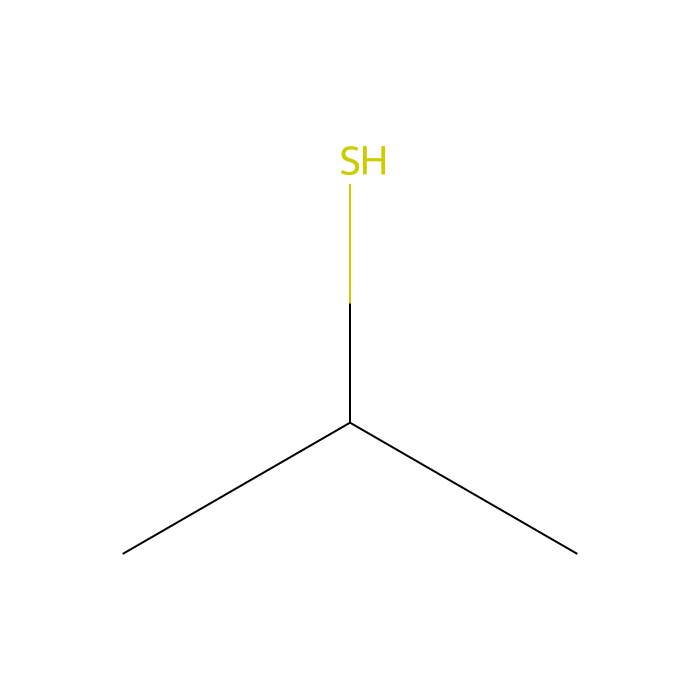
2D description in words: a central secondary carbon bearing a methyl group on each side and a terminal thiol substituent (CH3–CH(SH)–CH3).
Synthetic Utility
Functional group profile
Soft nucleophile (RS−) after deprotonation; engages readily in SN2 on unhindered electrophiles, conjugate additions to activated alkenes, and radical additions across C=C/C≡C.
Weak acid (pKa ~10–11, literature), enabling selective deprotonation relative to alcohols and many amide NHs.
Transformations (literature examples)
S-Alkylation: R–X + iPrSH → R–S–iPr (base, polar aprotic solvents). Useful for installing an isopropylthio handle that can later be oxidized (sulfone/sulfoxide) or displaced under specific conditions.
Thioester synthesis: RCO2H + iPrSH (DCC/DMAP or EDC-based activation) → RCO–S–iPr; thioesters serve as acyl donors or as intermediates in ligation method development.
Thiol–ene: anti-Markovnikov addition to terminal alkenes using photoinitiation (365–450 nm) or AIBN/thermal initiation; tolerant of many functional groups, enabling late-stage diversification.
Michael addition: efficient addition to acrylates/maleimides under mild base/organocatalysis, forming robust thioethers.
Oxidation: stepwise to sulfoxide/sulfone after prior S-alkylation, expanding polarity and reactivity.
Strategic retrosynthesis
Isopropylthio is a versatile masked functionality: it can modulate lipophilicity, act as a leaving group upon oxidation/activation, or serve as a handle for cross-coupling variants involving C–S activation (nickel-mediated aryl–S cleavage in literature).
Practicalities
Keep oxygen/moisture low to suppress disulfide. Freshly distill for sensitive applications. Strong bases can induce elimination/side oxidation; prefer carbonate/tertiary amine bases when feasible.
Target Specificity
Not applicable. This product is a small-molecule thiol reagent, not a biological targeting agent or antibody. No antigen, epitope, species reactivity, clone, or isotype information applies.
We use cookies to ensure the website functions properly and, where permitted, to improve your experience. You can manage your preferences at any time in Settings. Learn more in our Cookie Policy.
Shall we send you a message when we have discounts available?
Remind me later
Thank you! Please check your email inbox to confirm.
Products are supplied to verified businesses, institutions, and qualified professionals for research and development use only. Not for use in humans, animals, diagnosis, or therapy.

 I2607157