2-Undecylimidazole - ≥96%(T) , CAS No.16731-68-3

CAS: 16731-68-3 Cat. No.: U162914 Formula: C14H26N2 Molecular Weight: 222.38 EC Number: 240-796-9 PubChem CID: 85582
AVAILABLE TO ORDER
GRADE & PURITY ≥96%(T)
Synonyms
FT-0637411 | 1H-Imidazole, 2-undecyl- | 5-ethyl-2-methyl-4,5-dihydrothiazole | undecylimidazole | AKOS015898195 | SCHEMBL64393 | MFCD00038694 | DTXSID5066114 | 2-Undecyl-1H-imidazole | 2-Undecylimidazole | A882251 | AS-58179 | SY041816 | U0012 | 2-n-undec
Storage
Room temperature
Shipped In
Normal
★
Size
USA
Germany (EU)*
Price
Qty
5g
U162914-5g
5 In stock
—

$9.90

$14.90
Save $5.00 (33.56%)
25g
U162914-25g
4 In stock
—

$12.90

$19.90
Save $7.00 (35.18%)
100g
U162914-100g
2 In stock
—

$46.90

$70.90
Save $24.00 (33.85%)
500g
U162914-500g
1 In stock
—

$149.90

$224.90
Save $75.00 (33.35%)
Enter a quantity for the sizes you want to add.
🧪
Why this grade

≥96%(T) for sensitive chromatographic and analytical workflows requiring minimal baseline interference.

🌡

Storage & shipping

Room temperature Ships Normal Check lot-specific COA for exact specifications.

📋

Quality documents

SDS, COA, datasheet, and spec sheet available for download. Lot-specific COA accessible via lot number lookup.

📚

Literature proof

Cited in 3 peer-reviewed publications across chromatography, organic synthesis, and cross-coupling reactions.

Specifications

Synonyms
FT-0637411 | 1H-Imidazole, 2-undecyl- | 5-ethyl-2-methyl-4,5-dihydrothiazole | undecylimidazole | AKOS015898195 | SCHEMBL64393 | MFCD00038694 | DTXSID5066114 | 2-Undecyl-1H-imidazole | 2-Undecylimidazole | A882251 | AS-58179 | SY041816 | U0012 | 2-n-undec
Specifications & Purity
≥96%(T)
Storage
Room temperature
Shipped In
Normal
Purity
≥96%(T)
Names and Identifiers
Pubchem Sid
Pubchem Sid Url
https://pubchem.ncbi.nlm.nih.gov/substance/504755818
Canonical Smiles
CCCCCCCCCCCC1=NC=CN1
IUPAC Name
2-undecyl-1H-imidazole
InChIKey
LLEASVZEQBICSN-UHFFFAOYSA-N
INCHI
1S/C14H26N2/c1-2-3-4-5-6-7-8-9-10-11-14-15-12-13-16-14/h12-13H,2-11H2,1H3,(H,15,16)
Isomeric SMILES
CCCCCCCCCCCC1=NC=CN1
PubChem CID
85582
Molecular Weight
222.38
Reaxy-Rn
132952

Documentation

📋 Safety Data Sheet (SDS)

Comprehensive hazard, handling, storage, and regulatory compliance document.

Download SDS →

✅ Certificate of Analysis (COA)

Lot-specific quality data. Enter your lot number to retrieve the exact COA.

Look up COA →

📊 Datasheet

Quick-reference summary of product specifications and applications.

View datasheet →

🔬 Specification Sheet

Full quality attributes and acceptance criteria for this grade.

View spec sheet →

Advanced Data

Taxonomic Classification

Taxonomy Tree

KingdomOrganic compounds
SuperclassOrganoheterocyclic compounds
ClassAzoles
SubclassImidazoles
Intermediate Tree Nodes Not available
Direct ParentImidazoles
Alternative Parents Heteroaromatic compounds  Azacyclic compounds  Organopnictogen compounds  Organonitrogen compounds  Hydrocarbon derivatives  
Molecular FrameworkAromatic heteromonocyclic compounds
Substituents Heteroaromatic compound - Imidazole - Azacycle - Organic nitrogen compound - Organopnictogen compound - Hydrocarbon derivative - Organonitrogen compound - Aromatic heteromonocyclic compound
DescriptionThis compound belongs to the class of organic compounds known as imidazoles. These are compounds containing an imidazole ring, which is an aromatic five-member ring with two nitrogen atoms at positions 1 and 3, and three carbon atoms.
External Descriptors Not available
3D Structure
Interactive Chemical Structure Model


Certificates(CoA,COO,BSE/TSE and Analysis Chart)
C of A & Other Certificates(BSE/TSE, COO):
Analytical Chart:

Find and download the COA for your product by matching the lot number on the packaging.

14 results found

Lot NumberCertificate TypeDateItem
K2125256Certificate of AnalysisSep 08, 2025 U162914
K2125319Certificate of AnalysisSep 08, 2025 U162914
K2125320Certificate of AnalysisSep 08, 2025 U162914
K2125321Certificate of AnalysisSep 08, 2025 U162914
K2125322Certificate of AnalysisSep 08, 2025 U162914
K2119262Certificate of AnalysisSep 04, 2025 U162914
K2119306Certificate of AnalysisSep 04, 2025 U162914
A2105092Certificate of AnalysisOct 23, 2024 U162914
A2105090Certificate of AnalysisOct 23, 2024 U162914
A2105089Certificate of AnalysisOct 23, 2024 U162914
L2503431Certificate of AnalysisJun 13, 2024 U162914
L2503432Certificate of AnalysisJun 13, 2024 U162914
I2423614Certificate of AnalysisNov 25, 2021 U162914
C2315466Certificate of AnalysisNov 04, 2021 U162914
Chemical and Physical Properties
SolubilitySoluble in methanol
Boil Point(°C)215 °C/20 mmHg
Melt Point(°C)71.0 - 75.0 °C
Molecular Weight222.370 g/mol
XLogP35.600
Hydrogen Bond Donor Count1
Hydrogen Bond Acceptor Count1
Rotatable Bond Count10
Exact Mass222.21 Da
Monoisotopic Mass222.21 Da
Topological Polar Surface Area28.700 Ų
Heavy Atom Count16
Formal Charge0
Complexity148.000
Isotope Atom Count0
Defined Atom Stereocenter Count0
Undefined Atom Stereocenter Count0
Defined Bond Stereocenter Count0
Undefined Bond Stereocenter Count0
The total count of all stereochemical bonds0
Covalently-Bonded Unit Count1
Citations of This Product
Solution Calculators
Reviews

Customer Reviews

Application Protocols

No assay-specific or kit-style application protocols are provided for this small-molecule reagent. Typical uses are described under Reaction & Applications, Synthetic Utility, and Reaction Conditions. For coating/corrosion studies, users should develop protocols tailored to their substrates (surface preparation, concentration, solvent, contact time) and validate performance empirically.

Biological Roles

Overview: 2-Undecylimidazole is a synthetic imidazole derivative; it is not a natural metabolite. However, the imidazole motif is central to many biochemical processes via histidine residues.

General biochemical context (literature/general):

  • Imidazole ring: present in histidine and active sites of many enzymes; coordinates metal ions and participates in acid–base catalysis near physiological pH.
  • Amphiphilicity: the C11 chain imparts surfactant-like properties that may promote membrane association and micelle formation in aqueous media; such behavior is of interest in formulation science and biophysical studies (no claims on biological activity or safety implied).
  • Protonation state: the imidazole conjugate acid has pKa around 7; in biological buffers, protonation can modulate interactions with proteins and surfaces. The hydrophobic tail strongly reduces bulk aqueous solubility relative to imidazole.
  • Coordination: potential to bind to metalloproteins or model metal centers in vitro as a probe ligand (research use only).

Caveats:

  • Not intended for clinical or diagnostic use. Any in vitro biological testing should include appropriate cytotoxicity and membrane-interaction controls.
  • Surfactant-like compounds can disrupt lipid bilayers at sufficient concentrations; handle accordingly in biological assays.
Buffer Applications

Overview: Unlike imidazole (commonly used as a buffering agent around pH 6–8), 2-undecylimidazole is poorly water-soluble and not typically employed as a buffer component.

Applicability:

  • Aqueous buffering: not recommended due to low solubility and potential micelle formation that complicates pH control and ionic strength.
  • Organic media: in nonaqueous systems it can act as a weak base or proton shuttle, but not as a defined buffering agent.

Recommendation: If an imidazole-based buffer is required (e.g., for protein purification or metal-affinity chromatography), use reagent-grade imidazole rather than long-chain derivatives.

Green Alternatives

Overview: While 2-undecylimidazole is not a volatile solvent of concern, greener choices relate to solvent selection and downstream transformations (e.g., making ionic liquids or coatings with reduced hazard).

Greenness considerations (general):

  • Volatility: low; reduces inhalation exposure compared to short-chain bases.
  • Aquatic impact: cationic surfactants derived from imidazoles can be toxic to aquatic life; manage effluents and prefer readily biodegradable counterions where possible.
  • Solvent choice: prioritize low-toxicity, bio-based, or recyclable solvents for its use and transformations.

Comparison examples (literature/general):

| Use case | Conventional choice | Greener alternative | Trade-offs | |---|---|---|---| | Quaternization to imidazolium | DMF, dichloromethane | MeCN, 2-MeTHF, CPME, propylene carbonate | Reaction rate/solubility may change; MeCN offers good balance, 2-MeTHF is bio-based but less polar. | | Epoxy curing accelerator solvent | NMP | Cyrene, propylene carbonate, dimethyl isosorbide | Viscosity may increase; adjust temperature. | | Corrosion-inhibitor carrier | Aromatic hydrocarbons | Bio-based esters (e.g., methyl soyate), ethanol | Dry time and film formation differ; evaluate adhesion.

Operational tips:

  • Use solvent recycling where feasible (MeCN, 2-MeTHF).
  • Optimize loading to minimize residuals in products/coatings.
  • Assess biodegradability and aquatic toxicity in waste management planning.

Note: Selection of alternatives should be validated by performance testing in the specific application.

Pharmaceutical Uses

Overview: This product is for research use only. 2-Undecylimidazole is not a compendial excipient and has no approved therapeutic use.

Formulation and process context (literature/general):

  • Surface-active heterocycles like long-chain imidazoles may be explored in pre-formulation research as hydrophobic surface modifiers, corrosion inhibitors for processing equipment, or as intermediates toward imidazolium salts used in antimicrobial coatings on devices. No medical or clinical claims are made.
  • As a synthetic intermediate, quaternization can yield imidazolium surfactants/ionic liquids that may be screened for materials handling or antimicrobial surfaces in non-clinical settings.

Regulatory note:

  • Not listed with pharmacopeial monographs to our knowledge. Any use in regulated contexts would require comprehensive qualification (identity, purity, residual solvents, extractables/leachables), which are not specified here.

Conclusion: Use in pharmaceutical R&D should be limited to non-clinical, laboratory-scale studies, with substitution by compendial materials where buffer agents or excipients are required.

Physical Properties

Summary: As a long-chain 2-alkyl imidazole, 2-undecylimidazole is expected to be a lipophilic, low-volatility liquid or low-melting solid with limited water solubility and good solubility in organic media.

Item-specific specifications:

  • Appearance: Not specified for this item; refer to CoA/Spec Sheet.
  • Molecular weight (item-specific): Not specified for this item; refer to CoA/Spec Sheet. (Literature/computed ~222.38 g/mol provided separately.)

Literature/computed (non-spec) information and qualitative expectations:

  • Molecular formula: C14H26N2 (computed from structure)
  • State: waxy solid or viscous liquid near ambient (general behavior of C>10 alkyl imidazoles; verify on receipt)
  • Solubility:
    • Water: low (amphiphilic but dominated by C11 hydrophobe; forms emulsions at higher concentrations) — qualitative, literature-general.
    • Organic: soluble in alcohols, chlorinated solvents, ethers, esters, hydrocarbons, and polar aprotic media (EtOH, i-PrOH, MeCN, DCM, THF, toluene) — literature-general.
  • Acid–base: basic heteroaromatic; conjugate acid pKa (imidazolium) typically ~7.0–7.2 for imidazole; long alkyl substituent has minor electronic effect (literature-general).
  • Partitioning: high hydrophobic character due to C11 chain; logP expected to be high relative to imidazole (qualitative, literature-general).
  • Volatility: low relative to short-chain imidazoles; elevated boiling point and low vapor pressure (qualitative, literature-general).

Note: Where exact numerical values (bp, mp, density, refractive index, UV cutoff, residuals) are required for method validation or regulatory documentation, please consult the item’s CoA/Spec Sheet.

Quality & Grades

Overview: Grade and purity specifications govern suitability for analytical, synthetic, or process applications. This listing does not include an item-specific grade; consult documentation as needed.

Item-specific details:

  • Grade/Purity: Not specified for this item; refer to CoA/Spec Sheet.
  • Stabilizers/Inhibitors: Not specified for this item; refer to CoA/Spec Sheet.

Guidance on typical grades (general):

  • Research grade: suitable for most R&D syntheses and method development. Trace impurity levels are acceptable within research limits.
  • High-purity (≥98–99%): preferred for catalyst/ligand studies, surface/monolayer work, and structure–activity investigations where minor impurities can confound data.
  • Low-residual/low-UV grades: important when using as a mobile-phase modifier or UV-tracked reactant; verified by UV cutoff and trace analyses (metals, peroxides) — Not specified for this item; verify with CoA if critical.

Quality considerations for 2-alkylimidazoles (general):

  • Basic nitrogen sites can bind metal ions; if ppm metal background matters (e.g., in organometallic catalysis), request metals analysis — Not specified for this item; refer to CoA/Spec Sheet.
  • Water content can influence catalysis and phase behavior; Karl Fischer values are often reported for amphiphiles — Not specified for this item; refer to CoA/Spec Sheet.

Recommendation: For sensitive applications, request current CoA, NMR/GC/HPLC purity, residual solvents, water, and metal content. Verify peroxide tests are not relevant (azoles are not peroxide-forming like ethers).

Reaction & Applications

Overview: 2-Undecylimidazole serves as a basic, nucleophilic heteroaromatic with a hydrophobic C11 tail, useful in catalysis, materials modification, and as a precursor to functional cationic surfactants.

Representative applications (literature/general):

  • Organocatalysis/base catalysis: promotes transesterifications, acylations, and ring-opening polymerizations (e.g., epoxides, cyclic carbonates) where imidazoles act as nucleophilic catalysts.
  • Epoxy curing accelerators: imidazoles are classic latent accelerators for epoxy–amine and epoxy–anhydride systems; the C11 chain can improve compatibility with hydrophobic resins and lower volatility.
  • Corrosion inhibition: adsorption of the imidazole ring onto metal surfaces (Cu/Fe/Al) via N-donor sites; the long chain enhances hydrophobic barrier films.
  • Ligand for metals: acts as an N-donor ligand in coordination chemistry; hydrophobicity modulates solubility of complexes in nonpolar media.
  • Quaternization to imidazolium salts: N-alkylation (typically at N1) with alkyl halides or sulfate esters furnishes imidazolium surfactants/ionic liquids bearing an undecyl substituent, useful in phase-transfer catalysis and antimicrobial coatings (note: antimicrobial performance depends on structure; no claims made here).
  • Surface modification: grafting onto polymers or nanoparticles via coupling of activated esters/halides to introduce imidazole functionality and hydrophobic character.

Practical tips:

  • Dry conditions are beneficial when targeting nucleophilic catalysis; water can attenuate basicity.
  • For quaternization, use polar aprotic solvents (MeCN, DMF) and a slight excess of alkylating agent; monitor by 1H NMR (downfield shifts, disappearance of N–H if present).
  • For coatings/inhibition, pre-clean metal surfaces and use oxygen-free solvents if corrosion background must be minimized.
Reaction Conditions

Overview: Typical conditions below are generalized from literature for imidazole derivatives and long-chain analogs; adjust based on your substrate and consult primary sources.

Selected transformations (literature/general):

  • N-Alkylation to imidazolium salts:
    • Reagents: alkyl bromides/iodides, dialkyl sulfates
    • Solvent: MeCN, DMF, acetone
    • Base: often none (SN2 on ring N); mild base (K2CO3) can be used when needed
    • Temperature/time: 50–80 °C, 4–24 h; monitor by 1H NMR/LC-MS
  • Formation of N-acylimidazoles (acyl transfer reagents):
    • Reagents: acyl chlorides or anhydrides
    • Base: triethylamine or pyridine (catalytic) if needed
    • Solvent: DCM, THF, EtOAc
    • Temperature: 0 °C to rt; typically rapid (minutes to hours)
  • Epoxy curing acceleration (model systems):
    • Loading: 0.1–2 wt% relative to resin (optimize)
    • Temperature: 80–150 °C cure schedules depending on resin/anhydride systems
    • Atmosphere: dry; avoid acids that could neutralize basic sites
  • Coordination complex formation:
    • Metal salts: Cu(II), Zn(II), Fe(III) salts in alcohols or MeOH/H2O with co-solvent
    • Stoichiometry: 1–2 equiv ligand per metal center; adjust for target geometry
    • Temperature: rt to 60 °C; hours to overnight

Workup/analysis tips:

  • Long-chain products can be waxy; use gentle warming for transfers.
  • Purification: normal-phase silica may retain basic imidazoles; pre-treat with 1–2% Et3N in eluent or use reverse-phase methods.
  • Drying: remove residual high-boiling polar solvents under high vacuum at mild heat (30–50 °C) to avoid product loss.
Safety & Handling

Overview: Handle 2-undecylimidazole as a basic, organic heterocycle with a long hydrophobic chain. Apply standard precautions for organic amines/azoles. For authoritative information, consult the SDS.

GHS and hazard data (item-specific):

  • Signal word: Not specified for this item; refer to SDS.
  • Hazard statements (H-codes): Not specified for this item; refer to SDS.
  • GHS classification/pictograms: Not specified for this item; refer to SDS.

General safety considerations (literature/general):

  • Likely hazards: skin and eye irritation; harmful if swallowed; may cause respiratory irritation if aerosolized. Long-chain amphiphiles can be irritating to aquatic organisms; avoid release to environment.
  • PPE: lab coat, nitrile gloves, safety glasses/goggles. Use in a chemical fume hood to minimize inhalation.
  • Handling: avoid contact with strong oxidizers and strong acids (protonation increases corrosivity/irritancy). Prevent static accumulation when handling bulk oily liquids.
  • First aid (general guidance):
    • Inhalation: move to fresh air; seek medical attention if symptoms persist.
    • Skin contact: wash with soap and water; remove contaminated clothing.
    • Eye contact: rinse cautiously with water for several minutes; remove contact lenses if present and easy; get medical attention if irritation continues.
    • Ingestion: rinse mouth; do not induce vomiting; seek medical advice.
  • Spills: absorb with inert material (vermiculite, sand), collect for disposal. Clean surfaces with detergent/solvent compatible with waste rules.
  • Stability: stable under normal lab conditions. Keep containers tightly closed to limit moisture uptake and contamination.

Regulatory note: For research use only (Product Data). Dispose of in accordance with local regulations; consult SDS for specific waste codes.

Solvent Selection

Overview: 2-Undecylimidazole is amphiphilic but overall hydrophobic due to the C11 chain. Select solvents based on desired phase behavior (homogeneous vs. micellar/phase-transfer conditions) and compatibility with bases.

Solubility/miscibility profile (literature-general):

  • Polar protic: soluble in lower alcohols (MeOH, EtOH, i-PrOH), though solubility decreases with increasing hydrophobicity.
  • Polar aprotic: good solubility in DMSO, DMF, NMP, MeCN.
  • Moderately polar/aprotic: THF, dioxane, EtOAc — generally soluble.
  • Low polarity: toluene, xylene, chlorinated solvents — good solubility.
  • Water: limited solubility; can form emulsions or micelles near CMC.

Selection tips:

  • For homogeneous base-catalyzed reactions: use polar aprotic (DMF, DMSO) or alcohols when proton shuttling is beneficial.
  • For ligand/corrosion-inhibitor deposition on metals or hydrophobes: toluene, xylene, or isopropanol often provide good wetting.
  • For interfacial catalysis or extractions: biphasic water/organic systems may exploit its amphiphilicity; add a co-solvent (EtOH, i-PrOH) if needed.

Comparison (general):

  • Imidazole (water-soluble, high polarity): better for aqueous buffers.
  • 2-Undecylimidazole (hydrophobic, surface-active): better for nonaqueous catalysis, coatings, hydrophobic surface modification.

Note: Ensure solvent dryness and oxygen control only if your transformation requires it; the compound itself is not peroxide-forming.

Storage & Reconstitution

Overview: Store as supplied. Prevent contamination and moisture ingress to maintain consistency across experiments.

Item-specific conditions (from Product Data):

  • Storage Conditions: Room temperature
  • Shipped In: Normal

General guidance (literature/general):

  • Container: tightly closed glass bottle with PTFE-lined cap recommended to minimize permeation and interaction.
  • Atmosphere: store in a dry place; desiccant beneficial in humid environments. Inert atmosphere (N2/Ar) is optional but not required for stability under normal conditions.
  • Light: normal laboratory lighting is acceptable; avoid prolonged UV exposure when possible.
  • Reconstitution: not applicable; product is supplied neat. If solidified at low temperature, warm gently (e.g., 30–40 °C water bath) to liquefy before use.
  • Compatibility: avoid strong oxidizers and strong acids. Separate from acid-sensitive materials if using in the same workspace.
  • Shelf life: Not specified for this item; refer to CoA/Spec Sheet.

Note: For research use only (Product Data). Always consult the latest CoA/SDS for definitive handling and storage information.

Structure & Identity

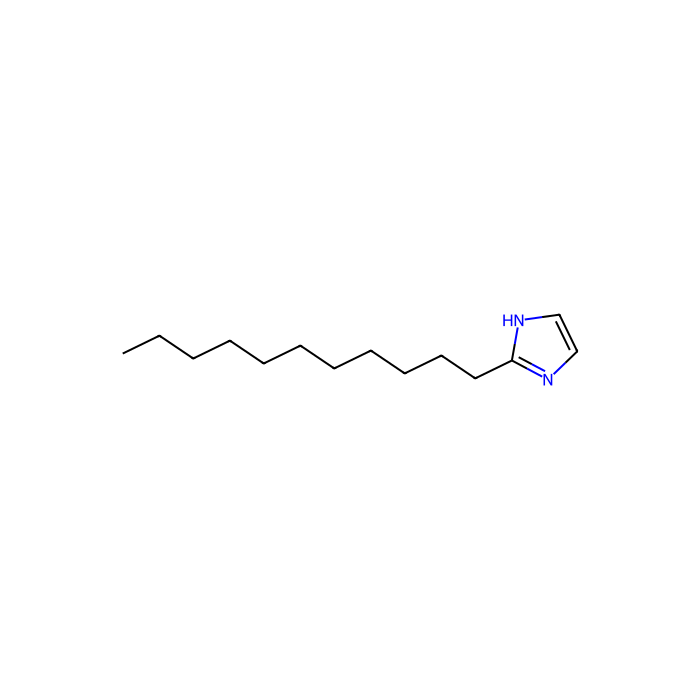
Overview: 2-Undecylimidazole is a long-chain alkylated imidazole in which an undecyl (C11) group is attached at the C2 position of the imidazole ring, imparting pronounced amphiphilicity and hydrophobic tail character.

  • CAS: 16731-68-3 (Product data)
  • PubChem CID: 85582 (Product data)
  • InChIKey: 202464 (as provided in Product Data; note: standard InChIKeys are typically 27 characters. Consult CoA/SDS for confirmation.)
  • SMILES: Not specified for this item; refer to CoA/Spec Sheet.
  • Molecular formula: C14H26N2 (literature/computed, based on a C11 chain at C2 of imidazole)
  • Molecular weight: ~222.38 g/mol (literature/computed)

Structural features (general description):

  • Heteroaromatic core: five-membered imidazole ring containing two nitrogens (one pyridine-like, one pyrrole-like).
  • Substitution pattern: linear n-undecyl substituent at the 2-position of the ring (sp2–sp3 bond).
  • Functional groups: aromatic imidazole (basic site at the ring imine N), long aliphatic hydrocarbon chain (lipophilic tail).
  • Stereochemistry: none (achiral).
  • 2D description: an imidazole ring (two adjacent nitrogens at positions 1 and 3) bearing a single straight C11 alkyl chain at C2; remaining ring carbons unsubstituted.
Synthetic Utility

Overview: The imidazole ring confers nucleophilicity and basicity, while the C11 chain tunes solubility and interfacial behavior. 2-Undecylimidazole is a versatile building block for surface-active materials and catalysts.

Key reactivity (literature/general):

  • N-Alkylation/acylation: the ring nitrogens can be alkylated (typically N1) with alkyl halides or sulfonates to give imidazolium salts; acylation with acid chlorides/anhydrides yields N-acylimidazoles (useful acyl-transfer agents).
  • Electrophile activation: imidazoles catalyze acyl-transfer and carbonate exchange via nucleophilic catalysis and general base mechanisms.
  • Metal coordination: acts as a neutral N-donor ligand; forms complexes used in catalysis or materials (e.g., Cu, Zn, Fe coordination for corrosion inhibition or catalytic studies).
  • Polymer chemistry: serves as an accelerator in epoxy curing; also participates in chain-transfer or activation pathways in ring-opening polymerizations (e.g., caprolactone, cyclic carbonates) under mild conditions.
  • Surface modification: coupling of a carboxyl- or isocyanate-terminated substrate with the imidazole (or via linkers) introduces basic, metal-binding sites with hydrophobic tails.

Retrosynthetic value:

  • Functions as a pre-installed hydrophobe on an imidazole, avoiding late-stage long-chain alkylations that can be low-yielding due to sterics or competing N/C alkylation on unsubstituted imidazoles.
Target Specificity

This section is generally applicable to biological macromolecules (e.g., antibodies, peptides). 2-Undecylimidazole is a small-molecule heterocycle and does not have target specificity data (antigens, clones, isotypes). No item-specific information is provided.

Shall we send you a message when we have discounts available?

Remind me later

Thank you! Please check your email inbox to confirm.

Oops! Notifications are disabled.