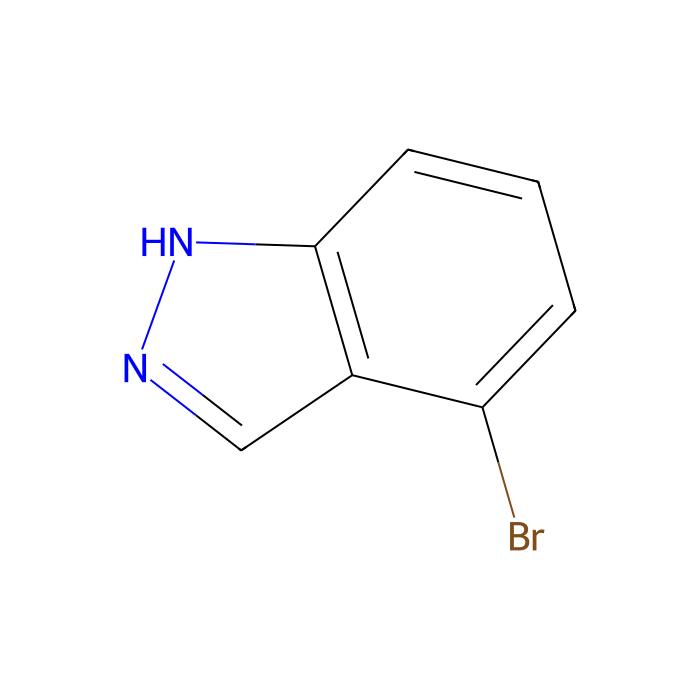
4-Bromoindazole - ≥97% , CAS No.186407-74-9

CAS: 186407-74-9 Cat. No.: B132684 Formula: C7H5BrN2 Molecular Weight: 197.03 EC Number: 803-241-7
AVAILABLE TO ORDER
GRADE & PURITY ≥97%
Synonyms
4-Bromoindazole|4-Methyl-N-[2-(4-morpholinyl)ethyl]-6-phenyl-3-pyridazinamine #|Ethane,1-dichloro-|4-bromo-1H-indazole|MINOXIDIL [MART.]|4-bromanyl-1H-indazole|4-bromo-2H-indazole|1H-Indazole, 4-bromo-|4-BROMO (1H)INDAZOLE|Ethyl2-(2-mercapto-4-methyl-1,3-thiazol-5-yl)acetate
Storage
Store at 2-8°C,Argon charged
Shipped In
Wet ice
★
Size
USA
Germany (EU)*
Price
Qty
1g
B132684-1g
3 In stock
—

$9.90

$14.90
Save $5.00 (33.56%)
5g
B132684-5g
2 In stock
—

$10.90

$16.90
Save $6.00 (35.50%)
10g
B132684-10g
Made to order · 8–12 wks

$18.90

$28.90
Save $10.00 (34.60%)
25g
B132684-25g
2 In stock
—

$38.90

$58.90
Save $20.00 (33.96%)
Enter a quantity for the sizes you want to add.

Specifications

Synonyms
4-Bromoindazole | 4-Methyl-N-[2-(4-morpholinyl)ethyl]-6-phenyl-3-pyridazinamine # | Ethane,1-dichloro- | 4-bromo-1H-indazole | MINOXIDIL [MART.] | 4-bromanyl-1H-indazole | 4-bromo-2H-indazole | 1H-Indazole, 4-bromo- | 4-BROMO (1H)INDAZOLE | Ethyl2-(2-mercapto-4-methyl-1,3-thiazol-5-yl)acetate
Specifications & Purity
≥97%
Storage
Store at 2-8°C,Argon charged
Shipped In
Wet ice
This product requires cold chain shipping. Ground and other economy services are not available.
Purity
≥97%
Names and Identifiers
Pubchem Sid
Pubchem Sid Url
https://pubchem.ncbi.nlm.nih.gov/substance/504769213
SMILES
C1=CC2=C(C=NN2)C(=C1)Br
IUPAC Name
4-bromo-1H-indazole
InChIKey
KJIODOACRIRBPB-UHFFFAOYSA-N
InChI
1S/C7H5BrN2/c8-6-2-1-3-7-5(6)4-9-10-7/h1-4H,(H,9,10)
Isomeric SMILES
C1=CC2=C(C=NN2)C(=C1)Br
WGK Germany
3
Molecular Weight
197.03
Reaxys
9757929
Reaxys-RN_link_address
https://www.reaxys.com/reaxys/secured/hopinto.do?context=S&query=IDE.XRN=9757929&ln=

Advanced Data

Taxonomic Classification

Taxonomy Tree

KingdomOrganic compounds
SuperclassOrganoheterocyclic compounds
ClassBenzopyrazoles
SubclassIndazoles
Intermediate Tree Nodes Not available
Direct ParentIndazoles
Alternative Parents Benzenoids  Aryl bromides  Pyrazoles  Heteroaromatic compounds  Azacyclic compounds  Organonitrogen compounds  Organobromides  Hydrocarbon derivatives  
Molecular FrameworkAromatic heteropolycyclic compounds
Substituents Indazole - Benzopyrazole - Benzenoid - Aryl halide - Aryl bromide - Heteroaromatic compound - Pyrazole - Azole - Azacycle - Organic nitrogen compound - Hydrocarbon derivative - Organonitrogen compound - Organobromide - Organohalogen compound - Aromatic heteropolycyclic compound
DescriptionThis compound belongs to the class of organic compounds known as indazoles. These are compounds containing an indazole, which is structurally characterized by a pyrazole fused to a benzene.
External Descriptors Not available
3D Structure
Interactive Chemical Structure Model


Associated Targets(Human)
NOS1 Tchem Nitric-oxide synthase, brain (1786 Activities)
Activity TypeRelationActivity valueUnitsAction TypeJournalPubMed IddoiAssay Aladdin ID
Associated Targets(non-human)
Mus musculus (284745 Activities)
Activity TypeRelationActivity valueUnitsAction TypeJournalPubMed IddoiAssay Aladdin ID
Mechanisms of Action
Certificates (CoA,COO,BSE/TSE and Analysis Chart)
C of A & Other Certificates(BSE/TSE, COO):
Analytical Chart:

Find and download the COA for your product by matching the lot number on the packaging.

3 results found

Lot NumberCertificate TypeDateItem
L2122210L2122210Certificate of AnalysisJul 09, 2025 B132684
L2122211L2122211Certificate of AnalysisJul 09, 2025 B132684
E1525018E1525018Certificate of AnalysisMar 05, 2025 B132684
Chemical and Physical Properties
SolubilitySoluble in Ethanol
Melt Point164-169°
Molecular Weight197.03
XLogP32.200
Hydrogen Bond Donor Count1
Hydrogen Bond Acceptor Count1
Rotatable Bond Count0
Exact Mass195.964 Da
Monoisotopic Mass195.964 Da
Topological Polar Surface Area28.700 Ų
Heavy Atom Count10
Formal Charge0
Complexity129.000
Isotope Atom Count0
Defined Atom Stereocenter Count0
Undefined Atom Stereocenter Count0
Defined Bond Stereocenter Count0
Undefined Bond Stereocenter Count0
The total count of all stereochemical bonds0
Covalently-Bonded Unit Count1
Safety and Hazards(GHS)
Pictogram(s)
GHS06,   GHS07
Signal
Danger
Hazard Statements

H301:Toxic if swallowed

H315:Causes skin irritation

H319:Causes serious eye irritation

H335:May cause respiratory irritation

Precautionary Statements

P261:Avoid breathing dust/fume/gas/mist/vapors/spray.

P264:Wash hands [and …] thoroughly after handling.

P270:Do not eat, drink or smoke when using this product.

P271:Use only outdoors or in a well-ventilated area.

P280:Wear protective gloves/protective clothing/eye protection/face protection.

P321:Specific treatment (see ... on this label).

P330:Rinse mouth.

P302+P352:IF ON SKIN: wash with plenty of water.

P304+P340:IF INHALED: Remove person to fresh air and keep comfortable for breathing.

P305+P351+P338:IF IN EYES: Rinse cautiously with water for several minutes. Remove contact lenses if present and easy to do - continue rinsing.

P362+P364:Take off contaminated clothing and wash it before reuse.

P405:Store locked up.

P403+P233:Store in a well-ventilated place. Keep container tightly closed.

P501:Dispose of contents/container to an approved waste disposal plant.

P264+P265:Wash hands [and …] thoroughly after handling. Do not touch eyes.

P301+P316:IF SWALLOWED: Get emergency medical help immediately.

P337+P317:If eye irritation persists: Get medical help.

P332+P317:If skin irritation occurs: Get medical help.

P319:Get medical help if you feel unwell.

WGK Germany
3
Reaxys
9757929
Reaxys-RN_link_address
https://www.reaxys.com/reaxys/secured/hopinto.do?context=S&query=IDE.XRN=9757929&ln=
Documents & Articles
Solution Calculators
Reviews

Customer Reviews

Application Protocols

No assay protocols (e.g., WB, IHC, IF, FC) apply to this small-molecule building block. For synthetic applications, see Reaction Conditions and Synthetic Utility for general procedural guidance. For any in-house methods, adapt standard cross-coupling or N-functionalization protocols to the specific substrate set, and consult primary literature.

Biological Roles

This product is supplied strictly for research use. No biological activity data are provided in the Product Data.

General context (literature, scaffold-level):

  • Indazole is a privileged heteroaromatic scaffold appearing in numerous research ligands and probes. The N–N annulated ring can participate in hydrogen bonding (donor/acceptor) and pi-stacking, supporting high target engagement across enzyme and receptor classes.
  • Halogenation at C4 modulates electronic density and lipophilicity, often enhancing interactions via halogen bonding or tuning metabolic stability in structure–activity relationship (SAR) studies.
  • 4-Substitution opens a vector orthogonal to N1 and C3 positions, enabling three-dimensional substitution patterns valuable in medicinal chemistry exploration (research only; no clinical claims).

Biotransformation considerations (general):

  • Aryl bromides can undergo oxidative dehalogenation or reductive debromination in biological systems; however, specific pathways and rates are highly structure- and species-dependent. No data are provided here for this compound.

Note: For any biological testing, ensure appropriate purity and counter-screens to exclude confounding reactivity. Consult the lot-specific CoA for purity and residual metals/solvents if biological assays are contemplated.

Buffer Applications

4-Bromoindazole is not a buffering agent and has no established role in preparing biochemical buffer systems. It lacks a defined conjugate acid/base pair in the physiological pH range suitable for buffering capacity.

Practical note: If used in biochemical assays, dissolve in appropriate organic cosolvents (e.g., DMSO) before dilution into aqueous buffer, ensuring final cosolvent percentages compatible with the assay. See Solvent Selection for guidance.

Green Alternatives

Greener strategies focus on solvent/catalyst/base selection and coupling partners rather than altering the indazole core.

Opportunities (literature, general):

  • Solvents:
    • Replace DMF/DMAc with 2-MeTHF, CPME, Me-GBL, or water/biobased cosolvents when compatible with the catalyst system.
    • Employ aqueous Suzuki couplings with phase-transfer or micellar media (e.g., TPGS-750-M) to reduce organic solvent use.
  • Catalysis:
    • Use ligand-enabled Pd at ppm levels or Ni catalysis to reduce precious metal loading.
    • Heterogeneous Pd/C or Pd on biobased supports may simplify recovery.
  • Bases:
    • Favor milder inorganic bases (K3PO4, K2CO3) or carbonate buffers in aqueous systems over strong alkoxides.
  • Energy:
    • Conduct reactions at ambient temperature using highly active catalysts or flow chemistry to reduce energy input.

Trade-offs:

  • While water or 2-MeTHF improves sustainability, solubility of 4-bromoindazole and partners may limit rate/conversion; micellar or co-solvent strategies can help.
  • Lower metal loadings often require carefully optimized ligands and rigorous exclusion of air/moisture.

Mini comparison (qualitative):

  • DMF/dioxane (classical): robust, broad scope; higher EHS burden.
  • 2-MeTHF/Me-GBL: renewable, lower toxicity; sometimes slower kinetics/solubility limits.
  • Micellar water: minimal VOCs; requires surfactants and adapted workup.

Always validate greener conditions on small scale to confirm performance and impurity profiles.

Pharmaceutical Uses

No pharmacopeial or excipient role is provided in the Product Data for this item. 4-Bromoindazole is best regarded as a synthetic intermediate/building block for research and development.

General (literature, non-clinical):

  • Indazole derivatives are frequently explored as components of small-molecule libraries in medicinal chemistry workflows. The aryl bromide at C4 serves as an efficient handle for late-stage diversification to tune properties such as lipophilicity, polarity, and vector geometry.
  • Process chemistry implications: aryl bromides often balance reactivity and stability during scale-up; however, selection of coupling partner and ligand/base system critically affects robustness and impurity profiles.

Compliance note: This product is for research use only and is not intended for human or veterinary use, nor for use in diagnostic or therapeutic applications.

Physical Properties

Item-specific numerical specifications are not provided in the Product Data.

  • Appearance: Not specified for this item; refer to CoA/Spec Sheet.
  • Melting point, boiling point, density, refractive index: Not specified for this item; refer to CoA/Spec Sheet.
  • Solubility (qualitative, literature):
    • Organics: typically soluble in polar aprotic solvents (DMSO, DMF, NMP) and moderately soluble in chlorinated solvents (DCM, CHCl3); limited solubility in nonpolar hydrocarbons; sparingly soluble in alcohols depending on temperature.
    • Water: generally very low solubility for neutral indazole aromatics.
  • Acid–base properties (literature, qualitative): indazoles exhibit tautomerism with a pyrrolic N–H and a pyridinic N; overall weakly acidic N–H (can be deprotonated with strong base) and weakly basic ring nitrogen (readily protonated in strong acids). Exact pKa values depend on substitution; consult primary literature for the 4-bromo isomer.
  • Partitioning (qualitative, literature): aryl bromination increases lipophilicity relative to unsubstituted indazole; expect moderate aromatic character with limited polarity.

Important:

  • Do not treat qualitative literature descriptors as specifications. For experimental design, verify actual solubility/phase behavior and any melting point for this lot via the CoA/Spec Sheet or small-scale trials.
Quality & Grades
  • Grade/Purity: Not specified for this item; refer to CoA/Spec Sheet.

Interpreting common grades (general guidance):

  • Research grade: suitable for synthetic chemistry, discovery, and method development. Impurity profiles typically compatible with reaction screening and library synthesis.
  • Purity reporting: for heteroaromatic building blocks, purity is commonly determined by HPLC/GC and supported by 1H NMR; residual solvent and water content may also be reported. When exact numerical limits are required (e.g., for medicinal chemistry or scale-up), consult the lot-specific CoA.
  • Stabilizers/inhibitors: none are indicated in the Product Data. Many indazoles are shipped neat; if any stabilizer is used, it will be listed on the CoA.

What is specific to this item:

  • Storage guidance is explicit: 2–8 °C and argon charged. This implies attention to minimizing oxidative or hydrolytic exposure and maintaining material quality across storage life.
  • Shipment on wet ice helps maintain a cool chain; upon receipt, equilibrate to room temperature in a desiccator before opening to limit moisture condensation, then return to recommended storage.

Documentation: For batch-specific assay, identity confirmation (NMR, HRMS), residual solvents, and any chromatographic purity thresholds, use the Aladdin CoA/Spec Sheet for SKU B132684.

Reaction & Applications

As an aryl bromide on a privileged indazole core, 4-bromoindazole is a versatile building block for rapid diversification of the indazole ring system.

Key transformations (literature):

  • Cross-coupling at C4:
    • Suzuki–Miyaura: coupling with boronic acids/esters to introduce aryl, heteroaryl, or vinyl groups at C4. Pd catalysts (e.g., Pd(PPh3)4, Pd2(dba)3/XPhos) with bases such as K2CO3, K3PO4 in dioxane/H2O or DMF.
    • Buchwald–Hartwig amination: installation of anilines or aliphatic amines at C4 using Pd/XPhos/BrettPhos-type ligands.
    • Sonogashira and Heck: access to alkynyl- and alkenyl-substituted indazoles.
  • Metal–halogen exchange:
    • Formation of 4-lithioindazole at low temperature (e.g., n-BuLi in THF) enabling electrophile trapping (formylation, acylation, stannylation, borylation).
  • Direct borylation:
    • Miyaura borylation (e.g., with B2pin2) to furnish 4-boro(indazolyl)pinacol esters for subsequent Suzuki couplings.
  • N-Functionalization:
    • Alkylation/acylation/sulfonylation at the indazole N–H providing additional substitution vectors orthogonal to C4 chemistry.

Practical tips:

  • Protecting group strategy: N1 of indazole may be protected (e.g., as N-alkyl, N-Boc, N-sulfonyl) to control regioselectivity or catalyst compatibility; deprotection after C4 functionalization is routine.
  • Catalyst/ligand choice: aryl bromide is a good balance of reactivity and stability; modern biaryl phosphines or NHCs promote high conversions under milder conditions.
  • Heteroarene effects: chelation or coordination by the indazole nitrogen can impact catalyst speciation; ligand and base selection mitigate this.

Applications:

  • Synthesis of kinase-inhibitor-like libraries and heteroaryl SAR exploration (research use only).
  • Construction of dyes, ligands, and materials motifs leveraging the indazole core.
Reaction Conditions

General literature guidance for common transformations of aryl bromides on indazole cores (optimize per substrate/catalyst; values are typical ranges, not specifications):

  • Suzuki–Miyaura cross-coupling:

    • Catalyst: 1–3 mol% Pd(PPh3)4 or 0.5–2 mol% Pd2(dba)3 with XPhos/SPhos.
    • Base: K3PO4, K2CO3, or Cs2CO3 (2–3 equiv).
    • Solvent: dioxane/H2O (3:1), DMF/H2O, or 2-MeTHF/H2O.
    • Temp/time: 60–100 °C, 2–16 h.
  • Buchwald–Hartwig amination:

    • Catalyst: 1–3 mol% Pd2(dba)3; ligands BrettPhos, RuPhos, XPhos (2–6 mol%).
    • Base: NaOtBu, Cs2CO3, or K3PO4 (2–3 equiv).
    • Solvent: toluene, dioxane, or tBuOH/PhMe mixtures.
    • Temp/time: 80–110 °C, 6–20 h.
  • Sonogashira coupling:

    • Catalyst: 1–2 mol% Pd(PPh3)2Cl2, 5–10 mol% CuI (or copper-free with bulky ligands).
    • Base: Et3N, iPr2NH, or K2CO3.
    • Solvent: DMF, THF, or Et3N.
    • Temp/time: rt–70 °C, 2–12 h.
  • Miyaura borylation:

    • Reagents: B2pin2 (1.2–1.5 equiv), 1–2 mol% Pd(dppf)Cl2•DCM.
    • Base: KOAc (2–3 equiv).
    • Solvent: dioxane.
    • Temp/time: 80–100 °C, 4–12 h.
  • Halogen–lithium exchange/electrophile trapping:

    • Base: n-BuLi or t-BuLi (1.1–1.3 equiv) at −78 to −40 °C in anhydrous THF.
    • Electrophiles: DMF (to aldehyde), CO2 (to acid), B(OMe)3 (to boronate), Me3SiCl, etc.

Notes:

  • Indazole N–H can coordinate or be deprotonated; N-protection or base selection often improves yield.
  • Rigorous dryness and degassing enhance catalytic efficiency.
  • Monitor by HPLC/LC–MS due to potential catalyst-derived UV background.
Safety & Handling

GHS and hazard classifications are not provided in the Product Data for this item. Always consult the SDS for authoritative guidance.

General laboratory safety for halogenated heteroarenes (good practice):

  • PPE: wear safety glasses, lab coat, and appropriate chemically resistant gloves (e.g., nitrile). Use in a fume hood to avoid dust or vapor exposure.
  • Inhalation/ingestion/skin contact: avoid generating dust; do not breathe dust; wash thoroughly after handling. If inhaled: move to fresh air. If on skin: wash with soap and water. If in eyes: rinse cautiously with water for several minutes. Seek medical attention as needed (per SDS).
  • Fire hazards: aromatic heterocycles are typically combustible solids; use CO2, dry chemical, or foam for small fires. Avoid water streams that may spread material.
  • Reactivity/incompatibilities (general): avoid strong oxidizers; strong bases can deprotonate the indazole N–H; organolithiums/Grignards may engage in halogen–metal exchange. Avoid prolonged exposure to strong acids/bases unless intended.
  • Special handling: Product Data specifies storage under argon and shipment on wet ice, suggesting a preference for an inert, cool environment. Minimize air/moisture exposure when transferring. Keep containers tightly closed.
  • Spill/cleanup: avoid raising dust. Sweep up with minimal disturbance; place in suitable container for disposal according to local regulations.

Disclaimer: The above are general precautions. For complete hazard statements, pictograms, first-aid, and disposal instructions, refer to the SDS for this exact catalog item.

Solvent Selection

4-Bromoindazole is a neutral, halogenated bicyclic heteroarene. Solvent choice is primarily driven by the intended transformation and its modest polarity.

  • Polarity class (qualitative): moderately aromatic, weakly polar; benefits from polar aprotic solvents for dissolution.
  • Typical miscibility/solubility (literature, qualitative):
    • Good: DMSO, DMF, NMP, DMAc.
    • Moderate: CH2Cl2, CHCl3, EtOAc, MeCN (warming may help).
    • Limited: toluene/xylene (can dissolve at reflux), alcohols (method-dependent).
    • Water: generally poor.

Selection by use case:

  • Cross-coupling (Suzuki, Buchwald–Hartwig): DMF, DMAc, dioxane, toluene, or mixed aqueous-organic (e.g., dioxane/H2O) depending on catalyst/base system.
  • Halogen–metal exchange/metalation: anhydrous THF or MTBE at low temperature; for directed lithiation of indazoles, strong bases (s-BuLi, LDA) in THF/Et2O are typical.
  • N-Functionalization (alkylation/acylation): DMF, acetonitrile, or acetone with a non-nucleophilic base.

Quick comparison (literature, qualitative):

  • DMSO/DMF: maximize solubility and rate; harder workups.
  • Dioxane/toluene: better for Pd catalysis/air stability; may require heating for solubility.
  • Aqueous-organic: advantageous for Suzuki with boronic acids; improves phase transfer.

Note: Verify actual solubility and compatibility with the chosen catalyst/base system on small scale before scale-up.

Storage & Reconstitution
  • Storage conditions (Product Data): Store at 2–8 °C, argon charged.
  • Shipping (Product Data): Shipped on wet ice.

Practical guidance:

  • Upon receipt, keep container closed until at ambient temperature to prevent condensation, then return to 2–8 °C storage under inert gas. If the original vial is argon-filled, maintain the headspace with inert gas after each use.
  • Moisture/air: Although aryl bromides and indazoles are typically stable solids, the provided guidance indicates preference for inert atmosphere. Minimize repeated exposure to air and humidity; consider storage in a desiccator or with molecular sieves.
  • Light: Store in the original amber container if provided to limit photochemical degradation.
  • Repackaging: If subdividing, purge secondary containers with argon or nitrogen and label with new opening date and lot ID.
  • Solution handling: Prepare stock solutions in dry, oxygen-free solvents (e.g., anhydrous DMSO, DMF, or THF) immediately before use. For longer-term solution storage, keep in sealed, inerted vials at low temperature; assess stability by LC–MS/NMR before critical experiments.

Stability/shelf life: Not specified for this item; refer to CoA/Spec Sheet.

Research use only: As stated in the Product Data, this material is for research use only.

Structure & Identity

4-Bromoindazole is a brominated benzo-fused 1,2-diazole (indazole) useful as a cross-coupling handle on an N–N fused bicyclic heteroarene.

  • SKU: B132684
  • Product name: 4-Bromoindazole
  • CAS: 186407-74-9
  • PubChem CID: 22352548
  • InChIKey (from Product Data): 181558
  • SMILES: Not specified for this item; refer to CoA/Spec Sheet.
  • Molecular formula: Not specified for this item; refer to CoA/Spec Sheet. (literature for 4-bromoindazole: C7H5BrN2)
  • Molecular weight: Not specified for this item; refer to CoA/Spec Sheet. (literature for C7H5BrN2: ~197.0 g/mol)

Structural features (general, literature):

  • Core scaffold: indazole (benzopyrazole), a bicyclic system consisting of a benzene ring fused to a pyrazole (1H-indazole).
  • Substitution: a bromine atom at the 4-position of the benzene ring of the indazole system, providing a robust aryl halide handle.
  • Functional groups: aromatic C–Br (aryl bromide), an annulated N–N heterocycle featuring one pyrrolic N–H (typically hydrogen-bond donor) and one pyridinic N (acceptor).
  • 2D description in words: a six-membered benzene ring fused to a five-membered N–N ring; the bromine resides on the benzene portion para to the fusion line along the long axis of the bicyclic system.

Notes:

  • Positional isomerism matters for reactivity (C4 vs C5 or C6 bromination). This item refers specifically to the 4-bromo isomer as named in the catalog.
Synthetic Utility

Functional elements enabling reactivity:

  • Aryl bromide at C4: amenable to Pd/Ni-catalyzed cross-coupling (Suzuki, Negishi, Stille, Kumada, Sonogashira, Heck), radical processes (e.g., photoredox debromination/defunctionalization), and halogen–metal exchange.
  • Indazole N–H: tunable reactivity via deprotonation (for N-alkylation/acylation) or protection (to improve cross-coupling selectivity); intramolecular H-bonding can influence regioselectivity.

Retrosynthetic value (literature):

  • Serves as a convergent node to access 4-substituted indazoles from a common bromide precursor, streamlining SAR.
  • Enables orthogonal diversification: sequence N1 functionalization and C4 cross-coupling in either order, selecting protecting groups compatible with catalysts (e.g., N-sulfonyl for stability under Pd).

Named reactions and tactics:

  • Suzuki–Miyaura to install aryl/heteroaryl groups.
  • Buchwald–Hartwig for diarylamine motifs.
  • Miyaura borylation to 4-BPin intermediate, then iterative coupling.
  • Lithium–halogen exchange to forge aldehydes/ketones via DMF or acid chlorides.
  • Photoredox-mediated Minisci-type or radical substitutions after bromide activation (via Ni/photoredox dual catalysis).

Scaffold elaboration examples (conceptual):

  • 4-(hetero)aryl indazoles for probe development.
  • 4-alkynyl indazoles as handles for click-derivatization after hydration/azide–alkyne cycloaddition.
Target Specificity

Not applicable to this chemical building block. No antigen/epitope, clone, isotype, or species reactivity information is relevant for 4-bromoindazole. This item is a small-molecule reagent, not a biological targeting reagent.

Frequently Asked Questions

What is the purity of this product?
This product is supplied at ≥97% purity (chemical assay). Lot-specific values are stated on the Certificate of Analysis.
How should this product be stored?
Store at 2–8 °C under argon. It is supplied under an argon blanket; reseal under inert gas after each use.
How is this product shipped?
This product ships chilled on wet ice. Unpack on arrival and transfer it to the storage condition stated above.
What are the CAS number, molecular formula and molecular weight?
The CAS Number is 186407-74-9, the molecular formula is C7H5BrN2, and the molecular weight is 197.03 g/mol. InChIKey KJIODOACRIRBPB-UHFFFAOYSA-N.
What documentation is provided?
Available product documentation, including Certificates of Analysis (COA), Safety Data Sheets (SDS), and specification sheets, is shown in the product document area. Document availability and access follow the current site policy.

Shall we send you a message when we have discounts available?

Remind me later

Thank you! Please check your email inbox to confirm.

Oops! Notifications are disabled.