
Determine the necessary mass, volume, or concentration for preparing a solution.
| Activity Type | Relation | Activity value | Units | Action Type | Journal | PubMed Id | doi | Assay Aladdin ID |
|---|
≥98% for sensitive chromatographic and analytical workflows requiring minimal baseline interference.
Protected from light,Store at -20°C,Argon charged Ships Ice chest + Ice pads Check lot-specific COA for exact specifications.
SDS, COA, datasheet, and spec sheet available for download. Lot-specific COA accessible via lot number lookup.
Cited in 0 peer-reviewed publications across chromatography, organic synthesis, and cross-coupling reactions.
Information
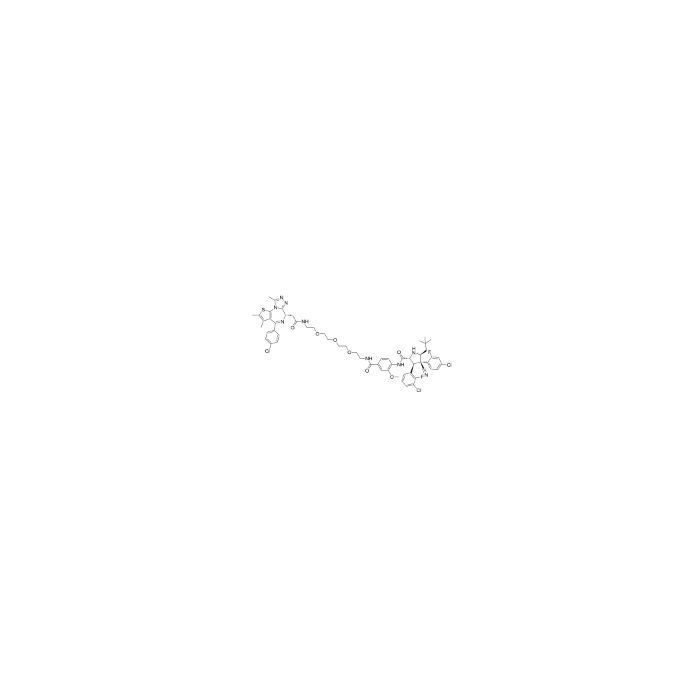
A1874 is a much improved nutlin-based, BRD4-degrading PROTAC and is able to degrade its target protein by 98% with nanomolar potency.
Targets
BRD4
In vitro
In HCT116 cells, A1874 causes a 97% decrease in viability and in A375 cells, A1874 causes a 98% loss of viability.A1874 reduced viability of Daudi cells by 70% and of MOLM-13 cells by 95%.
Cell Research(from reference)
Cell lines:HCT116 cell lines
Concentrations:0-10 μM
Incubation Time:24 h
Comprehensive hazard, handling, storage, and regulatory compliance document.
Download SDS →Lot-specific quality data. Enter your lot number to retrieve the exact COA.
Look up COA →Full quality attributes and acceptance criteria for this grade.
View spec sheet →Taxonomy Tree
| Kingdom | Organic compounds |
|---|---|
| Superclass | Phenylpropanoids and polyketides |
| Class | Stilbenes |
| Subclass | Not available |
| Intermediate Tree Nodes | Not available |
| Direct Parent | Stilbenes |
| Alternative Parents | Proline and derivatives Acylaminobenzoic acid and derivatives Alpha amino acid amides Phenylpyrrolidines Thienodiazepines Benzamides Methoxyanilines Anilides Pyrrolidinecarboxamides Phenoxy compounds Benzoyl derivatives Methoxybenzenes N-arylamides Anisoles 1,4-diazepines Fluorobenzenes Alkyl aryl ethers Chlorobenzenes Aralkylamines Aryl fluorides Aryl chlorides Pyrroles Triazoles Thiophenes Heteroaromatic compounds Secondary carboxylic acid amides Ketimines Dialkylamines Azacyclic compounds Propargyl-type 1,3-dipolar organic compounds Nitriles Dialkyl ethers Hydrocarbon derivatives Organic oxides Organochlorides Organofluorides Organopnictogen compounds Carbonyl compounds |
| Molecular Framework | Aromatic heteropolycyclic compounds |
| Substituents | Stilbene - Acylaminobenzoic acid or derivatives - Proline or derivatives - Alpha-amino acid amide - 3-phenylpyrrolidine - Thieno-para-diazepine - Alpha-amino acid or derivatives - Benzamide - Anilide - Methoxyaniline - Benzoic acid or derivatives - Pyrrolidine carboxylic acid or derivatives - Phenol ether - Pyrrolidine-2-carboxamide - Benzoyl - Methoxybenzene - Anisole - Phenoxy compound - N-arylamide - Aralkylamine - Chlorobenzene - Fluorobenzene - Halobenzene - Alkyl aryl ether - Para-diazepine - Aryl fluoride - Benzenoid - Monocyclic benzene moiety - Aryl halide - Aryl chloride - Heteroaromatic compound - 1,2,4-triazole - Azole - Thiophene - Pyrrolidine - Pyrrole - Ketimine - Amino acid or derivatives - Carboxamide group - Secondary carboxylic acid amide - Nitrile - Carbonitrile - Propargyl-type 1,3-dipolar organic compound - Organic 1,3-dipolar compound - Ether - Secondary aliphatic amine - Dialkyl ether - Azacycle - Secondary amine - Carboxylic acid derivative - Organoheterocyclic compound - Organic nitrogen compound - Carbonyl group - Imine - Organohalogen compound - Organochloride - Organofluoride - Organonitrogen compound - Organooxygen compound - Hydrocarbon derivative - Amine - Organic oxide - Organopnictogen compound - Organic oxygen compound - Aromatic heteropolycyclic compound |
| Description | This compound belongs to the class of organic compounds known as stilbenes. These are organic compounds containing a 1,2-diphenylethylene moiety. Stilbenes (C6-C2-C6 ) are derived from the common phenylpropene (C6-C3) skeleton building block. The introduction of one or more hydroxyl groups to a phenyl ring lead to stilbenoids. |
| External Descriptors | Not available |
| Activity Type | Relation | Activity value | Units | Action Type | Journal | PubMed Id | doi | Assay Aladdin ID |
|---|
| Activity Type | Relation | Activity value | Units | Action Type | Journal | PubMed Id | doi | Assay Aladdin ID |
|---|
| Activity Type | Relation | Activity value | Units | Action Type | Journal | PubMed Id | doi | Assay Aladdin ID |
|---|
Find and download the COA for your product by matching the lot number on the packaging.
| Lot Number | Certificate Type | Date | Item |
|---|---|---|---|
 B2302037 | Certificate of Analysis | Dec 29, 2023 | A414180 |
| B2402035 | Certificate of Analysis | Dec 29, 2023 | A414180 |
| B2402036 | Certificate of Analysis | Dec 29, 2023 | A414180 |
| B2402038 | Certificate of Analysis | Dec 29, 2023 | A414180 |
| B2402039 | Certificate of Analysis | Dec 29, 2023 | A414180 |
| B2402040 | Certificate of Analysis | Dec 29, 2023 | A414180 |
| B2402041 | Certificate of Analysis | Dec 29, 2023 | A414180 |
| B2402042 | Certificate of Analysis | Dec 29, 2023 | A414180 |
| Solubility | Solubility (25°C) In vitro DMSO: 100 mg/mL (85.2 mM); Ethanol: 100 mg/mL (85.2 mM); Water: Insoluble; |
|---|---|
| Sensitivity | light sensitive |
| Molecular Weight | 1173.600 g/mol |
| XLogP3 | 8.900 |
| Hydrogen Bond Donor Count | 4 |
| Hydrogen Bond Acceptor Count | 15 |
| Rotatable Bond Count | 23 |
| Exact Mass | 1171.35 Da |
| Monoisotopic Mass | 1171.35 Da |
| Topological Polar Surface Area | 231.000 Ų |
| Heavy Atom Count | 80 |
| Formal Charge | 0 |
| Complexity | 2140.000 |
| Isotope Atom Count | 0 |
| Defined Atom Stereocenter Count | 5 |
| Undefined Atom Stereocenter Count | 0 |
| Defined Bond Stereocenter Count | 0 |
| Undefined Bond Stereocenter Count | 0 |
| The total count of all stereochemical bonds | 0 |
| Covalently-Bonded Unit Count | 1 |