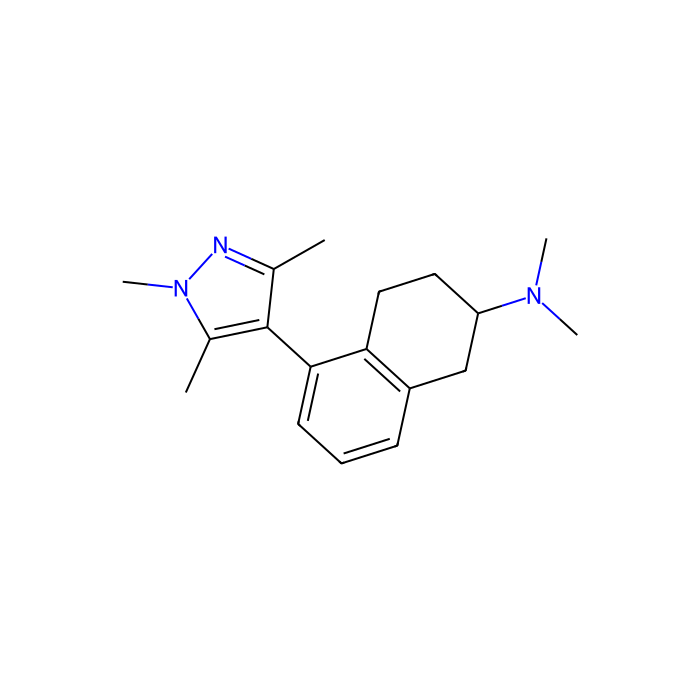
AS 19 - Moligand™, ≥98%(HPLC) , Agonist of 5-HT 7 receptor, CAS No.1000578-26-6, Agonist of 5-HT 7 receptor

CAS: 1000578-26-6 Cat. No.: A286601 Formula: C18H25N3 Molecular Weight: 283.41
AVAILABLE TO ORDER
GRADE & PURITY Moligand™ ? Moligand™ — Aladdin's line of ligands and bioactive small molecules. Use for receptor, pathway, and binding studies needing defined small-molecule tools. ≥98%(HPLC)
Synonyms
(2S)-N,N-dimethyl-5-(1,3,5-trimethyl-1H-pyrazol-4-yl)-1,2,3,4-tetrahydronaphthalen-2-amine | (2S)-(+)-5-(1,3,5-TRIMETHYLPYRAZOL-4-YL)-2-(DIMETHYLAMINO)TETRALIN | LA5AQ5R6QS | CHEMBL2164327
Storage
Store at -20°C,Desiccated
Shipped In
Ice chest + Ice pads
★
Size
USA
Germany (EU)*
Price
Qty
1mg
A286601-1mg
Made to order · 8–12 wks
$119.90
5mg
A286601-5mg
Made to order · 8–12 wks
$379.90
10mg
A286601-10mg
Made to order · 8–12 wks
$459.90
50mg
A286601-50mg
Made to order · 8–12 wks
$1,804.90
100mg
A286601-100mg
Made to order · 8–12 wks
$3,573.90
Enter a quantity for the sizes you want to add.
🧪

Why this grade

Moligand™, ≥98%(HPLC) Moligand™ for sensitive chromatographic and analytical workflows requiring minimal baseline interference.

🌡

Storage & shipping

Store at -20°C,Desiccated Ships Ice chest + Ice pads Check lot-specific COA for exact specifications.

📋

Quality documents

SDS, COA, datasheet, and spec sheet available for download. Lot-specific COA accessible via lot number lookup.

📚

Literature proof

Cited in 0 peer-reviewed publications across chromatography, organic synthesis, and cross-coupling reactions.

Specifications

Synonyms
(2S)-N,N-dimethyl-5-(1,3,5-trimethyl-1H-pyrazol-4-yl)-1,2,3,4-tetrahydronaphthalen-2-amine | (2S)-(+)-5-(1,3,5-TRIMETHYLPYRAZOL-4-YL)-2-(DIMETHYLAMINO)TETRALIN | LA5AQ5R6QS | CHEMBL2164327
Specifications & Purity
Moligand™, ≥98%(HPLC)
Storage
Store at -20°C,Desiccated
Shipped In
Ice chest + Ice pads
This product requires cold chain shipping. Ground and other economy services are not available.
Grade
Moligand™
Action Type
AGONIST
Mechanism of action
Agonist of 5-HT 7 receptor
Purity
≥98%(HPLC)
Names and Identifiers
Canonical SmilesCC1=C(C(=NN1C)C)C2=CC=CC3=C2CCC(C3)N(C)C
IUPAC Name(2S)-N,N-dimethyl-5-(1,3,5-trimethylpyrazol-4-yl)-1,2,3,4-tetrahydronaphthalen-2-amine
InChIKeyBTTOYOKCLDAHHO-HNNXBMFYSA-N
INCHI1S/C18H25N3/c1-12-18(13(2)21(5)19-12)17-8-6-7-14-11-15(20(3)4)9-10-16(14)17/h6-8,15H,9-11H2,1-5H3/t15-/m0/s1
Isomeric SMILES CC1=C(C(=NN1C)C)C2=CC=CC3=C2CC[C@@H](C3)N(C)C
Alternate CAS 1000578-26-6
Molecular Weight 283.41
Reaxy-Rn 18470646
Reaxys-RN_link_address https://www.reaxys.com/reaxys/secured/hopinto.do?context=S&query=IDE.XRN=18470646&ln=

Documentation

📋 Safety Data Sheet (SDS)

Comprehensive hazard, handling, storage, and regulatory compliance document.

Download SDS →

✅ Certificate of Analysis (COA)

Lot-specific quality data. Enter your lot number to retrieve the exact COA.

Look up COA →

📊 Datasheet

Quick-reference summary of product specifications and applications.

View datasheet →

🔬 Specification Sheet

Full quality attributes and acceptance criteria for this grade.

View spec sheet →

Advanced Data

Taxonomic Classification

Taxonomy Tree

KingdomOrganic compounds
SuperclassBenzenoids
ClassTetralins
SubclassNot available
Intermediate Tree Nodes Not available
Direct ParentTetralins
Alternative Parents Aralkylamines  Pyrazoles  Heteroaromatic compounds  Trialkylamines  Azacyclic compounds  Hydrocarbon derivatives  
Molecular FrameworkAromatic heteropolycyclic compounds
Substituents Tetralin - Aralkylamine - Heteroaromatic compound - Pyrazole - Azole - Tertiary aliphatic amine - Tertiary amine - Azacycle - Organoheterocyclic compound - Organic nitrogen compound - Hydrocarbon derivative - Organonitrogen compound - Amine - Aromatic heteropolycyclic compound
DescriptionThis compound belongs to the class of organic compounds known as tetralins. These are polycyclic aromatic compounds containing a tetralin moiety, which consists of a benzene fused to a cyclohexane.
External Descriptors Not available
3D Structure
Interactive Chemical Structure Model


Associated Targets(Human)
HTR5A Tchem 5-hydroxytryptamine receptor 5A (1 Activities)
Activity TypeActivity Value -log(M)Mechanism of ActionActivity ReferencePublications (PubMed IDs)
HTR7 Tclin 5-hydroxytryptamine receptor 7 (6 Activities)
Activity TypeActivity Value -log(M)Mechanism of ActionActivity ReferencePublications (PubMed IDs)
HTR1A Tclin 5-hydroxytryptamine receptor 1A (2 Activities)
Activity TypeActivity Value -log(M)Mechanism of ActionActivity ReferencePublications (PubMed IDs)
ABL1 Tclin Tyrosine-protein kinase ABL (18331 Activities)
Activity TypeRelationActivity valueUnitsAction TypeJournalPubMed IddoiAssay Aladdin ID
ADRB2 Tclin Beta-2 adrenergic receptor (11824 Activities)
Activity TypeRelationActivity valueUnitsAction TypeJournalPubMed IddoiAssay Aladdin ID
HTR1A Tclin Serotonin 1a (5-HT1a) receptor (14969 Activities)
Activity TypeRelationActivity valueUnitsAction TypeJournalPubMed IddoiAssay Aladdin ID
ADRA2A Tclin Alpha-2a adrenergic receptor (9450 Activities)
Activity TypeRelationActivity valueUnitsAction TypeJournalPubMed IddoiAssay Aladdin ID
HTR2A Tclin Serotonin 2a (5-HT2a) receptor (14758 Activities)
Activity TypeRelationActivity valueUnitsAction TypeJournalPubMed IddoiAssay Aladdin ID
AGTR1 Tclin Type-1 angiotensin II receptor (5176 Activities)
Activity TypeRelationActivity valueUnitsAction TypeJournalPubMed IddoiAssay Aladdin ID
GSK3B Tclin Glycogen synthase kinase-3 beta (11785 Activities)
Activity TypeRelationActivity valueUnitsAction TypeJournalPubMed IddoiAssay Aladdin ID
CSNK1D Tchem Casein kinase I delta (4546 Activities)
Activity TypeRelationActivity valueUnitsAction TypeJournalPubMed IddoiAssay Aladdin ID
HTR5A Tchem Serotonin 5a (5-HT5a) receptor (1433 Activities)
Activity TypeRelationActivity valueUnitsAction TypeJournalPubMed IddoiAssay Aladdin ID
HTR6 Tchem Serotonin 6 (5-HT6) receptor (9749 Activities)
Activity TypeRelationActivity valueUnitsAction TypeJournalPubMed IddoiAssay Aladdin ID
S1PR1 Tclin Sphingosine 1-phosphate receptor Edg-1 (5806 Activities)
Activity TypeRelationActivity valueUnitsAction TypeJournalPubMed IddoiAssay Aladdin ID
CDK2 Tchem Cyclin-dependent kinase 2 (9050 Activities)
Activity TypeRelationActivity valueUnitsAction TypeJournalPubMed IddoiAssay Aladdin ID
GLP1R Tclin Glucagon-like peptide 1 receptor (111429 Activities)
Activity TypeRelationActivity valueUnitsAction TypeJournalPubMed IddoiAssay Aladdin ID
C5AR1 Tclin C5a anaphylatoxin chemotactic receptor (2677 Activities)
Activity TypeRelationActivity valueUnitsAction TypeJournalPubMed IddoiAssay Aladdin ID
AURKA Tchem Serine/threonine-protein kinase Aurora-A (10240 Activities)
Activity TypeRelationActivity valueUnitsAction TypeJournalPubMed IddoiAssay Aladdin ID
U2OS (164939 Activities)
Activity TypeRelationActivity valueUnitsAction TypeJournalPubMed IddoiAssay Aladdin ID
CX3CR1 Tchem C-X3-C chemokine receptor 1 (1686 Activities)
Activity TypeRelationActivity valueUnitsAction TypeJournalPubMed IddoiAssay Aladdin ID
FPR2 Tchem Lipoxin A4 receptor (3472 Activities)
Activity TypeRelationActivity valueUnitsAction TypeJournalPubMed IddoiAssay Aladdin ID
FFAR4 Tchem G-protein coupled receptor 120 (2999 Activities)
Activity TypeRelationActivity valueUnitsAction TypeJournalPubMed IddoiAssay Aladdin ID
BRD4 Tchem Bromodomain-containing protein 4 (13122 Activities)
Activity TypeRelationActivity valueUnitsAction TypeJournalPubMed IddoiAssay Aladdin ID
GPR35 Tchem G-protein coupled receptor 35 (2643 Activities)
Activity TypeRelationActivity valueUnitsAction TypeJournalPubMed IddoiAssay Aladdin ID
TRIM24 Tchem Transcription intermediary factor 1-alpha (2087 Activities)
Activity TypeRelationActivity valueUnitsAction TypeJournalPubMed IddoiAssay Aladdin ID
BRPF1 Tchem Peregrin (2217 Activities)
Activity TypeRelationActivity valueUnitsAction TypeJournalPubMed IddoiAssay Aladdin ID
HEK-293T (167025 Activities)
Activity TypeRelationActivity valueUnitsAction TypeJournalPubMed IddoiAssay Aladdin ID
Associated Targets(non-human)
Htr7 Serotonin 7 (5-HT7) receptor (19 Activities)
Activity TypeRelationActivity valueUnitsAction TypeJournalPubMed IddoiAssay Aladdin ID
Aplnr Apelin receptor (201 Activities)
Activity TypeRelationActivity valueUnitsAction TypeJournalPubMed IddoiAssay Aladdin ID
Mapk1 MAP kinase ERK2 (650 Activities)
Activity TypeRelationActivity valueUnitsAction TypeJournalPubMed IddoiAssay Aladdin ID
Fgfr3 Fibroblast growth factor receptor 3 (21 Activities)
Activity TypeRelationActivity valueUnitsAction TypeJournalPubMed IddoiAssay Aladdin ID
Gpr119 Glucose-dependent insulinotropic receptor (270 Activities)
Activity TypeRelationActivity valueUnitsAction TypeJournalPubMed IddoiAssay Aladdin ID
Mechanisms of Action
Certificates(CoA,COO,BSE/TSE and Analysis Chart)
C of A & Other Certificates(BSE/TSE, COO):
Analytical Chart:
Chemical and Physical Properties
SolubilitySolvent:ethanol, Max Conc. mg/mL: 28.34, Max Conc. mM: 100; Solvent:DMSO, Max Conc. mg/mL: 28.34, Max Conc. mM: 100
Molecular Weight283.400 g/mol
XLogP33.400
Hydrogen Bond Donor Count0
Hydrogen Bond Acceptor Count2
Rotatable Bond Count2
Exact Mass283.205 Da
Monoisotopic Mass283.205 Da
Topological Polar Surface Area21.100 Ų
Heavy Atom Count21
Formal Charge0
Complexity356.000
Isotope Atom Count0
Defined Atom Stereocenter Count1
Undefined Atom Stereocenter Count0
Defined Bond Stereocenter Count0
Undefined Bond Stereocenter Count0
The total count of all stereochemical bonds0
Covalently-Bonded Unit Count1
Solution Calculators
Reviews

Customer Reviews

Application Protocols

Validated protocols (e.g., WB, IHC, IF, FC) are not applicable to small molecules and none are provided for this item.

General handling protocol for small-molecule screening stocks (not item-specific):

  • Allow vial to equilibrate to room temperature in a desiccator before opening to prevent moisture condensation.
  • Prepare a concentrated DMSO stock (e.g., 10–50 mM) using analytical balance and Class A volumetrics. Mix until clear; brief sonication may assist dissolution.
  • Aliquot into low-binding, amber vials or 96/384-well plates; seal tightly to minimize evaporation and moisture ingress.
  • For assays, dilute into buffer/media to the desired final concentration while keeping vehicle ≤0.5–1% v/v, unless otherwise validated.
  • Record batch, concentration, solvent, preparation date, and observed stability/precipitation. Discard if color change, precipitate, or LC–MS instability is detected.

For any item-specific instructions, consult the CoA/Spec Sheet supplied with your shipment.

Biological Roles

This listing does not disclose a biological target, pathway, or functional role for AS 19. Compound-specific mechanistic information should be obtained from the CoA/Spec Sheet or primary literature if available.

General guidance for small-molecule tools (non-clinical):

  • In discovery settings, small molecules may act as ligands, inhibitors, activators, or modulators across enzymatic and receptor targets. Definitive roles require validated assay data and orthogonal confirmation.
  • For any putative activity, perform concentration–response profiling across relevant assays, include vehicle controls, and assess selectivity versus potential off-targets.
  • Evaluate chemical stability in assay buffers and biological matrices (plasma, microsomes) to distinguish intrinsic potency from degradation or adsorption effects.
  • Use counter-screens (fluorescence quenching, aggregation controls with detergent, redox interference tests) to rule out assay artifacts.

Research Use Only: no medical, diagnostic, or veterinary applications are implied. For item-specific biological role or target information, consult the supplier documentation.

Buffer Applications

AS 19 is not a buffer reagent. However, preparation of assay-compatible buffers is often necessary for handling small-molecule stocks.

General buffer guidance (not item-specific):

  • Use PBS (pH 7.2–7.4) or HEPES (pH 7.2–7.6) as common assay media; maintain ionic strength to minimize nonspecific binding.
  • When delivering from DMSO stocks, limit final organic content to ≤0.5–1% v/v unless assay tolerance is established.
  • To mitigate precipitation, consider adding 0.01–0.05% non-ionic surfactant (e.g., Tween 80 or Pluronic F-68) after confirming no assay interference.
  • Filter buffers with 0.2 µm membranes to remove particulates; equilibrate buffers and compound solutions to the same temperature before mixing.

If binding or enzymatic assays are used, include protein (e.g., 0.1% BSA) to reduce surface adsorption where appropriate. These recommendations are general and should be tailored to your specific assay conditions.

Green Alternatives

Greener handling focuses on solvent choices during stock preparation and assay dilution, since compound identity-specific greener routes are not disclosed.

Comparison of common stock solvents (general considerations):

  • DMSO: High solvency, excellent for screening; moderate biodegradability concerns; widely accepted by assays at ≤1% v/v.
  • Ethanol/Isopropanol: Bio-based availability possible; lower toxicity profile than many polar aprotic solvents; flammable; solubility may be limited for highly lipophilic molecules.
  • PEG 400 or Propylene glycol: Low volatility and favorable safety profile; viscosity can complicate precise dispensing.
  • 2-Methyltetrahydrofuran (2-MeTHF) or CPME: Greener ethers for non-aqueous workups; applicability depends on compound solubility and stability; less typical for biological assay stocks.

Practical steps:

  • Prefer EtOH/IPA as first-line co-solvents when compatible with your assay and sufficient for solubility.
  • Minimize solvent volumes and implement microscale plate-based solubility tests to reduce waste.
  • Use closed, low-evaporation labware to limit VOC emissions.

Note: This guidance is general and not item-specific. Confirm compatibility with your assay system and institutional green-chemistry policies.

Pharmaceutical Uses

No pharmacopeial status or excipient use is provided for this item, and it is supplied strictly for research use only.

General, non-clinical context for small molecules:

  • May serve as a reference or system suitability standard in preclinical analytical method development (e.g., LC–MS method qualification) when structure and purity are documented.
  • Can be used to support in vitro screening and early discovery programs (e.g., SAR exploration) with appropriate documentation and QC.

No therapeutic, diagnostic, or clinical claims are made or implied for AS 19. If your workflow requires compliance with specific pharmacopeial monographs or GMP, request documentation or consider sourcing a compendial-grade material where applicable.

Physical Properties

Item-specific physicochemical data are not disclosed in this listing.

  • Appearance: Not specified for this item; refer to CoA/Spec Sheet.
  • Melting/Boiling Point: Not specified for this item; refer to CoA/Spec Sheet.
  • Density/Refractive Index: Not specified for this item; refer to CoA/Spec Sheet.
  • Solubility: Not specified for this item; refer to CoA/Spec Sheet.
  • LogP/pKa: Not specified for this item; refer to CoA/Spec Sheet.

General laboratory guidance (literature/practice, not item-specific):

  • For unknown small molecules in screening libraries, initial stock preparation commonly uses anhydrous DMSO (10–50 mM) due to broad solubilizing power and assay-compatibility at ≤0.5–1% v/v final.
  • If DMSO is undesirable, evaluate DMF, ethanol (EtOH), or isopropanol (IPA), then dilute into aqueous buffers containing surfactant (e.g., 0.01–0.05% Tween 80) to minimize precipitation. Validate compatibility with your biological assay.
  • Establish the kinetics of dissolution by mild vortex, brief sonication, and incremental solvent addition (do not heat unless stability is known). Filter through 0.2 µm PTFE or PVDF if particulate persists and the compound is filter-stable.
  • Record precise stock concentration, solvent lot, and observed stability/precipitation over time to build a reliability profile for this item.

Always defer to the CoA/SDS for authoritative property data once available.

Quality & Grades

This product is offered as Moligand™ grade, intended for discovery, screening, and medicinal chemistry workflows.

What Moligand-grade typically signifies (general guidance; check CoA for this lot):

  • Emphasis on identity verification (e.g., by NMR/LC–MS/MS or HRMS) to support reproducible screening data.
  • Purity is optimized for research applications; exact assay purity, residual solvent/water, and inorganic residue limits are CoA-specific. If numerical specifications are required, request the CoA/Spec Sheet.
  • Packaging designed to reduce adventitious moisture and contamination, suitable for DMSO stock preparation and automated screening.

Item-specific notes:

  • Grade/Purity: Moligand™ (no additional numeric purity disclosed here).
  • Stabilizers/Inhibitors: Not specified for this item; refer to CoA/Spec Sheet.

Best practices for quality-sensitive work:

  • Upon receipt, record lot number and retain a copy of the CoA.
  • If results are highly purity-dependent (e.g., SAR or lead optimization), consider an incoming QC check (LC at multiple wavelengths, qNMR) on your side.
  • For analytical reference use, confirm mass balance (assay + water + residual solvents + inorganic) where applicable.
Reaction & Applications

No specific synthetic or preparative reaction roles are listed for AS 19 in this catalog entry. As a Moligand™ small-molecule library member, typical uses center on chemical biology and discovery research rather than as a reagent.

Common research applications (general guidance):

  • Use as a test article in target-based or phenotypic assays; prepare controlled DMSO stocks and perform dose–response curves with appropriate vehicle controls.
  • Employ as a reference or comparator compound in screening cascades to benchmark assay performance (Z′, signal window) and to validate inter-plate reproducibility.
  • Analytical support: develop LC–MS methods to track stability, degradation, and carryover in screening plates; verify identity in working solutions if long study durations are expected.

If used in synthesis (contingent on structure, not item-specific):

  • Without disclosed functional groups, no named reaction recommendations can be made. If you intend derivatization or immobilization, obtain the full structure and evaluate reactive handles (e.g., amines, acids, halides) to select suitable coupling chemistries.

Please refer to the CoA/Spec Sheet for any manufacturer-provided application notes specific to this SKU.

Reaction Conditions

No item-specific reaction conditions are provided, and this product is not listed as a reagent. Therefore, no standard synthetic protocols can be recommended without structural disclosure.

General guidance (if derivatization is planned after structure is confirmed):

  • Choose solvents based on solubility screen results (e.g., DMF, DCM, MeCN, toluene) and moisture sensitivity of the transformation.
  • Maintain anhydrous conditions for air/moisture-sensitive couplings; validate stability by TLC/LC–MS before scale-up.
  • Use mild temperatures initially (rt to 40 °C) and escalate cautiously while monitoring for decomposition.
  • Employ in-process controls (LC–MS at multiple time points) to track conversion, identify side-products, and guide workup.

These are literature-based best practices and not specific to AS 19. Obtain structural data before planning any chemistry.

Safety & Handling

Hazard classification for this specific item is not provided in the listing.

  • Signal Word / GHS / Pictograms: Not specified for this item; refer to SDS.
  • H-Statements: Not specified for this item; refer to SDS.

General laboratory precautions (good practice, not item-specific):

  • Handle in a fume hood or well-ventilated area. Avoid inhalation of dust/aerosols and skin/eye contact.
  • Wear appropriate PPE: lab coat, safety glasses, and chemically resistant gloves (e.g., nitrile). Consider double-gloving for DMSO-based solutions due to enhanced dermal transport of solutes.
  • Avoid mixing with strong oxidizers, strong acids/bases, or reactive metals unless compatibility is known.
  • For solids: minimize dust generation; use antistatic measures if powders are free-flowing.
  • First aid (overview; consult SDS):
    • Skin: Wash with soap and water; remove contaminated clothing.
    • Eyes: Rinse cautiously with water for several minutes; remove contact lenses if present and easy.
    • Inhalation: Move to fresh air; seek medical attention if symptoms occur.
    • Ingestion: Rinse mouth; do not induce vomiting unless directed by medical personnel.
  • Spill response: Cover with inert absorbent (vermiculite) for liquids or dampen powders to avoid dust; collect for disposal in accordance with institutional and local regulations.

Always consult the SDS for authoritative, item-specific guidance.

Solvent Selection

Compound-specific solvent preferences are not disclosed for AS 19; use a tiered solubility screening strategy suitable for small molecules.

Recommended workflow (general practice):

  • Primary solvent: Anhydrous DMSO for initial stock (e.g., 10–50 mM). Verify clarity and absence of particulates.
  • Secondary options: DMF, NMP, ethanol, or isopropanol if DMSO is restricted. Assess assay and materials compatibility.
  • Aqueous delivery: Dilute organic stocks into buffered saline (e.g., PBS or HEPES-based buffers) while maintaining final organic content typically ≤0.5–1% v/v. Add dropwise with constant mixing to prevent local supersaturation.
  • Surfactants/co-solvents: For poorly soluble entities, include 0.01–0.05% Tween 80 or 0.1–1% PEG 400 in the receiving buffer after verifying no assay interference.

Practical tips:

  • Perform a small-scale solubility panel (DMSO, DMF, EtOH, IPA, MeCN, 1:1 solvent/water) and document mg/mL limits at room temperature.
  • If crystallization occurs upon dilution, consider pre-warming the buffer (if compound stability allows) and slower addition rates, or increase the dilution factor.
  • Use amber vials for light-sensitive compounds and minimize freeze–thaw of concentrated stocks to avoid precipitation.

Always consult the CoA/SDS for any item-specific incompatibilities or stability notes.

Storage & Reconstitution

Item-specific conditions (from Product Data):

  • Storage: Store at -20 °C, desiccated.
  • Shipped: In ice chest + ice pads.

General guidance for small-molecule solids/solutions (not item-specific):

  • Upon receipt, keep sealed until at ambient temperature to prevent condensation, then transfer promptly to -20 °C desiccated storage.
  • If supplied as a solid, prepare concentrated stock (commonly in anhydrous DMSO) and aliquot to minimize freeze–thaw cycles. If supplied in solution, verify solvent and concentration on the label/CoA and store accordingly.
  • Protect from light if chromophoric or light-sensitive functional groups are suspected; use amber vials/foil wrap.
  • For reconstitution, start with a small solvent volume, mix thoroughly, and stepwise increase until fully dissolved. Avoid heating unless stability is confirmed.
  • Document the final concentration, solvent, and date. For long-term storage of solutions, consider -20 °C or -80 °C in sealed containers with inert headspace when compatible.

Always defer to the CoA and SDS for definitive, lot-specific instructions on stability, reconstitution solvent, and shelf life.

Structure & Identity

Concise identity overview for a Moligand small-molecule library member.

  • Product Name: AS 19 (SKU: A286601)
  • CAS: 1000578-26-6
  • PubChem CID: 23642275
  • InChIKey: 34119 (as provided)
  • SMILES: Not specified for this item; refer to CoA/Spec Sheet.
  • Molecular Formula: Not specified for this item; refer to CoA/Spec Sheet.
  • Molecular Weight: Not specified for this item; refer to CoA/Spec Sheet.

Structural features (general note):

  • Specific ring systems, heteroatoms, stereocenters, and functional groups are not disclosed in this listing. For precise structural depiction (2D/3D), please consult the item’s CoA/Spec Sheet or the SDS where available.

How to reference in your records:

  • Use the CAS number as the primary registry identifier and cross-reference the SKU for procurement traceability. If you maintain screening databases, append the PubChem CID field when you obtain the full structure from the CoA.
Synthetic Utility

This product is presented as a Moligand™ small-molecule library member and is not described as a synthetic reagent or building block in this listing.

General notes (contingent on structure; not item-specific):

  • If structural information reveals derivatizable handles (e.g., amine, carboxyl, halogen), common transformations include amide coupling, Suzuki/Negishi couplings, reductive amination, or N-alkylation/acylation to generate analogs for SAR.
  • For linker installation (e.g., biotinylation, photoaffinity probes), validate functional group compatibility and preserve the hypothesized pharmacophore.
  • Prior to any modification, secure the full structure, stereochemistry, and protecting group status from the CoA/Spec Sheet and verify purity and stability under planned reaction conditions.

If you intend to use AS 19 as a building block, please obtain item-specific structural data and plan routes accordingly.

Target Specificity

No target specificity, binding data, or selectivity profiles are provided for this item.

  • Item-specific target or pathway information: Not specified for this item; refer to CoA/Spec Sheet.
  • If you possess literature data for this CAS/compound, validate it against the exact lot and structure provided with this SKU before incorporating into your research records.

Research Use Only: not for diagnostic or therapeutic use.

Shall we send you a message when we have discounts available?

Remind me later

Thank you! Please check your email inbox to confirm.

Oops! Notifications are disabled.