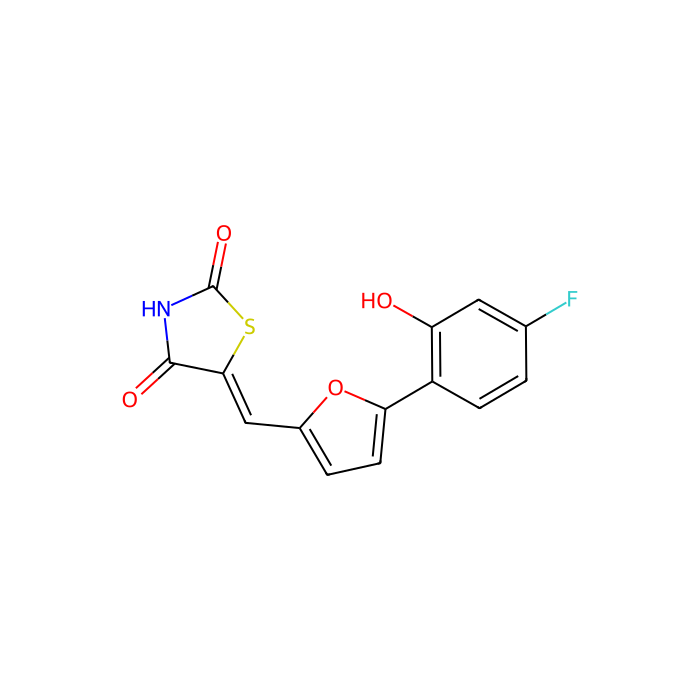
AS-252424 - Moligand™, ≥98% , Inhibitor of phosphatidylinositol-4;5-bisphosphate 3-kinase catalytic subunit alpha;Inhibitor of phosphatidylinositol-4;5-bisphosphate 3-kinase catalytic subunit gamma, CAS No.900515-16-4, Inhibitor of phosphatidylinositol-4;5-bisphosphate 3-kinase catalytic subunit alpha;Inhibitor of phosphatidylinositol-4;5-bisphosphate 3-kinase catalytic subunit gamma

CAS: 900515-16-4 Cat. No.: A129503 Formula: C14H8FNO4S Molecular Weight: 305.28
AVAILABLE TO ORDER
GRADE & PURITY Moligand™ ? Moligand™ — Aladdin's line of ligands and bioactive small molecules. Use for receptor, pathway, and binding studies needing defined small-molecule tools. ≥98%
Synonyms
HMS3229L07 | SCHEMBL1494573 | 2,4-Thiazolidinedione, 5-((5-(4-fluoro-2-hydroxyphenyl)-2-furanyl)methylene)-, (5Z)- | SR-02000000888-2 | N-Boc 1,6-diaminohexane hydrochloride | UNII-63D4RUV1GN | HMS3650K14 | NCGC00185997-01 | (5Z)-5-[[5-(4-fluoro-2-hydroxy
Storage
Store at 2-8°C
Shipped In
Wet ice
★
Size
USA
Germany (EU)*
Price
Qty
1mg
A129503-1mg
3 In stock
—
$41.90
2mg
A129503-2mg
3 In stock
—
$75.90
5mg
A129503-5mg
2 In stock
—
$115.90
25mg
A129503-25mg
3 In stock
—
$514.90
100mg
A129503-100mg
3 In stock
—
$1,474.90
Enter a quantity for the sizes you want to add.
🧪
Why this grade

Moligand™, ≥98% Moligand™ for sensitive chromatographic and analytical workflows requiring minimal baseline interference.

🌡

Storage & shipping

Store at 2-8°C Ships Wet ice Check lot-specific COA for exact specifications.

📋

Quality documents

SDS, COA, datasheet, and spec sheet available for download. Lot-specific COA accessible via lot number lookup.

📚

Literature proof

Cited in 0 peer-reviewed publications across chromatography, organic synthesis, and cross-coupling reactions.

Overview

AS-252424 is a novel, potent PI3Kγ inhibitor with IC50 of 30 nM with 30-fold selectivity for PI3Kγ than PI3Kα, and low inhibitory activity towards PI3Kδ/β.
A selective PI 3-kinase p110γ inhibitor.

Specifications

Synonyms
HMS3229L07 | SCHEMBL1494573 | 2,4-Thiazolidinedione, 5-((5-(4-fluoro-2-hydroxyphenyl)-2-furanyl)methylene)-, (5Z)- | SR-02000000888-2 | N-Boc 1,6-diaminohexane hydrochloride | UNII-63D4RUV1GN | HMS3650K14 | NCGC00185997-01 | (5Z)-5-[[5-(4-fluoro-2-hydroxy
Specifications & Purity
Moligand™, ≥98%
Biochemical and Physiological Mechanisms
AS-252424 is a potent and selective PI 3-kinase p110γ inhibitor (IC50 = 33 nM) shown to be selective for class IB PI 3-kinase-mediated cellular effects. AS-252424 also prevents C5a-mediated phosphorylation of Akt in RAW 264.7 macrophages with an IC50 of 0
Storage
Store at 2-8°C
Shipped In
Wet ice
This product requires cold chain shipping. Ground and other economy services are not available.
Grade
Moligand™
Action Type
INHIBITOR
Mechanism of action
Inhibitor of phosphatidylinositol-4;5-bisphosphate 3-kinase catalytic subunit alpha;Inhibitor of phosphatidylinositol-4;5-bisphosphate 3-kinase catalytic subunit gamma
Note
Wherever possible, you should prepare and use solutions on the same day. However, if you need to make up stock solutions in advance, we recommend that you store the solution as aliquots in tightly sealed vials at -20°C. Generally, these will be useable for up to one month. Before use, and prior to opening the vial we recommend that you allow your product to equilibrate to room temperature for at least 1 hour. Need more advice on solubility, usage and handling? Please visit our frequently asked questions (FAQ) page for more details.
Purity
≥98%
Names and Identifiers
Pubchem Sid
Pubchem Sid Url
https://pubchem.ncbi.nlm.nih.gov/substance/504766609
Canonical Smiles
C1=CC(=C(C=C1F)O)C2=CC=C(O2)C=C3C(=O)NC(=O)S3
IUPAC Name
(5Z)-5-[[5-(4-fluoro-2-hydroxyphenyl)furan-2-yl]methylidene]-1,3-thiazolidine-2,4-dione
InChIKey
OYYVWNDMOQPMGE-SDQBBNPISA-N
INCHI
1S/C14H8FNO4S/c15-7-1-3-9(10(17)5-7)11-4-2-8(20-11)6-12-13(18)16-14(19)21-12/h1-6,17H,(H,16,18,19)/b12-6-
Isomeric SMILES
C1=CC(=C(C=C1F)O)C2=CC=C(O2)/C=C\3/C(=O)NC(=O)S3
WGK Germany
3
Alternate CAS
1138220-19-5,900515-16-4
MeSH Entry Terms
5-(5-(4-fluoro-2-hydroxyphenyl)furan-2-ylmethylene)thiazolidine-2,4-dione;AS 252424;AS-252424;AS252424
Molecular Weight
305.28
Reaxy-Rn
20222686
Reaxys-RN_link_address
https://www.reaxys.com/reaxys/secured/hopinto.do?context=S&query=IDE.XRN=20222686&ln=

Documentation

📋 Safety Data Sheet (SDS)

Comprehensive hazard, handling, storage, and regulatory compliance document.

Download SDS →

✅ Certificate of Analysis (COA)

Lot-specific quality data. Enter your lot number to retrieve the exact COA.

Look up COA →

📊 Datasheet

Quick-reference summary of product specifications and applications.

View datasheet →

🔬 Specification Sheet

Full quality attributes and acceptance criteria for this grade.

View spec sheet →

Advanced Data

Taxonomic Classification

Taxonomy Tree

KingdomOrganic compounds
SuperclassBenzenoids
ClassPhenols
SubclassHalophenols
Intermediate Tree Nodes Fluorophenols
Direct ParentM-fluorophenols
Alternative Parents Thiazolidinediones  1-hydroxy-2-unsubstituted benzenoids  1-hydroxy-4-unsubstituted benzenoids  Fluorobenzenes  Aryl fluorides  Heteroaromatic compounds  Furans  Dicarboximides  Thiocarbamic acid derivatives  Oxacyclic compounds  Azacyclic compounds  Carbonyl compounds  Hydrocarbon derivatives  Organic oxides  Organofluorides  Organonitrogen compounds  
Molecular FrameworkAromatic heteromonocyclic compounds
Substituents 3-fluorophenol - 1-hydroxy-4-unsubstituted benzenoid - 1-hydroxy-2-unsubstituted benzenoid - Fluorobenzene - Halobenzene - Thiazolidinedione - Aryl fluoride - Aryl halide - Monocyclic benzene moiety - Dicarboximide - Furan - Heteroaromatic compound - Thiazolidine - Thiocarbamic acid derivative - Oxacycle - Carboxylic acid derivative - Azacycle - Organoheterocyclic compound - Organooxygen compound - Organonitrogen compound - Organofluoride - Organohalogen compound - Organic oxygen compound - Organic nitrogen compound - Hydrocarbon derivative - Carbonyl group - Organic oxide - Aromatic heteromonocyclic compound
DescriptionThis compound belongs to the class of organic compounds known as m-fluorophenols. These are fluorophenols carrying a iodine at the C3 position of the benzene ring.
External Descriptors Not available
3D Structure
Interactive Chemical Structure Model


Associated Targets(Human)
PIK3CG Tclin Phosphatidylinositol 4,5-bisphosphate 3-kinase catalytic subunit gamma isoform (0 Activities)
Activity TypeActivity Value -log(M)Mechanism of ActionActivity ReferencePublications (PubMed IDs)
PIK3CA Tclin Phosphatidylinositol 4,5-bisphosphate 3-kinase catalytic subunit alpha isoform (0 Activities)
Activity TypeActivity Value -log(M)Mechanism of ActionActivity ReferencePublications (PubMed IDs)
ABL1 Tclin Tyrosine-protein kinase ABL (18331 Activities)
Activity TypeRelationActivity valueUnitsAction TypeJournalPubMed IddoiAssay Aladdin ID
INSR Tclin Insulin receptor (5558 Activities)
Activity TypeRelationActivity valueUnitsAction TypeJournalPubMed IddoiAssay Aladdin ID
VDR Tclin Vitamin D receptor (26531 Activities)
Activity TypeRelationActivity valueUnitsAction TypeJournalPubMed IddoiAssay Aladdin ID
DRD1 Tclin Dopamine D1 receptor (9720 Activities)
Activity TypeRelationActivity valueUnitsAction TypeJournalPubMed IddoiAssay Aladdin ID
PDGFRB Tclin Platelet-derived growth factor receptor beta (5195 Activities)
Activity TypeRelationActivity valueUnitsAction TypeJournalPubMed IddoiAssay Aladdin ID
IGF1R Tclin Insulin-like growth factor I receptor (8605 Activities)
Activity TypeRelationActivity valueUnitsAction TypeJournalPubMed IddoiAssay Aladdin ID
MAPK11 Tchem MAP kinase p38 beta (2785 Activities)
Activity TypeRelationActivity valueUnitsAction TypeJournalPubMed IddoiAssay Aladdin ID
LCK Tclin Tyrosine-protein kinase LCK (9212 Activities)
Activity TypeRelationActivity valueUnitsAction TypeJournalPubMed IddoiAssay Aladdin ID
MAPK14 Tchem MAP kinase p38 alpha (12866 Activities)
Activity TypeRelationActivity valueUnitsAction TypeJournalPubMed IddoiAssay Aladdin ID
GSK3B Tclin Glycogen synthase kinase-3 beta (11785 Activities)
Activity TypeRelationActivity valueUnitsAction TypeJournalPubMed IddoiAssay Aladdin ID
MAP2K6 Tchem Dual specificity mitogen-activated protein kinase kinase 6 (1284 Activities)
Activity TypeRelationActivity valueUnitsAction TypeJournalPubMed IddoiAssay Aladdin ID
SRC Tclin Tyrosine-protein kinase SRC (10310 Activities)
Activity TypeRelationActivity valueUnitsAction TypeJournalPubMed IddoiAssay Aladdin ID
CHEK2 Tchem Serine/threonine-protein kinase Chk2 (4015 Activities)
Activity TypeRelationActivity valueUnitsAction TypeJournalPubMed IddoiAssay Aladdin ID
PDPK1 Tchem 3-phosphoinositide dependent protein kinase-1 (3758 Activities)
Activity TypeRelationActivity valueUnitsAction TypeJournalPubMed IddoiAssay Aladdin ID
AKT2 Tchem Serine/threonine-protein kinase AKT2 (4301 Activities)
Activity TypeRelationActivity valueUnitsAction TypeJournalPubMed IddoiAssay Aladdin ID
AKT3 Tchem Serine/threonine-protein kinase AKT3 (3157 Activities)
Activity TypeRelationActivity valueUnitsAction TypeJournalPubMed IddoiAssay Aladdin ID
ARSA Tbio Cerebroside-sulfatase (655 Activities)
Activity TypeRelationActivity valueUnitsAction TypeJournalPubMed IddoiAssay Aladdin ID
CHUK Tchem Inhibitor of nuclear factor kappa B kinase alpha subunit (3170 Activities)
Activity TypeRelationActivity valueUnitsAction TypeJournalPubMed IddoiAssay Aladdin ID
IKBKB Tchem Inhibitor of nuclear factor kappa B kinase beta subunit (5554 Activities)
Activity TypeRelationActivity valueUnitsAction TypeJournalPubMed IddoiAssay Aladdin ID
PKN2 Tchem Protein kinase N2 (1991 Activities)
Activity TypeRelationActivity valueUnitsAction TypeJournalPubMed IddoiAssay Aladdin ID
CSK Tchem Tyrosine-protein kinase CSK (2395 Activities)
Activity TypeRelationActivity valueUnitsAction TypeJournalPubMed IddoiAssay Aladdin ID
RPS6KA5 Tchem Ribosomal protein S6 kinase alpha 5 (3355 Activities)
Activity TypeRelationActivity valueUnitsAction TypeJournalPubMed IddoiAssay Aladdin ID
PRKCE Tchem Protein kinase C epsilon (1520 Activities)
Activity TypeRelationActivity valueUnitsAction TypeJournalPubMed IddoiAssay Aladdin ID
PRKCG Tchem Protein kinase C gamma (2471 Activities)
Activity TypeRelationActivity valueUnitsAction TypeJournalPubMed IddoiAssay Aladdin ID
PRKCI Tchem Protein kinase C iota (2821 Activities)
Activity TypeRelationActivity valueUnitsAction TypeJournalPubMed IddoiAssay Aladdin ID
PRKD1 Tchem Protein kinase C mu (1904 Activities)
Activity TypeRelationActivity valueUnitsAction TypeJournalPubMed IddoiAssay Aladdin ID
RAF1 Tclin Serine/threonine-protein kinase RAF (4169 Activities)
Activity TypeRelationActivity valueUnitsAction TypeJournalPubMed IddoiAssay Aladdin ID
SYK Tclin Tyrosine-protein kinase SYK (7372 Activities)
Activity TypeRelationActivity valueUnitsAction TypeJournalPubMed IddoiAssay Aladdin ID
RPS6KA1 Tchem Ribosomal protein S6 kinase alpha 1 (2796 Activities)
Activity TypeRelationActivity valueUnitsAction TypeJournalPubMed IddoiAssay Aladdin ID
CAMK4 Tbio CaM kinase IV (2116 Activities)
Activity TypeRelationActivity valueUnitsAction TypeJournalPubMed IddoiAssay Aladdin ID
GSK3A Tclin Glycogen synthase kinase-3 alpha (3764 Activities)
Activity TypeRelationActivity valueUnitsAction TypeJournalPubMed IddoiAssay Aladdin ID
MAP2K4 Tchem Dual specificity mitogen-activated protein kinase kinase 4 (1051 Activities)
Activity TypeRelationActivity valueUnitsAction TypeJournalPubMed IddoiAssay Aladdin ID
MAPK13 Tchem MAP kinase p38 delta (2605 Activities)
Activity TypeRelationActivity valueUnitsAction TypeJournalPubMed IddoiAssay Aladdin ID
MAPKAPK2 Tchem MAP kinase-activated protein kinase 2 (4814 Activities)
Activity TypeRelationActivity valueUnitsAction TypeJournalPubMed IddoiAssay Aladdin ID
MAPKAPK5 Tchem MAP kinase-activated protein kinase 5 (2831 Activities)
Activity TypeRelationActivity valueUnitsAction TypeJournalPubMed IddoiAssay Aladdin ID
ROCK2 Tclin Rho-associated protein kinase 2 (6206 Activities)
Activity TypeRelationActivity valueUnitsAction TypeJournalPubMed IddoiAssay Aladdin ID
PIK3CD Tclin PI3-kinase p110-delta subunit (6699 Activities)
Activity TypeRelationActivity valueUnitsAction TypeJournalPubMed IddoiAssay Aladdin ID
ABL2 Tchem Tyrosine-protein kinase ABL2 (1851 Activities)
Activity TypeRelationActivity valueUnitsAction TypeJournalPubMed IddoiAssay Aladdin ID
MAPK9 Tchem c-Jun N-terminal kinase 2 (4655 Activities)
Activity TypeRelationActivity valueUnitsAction TypeJournalPubMed IddoiAssay Aladdin ID
MAPK10 Tchem c-Jun N-terminal kinase 3 (3396 Activities)
Activity TypeRelationActivity valueUnitsAction TypeJournalPubMed IddoiAssay Aladdin ID
MAP2K1 Tclin Dual specificity mitogen-activated protein kinase kinase 1 (4127 Activities)
Activity TypeRelationActivity valueUnitsAction TypeJournalPubMed IddoiAssay Aladdin ID
PRKCH Tchem Protein kinase C eta (1863 Activities)
Activity TypeRelationActivity valueUnitsAction TypeJournalPubMed IddoiAssay Aladdin ID
PRKCA Tchem Protein kinase C alpha (5923 Activities)
Activity TypeRelationActivity valueUnitsAction TypeJournalPubMed IddoiAssay Aladdin ID
BLK Tchem Tyrosine-protein kinase BLK (2498 Activities)
Activity TypeRelationActivity valueUnitsAction TypeJournalPubMed IddoiAssay Aladdin ID
FYN Tclin Tyrosine-protein kinase FYN (5308 Activities)
Activity TypeRelationActivity valueUnitsAction TypeJournalPubMed IddoiAssay Aladdin ID
LYN Tclin Tyrosine-protein kinase Lyn (4251 Activities)
Activity TypeRelationActivity valueUnitsAction TypeJournalPubMed IddoiAssay Aladdin ID
RPS6KA2 Tchem Ribosomal protein S6 kinase alpha 2 (2184 Activities)
Activity TypeRelationActivity valueUnitsAction TypeJournalPubMed IddoiAssay Aladdin ID
PIK3CG Tclin PI3-kinase p110-gamma subunit (5411 Activities)
Activity TypeRelationActivity valueUnitsAction TypeJournalPubMed IddoiAssay Aladdin ID
ZAP70 Tchem Tyrosine-protein kinase ZAP-70 (2189 Activities)
Activity TypeRelationActivity valueUnitsAction TypeJournalPubMed IddoiAssay Aladdin ID
MAPK8 Tchem c-Jun N-terminal kinase 1 (5038 Activities)
Activity TypeRelationActivity valueUnitsAction TypeJournalPubMed IddoiAssay Aladdin ID
Associated Targets(non-human)
PIK3CA PI3-kinase p110-alpha subunit (51 Activities)
Activity TypeRelationActivity valueUnitsAction TypeJournalPubMed IddoiAssay Aladdin ID
Prkcd Protein kinase C delta (192 Activities)
Activity TypeRelationActivity valueUnitsAction TypeJournalPubMed IddoiAssay Aladdin ID
Prkcb Protein kinase C beta (2 Activities)
Activity TypeRelationActivity valueUnitsAction TypeJournalPubMed IddoiAssay Aladdin ID
Mapk1 MAP kinase ERK2 (650 Activities)
Activity TypeRelationActivity valueUnitsAction TypeJournalPubMed IddoiAssay Aladdin ID
Hdac6 Histone deacetylase 6 (222 Activities)
Activity TypeRelationActivity valueUnitsAction TypeJournalPubMed IddoiAssay Aladdin ID
Fgfr3 Fibroblast growth factor receptor 3 (21 Activities)
Activity TypeRelationActivity valueUnitsAction TypeJournalPubMed IddoiAssay Aladdin ID
Saccharomyces cerevisiae (19171 Activities)
Activity TypeRelationActivity valueUnitsAction TypeJournalPubMed IddoiAssay Aladdin ID
Mus musculus (284745 Activities)
Activity TypeRelationActivity valueUnitsAction TypeJournalPubMed IddoiAssay Aladdin ID
Rattus norvegicus (775804 Activities)
Activity TypeRelationActivity valueUnitsAction TypeJournalPubMed IddoiAssay Aladdin ID
RAW264.7 (28094 Activities)
Activity TypeRelationActivity valueUnitsAction TypeJournalPubMed IddoiAssay Aladdin ID
Mast cell (119 Activities)
Activity TypeRelationActivity valueUnitsAction TypeJournalPubMed IddoiAssay Aladdin ID
GCN5 Histone acetyltransferase GCN5 (89 Activities)
Activity TypeRelationActivity valueUnitsAction TypeJournalPubMed IddoiAssay Aladdin ID
rep Replicase polyprotein 1ab (378 Activities)
Activity TypeRelationActivity valueUnitsAction TypeJournalPubMed IddoiAssay Aladdin ID
pfk 6-phospho-1-fructokinase (7870 Activities)
Activity TypeRelationActivity valueUnitsAction TypeJournalPubMed IddoiAssay Aladdin ID
Txnrd1 Thioredoxin reductase 1, cytoplasmic (45279 Activities)
Activity TypeRelationActivity valueUnitsAction TypeJournalPubMed IddoiAssay Aladdin ID
Nfe2l2 Nuclear factor erythroid 2-related factor 2 (214 Activities)
Activity TypeRelationActivity valueUnitsAction TypeJournalPubMed IddoiAssay Aladdin ID
Camk2a Ca2+/calmodulin-dependent protein kinase II (CaM kinase II) (58 Activities)
Activity TypeRelationActivity valueUnitsAction TypeJournalPubMed IddoiAssay Aladdin ID
Mechanisms of Action
Certificates(CoA,COO,BSE/TSE and Analysis Chart)
C of A & Other Certificates(BSE/TSE, COO):
Analytical Chart:

Find and download the COA for your product by matching the lot number on the packaging.

6 results found

Lot NumberCertificate TypeDateItem
F1519046Certificate of AnalysisJul 07, 2026 A129503
A2213092Certificate of AnalysisJul 14, 2025 A129503
A2213108Certificate of AnalysisJul 14, 2025 A129503
A2213109Certificate of AnalysisJul 14, 2025 A129503
A2213110Certificate of AnalysisJul 14, 2025 A129503
A2213195Certificate of AnalysisJul 14, 2025 A129503
Chemical and Physical Properties
SolubilitySoluble in DMSO (~20 mg/ml), 100% ethanol (10 mg/ml), DMF (~20 mg/ml), and 1:1 solution of DMSO:PBS, pH 7.4 (0.5 mg/ml).
Molecular Weight305.280 g/mol
XLogP32.700
Hydrogen Bond Donor Count2
Hydrogen Bond Acceptor Count6
Rotatable Bond Count2
Exact Mass305.016 Da
Monoisotopic Mass305.016 Da
Topological Polar Surface Area105.000 Ų
Heavy Atom Count21
Formal Charge0
Complexity484.000
Isotope Atom Count0
Defined Atom Stereocenter Count0
Undefined Atom Stereocenter Count0
Defined Bond Stereocenter Count1
Undefined Bond Stereocenter Count0
The total count of all stereochemical bonds1
Covalently-Bonded Unit Count1
Documents & Articles
Solution Calculators
Reviews

Customer Reviews

Application Protocols

Only information from the Product Data may be listed here. Tested applications, recommended dilutions, and positive controls are not provided for this product.

General guidance for small-molecule tool compounds (not item-specific specifications):

  • Stock preparation: Dissolve in anhydrous DMSO to a convenient concentration (e.g., 10–50 mM), vortex and sonicate if needed, then filter (0.2 µm PTFE).
  • Plate handling: Use low-binding plates/tubes to minimize adsorption. Equilibrate to room temperature before uncapping to limit condensation.
  • Dose–response: Prepare serial dilutions (e.g., 1:3 or 1:2) to generate full concentration–response curves with sufficient top/bottom asymptotes.
  • Controls: Include vehicle-only control (matching DMSO%), and where possible, an orthogonal reference compound.
  • Data integrity: Record batch/lot, solution age, and solvent composition on each run to support reproducibility.

For validated, product-specific protocols, please refer to the CoA/Spec Sheet or internal method development documentation.

Biological Roles
  • Product-specific biological role claims are not provided in the Product Data. The following reflects literature-only context and general guidance and must not be construed as a product specification.
  • Literature context (not item-specific specification):
    • Compounds referenced as “AS-252424” have been reported in peer-reviewed studies as small-molecule tool inhibitors targeting lipid kinase signaling pathways (e.g., phosphoinositide 3-kinases). Exact target selectivity, potency, and off-target profiles should be verified from primary literature corresponding to CAS 900515-16-4 or PubChem CID 11630874.
  • Use in research workflows (general):
    • Tool compounds are commonly employed to probe signal transduction, validate target engagement, and dissect pathway-dependent phenotypes in biochemical or cellular models.
    • Orthogonal confirmation (chemical genetics): employ multiple structurally distinct ligands with convergent activity to reduce the risk of off-target interpretation.
  • Practical considerations:
    • Determine and document vehicle effects (e.g., DMSO) and any cytotoxicity or assay interference under your exact conditions.
    • Where possible, confirm on-target effects using genetic controls (knockdown/knockout) or rescue experiments.
  • Caution:
    • Biological effects can be context-dependent and concentration-dependent. Establish full concentration–response relationships and include appropriate negative/positive controls.
  • Note: No medical, diagnostic, or therapeutic uses are claimed or supported; for research use only.
Buffer Applications

This product is not a buffering agent. However, when using small-molecule tool compounds in biochemical or cell-based assays, buffer composition is critical to compound performance and data quality.

  • General buffer guidance (not item-specific):
    • Enzyme assays: HEPES or Tris buffers (10–50 mM) with appropriate salts (NaCl, Mg2+/Mn2+ if required), pH typically 7.0–7.5. Maintain ≤0.1–0.5% v/v DMSO after dilution to limit solvent effects.
    • Binding assays (SPR/MST/DSF): Use low-detergent buffers (e.g., 0.005–0.05% Tween-20) to mitigate nonspecific interactions; include reducing agents if protein requires it (e.g., 0.5–1 mM TCEP). Filter and degas buffers to minimize artifacts.
    • Cell-based assays: Culture-appropriate media; pre-dilute compound in media or a compatible vehicle to avoid local precipitation. Keep final solvent percentage within cell-tolerated ranges (often ≤0.1–0.2% DMSO, cell line dependent).
  • Additives:
    • BSA (0.01–0.1%) can reduce nonspecific adsorption of hydrophobic compounds to plastics but may sequester some ligands—validate recovery.
  • Practical tips:
    • Conduct a solubility/precipitation check by visual inspection and light scattering after compound addition.
    • Verify pH stability of the compound if acid/base-labile functional groups are suspected (unknown for this item).
Green Alternatives

Because this item is used primarily as a screening/tool compound in small quantities, environmental impact is dominated by solvent choices and work practices rather than by the compound itself. Consider the following greener strategies (general guidance):

  • Prefer greener solvents when feasible:
    • Replace DMF/NMP with ethanol, isopropanol, or water with small DMSO fractions, if solubility and assay tolerance permit.
    • For chromatography, use ethanol or isopropanol in place of acetonitrile/methanol where resolution allows.
  • Reduce DMSO usage:
    • Optimize stock concentration and assay miniaturization to reduce total DMSO volume per experiment.
  • Waste minimization:
    • Consolidate compatible organic wastes; use microplate-based assays to decrease solvent consumption and waste mass.
  • Energy and storage efficiency:
    • Store at 2–8°C as specified; avoid unnecessary ultra-low storage when not required, reducing energy use.

Comparison (general, not item-specific):

  • Traditional solvent: DMF/NMP — excellent solubility but reproductive toxicity concerns; difficult waste stream.
  • Greener alternative: Ethanol/IPA — renewable sources available, lower toxicity; may provide lower solubility for highly lipophilic compounds.
  • Balanced compromise: DMSO — relatively benign profile, high solvency, widely accepted in assays; may interfere with some targets at higher percentages.

Always validate greener substitutions experimentally to ensure assay performance and compound stability are maintained.

Pharmaceutical Uses
  • Regulatory/compendial status: Not specified for this item; refer to CoA/Spec Sheet. No pharmacopeial monograph is indicated in the Product Data.
  • Role in pharmaceutical R&D (general guidance):
    • Supplied as a research-use-only small molecule (Moligand™ grade), this compound may serve as a reference tool or positive control in target validation studies, screening cascades, and mechanistic assays.
    • It can be used to benchmark assay windows, assess structure–activity relationships, and support translational in vitro studies. Any use in formulation is strictly for preclinical research (e.g., solubility/permeability studies), not for human or veterinary administration.
  • Formulation considerations for research (not item-specific specifications):
    • Prepare concentrated DMSO stocks and dilute into aqueous systems with attention to precipitation risks.
    • For in vivo exploratory research in non-clinical models, appropriate vehicle design (cosolvents/surfactants) and dose-form feasibility studies are necessary; institutional and regulatory approvals apply. Aladdin Scientific supplies this product strictly for research use only.
  • Quality note:
    • No GMP, clinical, or excipient grade is implied by Moligand™. Do not use for manufacturing or clinical applications.
Physical Properties

Item-specific physical constants are not provided in the Product Data.

  • Appearance: Not specified for this item; refer to CoA/Spec Sheet.
  • Melting point, boiling point, density, refractive index: Not specified for this item; refer to CoA/Spec Sheet.
  • Solubility (item-specific): Not specified for this item; refer to CoA/Spec Sheet.
  • LogP, pKa: Not specified for this item; refer to CoA/Spec Sheet.

General/literature guidance for small-molecule screening compounds (not item-specific):

  • Many discovery tool compounds are supplied as solids with good solubility in high-boiling polar aprotic solvents (e.g., DMSO, DMF) and limited aqueous solubility. Stock solutions are commonly prepared at 10–50 mM in anhydrous DMSO and diluted into assay buffers to final DMSO contents ≤0.1–0.5% v/v (literature/general practice).
  • Hygroscopicity and polymorphism can affect apparent melting behavior and solubility. Verify experimentally for your batch.

Practical recommendations (general):

  • Perform a small-scale solubility screen in likely vehicles (e.g., DMSO, DMF, ethanol, aqueous buffer with co-solvent) before scale-up.
  • Filter stock solutions (0.2 µm PTFE) to remove particulates prior to bioassay or analytical use.
  • Record exact solvent/vehicle and concentration on vial for reproducibility.

Definitive values should be taken from the item’s CoA/Spec Sheet or measured in-house under your specific conditions.

Quality & Grades
  • Supplied grade: Moligand™ (as stated in Product Data)
    • Moligand™ is Aladdin Scientific’s screening/ligand library grade intended for discovery research and high-throughput screening workflows. It emphasizes identity confirmation and suitability for biochemical/biophysical assays.
  • What this implies (general expectations for such grade; not item-specific specifications):
    • Identity: Typically confirmed by one or more orthogonal methods (e.g., MS, NMR, HPLC/UPLC). Exact methods for this lot: Not specified for this item; refer to CoA/Spec Sheet.
    • Purity: Optimized for screening; exact numeric purity and limits for residual solvents/metals/UV cutoff: Not specified for this item; refer to CoA/Spec Sheet.
    • Formulation: Delivered as neat solid or pre-dissolved aliquots depending on catalog option. Specific form/appearance: Not specified for this item; refer to CoA/Spec Sheet.
  • Practical considerations for Moligand™ items:
    • Analytical characterization prior to critical assays is recommended (e.g., LC-MS to confirm mass and assess purity under your method).
    • For structure-activity studies, retain aliquots of the received lot and record internal identifiers to maintain data traceability.
    • If using in biophysical binding assays (SPR, DSF, MST), pre-clear solutions by centrifugation/filtration to remove colloids/aggregates that can confound results.
Reaction & Applications
  • Item intent: This product is listed under “small molecules and compound libraries,” and the grade is Moligand™, indicating use primarily as a research tool compound rather than a general synthetic reagent.
  • Synthetic chemistry usage:
    • Without item-specific functional group information, no particular reaction families (e.g., cross-coupling, nucleophilic substitutions) can be recommended. If employing this molecule as a starting material or intermediate, consult structural data from the CoA/literature and design transformations accordingly.
  • Screening and assay applications (general):
    • Suitable for biochemical target validation, pathway interrogation, and SAR benchmarking as a reference ligand or hit/lead analog in enzyme, receptor, or cell-based assays.
    • Can be profiled via thermal shift (DSF), microscale thermophoresis (MST), surface plasmon resonance (SPR), or enzyme kinetics to quantify binding/functional effects.
  • Analytical characterization (recommended before critical use):
    • LC-MS for identity and purity under the same buffers/solvents used in assays.
    • UV-Vis scan (200–400 nm) to determine chromophores and inform detection wavelengths; exact UV cutoff is not specified for this item.
  • Practical notes:
    • Prepare fresh DMSO stocks where possible and minimize freeze–thaw cycles to preserve integrity.
    • If the compound is hydrophobic, consider using low-binding plasticware to reduce adsorption losses.
    • Where precipitation is observed upon dilution, increase dilution steps, raise temperature slightly (room temp), or add compatible co-solvent in small increments.
Reaction Conditions

No item-specific reaction conditions are applicable or provided, as this product is supplied as a research tool compound rather than a reagent for named transformations.

General guidance if carrying out derivatization (based on typical practices for small organic molecules; not item-specific):

  • Solvents: Dry DMSO, DMF, MeCN, THF, or toluene as dictated by the functional groups present (unknown here).
  • Atmosphere: Use inert gas (N2/Ar) for air/moisture-sensitive steps.
  • Temperatures: 0–120°C depending on reaction class; start with milder conditions and escalate as needed.
  • Catalysts/Bases/Acids: Select per functional group chemistry (e.g., amide couplings with carbodiimides or HATU; palladium catalysis for cross-couplings if aryl halides are present).
  • Workup/purification: Aqueous quench, liquid–liquid extraction, and chromatographic purification (silica gel or prep HPLC) are standard; verify stability to silica and pH.
  • Yields and times: Strongly method- and scaffold-dependent; consult literature routes for analogs of the reported scaffold associated with this CAS.

For precise, validated conditions, refer to peer-reviewed procedures specific to the structure corresponding to CAS 900515-16-4 or conduct small-scale scouting experiments.

Safety & Handling
  • GHS/SDS status (item-specific):
    • Signal Word: Not specified for this item; refer to SDS.
    • Hazard Statements (H-Statements): Not specified for this item; refer to SDS.
    • GHS Classification and Pictograms: Not specified for this item; refer to SDS.
  • General lab safety (applicable to small organic research compounds):
    • Use in a chemical fume hood. Avoid inhalation of dust/aerosols and skin/eye contact.
    • Recommended PPE: lab coat, safety glasses or goggles, and appropriate chemically resistant gloves (e.g., nitrile). Consider double-gloving for extended handling of DMSO solutions.
    • Avoid incompatible materials until confirmed (strong oxidizers, strong acids/bases, reducing agents) and segregate from foodstuffs and non-lab areas.
  • First-aid overview (general):
    • Inhalation: Move to fresh air; seek medical attention if symptoms occur.
    • Skin contact: Wash with soap and water; remove contaminated clothing.
    • Eye contact: Rinse cautiously with water for several minutes; remove contact lenses if present and easy to do; seek medical advice if irritation persists.
    • Ingestion: Rinse mouth; do not induce vomiting; seek medical attention.
  • Spill and disposal (general):
    • Small spills: Absorb with inert material, collect in chemical waste. Prevent release to drains.
    • Dispose of contents/container in accordance with institutional, local, and national regulations.
  • Stability notes:
    • Store at 2–8°C as specified. Protect from light and moisture until more detailed stability data are available from the CoA/SDS.
Solvent Selection

Item-specific solubility and polarity parameters are not provided in the Product Data. The following guidance reflects general best practices for small-molecule tool compounds:

  • Primary stock solvent (general):
    • DMSO (anhydrous) is the default first-choice solvent due to broad solubilizing power and assay compatibility at low final percentages. Prepare 10–50 mM stocks as solubility allows.
  • Secondary/alternative solvents:
    • DMF or NMP for challenging solutes; ethanol or isopropanol for more lipophilic yet alcohol-soluble compounds; acetonitrile for LC compatibility. Combine with water or buffer in stepwise dilutions to minimize precipitation.
  • Aqueous work:
    • Many discovery compounds have limited intrinsic aqueous solubility. Use co-solvent strategies (e.g., 0.1–1% DMSO v/v) or surfactants (e.g., 0.01–0.05% Tween-20) as permitted by your assay.
  • Analytical compatibility:
    • For LC-MS, acetonitrile/water or methanol/water with 0.1% formic acid is common. Avoid phosphate in MS workflows.
  • Practical tips:
    • Perform a cosolvent titration: incrementally add aqueous buffer to the DMSO stock while monitoring for turbidity.
    • Record actual solvent composition used during screening to ensure reproducibility across plates/batches.
  • Noteworthy limitations:
    • Avoid high DMSO (>1–2% v/v) in sensitive biochemical or cell-based assays. Validate tolerability.
    • If the compound contains labile functional groups (unknown here), minimize exposure to strong acids/bases and high temperatures during dissolution.
Storage & Reconstitution
  • Storage conditions (from Product Data): Store at 2–8°C. Ship on wet ice. Protect from moisture and light until detailed stability data are confirmed.
  • Container handling:
    • Allow vial to equilibrate to room temperature before opening to prevent condensation. Reseal promptly with desiccant present in secondary packaging if supplied.
  • Reconstitution (general guidance; not item-specific specification):
    • For assay use, prepare a concentrated stock in anhydrous DMSO (e.g., 10–50 mM) based on observed solubility. Vortex and, if necessary, brief sonication to aid dissolution. Pass through a 0.2 µm PTFE filter prior to sensitive assays.
    • Prepare single-use aliquots to avoid repeated freeze–thaw. Store aliquots at 2–8°C for short term per Product Data; for longer-term storage, many customers keep DMSO stocks at −20°C protected from moisture—validate stability for your application.
  • Stability and specifications:
    • Exact shelf life, hygroscopicity, water content, and impurity limits: Not specified for this item; refer to CoA/Spec Sheet.
  • Disposal:
    • Dispose of residual solutions and containers according to institutional chemical waste procedures.

Always defer to the product’s CoA and SDS for definitive handling and stability instructions. For research use only.

Structure & Identity
  • Product identity
    • SKU: A129503
    • Product Name: AS-252424 (catalog title)
    • CAS: 900515-16-4
    • PubChem CID: 11630874 (literature identifier)
    • InChIKey: 271198 (truncated in Product Data; full InChIKey not specified for this item; refer to CoA/Spec Sheet.)
    • SMILES: Not specified for this item; refer to CoA/Spec Sheet.
    • Molecular Formula: Not specified for this item; refer to CoA/Spec Sheet.
    • Molecular Weight: Not specified for this item; refer to CoA/Spec Sheet.
  • Structural description
    • Item-specific 2D/3D structure: Not specified for this item; refer to CoA/Spec Sheet.
  • Literature context (general)
    • AS-252424 is described in the research literature as a small-molecule tool compound. Specific functional groups, ring systems, and stereochemical features are reported in external databases associated with CAS 900515-16-4 and CID 11630874 (literature). Consult primary literature or authoritative databases for structural diagrams.
  • Notes
    • Where exact structure identifiers (SMILES, full InChIKey) are required for computational or cheminformatics work, please source from the Certificate of Analysis or verified databases and cross-check against the CAS and CID listed above.
Synthetic Utility
  • Primary intent: tool compound for screening/biological investigation rather than a general-purpose synthetic building block.
  • Without the item’s structural information (functional groups, heterocycles, handles), specific transformations cannot be recommended. If you plan derivatization or analog synthesis:
    • Obtain the full structure (from CoA or literature corresponding to CAS 900515-16-4 / CID 11630874) and identify modifiable positions that retain activity (SAR hot spots).
    • Consider late-stage diversification strategies (e.g., C–H functionalization, SuFEx, or amide coupling) if the scaffold supports them.
  • Analytical support for synthetic work (general):
    • Track reaction progress with LC-MS using a method transferable to your bioassay system to ensure the integrity of the pharmacophore during modifications.
    • Use orthogonal purification (prep HPLC plus normal-phase or recrystallization) to remove closely eluting impurities that may affect biological readouts.
  • IP and provenance:
    • Review the primary literature for any patented routes or protected scaffolds before scale-up.

In summary, while not designed as a synthetic reagent, the compound may serve as a reference scaffold in medicinal chemistry if its detailed structure and reactivity profile are obtained from authoritative sources.

Target Specificity

Only information from the Product Data may be listed here. Item-specific target, epitope, or selectivity data are not provided for this product.

  • Target/antigen: Not specified for this item.
  • Species reactivity: Not specified for this item.
  • Clone/isotype: Not applicable (small molecule), and not specified for this item.

For literature-reported targets associated with AS-252424, consult peer-reviewed sources; such information is not part of this product’s certified specification.

Shall we send you a message when we have discounts available?

Remind me later

Thank you! Please check your email inbox to confirm.

Oops! Notifications are disabled.