This compound belongs to the class of organic compounds known as xanthenes. These are polycyclic aromatic compounds containing a xanthene moiety, which consists of two benzene rings joined to each other by a pyran ring.
External Descriptors
Not available
1. Djoumbou Feunang Y, Eisner R, Knox C, Chepelev L, Hastings J, Owen G, Fahy E, Steinbeck C, Subramanian S, Bolton E, Greiner R, and Wishart DS. ClassyFire: Automated Chemical Classification With A Comprehensive, Computable Taxonomy. Journal of Cheminformatics, 2016, 8:61.
Determine the necessary mass, volume, or concentration for preparing a solution.
Dilution Calculator
Determine the dilution needed to prepare a stock solution.
Reconstitution Calculator
Reviews
Customer Reviews
Application Protocols
Example research protocol for blood smear staining with Azure B eosinate (literature/general; optimize for your lab):
Materials: Azure B eosinate stock (0.5–1.0% w/v in methanol or ethanol), 0.01–0.05 M phosphate buffer pH 6.8, distilled water, coplin jars, timer, covers.
Slide preparation: Prepare thin, air-dried blood smears. Fix in absolute methanol for 1–3 min; air-dry.
Staining:
Apply Azure B eosinate working solution (e.g., 1:10–1:20 dilution of stock in alcohol or buffer) to cover the smear for 1–3 min.
Add an equal volume of pH 6.8 phosphate buffer to the slide or transfer to a jar containing buffer to develop the Romanowsky effect for 2–5 min. Gentle agitation improves uniformity.
Rinse: Briefly rinse with the same buffer or distilled water until runoff is nearly colorless (5–15 s). Avoid over-rinsing.
Dry: Stand slides upright to air-dry; avoid blotting the smear.
Microscopy: Mount with a suitable mounting medium if desired. Evaluate hue and intensity; adjust stain or buffer times accordingly.
Notes:
Filter stain and buffer through 0.22–0.45 μm filters before use.
Maintain consistent pH and temperature; small pH shifts markedly affect chromatin purple and cytoplasm pink tones.
Protect solutions from light; prepare fresh working dilutions daily.
Biological Roles
Azure B eosinate is a synthetic dye salt without intrinsic biological function. In research workflows, its utility derives from noncovalent interactions with biomacromolecules.
Binding interactions (literature/general):
Azure B (phenothiazinium cation) exhibits electrostatic and intercalative/stacking interactions with polyanionic nucleic acids (DNA, RNA) and sulfated glycosaminoglycans, producing blue to purple coloration in nuclei and basophilic cellular structures.
Eosinate (xanthene anion of eosin Y) preferentially associates with basic proteins and cytoplasmic components, yielding pink to red hues.
The Romanowsky effect arises from ion-pair complexes between Azure B and eosin bound within cellular microenvironments, producing metachromatic purples in chromatin and certain granules.
pH, ionic strength, and fixation state modulate dye–biomolecule interactions; precise conditions determine contrast and specificity.
Photobleaching particularly affects eosinate; minimize exposure during microscopy for consistent intensity.
Scope:
Intended strictly for laboratory research and educational microscopy. It is not a nutrient, signaling molecule, or therapeutic agent. No clinical or diagnostic claims are made for this product.
Buffer Applications
Azure B eosinate is not a buffer reagent. However, buffer choice is pivotal in its staining performance.
Practical guidance (literature/general):
Phosphate buffer (≈0.006–0.067 M) at pH 6.4–6.8 is commonly used to develop the Romanowsky effect in blood smear staining. Slightly acidic conditions enhance differential binding and purple chromatin tones.
Carbonate–bicarbonate buffers at near-neutral pH can be used for rinsing but may shift hues; validate on your specimens.
Prepare buffers with low ionic strength to limit dye salting out and background precipitation. Filter (0.22–0.45 μm) before use.
Control CO2 exposure; open reservoirs can drift acidic due to CO2 absorption, altering staining balance. Use covered vessels or pre-equilibrate consistently.
Example working approach (literature/general):
Fix smear with methanol (1–3 min), apply dye solution, then develop with pH 6.8 phosphate buffer for defined times. Rinse gently with the same buffer or distilled water to avoid streaking.
Note: Exact molarity and pH should be optimized empirically for your slides, dye concentration, and fixation method.
Green Alternatives
Greener practice with Azure B eosinate centers on solvent choices, waste minimization, and safer formulations rather than changing the dye itself.
Opportunities (literature/general):
Replace methanol with ethanol or isopropanol in stock and fixation steps where acceptable, reducing toxicity while maintaining performance.
Transition from xylene-based clearing to less hazardous alternatives (e.g., aliphatic hydrocarbons or citrus-based agents) when compatible with downstream imaging.
Use aqueous staining systems with minimal alcohol content; extend staining time to compensate if needed.
Prepare concentrated stocks to reduce packaging and shipping mass; dilute on-site.
Implement closed, small-volume staining systems and microfluidic slide processors to cut reagent use and waste.
Comparison highlights (literature/general):
Methanol vs ethanol stocks:
Health/safety: methanol is more toxic (neurotoxic/ocular hazard); ethanol is less hazardous.
Performance: methanol fixes faster; ethanol often provides comparable morphology with slight adjustments to times.
Aqueous-only systems:
Environmental profile: best in class; lowest VOC emissions.
Tradeoff: stricter pH control and longer staining; possible variability with air exposure (CO2 uptake).
Waste handling:
Segregate dye-containing solutions; evaluate adsorption onto activated carbon before disposal where permitted.
Reuse/recirculate working baths with routine filtration to extend bath life and reduce waste generation.
Pharmaceutical Uses
This product is a laboratory dye for research staining and microscopy. It is not typically employed as a pharmaceutical active or common excipient.
Pharmacopeia status: Not specified for this item; refer to CoA/Spec Sheet.
Formulation role: Not typical. Dye markers in pharmaceuticals are generally food/cosmetic-grade colorants with established toxicology; phenothiazinium–xanthene dye salts like Azure B eosinate are specialized for histology/cytology.
Manufacturing: No standard role in GMP drug manufacture. If used in device or reagent kits, suitability, purity, and extractables/leachables must be evaluated to the specific application.
For any regulated use, a full risk assessment and qualification (impurity profile, residual metals, bioburden, endotoxin where relevant) would be required. Aladdin supplies this product strictly for research use only.
Physical Properties
Item-specific specifications are not provided in the Product Data. Values below are general, literature-based expectations for Azure B–eosin dye salts used in Romanowsky systems and must not be interpreted as specifications for this SKU.
Physical state/appearance: Not specified for this item; refer to CoA/Spec Sheet. (Literature: typically a dark green to blue-purple solid dye salt.)
Melting point/decomposition: Not specified for this item; refer to CoA/Spec Sheet. (Literature: many dye salts char/decompose before clear melting.)
Solubility (literature/general):
Water: moderate to good solubility depending on ionic stoichiometry and counterions; often used as aqueous or alcoholic stock solutions.
Alcohols (methanol, ethanol): soluble; methanolic stocks common in Romanowsky-type stains.
pH behavior (literature/general): color tone and complexation are pH-sensitive; Romanowsky effect optimized near mildly acidic to neutral buffers (≈ pH 6.4–6.8) for smear staining.
LogP/partitioning: Not applicable as a discrete neutral molecule; behaves as an ionic dye salt.
Density, refractive index, vapor pressure: Not applicable/not typically reported for solid dyes; Not specified for this item; refer to CoA/Spec Sheet.
Always validate working concentrations and solvent choices empirically for your protocol and matrix.
Quality & Grades
Grade/Purity: Not specified for this item; refer to CoA/Spec Sheet.
Guidance on dye quality considerations (literature/general):
Dye content vs. salt/ash: Analytical dye lots are often characterized by dye content (%), presence of inorganic salts (e.g., Na+, Cl−, SO4 2−), moisture, and residual organic impurities. For Azure B eosinate, stoichiometric variability and associated counterions can influence stain performance and tone.
Performance characteristics: For cytological use, key quality indicators include batch-to-batch consistency in hue, absorbance spectrum (λmax positions for Azure B and eosin components), and low particulate content (filterability/clarity).
Stabilizers: Not specified for this item. Some commercial dye concentrates include trace stabilizers or buffer components in ready-to-use formulations; raw dye salts typically do not. Verify on CoA/Spec Sheet.
Photostability: Eosinates are photosensitive; quality can degrade with prolonged light exposure. Suppliers may package in amber containers to preserve performance.
Application suitability: If you perform quantitative image analysis, request a spectrum trace and dye content by UV–Vis to ensure optical reproducibility across lots.
Recommendation: Validate a new lot with a small-scale smear or tissue test panel alongside a retained control batch to benchmark staining intensity and Romanowsky effect.
Reaction & Applications
This product functions primarily as a research staining reagent rather than a synthetic reactant. Applications focus on polychromatic staining of cells and tissues leveraging the Romanowsky effect.
Research applications (literature/general):
Differential staining of blood and bone marrow smears for morphological studies: Azure B preferentially binds polyanionic nucleic acids (DNA/RNA) and acidic granules, while eosinate (eosin) counterstains basic cytoplasmic/protein regions. Their ion-pair complexes yield purple hues in chromatin and specific granules.
Cytology and histology: used in formulations akin to Giemsa, Wright, Leishman, and May–Grünwald stains, often as part of a combined dye system with methanol/ethanol and phosphate buffer.
Microscopy QA and training slides: consistent coloration supports image analysis calibration in research labs.
Practical notes (literature/general):
pH control is critical (≈6.4–6.8) to optimize contrast; CO2 absorption can shift pH—use freshly prepared, CO2-equilibrated buffers.
Filtration (0.22–0.45 μm) of working solutions removes particulates and dye aggregates that cause background speckling.
Avoid prolonged light exposure of solutions to prevent eosin photobleaching and hue drift; store in amber glass.
Pre-fixation with methanol (1–3 minutes) improves smear adhesion and nuclear detail.
Manufacturer applications: Not provided; this content expands on the common research use of Azure B–eosin systems for laboratory staining. For protocolized, validated methods, see Application Protocols below.
Reaction Conditions
Not applicable in the sense of chemical synthesis. For staining workflows (application conditions), see Application Protocols and Buffer Applications.
General working solution guidance (literature/general):
Solvent: methanol or ethanol stocks; dilute into phosphate buffer (pH ~6.4–6.8) immediately before use.
Concentrations: stock solutions typically 0.1–1% (w/v); working solutions often 0.01–0.3% depending on specimen and desired intensity. Optimize empirically.
Temperature: ambient lab temperature (20–25°C).
Light: minimize exposure; protect vessels with foil/amber glass to reduce photobleaching.
Time: stain development from 30 seconds to several minutes; rinse times similarly brief to avoid dye extraction.
These are general literature practices and are not specifications for this SKU.
Safety & Handling
Hazard classification for this specific SKU is not provided in the Product Data. Handle as a laboratory dye chemical of unknown acute toxicity and consult the product SDS for authoritative information.
GHS classification, signal word, pictograms, H-statements: Not specified for this item; refer to SDS.
General hazards (literature/general): may cause skin/eye irritation and respiratory tract irritation as dust/aerosol; strong staining of skin and surfaces. Dyes can be harmful if swallowed; treat as a potential aquatic pollutant—avoid release to the environment.
PPE: laboratory coat, safety glasses, and appropriate chemical-resistant gloves (e.g., nitrile). Use in a fume hood or well-ventilated area to minimize dust exposure and inhalation.
Handling: avoid generating dust; weigh in a draft-free enclosure; immediately wipe spills with damp disposable towels to prevent tracking. Protect solutions from strong light to minimize photobleaching/degradation (eosinates are light-sensitive).
Incompatibilities: strong oxidizers/reducers may alter dye chromophores; avoid strong acids/bases that can irreversibly change dye forms. Salting-out electrolytes can precipitate ionic dyes.
First aid (overview; defer to SDS):
Skin: wash with soap and water; remove stained clothing.
Eyes: rinse cautiously with water for several minutes; seek medical attention if irritation persists.
Inhalation: move to fresh air; seek attention if symptoms occur.
Ingestion: rinse mouth; do not induce vomiting; seek medical advice.
Waste: collect dye-containing solutions and rinses as hazardous chemical waste per institutional and local regulations.
Solvent Selection
Azure B eosinate is an ionic dye salt. Solvent choice strongly impacts solubility, stability, and staining behavior.
Polarity/miscibility (literature/general):
Aqueous buffers: compatible; pH controls ionization state and stain tone. Phosphate buffers near pH 6.4–6.8 are commonly used for Romanowsky-type staining.
Alcohols: methanol and ethanol dissolve the dye salt well and act as fixatives for blood/cell smears. Methanolic stock solutions are widely used in rapid protocols.
Aprotic polar solvents (DMSO, DMF): high solubility but limited relevance for biological staining; may extract cellular components undesirably.
Nonpolar solvents: poor solubility.
Selection guidance (literature/general):
Use methanol or ethanol for concentrated stock solutions (e.g., 0.1–1% w/v), kept protected from light; dilute into buffer immediately before use to working strength.
For water-only systems, include small percentages of ethanol/isopropanol to improve wetting and reduce precipitation on slides.
Avoid strong acids/bases that irreversibly change chromophore protonation and the Azure B:eosin interaction balance.
Comparison (literature/general):
Methanol stocks: highest solubility, rapid fixation, but toxic and volatile.
Ethanol stocks: safer than methanol, slightly lower solvency; suitable for many labs.
Aqueous buffer only: greener, but may require longer staining and careful pH control to achieve Romanowsky effect.
Appearance: Not specified for this item; refer to CoA/Spec Sheet.
General guidance (literature/general):
Protect from light: Store the solid and any solutions in amber containers or wrapped in foil to minimize eosin photobleaching and color drift.
Dry storage: Keep container tightly closed in a dry place to prevent moisture uptake and caking. Avoid high humidity.
Stock solutions: Prepare 0.1–1.0% (w/v) stocks in methanol or ethanol. Filter through 0.22–0.45 μm PTFE or PES membranes. Label with concentration and date.
Working solutions: Dilute stocks with phosphate buffer (pH 6.4–6.8) immediately before use. Prepare only the volume needed for the day; discard spent baths according to waste procedures.
Stability: Solid dye salts are typically stable for months at room temperature when protected from light and moisture. Alcoholic stocks can be stable for several weeks at room temperature or refrigerated; monitor for precipitation or hue change. These are general observations and not specifications for this SKU.
Freeze–thaw: Not applicable to the dry dye; avoid freezing aqueous solutions as crystallization/phase separation can alter performance.
For exact shelf life and lot-specific guidance, consult the item’s CoA/Spec Sheet and SDS. Research use only.
Structure & Identity
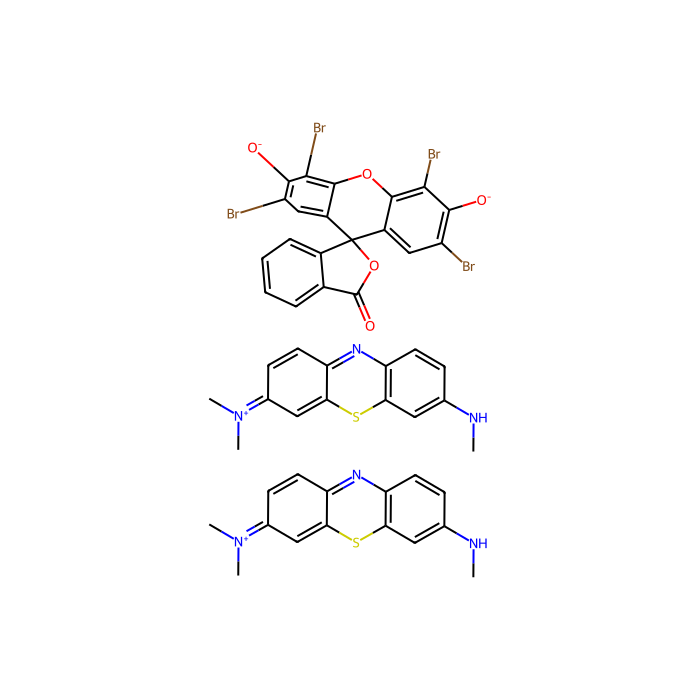
Azure B eosinate is a cation–anion dye salt widely used in Romanowsky-type staining systems in research cytology and hematology. It combines the phenothiazinium dye Azure B (cation) with the xanthene dye eosinate (anion of eosin Y). The complex exploits complementary affinity for polyanionic nucleic acids and basic cytoplasmic/protein sites to yield characteristic differential coloration.
CAS: 62298-42-4 (product-specific)
CID: 2724069 (product-specific)
InChIKey: 234596 (product-specific)
SMILES: Not specified for this item; refer to CoA/Spec Sheet.
Molecular Formula: Not specified for this item; refer to CoA/Spec Sheet.
Molecular Weight: Not specified for this item; refer to CoA/Spec Sheet.
Structural features (literature/general):
Azure B cation: phenothiazinium core (tricyclic aromatic system with a thiazine S–N heterocycle), typically dimethylamino substituent; permanently cationic.
Eosinate anion: tetrabrominated xanthene (fluorone) framework of eosin Y (tetrabromofluorescein), bearing phenolic/carboxylate functions; dianionic under neutral conditions.
The salt is formed via electrostatic pairing of the Azure B monocation(s) and the eosinate anion; stoichiometry may vary among commercial materials.
2D description (literature/general):
Azure B: planar, fused aromatic rings with central S and N; peripheral dimethylamino group; charged heteroatom.
Eosinate: xanthene core with two aryl rings, multiple bromine atoms, phenolate/carboxylate groups distributing negative charge.
Note: For definitive elemental composition and exact stoichiometry of this SKU, consult the item’s CoA/Spec Sheet.
Synthetic Utility
Azure B eosinate is not commonly used as a reagent or building block in chemical synthesis. It serves as a staining dye salt in microscopy workflows.
Eosinate: brominated xanthene with phenolate/carboxylate functions.
Reactivity: While these motifs can, in principle, undergo electrophilic substitution, nucleophilic aromatic substitution (on activated brominated rings), or salt metathesis, such transformations are not typical or recommended in routine lab practice with this product.
If you require phenothiazinium or xanthene scaffolds for synthesis, consider purchasing the corresponding base dyes (e.g., Azure B chloride or eosin Y) or appropriate intermediates with defined stoichiometry and counterions.
Target Specificity
Not an antibody, enzyme, or targeted affinity reagent. No antigen/epitope specificity data apply.
Functional affinity (literature/general):
Azure B component: preferential binding to polyanionic biomolecules (DNA/RNA), producing basophilic staining.
Eosinate component: preferential association with basic proteins/cytoplasm, producing acidophilic staining.
These interactions are noncovalent and driven by electrostatics and π–π interactions rather than defined epitope recognition.
Frequently Asked Questions
How should this product be stored?
Store at room temperature.
How is this product shipped?
This product ships under standard ambient conditions. No temperature-controlled packaging is required.
What are the CAS number, molecular formula and molecular weight?
The CAS Number is 62298-42-4, the molecular formula is C20H6Br4O5?2C15H16N3S, and the molecular weight is 1186.6 g/mol. InChIKey NCBQBFXQRBYYGY-UHFFFAOYSA-N.
What documentation is provided?
Available product documentation, including Certificates of Analysis (COA), Safety Data Sheets (SDS), and specification sheets, is shown in the product document area. Document availability and access follow the current site policy.
We use cookies to ensure the website functions properly and, where permitted, to improve your experience. You can manage your preferences at any time in Settings. Learn more in our Cookie Policy.
Shall we send you a message when we have discounts available?
Remind me later
Thank you! Please check your email inbox to confirm.
Products are supplied to verified businesses, institutions, and qualified professionals for research and development use only. Not for use in humans, animals, diagnosis, or therapy.

 F2313833