GRADE & PURITYMoligand™?Moligand™ — Aladdin's line of ligands and bioactive small molecules. Use for receptor, pathway, and binding studies needing defined small-molecule tools.≥98%(HPLC)
Moligand™, ≥98%(HPLC) Moligand™ for sensitive chromatographic and analytical workflows requiring minimal baseline interference.
🌡
Storage & shipping
Store at -20°C,Argon charged Ships Ice chest + Ice pads Check lot-specific COA for exact specifications.
📋
Quality documents
SDS, COA, datasheet, and spec sheet available for download. Lot-specific COA accessible via lot number lookup.
📚
Literature proof
Cited in 0 peer-reviewed publications across chromatography, organic synthesis, and cross-coupling reactions.
Overview
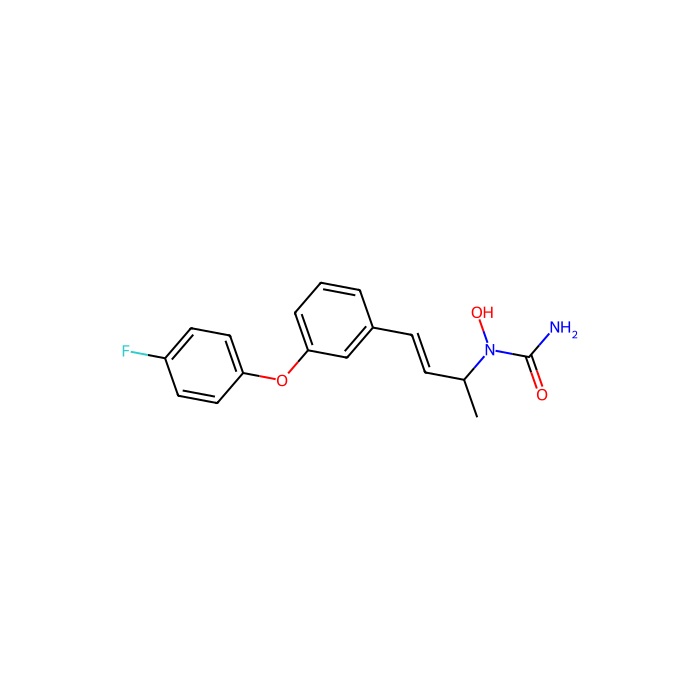
BW B70C is a potent and selective acid 5-lipoxygenase inhibitor. BW B70C inhibits both acute and allergic bronchoconstriction and late-phase eosinophil accumulation subsequent to allergen inhalation in guinea-pigs. BW B70C prevents leukotriene C4 synthesis and reduces leucocyte migration to the airways lumen as well as albumin microvascular leakage. BW B70C has the potential for the research of anti-asthma agent.
This compound belongs to the class of organic compounds known as diphenylethers. These are aromatic compounds containing two benzene rings linked to each other through an ether group.
1. Djoumbou Feunang Y, Eisner R, Knox C, Chepelev L, Hastings J, Owen G, Fahy E, Steinbeck C, Subramanian S, Bolton E, Greiner R, and Wishart DS. ClassyFire: Automated Chemical Classification With A Comprehensive, Computable Taxonomy. Journal of Cheminformatics, 2016, 8:61.
Determine the necessary mass, volume, or concentration for preparing a solution.
Dilution Calculator
Determine the dilution needed to prepare a stock solution.
Reconstitution Calculator
Reviews
Customer Reviews
Application Protocols
No validated biological assay protocols (e.g., WB, IHC, IF, FC) are provided for this item, and it is not described as an antibody or biochemical probe in the Product Data.
General laboratory protocol suggestions (for chemical research use):
Inert handling: Purge vials with argon or nitrogen before opening. If weighing on the bench, minimize exposure time and promptly re-seal under inert gas.
Catalyst pre-formation (generic): Combine metal precursor and BW-B 70C in dry solvent under inert gas; stir 10–30 min at ambient or mildly elevated temperature, then add substrates/reagents. Optimize equivalents empirically.
Documentation: Record atmosphere, solvent dryness, and temperatures for reproducibility.
For any biological or materials application, develop and validate a bespoke protocol based on your system; consult the SDS and CoA before commencing.
Biological Roles
This product is supplied as a research ligand/reagent (Moligand class). No biological function, metabolic role, or biomolecular target is provided in the Product Data.
Biological function: Not specified for this item; refer to CoA/Spec Sheet.
Pathways/targets: Not specified for this item; refer to CoA/Spec Sheet.
General note:
Unless otherwise stated, Moligand-class ligands are intended for chemical research (e.g., coordination chemistry, catalysis) rather than biochemical or cellular pathway modulation. Use in biological systems should only proceed after thorough compatibility and toxicity assessments in appropriate models and under institutional safety approvals.
Buffer Applications
Not typically applicable. BW-B 70C is provided as a Moligand-class research reagent rather than a buffering agent.
There are no specified buffering ranges, pKa values, or recommended buffer formulations in the Product Data.
For aqueous workups or extractions in syntheses that use BW-B 70C-derived catalysts, standard inorganic buffer systems (e.g., phosphate, bicarbonate) may be chosen based on substrate needs—not on BW-B 70C properties.
Green Alternatives
While BW-B 70C is a ligand/reagent rather than a solvent, greener process choices can be made around its use. Below are general, literature-based considerations (not item-specific specs):
Prefer greener solvents where compatible: 2-MeTHF or CPME instead of THF/diethyl ether; toluene or anisole over chlorinated solvents when feasible; propylene carbonate or dimethyl carbonate for certain polar applications.
Minimize halogenated waste: Use DCM/DCE only when necessary for performance, and plan for proper waste segregation.
Energy efficiency: Run at the lowest effective temperature and shortest time; consider flow chemistry for improved heat/mass transfer and reduced solvent volumes.
Catalyst recycling: If BW-B 70C is part of a metal complex, explore immobilized catalysts or biphasic systems to facilitate recovery.
Example comparison (general solvent swap guidance):
THF → 2-MeTHF: similar polarity and coordination ability; higher boiling point and better safety/renewability profile for 2-MeTHF.
DCM → EtOAc/toluene: EtOAc provides moderate polarity with lower toxicity; toluene is non-chlorinated with suitable aromatic solvation.
Note: Validate solvent swaps experimentally, as ligand solubility and catalytic performance can be solvent-sensitive.
Pharmaceutical Uses
No pharmacopeial status, excipient role, or manufacturing use is provided in the Product Data.
Regulatory/compendial status: Not specified for this item; refer to CoA/Spec Sheet.
Formulation roles: Not specified for this item; refer to CoA/Spec Sheet.
General guidance:
This product is labeled for research use only. It is not intended for use in humans or for clinical applications. Any exploration of process-chemistry relevance (e.g., as a screening ligand for route scouting) should remain within non-GMP research environments unless otherwise qualified and documented.
Physical Properties
Item-specific physicochemical data were not provided in the Product Data. Do not assume values for method development; verify with the CoA/spec sheet for your lot.
Appearance: Not specified for this item; refer to CoA/Spec Sheet.
Melting point: Not specified for this item; refer to CoA/Spec Sheet.
Boiling point: Not specified for this item; refer to CoA/Spec Sheet.
Density: Not specified for this item; refer to CoA/Spec Sheet.
Solubility: Not specified for this item; refer to CoA/Spec Sheet.
LogP/partitioning: Not specified for this item; refer to CoA/Spec Sheet.
Refractive index: Not applicable to a solid; if liquid, Not specified for this item; refer to CoA/Spec Sheet.
pKa: Not specified for this item; refer to CoA/Spec Sheet.
UV-vis characteristics: Not specified for this item; refer to CoA/Spec Sheet.
General guidance (literature/practice for many organo-ligands; not item-specific):
Many neutral ligands used in homogeneous catalysis are soluble in dry, aprotic organic solvents (e.g., toluene, THF, DCM, MeCN, CPME) and poorly soluble in water. Actual solubility for BW-B 70C must be verified experimentally.
Sensitivity to moisture/air is possible (storage guidance indicates argon and −20°C). Handle under inert atmosphere to preserve integrity if your preliminary tests show degradation in air.
Quality & Grades
Grade/Purity: Moligand™ (as provided). “Moligand” denotes a ligand-focused research grade suitable for coordination chemistry and catalyst development in research settings. It does not by itself specify assay %, trace metal limits, or residual solvent content.
What Moligand™ typically implies (general guidance; not item-specific specifications):
Intended for use as a ligand or complexation component in homogeneous or heterogeneous catalysis screening.
May be supplied with analytical identification (e.g., NMR/HRMS/elemental) on the CoA. Verification methods and acceptance criteria should be taken from the specific lot’s CoA/Spec Sheet.
Item-specific details not provided in Product Data:
Assay/purity percentage: Not specified for this item; refer to CoA/Spec Sheet.
Stabilizers/inhibitors: Not specified for this item; refer to CoA/Spec Sheet.
Water/peroxide/metal content, UV cutoff: Not specified for this item; refer to CoA/Spec Sheet.
Best practices for quality-critical workflows:
Record lot number and retain CoA.
If used in catalysis, consider pre-drying and handling under inert gas to maintain performance consistency between runs.
For analytical verification, compare spectra to reference provided in the CoA or request supporting documentation if needed.
Reaction & Applications
Manufacturer Applications: Not specified in the Product Data.
General research use context for Moligand-class materials (literature/practice; not specific to BW-B 70C without a disclosed structure):
Transition-metal coordination: Employed as a ligand component to assemble active catalyst systems for cross-coupling (e.g., C–C, C–N), hydrogenation/hydrosilylation, and related transformations.
Catalyst optimization: Used in ligand screening libraries to tune sterics/electronics, affecting oxidative addition, transmetalation, and reductive elimination steps.
Complex synthesis: Pre-formation of defined metal–ligand complexes may enhance reproducibility; stoichiometry typically ranges from 1:1 to 2:1 ligand:metal depending on denticity.
Practical tips:
Handle under inert atmosphere to prevent oxidation/hydrolysis if sensitive (suggested by argon storage). Store prepared catalyst stocks in septum-sealed, inerted vials.
If solubility is limited, consider in situ generation of catalyst in a more soluble solvent and then solvent-switch or add co-solvent.
Monitor reactions by GC/LC to assess ligand effects on rate and selectivity; small changes in ligand loading (e.g., 1–10 mol%) can be significant.
Documentation:
Record exact metal precursors, ligand equivalents, solvent dryness, and temperature profiles. Reproducibility in ligand-enabled catalysis is highly sensitive to these parameters.
Reaction Conditions
Item-specific reaction parameters are not provided. The following are general, literature-based ranges for ligand-enabled catalysis development and should be used only as starting points for screening, not as specifications for BW-B 70C.
Ligand loading: Commonly 1–20 mol% relative to metal, depending on denticity and catalyst design.
Metal sources: Pd(0/II), Ni(0/II), Cu(I), Rh, Ru, Ir, etc., chosen per transformation; pre-complexation time 10–60 min at RT to 60°C is typical before adding substrates.
Solvents: Dry toluene, 2-MeTHF, THF, dioxane, DCM/DCE, MeCN, or DMA/DMF/NMP as dictated by solubility and reaction.
Temperature: Ambient to 120°C (oil bath or sealed-vessel), observing thermal stability limits of all components.
Atmosphere: Inert (N2/Ar) recommended, especially when storage guidance indicates argon protection.
Bases/additives: KOtBu, NaOtBu, K3PO4, Cs2CO3, NaOAc, or amines, screened according to transformation; confirm compatibility to avoid ligand degradation.
Time: 0.5–24 h depending on system; monitor progress by GC/LC.
Note: Because the exact donor set and stability of BW-B 70C are not disclosed, run a small DoE or factorial screen to map solvent/base/temperature/ligand:metal ratios, and document reproducibility.
Safety & Handling
Authority for safety is the product SDS. The following reflects only what is in the Product Data plus general laboratory best practices.
GHS classification: Not specified for this item; refer to SDS.
Signal word / Pictograms / H-statements: Not specified for this item; refer to SDS.
Handling and PPE (general best practice):
Work in a chemical fume hood. Wear lab coat, nitrile gloves, and splash goggles. Avoid inhalation of dusts/aerosols and skin contact.
Storage indicates “Store at −20°C, Argon charged,” implying possible air/moisture sensitivity. Minimize exposure to air; use inert-gas techniques (Schlenk line or glovebox) as appropriate.
Avoid contact with oxidizers and strong acids/bases until compatibility is confirmed from the SDS/CoA.
First aid (general):
Inhalation: Move to fresh air; seek medical attention if symptoms persist.
Skin/eye contact: Rinse thoroughly with water for several minutes; remove contaminated clothing; seek medical attention as needed.
Ingestion: Rinse mouth; do not induce vomiting; seek medical attention.
Spill/leak response:
Contain and collect with inert absorbent under a fume hood. Avoid water if the material is moisture sensitive. Dispose in accordance with local regulations.
Fire and reactivity:
Combustible organic solids/liquids may burn; use CO2, dry chemical, or foam. If air- or moisture-sensitive, sealed storage under inert gas is prudent.
Solvent Selection
Item-specific solubility data are not provided; verify experimentally on a small scale. The following are general considerations for many organo-ligands used in catalysis.
Polarity/miscibility (general): Ligands of this class are commonly soluble in moderately polar aprotic solvents (THF, DCM, acetone, MeCN) and in less polar aromatics (toluene). Solubility in alcohols or water varies widely and must be tested.
Moisture/air sensitivity: Given the argon-charged storage, prepare solutions using dry, degassed solvents. Apply freeze–pump–thaw or sparging with inert gas for degassing where relevant.
Screening approach: Start with 10–20 mg/mL test dissolutions in dry toluene, THF, DCM, and MeCN. If heterogeneous, gentle warming (≤40–50°C) and sonication may help. Avoid prolonged heating if stability is unknown.
Comparison notes (general literature guidance):
THF vs 2-MeTHF: 2-MeTHF offers better hydrophobicity and greener credentials; both can solubilize many ligands and catalytic complexes.
Toluene vs xylene: Toluene is lower boiling and often preferable for initial screens; xylene may be used for higher-temperature studies.
DCM vs DCE: DCE provides a higher boiling point while maintaining similar polarity; choose based on temperature needs and safety policies.
Always confirm solvent compatibility with your metal precursors, substrates, and any bases or reductants present in the reaction.
Storage & Reconstitution
Storage conditions (as provided): Store at −20°C, argon charged. Maintain containers tightly closed under an inert atmosphere to limit exposure to oxygen and moisture.
Shipping: Shipped on ice (ice chest + ice pads), indicating temperature control is important during transit.
Best practices:
Upon receipt, allow container to equilibrate to room temperature under inert conditions before opening to minimize condensation ingress if the material is moisture sensitive.
If frequent use is expected, prepare small aliquots under inert gas (e.g., in crimp-sealed or screw-cap vials with septa) and return unused material promptly to −20°C.
Protect from light if the ligand is photosensitive (not specified; assess based on your observations or CoA notes).
Reconstitution/solutions:
Solvent choice: Use dry, oxygen-free solvents compatible with your application (e.g., toluene, THF, MeCN, DCM, 2-MeTHF). Test solubility on small scale first.
Solution stability: Not specified for this item; refer to CoA/Spec Sheet. As a precaution, prepare fresh solutions for critical experiments and store any stock solutions under inert gas at low temperature when feasible.
Expiration/retention:
Retest or re-verify performance after prolonged storage. Follow any lot-specific expiry or retest dates provided on the CoA/label.
Research use only: As stated in the Product Data.
Structure & Identity
Product name: BW-B 70C (Moligand series)
CAS: 134470-38-5 (as provided)
PubChem CID: 5353454 (as provided)
InChIKey: 354734 (as provided; note: format appears non-standard for a typical 27-character InChIKey)
SMILES: Not specified for this item; refer to CoA/Spec Sheet.
Molecular formula: Not specified for this item; refer to CoA/Spec Sheet.
Molecular weight: Not specified for this item; refer to CoA/Spec Sheet.
Structural features (general notes):
Specific structural motifs, functional groups, and stereochemistry are not disclosed in the product data. BW-B 70C belongs to the Moligand class, which generally denotes ligands intended for coordination to transition metals in catalysis or complexation workflows.
Without a disclosed structure, the 2D representation, ring systems, donor atoms (P/N/S/O), denticity, and steric/electronic profile cannot be detailed for this item.
What this means for users:
Treat BW-B 70C as a proprietary ligand/reagent where metal-binding behavior is intended but item-specific donor set and geometry are not provided in the catalog entry. For structural and elemental confirmation, consult the item’s Certificate of Analysis (CoA) and any supplemental specification sheet provided with your lot.
Synthetic Utility
Without a disclosed structure, synthetic reactivity must be discussed at a general level for Moligand-class ligands:
Enabling role: Ligands modulate the electronic and steric environment of a metal center, tuning key steps like oxidative addition, migratory insertion, and reductive elimination in cross-coupling and hydrogenation chemistry.
Retrosynthetic impact: Access to an effective ligand can unlock milder conditions, broader substrate scope, or improved selectivity, influencing route selection and protecting-group strategy.
Complex pre-formation: Many systems benefit from pre-stirring the metal precursor with the ligand (e.g., 1–2 equivalents relative to metal) before substrate introduction to generate a well-defined species.
Heterogenization: Some ligands allow immobilization on supports for catalyst recovery; feasibility depends on functional handles present (not specified here).
Operational tips (general):
Control ligand-to-metal ratio precisely; minor deviations can shift selectivity.
Verify compatibility with bases/nucleophiles if used (e.g., in Buchwald–Hartwig or C–S couplings) to avoid ligand degradation.
Monitor by 31P NMR or UV–vis, where applicable, to assess complex formation and stability (technique depends on actual donor atoms, not specified for this product).
Target Specificity
Not applicable. This product is not an antibody or affinity reagent with defined biological epitope specificity in the provided Product Data.
Antigen/epitope: Not specified for this item; refer to CoA/Spec Sheet.
Species reactivity/clone/isotype: Not applicable to this item as listed.
Need help choosing the grade?
Our grade selection guide covers purity, stabilizer status, and application suitability for all variants in our catalog.
We use cookies to ensure the website functions properly and, where permitted, to improve your experience. You can manage your preferences at any time in Settings. Learn more in our Cookie Policy.
Shall we send you a message when we have discounts available?
Remind me later
Thank you! Please check your email inbox to confirm.
Products are supplied to verified businesses, institutions, and qualified professionals for research and development use only. Not for use in humans, animals, diagnosis, or therapy.