Carrageenan - Reagent Grade , CAS No.9000-07-1

CAS: 9000-07-1 Cat. No.: C107615 EC Number: 232-524-2
AVAILABLE TO ORDER
GRADE & PURITY Reagent Grade ? General reagent-grade purity suitable for most laboratory work. Use as a dependable default when no specific higher grade is required.
Synonyms
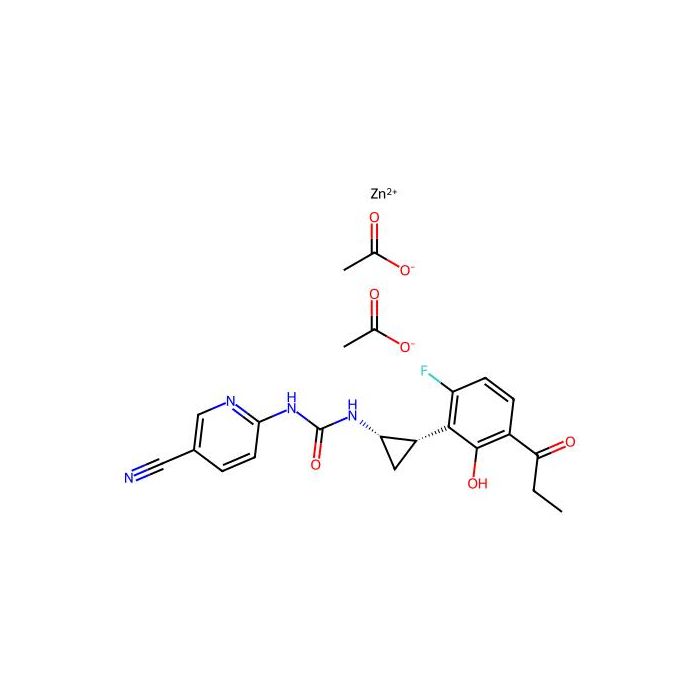
zinc;1-(5-cyanopyridin-2-yl)-3-[(1S,2S)-2-(6-fluoro-2-hydroxy-3-propanoylphenyl)cyclopropyl]urea;diacetate | zinc 1-(5-cyano-2-pyridyl)-3-[(1S,2S)-2-(6-fluoro-2-hydroxy-3-propanoyl-phenyl)cyclopropyl]urea diacetate | MIV-150/ZA/CG
Storage
Protected from light,Room temperature
Shipped In
Normal
★
Size
USA
Germany (EU)*
Price
Qty
25g
C107615-25g
5 In stock
—
$15.90
100g
C107615-100g
4 In stock
—
$38.90
500g
C107615-500g
3 In stock
1 In stock
$116.90
Enter a quantity for the sizes you want to add.
🧪
Why this grade

Reagent Grade Reagent Grade for sensitive chromatographic and analytical workflows requiring minimal baseline interference.

🌡

Storage & shipping

Protected from light,Room temperature Ships Normal Check lot-specific COA for exact specifications.

📋

Quality documents

SDS, COA, datasheet, and spec sheet available for download. Lot-specific COA accessible via lot number lookup.

📚

Literature proof

Cited in 75 peer-reviewed publications across chromatography, organic synthesis, and cross-coupling reactions.

Overview

Carrageenans are mucopolysaccharides from the cell walls of the red algae. They are anionic linear polymers composed of 1,3α-1,4β-galactans having one (κ-), two (ι-) or three (λ-) sulfates per disaccharide unit. In ionic solutions, κ- and ι-carrageenans self-associate into helical structures that form rigid or flexible gels, respectively. λ-carrageenans do not form helices and are non-gelling. Carrageenans are used commercially as thickeners and stabilizing agents.
Carrageenans are used to suppress immune response in vivo and in vitro via mechanisms believed to involve selective cytopathic effect on macrophages. As ι-, κ-, and λ-carrageenans have varying degress of sulfation, they may be studied comparatively for differences in protective, antiviral, and immunosuppression activities.

Specifications

Synonyms
zinc;1-(5-cyanopyridin-2-yl)-3-[(1S,2S)-2-(6-fluoro-2-hydroxy-3-propanoylphenyl)cyclopropyl]urea;diacetate | zinc 1-(5-cyano-2-pyridyl)-3-[(1S,2S)-2-(6-fluoro-2-hydroxy-3-propanoyl-phenyl)cyclopropyl]urea diacetate | MIV-150/ZA/CG
Specifications & Purity
Reagent Grade
Storage
Protected from light,Room temperature
Shipped In
Normal
Grade
Reagent Grade
Names and Identifiers
Pubchem Sid
Pubchem Sid Url
https://pubchem.ncbi.nlm.nih.gov/substance/488202268
Isomeric SMILES
CCC(=O)C1=C(C(=C(C=C1)F)[C@@H]2C[C@@H]2NC(=O)NC3=NC=C(C=C3)C#N)O.CC(=O)[O-].CC(=O)[O-].[Zn+2]
WGK Germany
2
RTECS
FI0700000
Reaxy-Rn
48024413
Reaxys-RN_link_address
https://www.reaxys.com/reaxys/secured/hopinto.do?context=S&query=IDE.XRN=48024413&ln=

Documentation

📋 Safety Data Sheet (SDS)

Comprehensive hazard, handling, storage, and regulatory compliance document.

Download SDS →

✅ Certificate of Analysis (COA)

Lot-specific quality data. Enter your lot number to retrieve the exact COA.

Look up COA →

📊 Datasheet

Quick-reference summary of product specifications and applications.

View datasheet →

🔬 Specification Sheet

Full quality attributes and acceptance criteria for this grade.

View spec sheet →

Advanced Data

Certificates(CoA,COO,BSE/TSE and Analysis Chart)
C of A & Other Certificates(BSE/TSE, COO):
Analytical Chart:

Find and download the COA for your product by matching the lot number on the packaging.

31 results found

Lot NumberCertificate TypeDateItem
G2220369Certificate of AnalysisMay 09, 2026 C107615
K2116345Certificate of AnalysisAug 13, 2025 C107615
H2507296Certificate of AnalysisJun 23, 2025 C107615
H2507297Certificate of AnalysisJun 23, 2025 C107615
H2507298Certificate of AnalysisJun 23, 2025 C107615
H2507299Certificate of AnalysisJun 23, 2025 C107615
H2507300Certificate of AnalysisJun 23, 2025 C107615
F2608186Certificate of AnalysisJun 23, 2025 C107615
D2624042Certificate of AnalysisJun 23, 2025 C107615
A2517191Certificate of AnalysisJan 08, 2025 C107615
A2517195Certificate of AnalysisJan 08, 2025 C107615
A2517194Certificate of AnalysisJan 08, 2025 C107615
A2517193Certificate of AnalysisJan 08, 2025 C107615
A2517192Certificate of AnalysisJan 08, 2025 C107615
K2429635Certificate of AnalysisNov 15, 2024 C107615
K2429636Certificate of AnalysisNov 15, 2024 C107615
K2429637Certificate of AnalysisNov 15, 2024 C107615
K2429638Certificate of AnalysisNov 15, 2024 C107615
K2429639Certificate of AnalysisNov 15, 2024 C107615
G2528068Certificate of AnalysisJul 05, 2024 C107615
B23221118Certificate of AnalysisFeb 25, 2023 C107615
B2322978Certificate of AnalysisFeb 25, 2023 C107615
B2303853Certificate of AnalysisFeb 08, 2023 C107615
B2303851Certificate of AnalysisFeb 07, 2023 C107615
G2220381Certificate of AnalysisJun 10, 2022 C107615
G2220379Certificate of AnalysisJun 10, 2022 C107615
G2220378Certificate of AnalysisJun 10, 2022 C107615
G2220375Certificate of AnalysisJun 10, 2022 C107615
C2404229Certificate of AnalysisJun 10, 2022 C107615
K2405253Certificate of AnalysisJun 10, 2022 C107615
A2412062Certificate of AnalysisJun 10, 2022 C107615
Chemical and Physical Properties
SensitivityLight sensitive
Documents & Articles
The Technology Driving Biomedical Revolution — Animal Modeling
How to Choose Reagent Grades in Scientific Research? A Practical Guide to Reagent Grade
Carrageenan: Classification, Gelation Behavior, and Formulation Applications of Red-Algae–Derived Sulfated Polysaccharides
An Introduction to Research-Grade Carbohydrates: Decoding the “Glycan Language” and a Product-Selection Guide (with Tables 1–3)
Understanding Hydrophilic Polymers in Aqueous Systems: Hydration Mechanisms, Structural Knobs, and Task-Oriented Selection Guide (Including Tables 1–3)
Molecular Network of the Kinin System in Pain and Neural Regulation
Functional Framework of Starch Metabolism-Related Enzymes in Food Science Research and Mechanistic Analysis of Quality Regulation
Thickening, Suspension, Auxiliary Stabilization, and Agglomeration Mechanisms of Xanthan Gum in Personal Care Formulations: From Molecular Structure to Processing Applications
From Structure to Rheology: Thickening, Stabilization, and Selection Logic of Cellulose Ethers for Personal Care Applications
R&D Selection and Experimental Evaluation of Common Food Hydrocolloids
Citations of This Product
Solution Calculators
Reviews

Customer Reviews

Shall we send you a message when we have discounts available?

Remind me later

Thank you! Please check your email inbox to confirm.

Oops! Notifications are disabled.