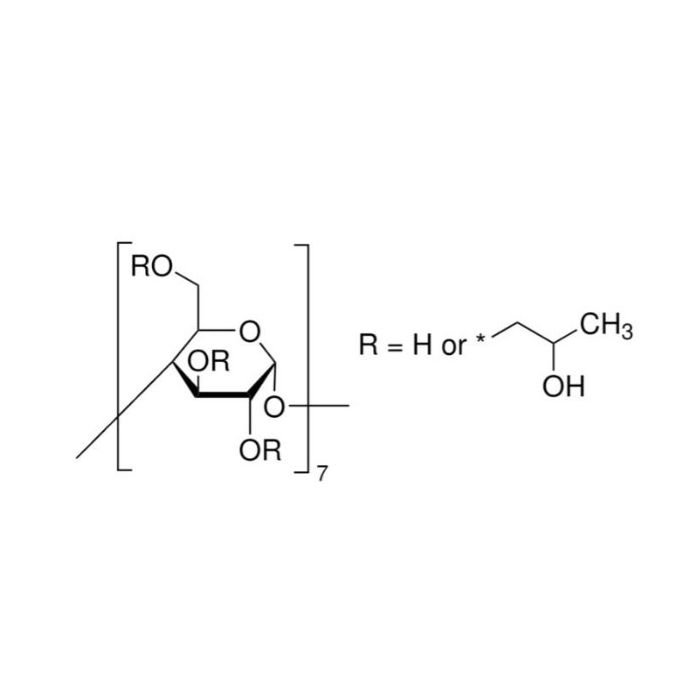
Cyclodextrin HPB (HP-β-CD) - PharmPure™, USP , CAS No.128446-35-5

CAS: 128446-35-5 Cat. No.: C485578 EC Number: 603-269-8
AVAILABLE TO ORDER
GRADE & PURITY PharmPure™ ? PharmPure™ — Aladdin's line of biopharmaceutical raw and starting materials. Use for pharma manufacturing inputs needing high purity and documentation. USP ? United States Pharmacopeia grade — meets USP monograph specs for pharmaceutical use. Use for drug manufacturing, QC, and applications requiring US compendial compliance.
Synonyms
A-cyclodextrin (HP- | CCG-270688 | (2-Hydroxypropyl)- | HP-b-CDHydroxypropyl betadex | s4760 | HP-b-CD | AC-3234 | (2-Hydroxypropyl)-b-cyclodextrin | AKOS025212232 | AS-15255 | Hydroxypropyl-b-cyclodextrin | HMS3885J22 | A-cyclodextrin | A-CD) | (1R,3S,5S
Storage
Room temperature
Shipped In
Normal
★
Size
USA
Germany (EU)*
Price
Qty
5g
C485578-5g
US Made to order · 2–4 wks ·
—
$19.90
25g
C485578-25g
Made to order · 8–12 wks
$62.90
100g
C485578-100g
1 In stock
—
$171.90
500g
C485578-500g
—
1 In stock
$571.90
Enter a quantity for the sizes you want to add.
🧪
Why this grade

PharmPure™, USP PharmPure™,USP for sensitive chromatographic and analytical workflows requiring minimal baseline interference.

🌡

Storage & shipping

Room temperature Ships Normal Check lot-specific COA for exact specifications.

📋

Quality documents

SDS, COA, datasheet, and spec sheet available for download. Lot-specific COA accessible via lot number lookup.

📚

Literature proof

Cited in 176 peer-reviewed publications across chromatography, organic synthesis, and cross-coupling reactions.

Overview

(2-Hydroxypropyl)-β-cyclodextrin is the most widely used modified cyclodextrin. The compound has shown to change the physicochemical properties of lipophilic compounds when co-administered. (2-Hydroxypropyl)-β-cyclodextrin functions by forming an inclusion complex with the compound being administered for easier diffusion across biological membranes, and its popularity can be attributed to its large 7 glucose unit cavity size. Some advantageous effects are reduction of negative effects, increased aqueous solubility and increased stability. The effects of (2-Hydroxypropyl)-β-cyclodextrin have been observed to be dose dependent with both advantageous and disadvantageous results occurring at sporadic concentrations. The compound may also increase the antimicrobial effectiveness of chemical agents by increasing their release rate.
A cyclodextrin that allows easier diffusion of lipophiles across biological membranes

Specifications

Synonyms
A-cyclodextrin (HP- | CCG-270688 | (2-Hydroxypropyl)- | HP-b-CDHydroxypropyl betadex | s4760 | HP-b-CD | AC-3234 | (2-Hydroxypropyl)-b-cyclodextrin | AKOS025212232 | AS-15255 | Hydroxypropyl-b-cyclodextrin | HMS3885J22 | A-cyclodextrin | A-CD) | (1R,3S,5S
Specifications & Purity
PharmPure™, USP
Storage
Room temperature
Shipped In
Normal
Grade
PharmPure™, USP
Names and Identifiers
Pubchem Sid504771528
Pubchem Sid Urlhttps://pubchem.ncbi.nlm.nih.gov/substance/504771528
Canonical SmilesCC(O)COCC1OC2OC3C(COCC(C)O)OC(OC4C(COCC(C)O)OC(OC5C(COCC(C)O)OC(OC6C(COCC(C)O)OC(OC7C(COCC(C)O)OC(OC8C(COCC(C)O)OC(OC1C(OCC(C)O)C2OCC(C)O)C(OCC(C)O)C8OCC(C)O)C(OCC(C)O)C7OCC(C)O)C(OCC(C)O)C6OCC(C)O)C(OCC(C)O)C5OCC(C)O)C(OCC(C)O)C4OCC(C)O)C(OCC(C)O)C3OCC(C)O
IUPAC Name(1R,3S,5S,6R,8S,10S,11R,13S,15S,16R,18S,20S,21R,23S,25S,26R,28S,30S,31R,33S,35S,36S,37S,38S,39S,40S,41S,42S,43S,44S,45S,46S,47S,48S,49S)-5,10,15,20,25,30,35-heptakis(2-hydroxypropoxymethyl)-2,4,7,9,12,14,17,19,22,24,27,29,32,34-tetradecaoxaoctacyclo[31.2.2.23,6.28,11.213,16.218,21.223,26.228,31]nonatetracontane-36,37,38,39,40,41,42,43,44,45,46,47,48,49-tetradecol
InChIKeyODLHGICHYURWBS-FOSILIAISA-N
INCHI1S/C63H112O42/c1-22(64)8-85-15-29-50-36(71)43(78)57(92-29)100-51-30(16-86-9-23(2)65)94-59(45(80)38(51)73)102-53-32(18-88-11-25(4)67)96-61(47(82)40(53)75)104-55-34(20-90-13-27(6)69)98-63(49(84)42(55)77)105-56-35(21-91-14-28(7)70)97-62(48(83)41(56)76)103-54-33(19-89-12-26(5)68)95-60(46(81)39(54)74)101-52-31(17-87-10-24(3)66)93-58(99-50)44(79)37(52)72/h22-84H,8-21H2,1-7H3/t22?,23?,24?,25?,26?,27?,28?,29-,30-,31-,32-,33-,34-,35-,36-,37-,38-,39-,40-,41-,42-,43-,44-,45-,46-,47-,48-,49-,50-,51-,52-,53-,54-,55-,56-,57-,58-,59-,60-,61-,62-,63-/m0/s1
Isomeric SMILES CC(COC[C@H]1[C@H]2[C@H]([C@@H]([C@@H](O1)O[C@H]3[C@@H](O[C@H]([C@H]([C@@H]3O)O)O[C@H]4[C@@H](O[C@H]([C@H]([C@@H]4O)O)O[C@H]5[C@@H](O[C@H]([C@H]([C@@H]5O)O)O[C@H]6[C@@H](O[C@H]([C@H]([C@@H]6O)O)O[C@H]7[C@@H](O[C@H]([C@H]([C@@H]7O)O)O[C@H]8[C@@H](O[C@@H](O2)[C@H]([C@@H]8O)O)COCC(C)O)COCC(C)O)COCC(C)O)COCC(C)O)COCC(C)O)COCC(C)O)O)O)O
WGK Germany 3
Alternate CAS 94035-02-6

Documentation

📋 Safety Data Sheet (SDS)

Comprehensive hazard, handling, storage, and regulatory compliance document.

Download SDS →

✅ Certificate of Analysis (COA)

Lot-specific quality data. Enter your lot number to retrieve the exact COA.

Look up COA →

📊 Datasheet

Quick-reference summary of product specifications and applications.

View datasheet →

🔬 Specification Sheet

Full quality attributes and acceptance criteria for this grade.

View spec sheet →

Advanced Data

Taxonomic Classification

Taxonomy Tree

KingdomOrganic compounds
SuperclassOrganic oxygen compounds
ClassOrganooxygen compounds
SubclassCarbohydrates and carbohydrate conjugates
Intermediate Tree Nodes Not available
Direct ParentOligosaccharides
Alternative Parents Oxanes  Secondary alcohols  Polyols  Oxacyclic compounds  Dialkyl ethers  Acetals  Hydrocarbon derivatives  
Molecular FrameworkAliphatic heteropolycyclic compounds
Substituents Oligosaccharide - Oxane - Secondary alcohol - Oxacycle - Organoheterocyclic compound - Polyol - Ether - Dialkyl ether - Acetal - Hydrocarbon derivative - Alcohol - Aliphatic heteropolycyclic compound
DescriptionThis compound belongs to the class of organic compounds known as oligosaccharides. These are carbohydrates made up of 3 to 10 monosaccharide units linked to each other through glycosidic bonds.
External Descriptors Not available
3D Structure
Interactive Chemical Structure Model


Certificates(CoA,COO,BSE/TSE and Analysis Chart)
C of A & Other Certificates(BSE/TSE, COO):
Analytical Chart:

Find and download the COA for your product by matching the lot number on the packaging.

24 results found

Lot NumberCertificate TypeDateItem
J2311618Certificate of AnalysisJul 03, 2026 C485578
J2311617Certificate of AnalysisJul 03, 2026 C485578
J2311616Certificate of AnalysisJul 03, 2026 C485578
J2311615Certificate of AnalysisJul 03, 2026 C485578
C2610053Certificate of AnalysisMar 02, 2026 C485578
C2610055Certificate of AnalysisMar 02, 2026 C485578
C2610663Certificate of AnalysisMar 02, 2026 C485578
C2610050Certificate of AnalysisMar 02, 2026 C485578
I2611587Certificate of AnalysisMar 02, 2026 C485578
H2615090Certificate of AnalysisMar 02, 2026 C485578
J2523238Certificate of AnalysisOct 28, 2025 C485578
J2523237Certificate of AnalysisOct 28, 2025 C485578
J2523236Certificate of AnalysisOct 28, 2025 C485578
J2523232Certificate of AnalysisOct 28, 2025 C485578
H2316364Certificate of AnalysisAug 07, 2023 C485578
H2316363Certificate of AnalysisAug 07, 2023 C485578
H2316362Certificate of AnalysisAug 07, 2023 C485578
H2316361Certificate of AnalysisAug 07, 2023 C485578
H2316360Certificate of AnalysisAug 07, 2023 C485578
H2316359Certificate of AnalysisAug 07, 2023 C485578
H2316358Certificate of AnalysisAug 07, 2023 C485578
H2316357Certificate of AnalysisAug 07, 2023 C485578
H2316356Certificate of AnalysisAug 07, 2023 C485578
H2316355Certificate of AnalysisAug 07, 2023 C485578
Chemical and Physical Properties
Solubility450g/L
Molecular Weight1541.500 g/mol
XLogP3-13.000
Hydrogen Bond Donor Count21
Hydrogen Bond Acceptor Count42
Rotatable Bond Count28
Exact Mass1540.66 Da
Monoisotopic Mass1540.66 Da
Topological Polar Surface Area619.000 Ų
Heavy Atom Count105
Formal Charge0
Complexity2010.000
Isotope Atom Count0
Defined Atom Stereocenter Count35
Undefined Atom Stereocenter Count7
Defined Bond Stereocenter Count0
Undefined Bond Stereocenter Count0
The total count of all stereochemical bonds0
Covalently-Bonded Unit Count1
Documents & Articles
From Spec to Bench: Understanding and Using USP Grade Reagents
Cyclodextrins, Explained: Structure, Inclusion Mechanism, Derivatization Types, and a Quick Selection Guide (with a 5-Category Checklist)
A Practical Guide to Fragrance Compositions: Turning a Black-Box Formula into an Engineerable System—Compatibility, Stability, Controlled Release, Traceability, and Selection
An Introduction to Research-Grade Carbohydrates: Decoding the “Glycan Language” and a Product-Selection Guide (with Tables 1–3)
Small-Molecule Inhibitors: A Practical Guide for Research Selection — A Minimal Evidence Chain and Scenario-Based Validation Framework (Including a Selection Matrix, Case Cards, and Product Tables 1–4)
Structure, Properties, and Mechanisms of Powdered Fragrances and Fragrance Delivery Materials: Stability, Release Mechanisms, and Selection Logic
How to Extend Fragrance Longevity in Personal and Home Care Products: Fragrance Structure, Surface Deposition, and Release Modulation
Antioxidant Mechanisms, Stability, and Delivery Strategies of Resveratrol in Skincare Research
UVA Absorption Mechanism of Avobenzone: Keto–Enol Tautomerism, Photochemical Instability, and Formulation Photostabilization Strategies
Potential Mechanisms of p-Cymene in Problem-Prone Skin: Membrane Perturbation, Inflammatory Signaling Modulation, and Localized Delivery
Citations of This Product
Solution Calculators
Reviews

Customer Reviews

Shall we send you a message when we have discounts available?

Remind me later

Thank you! Please check your email inbox to confirm.

Oops! Notifications are disabled.