Determine the necessary mass, volume, or concentration for preparing a solution.
Description:
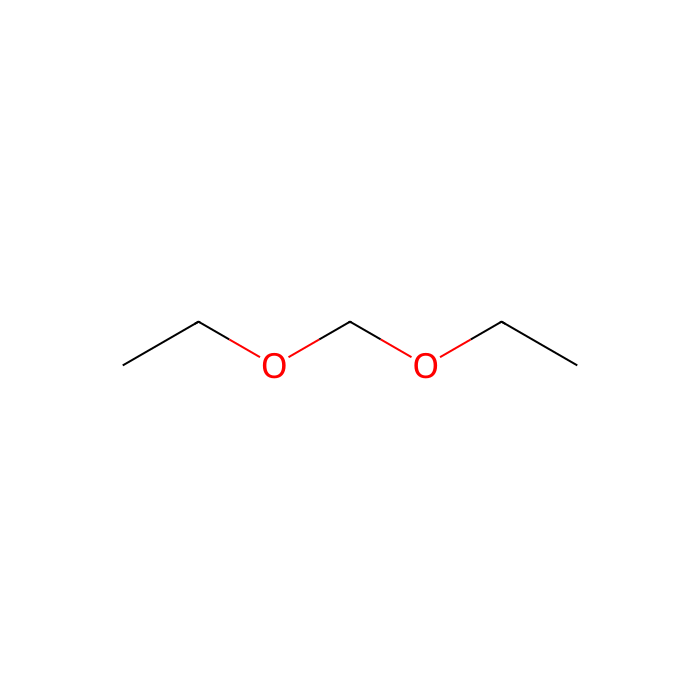
Formaldehyde diethyl acetal (FDEA, diethoxymethane, DEM) is a diethyl acetal. It has been synthesized from ethanol and aqueous formaldehyde. It is a low boiling solvent useful for sodium hydride reactions, organolithium chemistry, copper-catalyzed conjugate additions and phase-transfer reactions. It is a potential alternate for tetrahydrofuran, dichloromethane, glyme and methylal. DEM is an ethoxymethylating agent, a formaldehyde equivalent and a carbonylation substrate. Its condensation with 2-propylresorcinol to form resorcin[n]arenes (n=4–7) has been investigated. The IR and Raman spectra and conformations of DEM have been studied. NMR spectroscopy has been used to study the aggregation behavior of organolithium compounds in diethoxymethane. Unimolecular metastable decomposition of DEM upon electron impact has been studied. Solubility of non-polar gases in DEM has been evaluated.
Taxonomy Tree
| Kingdom | Organic compounds |
|---|---|
| Superclass | Organic oxygen compounds |
| Class | Organooxygen compounds |
| Subclass | Ethers |
| Intermediate Tree Nodes | Not available |
| Direct Parent | Acetals |
| Alternative Parents | Hydrocarbon derivatives |
| Molecular Framework | Aliphatic acyclic compounds |
| Substituents | Acetal - Hydrocarbon derivative - Aliphatic acyclic compound |
| Description | This compound belongs to the class of organic compounds known as acetals. These are compounds having the structure R2C(OR')2 ( R' not Hydrogen) and thus diethers of geminal diols. Originally, the term was confined to derivatives of aldehydes (one R = H), but it now applies equally to derivatives of ketones (neither R = H ). Mixed acetals have different R' groups. |
| External Descriptors | Not available |
Find and download the COA for your product by matching the lot number on the packaging.
| Lot Number | Certificate Type | Date | Item |
|---|---|---|---|
| Certificate of Analysis | Jan 06, 2026 | D139939 | |
| Certificate of Analysis | Jun 09, 2025 | D139939 | |
| Certificate of Analysis | Jun 09, 2025 | D139939 | |
| Certificate of Analysis | Jun 09, 2025 | D139939 | |
| Certificate of Analysis | Jun 09, 2025 | D139939 | |
| Certificate of Analysis | Aug 17, 2021 | D139939 |
| Sensitivity | Moisture sensitive |
|---|---|
| Refractive Index | 1.372-1.374 |
| Flash Point | 23 °F |
| Flash Point | -5℃ |
| Boil Point | 87.5°C |
| Melt Point | -66.5°C |
| Molecular Weight | 104.15 |
| XLogP3 | 0.800 |
| Hydrogen Bond Donor Count | 0 |
| Hydrogen Bond Acceptor Count | 2 |
| Rotatable Bond Count | 4 |
| Exact Mass | 104.084 Da |
| Monoisotopic Mass | 104.084 Da |
| Topological Polar Surface Area | 18.500 Ų |
| Heavy Atom Count | 7 |
| Formal Charge | 0 |
| Complexity | 25.300 |
| Isotope Atom Count | 0 |
| Defined Atom Stereocenter Count | 0 |
| Undefined Atom Stereocenter Count | 0 |
| Defined Bond Stereocenter Count | 0 |
| Undefined Bond Stereocenter Count | 0 |
| The total count of all stereochemical bonds | 0 |
| Covalently-Bonded Unit Count | 1 |
H225:Highly Flammable liquid and vapor
H315:Causes skin irritation
H319:Causes serious eye irritation
H335:May cause respiratory irritation
P210:Keep away from heat, hot surface, sparks, open flames and other ignition sources. - No smoking.
P233:Keep container tightly closed.
P240:Ground/bond container and receiving equipment.
P241:Use explosion-proof [electrical/ventilating/lighting/.../] equipment.
P242:Use only non-sparking tools.
P243:Take precautionary measures against static discharge.
P261:Avoid breathing dust/fume/gas/mist/vapors/spray.
P264:Wash hands [and …] thoroughly after handling.
P271:Use only outdoors or in a well-ventilated area.
P280:Wear protective gloves/protective clothing/eye protection/face protection.
P321:Specific treatment (see ... on this label).
P302+P352:IF ON SKIN: wash with plenty of water.
P303+P361+P353:IF ON SKIN (or hair): Take off Immediately all contaminated clothing. Rinse SKIN with water [or shower].
P304+P340:IF INHALED: Remove person to fresh air and keep comfortable for breathing.
P305+P351+P338:IF IN EYES: Rinse cautiously with water for several minutes. Remove contact lenses if present and easy to do - continue rinsing.
P362+P364:Take off contaminated clothing and wash it before reuse.
P370+P378:In case of fire: Use ... to extinguish.
P405:Store locked up.
P403+P233:Store in a well-ventilated place. Keep container tightly closed.
P403+P235:Store in a well-ventilated place. Keep cool.
P501:Dispose of contents/container to an approved waste disposal plant.
P264+P265:Wash hands [and …] thoroughly after handling. Do not touch eyes.
P337+P317:If eye irritation persists: Get medical help.
P332+P317:If skin irritation occurs: Get medical help.
P319:Get medical help if you feel unwell.
Our grade selection guide covers purity, stabilizer status, and application suitability for all variants in our catalog.
View Anhydrous Grade grade guide →