This compound belongs to the class of organic compounds known as dicarboxylic acids and derivatives. These are organic compounds containing exactly two carboxylic acid groups.
External Descriptors
Not available
1. Djoumbou Feunang Y, Eisner R, Knox C, Chepelev L, Hastings J, Owen G, Fahy E, Steinbeck C, Subramanian S, Bolton E, Greiner R, and Wishart DS. ClassyFire: Automated Chemical Classification With A Comprehensive, Computable Taxonomy. Journal of Cheminformatics, 2016, 8:61.
Determine the necessary mass, volume, or concentration for preparing a solution.
Dilution Calculator
Determine the dilution needed to prepare a stock solution.
Reconstitution Calculator
Reviews
Customer Reviews
Application Protocols
No item-specific, validated application protocols are provided for this reagent.
General guidance
For SN2 substitutions, charge a dry flask with solvent and base/nucleophile under inert gas, cool if exothermic, then add diethyl bromomalonate dropwise. Monitor by TLC/GC. Quench with buffered aqueous solution, extract, dry, and purify quickly to avoid ester hydrolysis.
For Arbuzov reactions, combine with trialkyl phosphite and heat under inert atmosphere; vent cautiously to control evolved alkyl bromide.
For radical steps, rigorously degas and exclude oxygen; employ appropriate initiator loading and light/heat as required.
Refer to the Reaction Conditions section for literature-based parameters and always pilot on millimole scale before scale-up. Consult the SDS for operational safety.
Biological Roles
This product is a synthetic organic building block and is intended strictly for research and laboratory use.
Biological function (general)
Diethyl bromomalonate has no established physiological role. As an alpha-bromo diester, it is electrophilic and can react with biological nucleophiles; such reactivity underlies general irritancy/lachrymatory properties rather than any beneficial biological function.
Use in biochemical studies (literature context; not a product claim)
Alpha-halo carbonyl compounds are sometimes employed as chemical probes to modify nucleophilic residues in biomolecules in vitro; however, DBM’s use in biochemistry is limited due to its lack of selectivity and propensity for broad alkylation.
Metabolism/toxicity considerations (general)
Esters can undergo hydrolysis by esterases to yield alcohols and carboxylates; for DBM, prior substitution/debromination and nonspecific alkylation can occur. Data are context-dependent and not specific to this product.
No medical, diagnostic, or therapeutic applications are implied. For any work near biological systems, ensure containment protocols, quench residual electrophile, and consult institutional biosafety guidelines.
Buffer Applications
Diethyl bromomalonate is not a buffering agent and is not typically used to prepare or adjust buffer systems.
Practical note
Due to its electrophilicity and instability in aqueous basic media, it is unsuitable for buffering or for prolonged aqueous exposure. For buffer preparation and pH control, use dedicated buffering compounds (e.g., phosphate, TRIS, HEPES) and refer to their respective specifications.
See Reaction & Applications and Synthetic Utility sections for relevant uses of this reagent.
Green Alternatives
While diethyl bromomalonate (DBM) is efficient for α-substitution, greener strategies may reduce halogenated waste or employ safer solvents.
Use diethyl malonate with green bases/solvents for alkylation, avoiding pre-halogenated substrates; this shifts halide waste to the alkylating partner selection.
Employ catalytic oxidation or organocatalytic α-functionalization of malonates (e.g., phase-transfer catalysis) to minimize stoichiometric halides.
Consider photoredox or electrochemical approaches for C–C bond formation from malonates under milder conditions and benign electrolytes.
Greener solvent choices (compared to DMF/DMSO/DCM)
2-Methyltetrahydrofuran (2-MeTHF), cyclopentyl methyl ether (CPME), ethyl acetate (EtOAc), propylene carbonate (PC), or dimethyl carbonate (DMC) when compatible with nucleophile and base.
Acetonitrile remains a practical option with a reasonable EHS profile relative to chlorinated solvents; ensure proper recovery.
Comparison snapshot (general guidance)
DBM route vs. in situ activation of diethyl malonate:
Trade-offs: Halogenated reagent/waste; potential lachrymatory properties; need for careful hydrolysis control.
Practical green tips
Minimize excess nucleophile; use phase-transfer catalysis to reduce solvent and base load.
Apply solvent recycling where feasible; avoid chlorinated media unless required.
Adopt telescoped sequences to reduce isolations and washes (lower solvent and energy footprint).
Always evaluate process mass intensity (PMI) and E-factor during route selection and perform small-scale solvent/nucleophile compatibility screens in greener media.
Pharmaceutical Uses
Role in pharmaceutical contexts (general; research/manufacturing)
Diethyl bromomalonate is a synthetic intermediate used to introduce the malonyl fragment in multi-step routes to small molecules. It may appear in route scouting for API intermediates, fine chemicals, and agrochemical candidates.
As an alpha-bromo diester, it enables rapid α-functionalization steps (e.g., installation of azido, cyano, thio, or amino groups) that can be transformed further into pharmacophore fragments after hydrolysis/decarboxylation.
Excipient/formulation status
Not used as an excipient and has no pharmacopeial monograph as a formulated component to our knowledge (literature context). Its reactivity precludes direct formulation roles.
Process considerations
Residuals control: Downstream processes must demonstrate effective removal of bromide and unreacted electrophile; typical controls include GC residual solvent/reagent testing and ion chromatography for halides.
Greener/process safety: Selection of safer solvents (e.g., EtOAc, 2-MeTHF) and closed handling can reduce operator exposure. Implement robust quench and neutralization to avoid exotherms during scale-up.
For cGMP or regulatory applications, rely on validated specifications, impurity fate-and-purge assessments, and quality agreements. This product is supplied for research use only.
Physical Properties
Item-specific physicochemical specifications (appearance, density, refractive index, UV cutoff, water/peroxide/metal limits) are not included in the provided Product Data.
Item-specific data
Appearance: Not specified for this item; refer to CoA/Spec Sheet.
Grade/Purity: Not specified for this item; refer to CoA/Spec Sheet.
Molecular weight (catalog field): Not specified for this item; refer to CoA/Spec Sheet.
Literature and general reference values (for context; not product specifications)
Typical physical state: Colorless to pale-yellow liquid (literature)
Odor: Characteristic ester, may be lachrymatory (literature)
Solubility: Miscible with many organic solvents (e.g., dichloromethane, THF, acetone, ethyl acetate); very low solubility in water; slowly hydrolyzes in aqueous base (literature)
Stability: Stable under dry, neutral conditions; sensitive to strong bases and nucleophiles (literature)
Volatility: Low-to-moderate; higher boiling than the non-brominated diethyl malonate due to the bromine atom (literature)
Partitioning: Expected to have moderate hydrophobicity owing to two ethyl groups and limited hydrogen bonding donors (qualitative, literature)
Practical notes (general)
Avoid prolonged exposure to moisture and bases to prevent hydrolysis and debromination.
Handle in a well-ventilated hood; alpha-halo carbonyl compounds can be irritant/lachrymatory.
For authoritative, lot-specific values (e.g., BP/MP, density, refractive index), consult the item’s CoA/Spec Sheet and SDS.
Quality & Grades
Item-specific quality status
Grade/Purity: Not specified for this item; refer to CoA/Spec Sheet.
Stabilizers/Inhibitors: Not specified for this item; refer to CoA/Spec Sheet.
How to interpret grades (general guidance)
Research-grade organics: Typically suitable for synthetic and analytical work; trace impurity profiles (water, alcohols, acid, non-volatile residue) can impact sensitive reactions (e.g., enolate chemistry, phase-transfer SN2). When grades such as “anhydrous,” “distilled,” or “HPLC grade” are offered, they indicate specific controls on moisture or UV-absorbing impurities; absent such indicators, assume standard research-grade and verify by CoA.
For alpha-halo esters like diethyl bromomalonate, hydrolysis to malonate and formation of debrominated species can occur on storage, especially if exposed to base or moisture. Certificates typically specify assay by GC/1H NMR and may list acidity and residual ethanol.
Practical quality checks (general)
Before critical use, verify purity by GC or 1H NMR (diagnostic CH–Br singlet ~4–5 ppm region; literature) and check for diethyl malonate or diethyl chloromalonate impurities depending on source.
If low UV background is required (e.g., kinetics by UV), HPLC-grade or freshly distilled material may be preferred. In the absence of a stated grade, perform an in-house specification fit for purpose.
Always defer to the product’s CoA/Spec Sheet for lot-specific specifications and acceptance criteria.
Reaction & Applications
Diethyl bromomalonate (DBM) serves as a versatile electrophile for installing the diethyl malonyl fragment or for alpha-functionalization chemistry of malonates.
Nucleophilic substitution (SN2) at the α-carbon: Displacement of bromide by heteroatom nucleophiles (RS−, RO−, N3−, CN−, I−) and stabilized carbon nucleophiles (e.g., enolates, 1,3-dicarbonyl anions) to give α-substituted malonates.
Michaelis–Arbuzov reaction: Formation of dialkyl (malonylmethyl)phosphonates with trialkyl phosphites under heating.
Radical reactions: Generation of malonyl radicals via AIBN/initiator systems for C–C bond formation or dehalogenative couplings.
Condensation sequences: Conversion to active methylene derivatives and subsequent Knoevenagel-type condensations after substitution/debromination steps.
Heterocycle synthesis: Construction of pyridines, barbiturates, and other frameworks via incorporation of the malonate synthon.
Practical tips (general)
Base sensitivity: Strong base promotes debromination to diethyl malonate; for clean SN2, favor mild bases (K2CO3, Cs2CO3) and polar aprotic solvents.
Regioselectivity: With ambident nucleophiles (e.g., thiocyanate), control S- vs N-attack by solvent and temperature.
Leaving group: Bromide offers a good balance of reactivity and selectivity; iodide can be generated in situ with NaI (Finkelstein) to accelerate sluggish substitutions.
Workup: Quench nucleophiles carefully (e.g., buffered aqueous NH4Cl) to minimize ester hydrolysis; wash organic extracts promptly and dry under mild conditions.
Typical use-cases
Introduction of a masked acetic acid equivalent that can be further diversified and later unmasked by hydrolysis/decarboxylation.
Preparation of α-azido-, α-thio-, α-amino-, and α-cyano-malonate derivatives as versatile intermediates for building APIs, agrochemicals, and materials (research context).
Reaction Conditions
The following are general, literature-based guidelines for using diethyl bromomalonate (DBM) in common transformations. Optimize per substrate and scale.
SN2 substitution with soft nucleophiles
Solvent: Dry MeCN or DMF; THF for base-sensitive nucleophiles.
Base: K2CO3/Cs2CO3 (1.2–2.0 equiv) or the nucleophile as its alkali salt.
Temperature: 0–25 °C typically; 40–60 °C if sluggish.
Notes: Add NaI (cat., 0.1–0.3 equiv) to accelerate via in situ iodide exchange. Exclude water to limit hydrolysis.
Formation of α-azidomalonates
Reagents: NaN3 (1.1–1.5 equiv).
Solvent: DMF or DMSO; 20–50 °C.
Workup: Quench cautiously; azides can be energetic—avoid heavy-metal salts.
Thioether formation
Reagents: Thiols with base (NaH, K2CO3) or preformed thiolates.
Solvent: MeCN, acetone, or DMF; 0–25 °C.
Caution: Control odor and air exposure; thiols can overreact.
Michaelis–Arbuzov phosphonylation
Reagents: P(OR)3 (3–5 equiv).
Conditions: 80–140 °C, neat or in toluene/chlorobenzene.
Outcome: Dialkyl (malonylmethyl)phosphonates.
Radical dehalogenation/coupling
Initiation: AIBN/photoredox; chain carriers such as Bu3SnH or silanes.
Solvent: Degassed toluene or chlorinated aromatics; 60–110 °C or visible light.
Hydrolysis/decarboxylation (downstream)
Hydrolysis: Aqueous base or acid to malonic acid derivatives.
Decarboxylation: Thermal or acid-promoted after mono-saponification.
These are general literature conditions and not product specifications. Validate on small scale and consult primary references.
Safety & Handling
Item-specific GHS information
Signal word: Not specified for this item; refer to SDS.
Hazard statements (H-Statements): Not specified for this item; refer to SDS.
GHS classification/pictograms: Not specified for this item; refer to SDS.
General safety profile (literature/general guidance; not a substitute for SDS)
Hazard nature: Alpha-halo carbonyls are typically irritant and may be harmful if swallowed, inhaled, or in contact with skin. Bromomalonates can be lachrymatory and are electrophilic/alkylating toward nucleophilic tissues.
Acute effects: Eye, skin, and respiratory tract irritation. Use in a certified fume hood.
Chronic considerations: Prolonged exposure to alkylating agents should be minimized; implement exposure controls per institutional policies.
PPE: Lab coat, nitrile gloves (change regularly), splash goggles; consider face shield for scale-up.
Engineering controls: Work in fume hood; avoid aerosol formation.
Incompatibilities: Strong bases, strong nucleophiles, aqueous alkali (hydrolysis and substitution). Avoid contact with amines, thiols, and active metals without proper quench/controls.
Peroxide risk: Not a typical peroxide former; nonetheless, follow standard solvent safety if co-used with ethers.
First-aid overview (consult SDS for full procedures)
Skin/eye contact: Immediate decontamination with copious water for ≥15 minutes; remove contaminated clothing; seek medical evaluation.
Inhalation: Move to fresh air; monitor breathing; medical attention if symptoms persist.
Ingestion: Rinse mouth; do not induce vomiting; seek medical attention.
Spill/fire response (general)
Spill: Absorb with inert material; avoid bases; ventilate area.
Fire: Use CO2, dry chemical, or foam; combustion can produce HBr and carbonyl-containing fumes.
Solvent Selection
Diethyl bromomalonate is a reactive electrophile used as a substrate, not as a solvent. Solvent choice concerns its use in substitution, condensation, or radical reactions.
Ethers (THF, MTBE, 2-MeTHF): Favored for base-promoted transformations and low-temperature work; ensure rigorously dry conditions to limit hydrolysis.
Chlorinated solvents (DCM, chloroform): Suitable for neutral or Lewis-acid catalyzed processes and radical reactions; avoid strong base in DCM.
Alcohols/water: Promote solvolysis/hydrolysis; typically avoided unless used deliberately for ester exchange under controlled conditions.
Selection tips by transformation (general)
SN2 substitutions with soft nucleophiles (e.g., thiolates, azide, cyanide): Use dry acetonitrile or DMF; add phase-transfer catalysts if employing inorganic bases.
Enolate chemistry (umpolung strategies): Conduct in THF or toluene with strong, non-nucleophilic bases at low temperature to avoid premature substitution.
Maintain low water content; even trace moisture can lead to hydrolysis to diethyl malonate.
If product isolation is by chromatography, select solvents that limit ester saponification on silica (avoid basic modifiers).
These are general guidelines; optimize solvent choice per substrate/nucleophile and consult primary literature.
Storage & Reconstitution
Item-specific storage and shipping
Storage Conditions: Room temperature (as provided in Product Data).
Shipped In: Normal (as provided in Product Data).
General storage guidance (complementary; not a substitute for label instructions)
Keep container tightly closed in a dry, well-ventilated place. Protect from moisture and bases to prevent hydrolysis or debromination.
Store in amber glass or away from strong light sources if long-term storage is anticipated. Use inert gas blanket (N2/Ar) after opening for sensitive applications.
Segregate from strong nucleophiles, amines, and alkali.
Reconstitution/Preparation for use
This product is typically supplied as a neat liquid; no reconstitution is required.
For moisture-sensitive operations, pre-dry glassware and solvents. If necessary, pass through a short plug of basic alumina to remove trace acids just prior to use (test on small aliquot to avoid loss by substitution).
Shelf-life monitoring
Periodically check by GC or 1H NMR for appearance of diethyl malonate or other byproducts. If significant degradation is observed, purify or procure fresh material.
Always defer to the product label, SDS, and CoA/Spec Sheet for definitive storage and handling instructions.
Structure & Identity
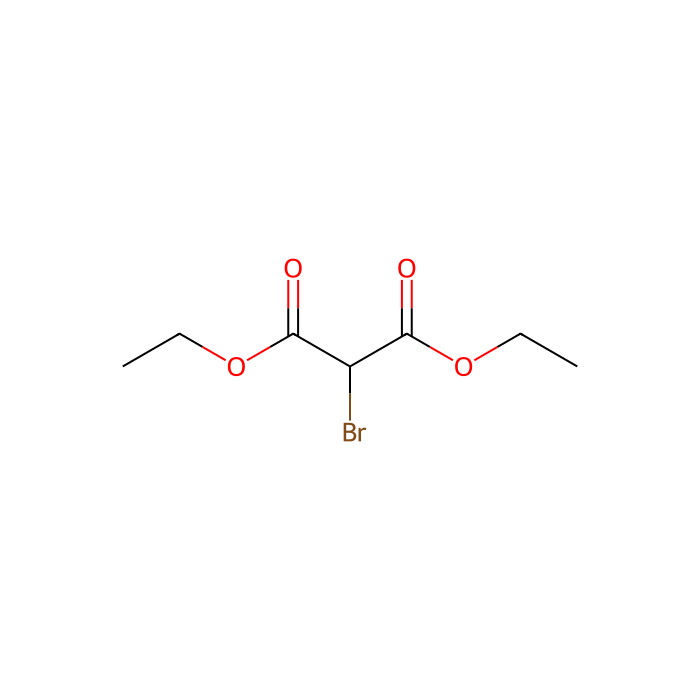
Diethyl bromomalonate is an alpha-brominated diester derived from malonic acid, widely used as an electrophilic C3 synthon in organic synthesis.
Item-specific identifiers (from Product Data)
SKU: D139177
CAS: 685-87-0
InChIKey: 87226 (as provided)
Storage/Shipping: Room temperature; Shipped under normal conditions
Literature identity data (for reference; not item-specific specifications)
InChI (string): Not specified for this item; refer to CoA/Spec Sheet.
Structural features (general description)
Functional groups: Two ethyl ester groups (–CO2Et) attached to the malonate framework; one alpha-bromine at the methine carbon between the two carbonyls.
Electrophilic center: The α-carbon bearing bromine is strongly activated by the flanking carbonyls, enabling SN2 displacement by a range of hetero- and carbon nucleophiles.
2D structure (verbal): A central CH bearing Br is flanked on both sides by carbonyls (–C(=O)–), each continued to an ethoxy substituent (–O–CH2–CH3), yielding a symmetrical diethyl ester backbone with an asymmetric α-carbon due to bromine substitution (no defined stereochemistry in the bulk material).
Synthetic Utility
Diethyl bromomalonate (DBM) is a compact, electrophilic C3 synthon enabling rapid access to α-functionalized malonates and downstream acetic-acid equivalents.
Key reactive elements (general)
Activated α-carbon: The brominated methine between two carbonyls supports high-rate SN2 with a broad spectrum of nucleophiles.
Masked functionality: The diester can be unmasked by hydrolysis and decarboxylation to deliver substituted acetic acids or ethanol-derived fragments.
Typical transformations (literature)
Heteroatom substitution: RS−, RO−, N3−, CN−, and amines to furnish α-substituted malonates; azides can be reduced to primary amines, providing an entry to α-aminomalonates.
Carbon–carbon bond formation: Reaction with stabilized carbanions (e.g., malonate, nitroacetate, cyanoacetate) and via radical pathways to extend carbon skeletons.
Arbuzov chemistry: Access to malonylmethyl phosphonates, valuable for Horner–Wadsworth–Emmons and related olefinations after conversion.
Umpolung/annulation: Use in assembling heterocycles where the malonate acts as both electrophile and subsequent nucleophile after transformation.
Retrosynthetic value
Enables late-stage installation of α-substituents adjacent to a masked carboxylate equivalent, simplifying protecting-group strategy.
Practical cautions
Competes with solvolysis/hydrolysis; maintain anhydrous conditions.
Over-alkylation or elimination is minimized by controlling base strength and temperature.
DBM thus offers concise access to richly functionalized intermediates that can be diversified and subsequently unmasked under standard ester chemistry.
Target Specificity
Not applicable. This product is a small-molecule reagent, not a biological targeting reagent (e.g., antibody, enzyme inhibitor with defined biomolecular specificity, or probe with validated selectivity profile). It exhibits general electrophilic reactivity toward nucleophiles rather than specific biomolecular targets.
We use cookies to ensure the website functions properly and, where permitted, to improve your experience. You can manage your preferences at any time in Settings. Learn more in our Cookie Policy.
Shall we send you a message when we have discounts available?
Remind me later
Thank you! Please check your email inbox to confirm.
Products are supplied to verified businesses, institutions, and qualified professionals for research and development use only. Not for use in humans, animals, diagnosis, or therapy.

 F2528088