Determine the necessary mass, volume, or concentration for preparing a solution.
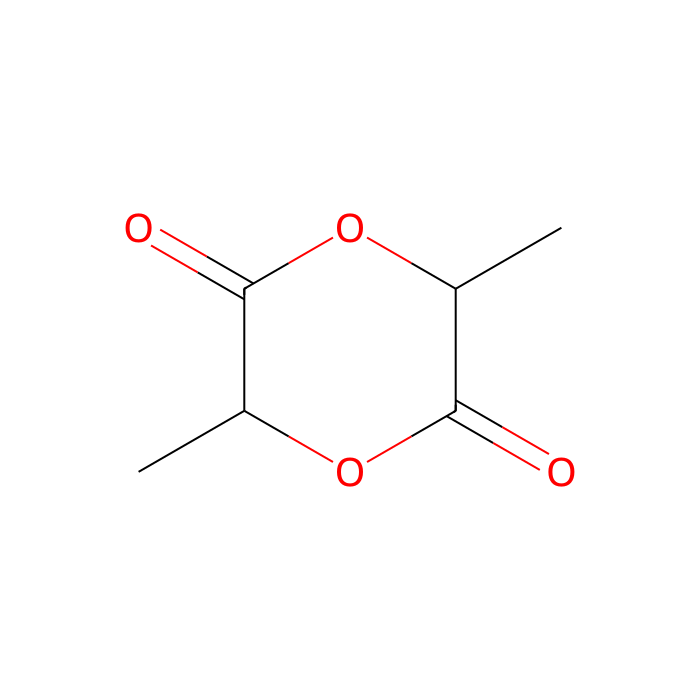
3,6-Dimethyl-1,4-dioxane-2,5-dione (or rac-lactide), is the 50:50 racemic mixture of D- and L-Lactide. Rac-lactide is a lactone derived from lactic acid that has attracted great interest in academia and commercial applications, as it is derived from abundant renewable resources. Rac-lactide can be ready polymerized via ring-opening polymerization, using a variety of metal or organocatalysts, yielding poly(D,L-lactide). While the resulting polymer is generally amorphous, the use of stereospecific catalysts can lead to heterotactic PLA, which exhibits some degree of crystallinity.
Application
DL-Lactide is used to produce 2-hydroxy-propionic acid 1-(1-phenyl-ethoxycarbonyl)-ethyl ester. It acts as an important raw material and an intermediate used in organic synthesis, pharmaceuticals, agrochemicals and dyes. It is involved in enzymatic alcoholysis to produce both alkyl (R)-lactates and alkyl (S,S)-lactyllactates.
Taxonomy Tree
| Kingdom | Organic compounds |
|---|---|
| Superclass | Organoheterocyclic compounds |
| Class | Dioxanes |
| Subclass | 1,4-dioxanes |
| Intermediate Tree Nodes | Not available |
| Direct Parent | 1,4-dioxanes |
| Alternative Parents | Dicarboxylic acids and derivatives Lactones Carboxylic acid esters Oxacyclic compounds Organic oxides Hydrocarbon derivatives Carbonyl compounds |
| Molecular Framework | Aliphatic heteromonocyclic compounds |
| Substituents | Dicarboxylic acid or derivatives - Para-dioxane - Lactone - Carboxylic acid ester - Oxacycle - Carboxylic acid derivative - Organic oxygen compound - Organic oxide - Hydrocarbon derivative - Organooxygen compound - Carbonyl group - Aliphatic heteromonocyclic compound |
| Description | This compound belongs to the class of organic compounds known as 1,4-dioxanes. These are organic compounds containing 1,4-dioxane, an aliphatic six-member ring with two oxygen atoms in ring positions 1 and 4. |
| External Descriptors | a small molecule |
Find and download the COA for your product by matching the lot number on the packaging.
| Lot Number | Certificate Type | Date | Item |
|---|---|---|---|
| Certificate of Analysis | Mar 11, 2026 | S161100 | |
| Certificate of Analysis | Mar 11, 2026 | S161100 | |
| Certificate of Analysis | Mar 11, 2026 | S161100 | |
| Certificate of Analysis | Mar 11, 2026 | S161100 | |
| Certificate of Analysis | Mar 11, 2026 | S161100 | |
| Certificate of Analysis | Mar 11, 2026 | S161100 | |
| Certificate of Analysis | Sep 09, 2025 | S161100 | |
| Certificate of Analysis | Aug 27, 2025 | S161100 | |
| Certificate of Analysis | Aug 27, 2025 | S161100 | |
| Certificate of Analysis | Aug 27, 2025 | S161100 | |
| Certificate of Analysis | Aug 27, 2025 | S161100 | |
| Certificate of Analysis | Jun 09, 2025 | S161100 | |
| Certificate of Analysis | May 19, 2025 | S161100 | |
| Certificate of Analysis | May 19, 2025 | S161100 | |
| Certificate of Analysis | May 19, 2025 | S161100 | |
| Certificate of Analysis | Mar 31, 2025 | S161100 | |
| Certificate of Analysis | Mar 31, 2025 | S161100 | |
| Certificate of Analysis | Jan 13, 2025 | S161100 | |
| Certificate of Analysis | Jan 13, 2025 | S161100 | |
| Certificate of Analysis | Jan 13, 2025 | S161100 | |
| Certificate of Analysis | Nov 30, 2022 | S161100 | |
| Certificate of Analysis | Nov 30, 2022 | S161100 | |
| Certificate of Analysis | Nov 30, 2022 | S161100 | |
| Certificate of Analysis | Nov 30, 2022 | S161100 | |
| Certificate of Analysis | Nov 30, 2022 | S161100 | |
| Certificate of Analysis | Nov 30, 2022 | S161100 | |
| Certificate of Analysis | Nov 30, 2022 | S161100 | |
| Certificate of Analysis | Nov 30, 2022 | S161100 | |
| Certificate of Analysis | Nov 30, 2022 | S161100 | |
| Certificate of Analysis | Oct 20, 2022 | S161100 |
| Solubility | Slightly soluble in water, decomposes upon contact with water; Soluble in methanol and acetone |
|---|---|
| Sensitivity | Moisture sensitive |
| Boil Point | 142 °C/8 mmHg |
| Melt Point | 123.0-127.0℃ |
| Molecular Weight | 144.12 |
| XLogP3 | 0.600 |
| Hydrogen Bond Donor Count | 0 |
| Hydrogen Bond Acceptor Count | 4 |
| Rotatable Bond Count | 0 |
| Exact Mass | 144.042 Da |
| Monoisotopic Mass | 144.042 Da |
| Topological Polar Surface Area | 52.600 Ų |
| Heavy Atom Count | 10 |
| Formal Charge | 0 |
| Complexity | 155.000 |
| Isotope Atom Count | 0 |
| Defined Atom Stereocenter Count | 0 |
| Undefined Atom Stereocenter Count | 2 |
| Defined Bond Stereocenter Count | 0 |
| Undefined Bond Stereocenter Count | 0 |
| The total count of all stereochemical bonds | 0 |
| Covalently-Bonded Unit Count | 1 |
H315:Causes skin irritation
H319:Causes serious eye irritation
P264:Wash hands [and …] thoroughly after handling.
P280:Wear protective gloves/protective clothing/eye protection/face protection.
P302+P352:IF ON SKIN: wash with plenty of water.
P305+P351+P338:IF IN EYES: Rinse cautiously with water for several minutes. Remove contact lenses if present and easy to do - continue rinsing.
P332+P313:IF SKIN irritation occurs: Get medical advice/attention.
P337+P313:IF eye irritation persists: Get medical advice/attention.
P362+P364:Take off contaminated clothing and wash it before reuse.
P405:Store locked up.
P501:Dispose of contents/container to an approved waste disposal plant.