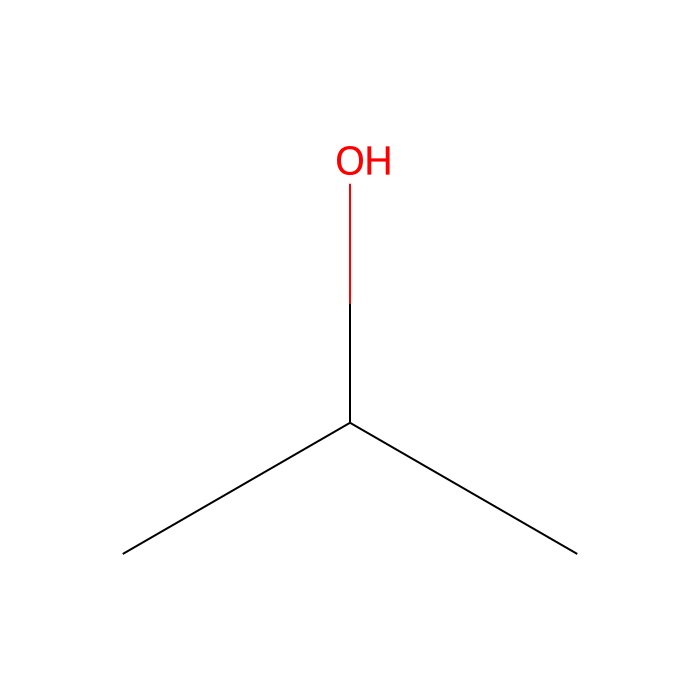
Isopropyl Alcohol(IPA) - UltraPureChrom™, for HPLC, ≥99.9% , CAS No.67-63-0

CAS: 67-63-0 Cat. No.: P433289 Summenformel: C3H8O Molekulargewicht: 60.10 Beilstein Registry Number: 635639 EG-Nummer: 200-661-7
Zu bestellen verfügbar
QUALITÄT & REINHEIT UltraPureChrom™ ? UltraPureChrom™ — Aladdin's ultra-pure line for chromatography and spectroscopy. Use as a premium solvent/reagent where the lowest impurity background is required. for HPLC ? Suitable for HPLC — meets purity needs for liquid-chromatography use. Use for routine HPLC mobile phases and sample prep. ≥99.9%
Synonyms
Isopropyl alcohol | isopropanol | IPA | Isopropyl Alcohol
Storage
Room temperature,Argon charged
Shipped In
FedEx DG Service
★
Größe
Deutschland (EU)
USA*
Preis
Menge
100ml
P433289-100ml
—
8 Auf Lager
12,06€
500ml
P433289-500ml
7 Auf Lager
Auf Lager ≥10
43,30€
Enter a quantity for the sizes you want to add.
🧪
Warum diese Qualität

UltraPureChrom™, for HPLC, ≥99.9% for HPLC,UltraPureChrom™ für empfindliche chromatographische und analytische Workflows, die minimale Basislinieninterferenzen erfordern.

🌡

Lagerung & Versand

Room temperature,Argon charged Versand FedEx DG Service. Genaue Spezifikationen finden Sie im chargenspezifischen COA.

📋

Qualitätsdokumente

SDS, COA, Datenblatt und Spezifikationsblatt stehen zum Download bereit. Chargenspezifische COA über Chargennummernsuche abrufbar.

📚

Literaturbeleg

In 2954 peer-reviewten Publikationen zu Chromatographie, organischer Synthese und Kreuzkupplungsreaktionen zitiert.

Übersicht

2-Propanol (Isopropanol) is a secondary alcohol. It has been tested as substitute to fuel for various fuel cells. Cuo powder dissolved in 2-propanol has been used for the laser ablation assisted synthesis of Cu colloids. Its suspension with Zn(NO 3 ) 2 has been employed for the fabrication of titanium dioxide-coated stainless steel (P 25 -TiO 2 /SS) photoanode coated with uniformly thick layer of P 25 -TiO 2 . This photoanode was used for the electrochemical photocatalytic (ECPC) degradation process.

Application

2-propanol may be used in the synthesis of methyl isobutyl ketone with satisfactory yield in the presence of bifunctional Cu-base catalysts. It can undergo oxidation in the presence of titanium oxide-supported manganese oxide to form acetone. 2-Propanol (Isopropanol) has been used for isolation and quantitative determination of carotenes and xanthophylls from Capsicum annum pericarp extracts by HPLC. It has been used as solvent in the dissolution of Pt and TiO 2 precursors, for the fabrication of Pt-TiO 2 /Ti electrodes.


Spezifikationen

Synonyme
Isopropyl alcohol | isopropanol | IPA | Isopropyl Alcohol
Spezifikationen & Reinheit
UltraPureChrom™, for HPLC, ≥99.9%
Storage
Room temperature,Argon charged
Verschickt in
FedEx DG Service
Note
for HPLC, UltraPureChrom™
Reinheit
≥99.9%
Namen und Kennungen
Pubchem Sid
Pubchem Sid Url
https://pubchem.ncbi.nlm.nih.gov/substance/504750711
Kanonisches Lächeln
CC(C)O
IUPAC Name
propan-2-ol
InChIKey
KFZMGEQAYNKOFK-UHFFFAOYSA-N
INCHI
1S/C3H8O/c1-3(2)4/h3-4H,1-2H3
Isomere SMILES
CC(C)O
WGK Deutschland
1
RTECS
NT8050000
UN-Nummer
1219
Verpackungsgruppe
II
Molekulargewicht
60.10
Beilstein
635639
Reaxy-Rn
635639
Reaxys-RN_link_address
https://www.reaxys.com/reaxys/secured/hopinto.do?context=S&query=IDE.XRN=635639&ln=

Dokumentation

📋 Sicherheitsdatenblatt (SDS)

Umfassendes Dokument zu Gefahren, Handhabung, Lagerung und Einhaltung regulatorischer Vorschriften.

<<<<<<< HEAD SDS herunterladen → ======= SDS herunterladen → >>>>>>> release248-p3

✅ Analysezertifikat (COA)

Chargenspezifische Qualitätsdaten. Geben Sie Ihre Chargennummer ein, um das genaue COA abzurufen.

COA nachschlagen →

📊 Datenblatt

Kurzübersicht über Produktspezifikationen und Anwendungen.

Datenblatt ansehen →

🔬 Spezifikationsblatt

Vollständige Qualitätsmerkmale und Akzeptanzkriterien für diese Qualität.

Spezifikationsblatt ansehen →

Erweiterte Daten

Taxonomic Classification

Taxonomy Tree

KingdomOrganic compounds
SuperclassOrganic oxygen compounds
KlasseOrganooxygen compounds
SubclassAlcohols and polyols
Intermediate Tree Nodes Not available
Direct ParentSecondary alcohols
Alternative Parents Hydrocarbon derivatives  
Molecular FrameworkAliphatic acyclic compounds
Substituents Secondary alcohol - Hydrocarbon derivative - Aliphatic acyclic compound
BeschreibungThis compound belongs to the class of organic compounds known as secondary alcohols. These are compounds containing a secondary alcohol functional group, with the general structure HOC(R)(R') (R,R'=alkyl, aryl).
External Descriptors a small molecule
3D-Struktur
Interaktives chemisches Strukturmodell


Zertifikate (CoA, COO, BSE/TSE und Analyse-Diagramm)
C of A & Other Certificates(BSE/TSE, COO):
Analytical Chart:

Find and download the COA for your product by matching the lot number on the packaging.

35 results found

Lot NumberCertificate TypeDatumArtikel
J2628926J2628926Certificate of AnalysisOct 15, 2026 P433289
J2628925J2628925Certificate of AnalysisOct 15, 2026 P433289
I2604405I2604405Certificate of AnalysisAug 26, 2026 P433289
I2604404I2604404Certificate of AnalysisAug 26, 2026 P433289
G2622013G2622013Certificate of AnalysisJun 14, 2025 P433289
F2505432F2505432Certificate of AnalysisJun 14, 2025 P433289
F2505430F2505430Certificate of AnalysisJun 14, 2025 P433289
F2505429F2505429Certificate of AnalysisJun 14, 2025 P433289
F2505414F2505414Certificate of AnalysisJun 14, 2025 P433289
L2525624L2525624Certificate of AnalysisMay 22, 2025 P433289
L2525622L2525622Certificate of AnalysisMay 22, 2025 P433289
I2510674I2510674Certificate of AnalysisMay 22, 2025 P433289
I2510673I2510673Certificate of AnalysisMay 22, 2025 P433289
I2510471I2510471Certificate of AnalysisMay 22, 2025 P433289
D2623646D2623646Certificate of AnalysisMay 22, 2025 P433289
D2623644D2623644Certificate of AnalysisMay 22, 2025 P433289
D2623647D2623647Certificate of AnalysisMay 22, 2025 P433289
A2513180A2513180Certificate of AnalysisDec 25, 2024 P433289
A2513181A2513181Certificate of AnalysisDec 25, 2024 P433289
A2513331A2513331Certificate of AnalysisDec 25, 2024 P433289
D2528022D2528022Certificate of AnalysisDec 25, 2024 P433289
J2408630J2408630Certificate of AnalysisSep 20, 2024 P433289
J2408631J2408631Certificate of AnalysisSep 20, 2024 P433289
L2413267L2413267Certificate of AnalysisSep 20, 2024 P433289
G2404410G2404410Certificate of AnalysisJun 21, 2024 P433289
G2404411G2404411Certificate of AnalysisJun 21, 2024 P433289
G2404409G2404409Certificate of AnalysisJun 21, 2024 P433289
D2428435D2428435Certificate of AnalysisApr 11, 2024 P433289
D2428434D2428434Certificate of AnalysisApr 11, 2024 P433289
D2428433D2428433Certificate of AnalysisApr 11, 2024 P433289
D2428436D2428436Certificate of AnalysisApr 11, 2024 P433289
C2325715C2325715Certificate of AnalysisMar 13, 2023 P433289
C2325712C2325712Certificate of AnalysisMar 13, 2023 P433289
C2325705C2325705Certificate of AnalysisMar 13, 2023 P433289
C2325693C2325693Certificate of AnalysisMar 13, 2023 P433289
Chemische und physikalische Eigenschaften
LöslichkeitSoluble in benzene; Miscible with water, ether, acetone, alcohol, and chloroform
EmpfindlichkeitMoisture sensitive.
Brechungsindexn20/D 1.377
Flammpunkt (°F)53.6 °F
Flammpunkt (°C)12 °C
Siedepunkt (°C)82°C
Schmelzpunkt (°C)-88.5°C
Molekulargewicht60.100 g/mol
XLogP30.300
Hydrogen Bond Donor Count1
Hydrogen Bond Acceptor Count1
Rotatable Bond Count0
Exact Mass60.0575 Da
Monoisotopic Mass60.0575 Da
Topological Polar Surface Area20.200 Ų
Heavy Atom Count4
Formal Charge0
Complexity10.800
Isotope Atom Count0
Defined Atom Stereocenter Count0
Undefined Atom Stereocenter Count0
Defined Bond Stereocenter Count0
Undefined Bond Stereocenter Count0
The total count of all stereochemical bonds0
Covalently-Bonded Unit Count1
FAQs und Artikel
Chromium Compounds
UltraPureChrom™: The Pinnacle of Purity for Chromatography
Introduction: “Suitable for HPLC” (HPLC Grade)
HPLC-Grade Solvents for High-Performance Liquid Chromatography: From Concept to Practice
How do I load a hydrophobic drug into liposomes?
Stripping, Cleaning, and Metal Recharging Workflow for Ni²⁺–Agarose Resins
Oil Red O Staining Protocol
Five Key Structural Features of Plasmids
Protease & Phosphatase Inhibitor Cocktails: Research Applications and Principles
Applications of Nanoclay in Materials and Formulations: Dispersion Mechanisms, Performance Enhancement, and Product Selection
A Practical Guide to Fragrance Compositions: Turning a Black-Box Formula into an Engineerable System—Compatibility, Stability, Controlled Release, Traceability, and Selection
Fatty Acids from Basics to Lab Practice: Structural Classification, Research Uses, and Selection Tips (with an Aladdin Representative Product Quick-Reference Table)
How to Choose a Hydrogen Evolution (HER) Catalyst: Kinetic Barriers in Water Electrolysis, AWE/PEM/AEM Pathways, and a Materials-Family Roadmap (with a Product Map)
Practical Guide to Carbon Nanotube (CNT) Dispersion: Three Key Knobs, SOP, and Selection Roadmap (Tables A–F)
Practical Guide to Sodium Carboxymethyl Cellulose (CMC-Na): Thickening/Stabilizing Mechanisms, Key Controls for Solution Preparation, and Selection Navigation (including Table 1 and Tables A–C)
A Review of Ten Commonly Used Techniques for Detection, Quantification, and Interaction Analysis in Nucleic Acid Research
Plant Omics Panorama: Workflow Frameworks and Multi-Omics Integration from Genomics to Transcriptomics, Proteomics, and Metabolomics
RNA Extraction Technologies: Method Systems, Operational Workflows, and Key Quality-Control Considerations
Lipase (Triacylglycerol Hydrolase): Interfacial Catalysis, Selectivity Classes, and Assay/Application Systems
Agarose Precast Gels: Composition, Advantages, and Application Workflows for Standardized Nucleic Acid Electrophoresis Matrices
Micrococcal Nuclease (MNase): A Technical Review of Enzymatic Properties, Reaction Control, and Research and Biomanufacturing Applications
Interleukin-29 (IL-29/IFN-λ1): Molecular Features, Signaling Networks, and a Systematic Framework for Research Applications
Silane Precursors in Sol-Gel Film Formation: Precursor Selection and Its Influence on Film-Formation Outcomes
Revisiting Titanium Tetrachloride: New Advances in the Direct Amidation and Esterification of Carboxylic Acids
What a Disagreement in Specific Rotation Results Reveals About Method Control: Why Specific Rotation Values for Chiral Samples Cannot Be Discussed Apart from Measurement Conditions
Phthaloyl: Its Role in Primary Amine Protection and Practical Considerations for Experimental Selection
The Methodological Value of DSC: Building NHS-Type Activated Intermediates and Deciding When to Use Them
Research Framework for Multi-Enzyme Digestion Strategies and Optimization of Proteomic Coverage
Technical Comparison and Method Selection for Hydroxyproline Determination
Triphenylphosphine Dibromide (PPh₃Br₂) Is More Than Just a Brominating Reagent: Experimental Selection Logic from Alcohol-to-Alkyl Bromide Conversion to Carboxylic Acid Activation and One-Pot Esterification, Vinyl Bromide Formation, and Nitrile Constructi
Preparation Methods and Precautions for Silane Coupling Agent Primer Solutions
Fluorocarbon Resin Coating Formulation Design: Resin Selection, Supporting Systems, and Key Application Control Points
Silicone Resin Coating Formulation Design: From Application Conditions to Matching Resins, Pigments and Fillers, Curing, and Substrates
How ZnO Nanoparticle Electron Transport Layers Reduce Dark Current in Organic Photodetectors: Mechanisms, Film Quality, and Material Selection
VC/VAc Resins and Their Modification: An Analysis of VC/VAc Vinyl Resins for Coatings and Inks
Porous Graphitic Carbon (PGC) Chromatography Columns: Creating New Selectivity for Challenging Separations through Molecular Shape and the π-Electron Cloud on the Graphitic Surface
Application of Shellac, a Natural Film-Forming Resin, in Coatings: Alcohol-Soluble Fast-Drying Film Formation, Sealing and Repair, and Performance Boundaries
Mechanism, Diagnosis, and Control of Coating Lifting: Solvent Penetration, Film Swelling, and Interlayer Instability
Resin Polarity in Coating Formulations: From Molecular Structure to Dissolution, Compatibility, Interfacial Interactions, and Formulation Design
Why LABSA (Sulfonic Acid) Is Commonly Used in Household Cleaning Formulations: Neutralization Mechanism, Detergency Action, and Formulation Application Points
Solvents, Co-solvents, and Solubilization Systems in Home and Personal Care Formulations: Classification, Functions, and Selection Guide
From Structure to Rheology: How Carbomer Forms Gel Structures and Enables Thickening, Suspension, and Auxiliary Emulsion Stabilization
Why Do Alcohols Differ in Function: Why Is Glycerol Mainly Moisturizing, Propylene Glycol Mainly Solubilizing, and Isopropyl Alcohol Fast-Drying? — Understanding Personal Care Formulation Functions from Structural Differences
Xiao Fang Bai, Da Fang Bai, PnB and DPnB: Mechanisms and Selection of Butyl Glycol Ethers in Hard-Surface Cleaning Formulations
Degreasing Agents from a Molecular-Structure Perspective: How AEO, APG, and Related Surfactants Can Replace Nonylphenol Ethoxylates (NPE)
How to Select Thickeners for Strongly Acidic Cleaning Systems: Comparison of Thickening Mechanisms and Application Considerations for Fatty Amine Ethoxylates
More Than a pH Adjuster: Mechanisms, Selection Logic, and Alternative Acid Source Analysis of Citric Acid in Home-Care Cleaning
Mechanisms and Troubleshooting of Foam Reduction in Personal and Household Care Formulations: Film Rupture, Weak Interfacial Films, Insufficient Surfactant Supply, and Phase-State Disturbance
Analysis of the Production Process of Hydroxypropyl Methylcellulose (HPMC) for Putty: Understanding Differences in Substitution Structure and Gelation Temperature from High-Ratio and Low-Ratio Formulations
Phase-Partitioning Principles, System Differences, and Application Selection in Phenol-Based DNA and RNA Extraction
How Coenzyme Q10 Acts on the Skin: Mitochondrial Electron Transfer, Antioxidant Protection of Membrane Lipids, and Lipid-Carrier Delivery
Bond-Formation Sequence and Process Improvement for 3-Bromo-6-alkyl-1,6-naphthyridin-5(6H)-ones: From Late-Stage N-Alkylation to Enamine Cyclization with Primary Amines
MTAD-Mediated Oxidative Dearomatization of Pyridines: Transient para-Cycloaddition, Alkene Oxidation, and Heteroatom Functionalization
Citations of This Product
Lösungsrechner
Bewertungen

Kundenbewertungen

Benötigen Sie Hilfe bei der Auswahl der Qualität?

Unser Leitfaden zur Qualitätsauswahl behandelt Reinheit, Stabilisatorstatus und Anwendungseignung für alle Varianten in unserem Katalog.

UltraPureChrom™ Qualitätsleitfaden ansehen → for HPLC Qualitätsleitfaden ansehen →

Dürfen wir Sie über Rabattaktionen informieren?

Später erinnern

Vielen Dank! Bitte überprüfen Sie Ihren E-Mail-Posteingang, um zu bestätigen.

Hoppla! Benachrichtigungen sind deaktiviert.